
On this page
Start here
Quick answer
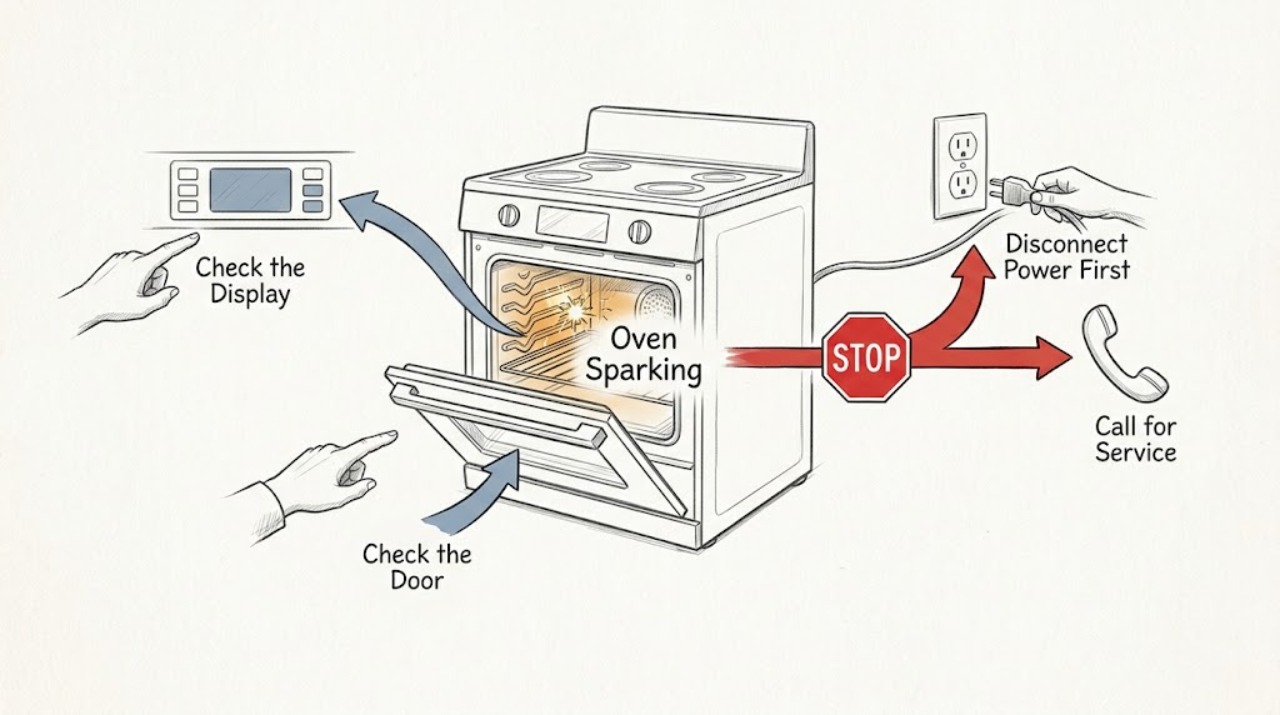
First identify whether the spark is the brief, repeated igniter click that a KitchenAid gas oven can make while establishing a flame, a surface-burner ignition symptom, or a visible electrical arc inside or around the oven. A normal gas-oven click should stop after flame detection; it is not the same as a flash, arc, popping sound, burning odor, or spark that continues with the controls off. Stop immediately for gas odor, delayed ignition, a bang, smoke, abnormal flame, electric arc, hot or damaged wiring, water contact, or a repeated breaker trip. Do not open panels, touch an energized appliance, manually light the oven, test a leak with a flame, or repeat a hazardous ignition attempt. With the appliance cool and no warning signs, make only external checks of fuel type, power, door, controls, and accessible supply; arrange qualified gas or appliance service when sparking is persistent, mislocated, or accompanied by any abnormal symptom.
Work through in order
Diagnostic checks
Use only checks that match the exact appliance or system and its official guide.
-
Check 1
From a safe position with the appliance off, identify the fuel type and locate the reported spark by noting whether it was inside the oven, at a surface burner, near the control panel, plug, receptacle, or another visible location; do not reach toward it.
Expected result: The spark is a visible arc, flash, or popping event, occurs with controls off, or is accompanied by gas odor, smoke, soot, burning odor, water, heat, or a breaker trip.
Next step: Stop using the appliance and do not touch energized or wet areas, open panels, or create a flame. Leave for gas or carbon-monoxide symptoms and contact the appropriate emergency, gas, fire, or qualified electrical service from a safe location.
Stop if: Stop immediately for gas odor, delayed ignition, bang, smoke, abnormal flame, arc, burning smell, water contact, hot wiring, or repeated breaker trips.
Why this matters
Why: This is not a normal ignition sound. It can indicate a gas, combustion, or electrical safety fault and should not be explored by another start.
-
Check 2
If the oven is a KitchenAid gas model and the only symptom was a short click during an otherwise normal cycle, compare the sound with the model's normal ignition behavior without opening the door or cavity.
Expected result: The clicks are brief and tied to a commanded cycle, then stop after a stable flame is established, or they continue without a stable flame or continue when all controls are off.
Next step: For the abnormal result, cancel the cycle and leave the oven off; record the timing and arrange qualified service rather than repeating the ignition.
Stop if: Stop if the click becomes a flash, bang, delayed ignition, odor, smoke, or abnormal flame.
Why this matters
Why: Brief clicks during flame detection can be normal. Continuous clicking, no stable flame, or clicking with controls off indicates an ignition, moisture, control, or supply problem that needs a different branch.
-
Check 3
Check the display, clock, interior light, and other controls with the oven cool; note whether the control is completely dark, responds normally, or shows a lock, demo, delay, or error indication.
Expected result: The panel is dark, partially responsive, locked, delayed, in a special mode, or displaying a code.
Next step: Record the exact display and model number. Follow only the matching manual's external control instructions; do not bypass a lock or open the control panel.
Stop if: Stop if the panel is hot, smells burned, flashes abnormally, sparks, or the breaker trips.
Why this matters
Why: A power or control-state issue can prevent the intended ignition sequence or make a symptom appear unrelated. An error code is model-specific and should not be guessed.
-
Check 4
If the area is dry and the connection is safely accessible, inspect that the power cord is seated in a grounded operational outlet and that no two-prong adapter or extension cord is used; verify an outlet only with a known-working small appliance when safe.
Expected result: The outlet is dead, grounding is uncertain, the cord or receptacle is loose or damaged, or the test appliance also fails.
Next step: Leave the oven off and arrange qualified electrician or installer service. If the supply is stable and undamaged, continue with model and control checks.
Stop if: Stop for a hot, scorched, wet, cracked, loose, discolored, or sparking outlet or cord.
Why this matters
Why: KitchenAid says the oven igniter depends on a good ground path and a grounded operational outlet. A supply or grounding fault can cause ignition symptoms and is an electrical-service issue.
-
Check 5
If a household breaker is clearly tripped and there is no water, odor, damage, or active sparking, restore the circuit once using the normal panel control; do not repeatedly reset it or move the appliance.
Expected result: The circuit stays on and the control returns, or it trips again immediately or when an oven function is selected.
Next step: If stable, record the reset and continue only with low-risk external checks. If it trips again, leave the appliance off and arrange qualified electrical or appliance service.
Stop if: Stop after one reset if the breaker trips again, wiring heats, the panel flashes, or odor, smoke, or a spark appears.
Why this matters
Why: A single reset can restore power after an interruption. A repeat trip indicates an unresolved electrical fault or overload and is not permission to test the spark again.
-
Check 6
Close the cool oven door fully and look only for an obvious rack, pan, debris, or self-clean latch position preventing normal closure; do not force, bypass, or disassemble the door interlock.
Expected result: The door closes and latches normally, or it stays misaligned, locked, hot, or damaged.
Next step: Remove only an obvious cool obstruction if the manual allows it. For damaged glass, hinges, latch, or alignment, leave the appliance off and request service.
Stop if: Stop if the glass is broken, the door is hot, the latch is damaged, or releasing the lock requires force.
Why this matters
Why: Some KitchenAid models will not operate normally with the door open. A latch or door fault can interrupt a safe gas or electric sequence and should not be defeated.
-
Check 7
For a gas range with the cooktop working, note whether the reported clicking is only the short click associated with a commanded oven cycle; do not use a flame, open the oven bottom, or manually light the oven to compare sparks.
Expected result: The cooktop works but the oven has no stable ignition, or the click continues after the control is Off; alternatively, the sound is limited to the documented short ignition sequence.
Next step: Treat persistent or unsuccessful oven ignition as a service diagnosis. If it is only normal short clicking and the oven heats safely, monitor without opening the cavity; any new abnormality is a stop condition.
Stop if: Stop for gas odor, delayed ignition, flare, bang, smoke, abnormal flame, continuous spark, or a need to access the burner.
Why this matters
Why: Cooktop operation does not prove that the oven ignition path is healthy. KitchenAid identifies separate oven gas-supply and ignition checks, while normal short clicking is distinct from persistent sparking.
-
Check 8
For a gas or dual-fuel range recently installed or reconnected, compare the fuel type and clearly identified accessible main gas valve with the exact installation instructions; do not loosen a fitting, move the range, or perform a leak test.
Expected result: The fuel type or valve state is uncertain, the gas line was recently changed, or a connector or valve appears damaged.
Next step: Leave the oven off and arrange qualified gas or installation service. If there is no hazard and the documented setup is confirmed, continue only with the service handoff.
Stop if: Stop for gas odor, hissing, damaged connector, inaccessible valve, uncertain fuel conversion, or any need for tools or appliance movement.
Why this matters
Why: KitchenAid lists recent reconnection, an off gas valve, and incorrect supply conditions as possible reasons for gas-oven ignition problems. Connection, conversion, and leak work require a licensed professional.
-
Check 9
Record whether a visible spark occurred at the plug or receptacle, inside the cavity, at a surface control, or nowhere visible, along with the exact cycle stage, display, sounds, and whether controls were Off; do not repeat the event to obtain a video.
Expected result: The location or timing points to a supply, control, gas ignition, or internal electrical symptom, or the location cannot be safely identified.
Next step: Keep the appliance off and provide the record and model number to qualified appliance service; use electrical or gas specialists when the corresponding supply is implicated.
Stop if: Do not continue once internal components, live measurements, gas connections, repeated sparks, or combustion warnings are involved.
Why this matters
Why: Location and timing help a technician separate normal gas igniter behavior from electrical arcing or a delayed combustion event without exposing you to another hazardous test.
-
Check 10
Arrange service when sparking is visible, continuous, occurs with controls off, returns after the appliance is dry and idle, or is accompanied by no stable flame, no heat, an error, or a breaker trip; provide the full model and fuel type.
Expected result: The safe external checks do not restore normal operation, or the spark cannot be confidently classified as the documented short gas-ignition click.
Next step: Use qualified appliance service, a licensed electrician for electrical-supply faults, and a qualified gas professional for gas connections, conversion, suspected leak, delayed ignition, or abnormal flame.
Stop if: Do not open panels, bypass interlocks, manually light gas, measure live voltage, or resume use until the relevant professional clears the appliance.
Why this matters
Why: Persistent or uncertain sparking can involve an igniter, spark module, control, wiring, burner, valve, or supply fault. These are not safe trial-and-error repairs.
Use your observations
Decision map
Find the observation that best matches what you see, then follow the next safe action.
-
PATH 01Safety boundary
What you see
There is a visible arc or flash, gas odor, delayed ignition, bang, smoke, abnormal flame, carbon-monoxide alarm, water contact, hot wiring, or repeated breaker trip.
Do this next
Stop using the oven and do not create a spark, open a hot door, manually light gas, or retry. Leave for gas or carbon-monoxide symptoms and contact appropriate emergency, gas, fire, or qualified electrical service from a safe location.
Why this path and its safety boundary
Safety stop: Classify the sound or spark by location and whether it occurs only during a commanded gas ignition sequence.
-
PATH 02Safety boundary
What you see
A gas-oven click is brief, tied to a commanded cycle, and stops after flame detection with no odor, smoke, or abnormal flame.
Do this next
It may be the normal KitchenAid ignition sound; monitor without opening the cavity and use service if it becomes continuous, visible, or fails to produce stable heat.
Why this path and its safety boundary
Safety stop: Cancel the cycle and use the persistent-spark or no-ignition service path.
-
PATH 03Safety boundary
What you see
The oven is electric or the spark occurs at the plug, receptacle, control, wiring, or another area outside a gas igniter.
Do this next
Leave the appliance off and arrange qualified electrical or appliance service; do not touch, probe, or reset repeatedly.
Why this path and its safety boundary
Safety stop: Continue only with the gas-specific external supply and ignition observations.
-
PATH 04Safety boundary
What you see
The display is dark, locked, in demo mode, delayed, or showing an error.
Do this next
Record the exact state and follow only the matching manual's external control steps; persistent control faults need service.
Why this path and its safety boundary
Safety stop: Continue to the door, supply, and safe ignition classification checks.
-
PATH 05Safety boundary
What you see
The outlet is dead or ungrounded, or the breaker trips again after one safe reset.
Do this next
Leave the appliance off and use a qualified electrician or installer; do not use an adapter, extension cord, or repeated reset as a workaround.
Why this path and its safety boundary
Safety stop: Record the stable supply and continue with the door and model-specific gas checks.
-
PATH 06Safety boundary
What you see
The door or latch cannot close and release normally, or the gas supply, fuel conversion, or connector is uncertain.
Do this next
Stop and arrange qualified appliance, gas, or installation service; do not force the door, bypass the latch, move the appliance, or loosen a fitting.
Why this path and its safety boundary
Safety stop: Use the service handoff to report the precise spark location, stage, and observed result.
Helpful context
Understand the symptom
What may be normal
KitchenAid says a gas-oven igniter can make short clicks while the flame is being detected, and another KitchenAid range article describes clicking at intervals during a cycle as normal. That description applies to the appliance's designed ignition sequence, not to a visible arc, a flash outside the burner area, continuous sparking while every control is off, or a spark accompanied by odor, smoke, or heat damage.
The first decision is the spark's location and state
A gas range may spark as part of burner ignition, while an electric oven should not produce a visible electrical arc during normal use. Note whether the sound or flash occurs inside the oven, at a surface control, at the plug or receptacle, or elsewhere, and whether it stops when the control is returned to Off. Do not reach into a hot or energized cavity to locate it.
When to stop
Gas odor, delayed ignition, a bang, smoke, soot, abnormal flame, or a carbon-monoxide alarm requires an immediate safety response. Move away from the appliance as appropriate and contact emergency, gas, fire, or qualified electrical service from a safe location. A persistent electrical arc or heat-damaged supply also requires the appliance to remain off; a breaker reset is not a repair.
Only after diagnosis
Potential parts
- gas oven igniter or spark module
Consider only after qualified model-specific diagnosis identifies an ignition-circuit or igniter fault.
Confirm the complete model and manufacturer's fit information; do not replace or test a gas ignition component without qualified service. - oven control or wiring component
This category is relevant only if service identifies a control, harness, or insulation fault rather than a normal ignition click.
Do not infer part fit or safety from appearance; internal electrical work requires the appliance to be isolated and professionally diagnosed.
When checks do not resolve it
Need a professional?
Call qualified service for any visible or persistent spark, sparking with controls off, failed or delayed gas ignition, an unknown error, a repeat breaker trip, a damaged door or cord, or a spark whose location cannot be safely classified. Use a licensed electrician for outlet, grounding, cord, or arc symptoms and a qualified gas professional for gas supply, conversion, connector, suspected leak, delayed ignition, or abnormal flame.
Common questions
FAQ
Is clicking from a KitchenAid gas oven always dangerous?
No. KitchenAid describes brief igniter clicks while a gas oven detects a flame as normal. A visible arc, continuous spark with controls off, bang, odor, smoke, abnormal flame, or no stable flame is not normal and requires the oven to stay off.
Why is my KitchenAid oven sparking but not heating?
A live display with clicking but no stable heat can involve the gas supply, grounded power, igniter, valve, sensor, control, or burner path. Check only the safe external conditions for the exact model, then arrange qualified service rather than opening the cavity or repeating ignition.
What if the spark happens with the oven controls off?
Leave the oven off and do not touch or probe it. Sparking with controls off is not the documented gas ignition sequence; a persistent electrical or control fault needs qualified appliance or electrical service.
Can I open the oven door to see the spark?
Do not open a hot oven or reach into the cavity to locate a spark. Delayed ignition can leave gas inside the oven and opening the door can expose you to a flare-up. Let qualified service inspect it.
Should I reset the breaker when my KitchenAid oven sparks?
Only a single normal reset is reasonable when the area is dry and there is no odor, smoke, damage, or active sparking. If the breaker trips again or the outlet or cord is hot or discolored, leave the appliance off and use qualified electrical service.
Should I manually light a KitchenAid gas oven?
No. Do not manually light the oven, test a suspected leak with a flame, bypass a safety control, or open panels. Gas ignition and internal electrical diagnosis require qualified service, especially after a spark or delayed ignition.
When should a technician inspect the oven?
Arrange service for visible or persistent sparking, sparking with controls off, failed or delayed ignition, abnormal flame, a repeat breaker trip, damaged wiring or door, an unknown code, or any symptom that cannot be safely classified as a brief normal igniter click.
Read the exact guide
Official sources
- Click or Clicking Noise in Oven - RangeKitchenAid Product Help · KitchenAid gas ranges; model-specific operating instructions apply
- Oven Not Heating Up: Possible Causes and FixesKitchenAid · KitchenAid gas and electric ovens; licensed technician for complex repairs
- Clicking Noise in a Gas OvenKitchenAid Product Help · KitchenAid gas ovens and gas ranges with electronic ignition; exact model manual applies
- Oven Not Working - Gas and Dual Fuel RangeKitchenAid Product Help · KitchenAid gas and dual-fuel ranges; exact model and installation instructions apply
- Oven Not Working - Electric - Product Help | KitchenAidKitchenAid Product Help · KitchenAid electric ovens and ranges; model-specific controls and manual apply
- Oven Not Working - GasKitchenAid Product Help · KitchenAid gas ovens and ranges; exact model and installation instructions control
- Carbon Monoxide Fact SheetU.S. Consumer Product Safety Commission · Homes using fuel-burning appliances including gas ranges and ovens
- FREESTANDING GAS RANGE OWNER’S MANUALKitchenAid · The specific freestanding gas range models covered by this manual; other models require their own manual
- Gas Range Delayed Ignitions - Tests and Examinations of RangesU.S. Consumer Product Safety Commission · Residential gas ranges and ovens; safety context for abnormal or delayed ignition
Community feedback
Share a repair observation
Share a plain-text repair observation. Accepted observations are published automatically; this page may take a moment to update.