
On this page
Start here
Quick answer
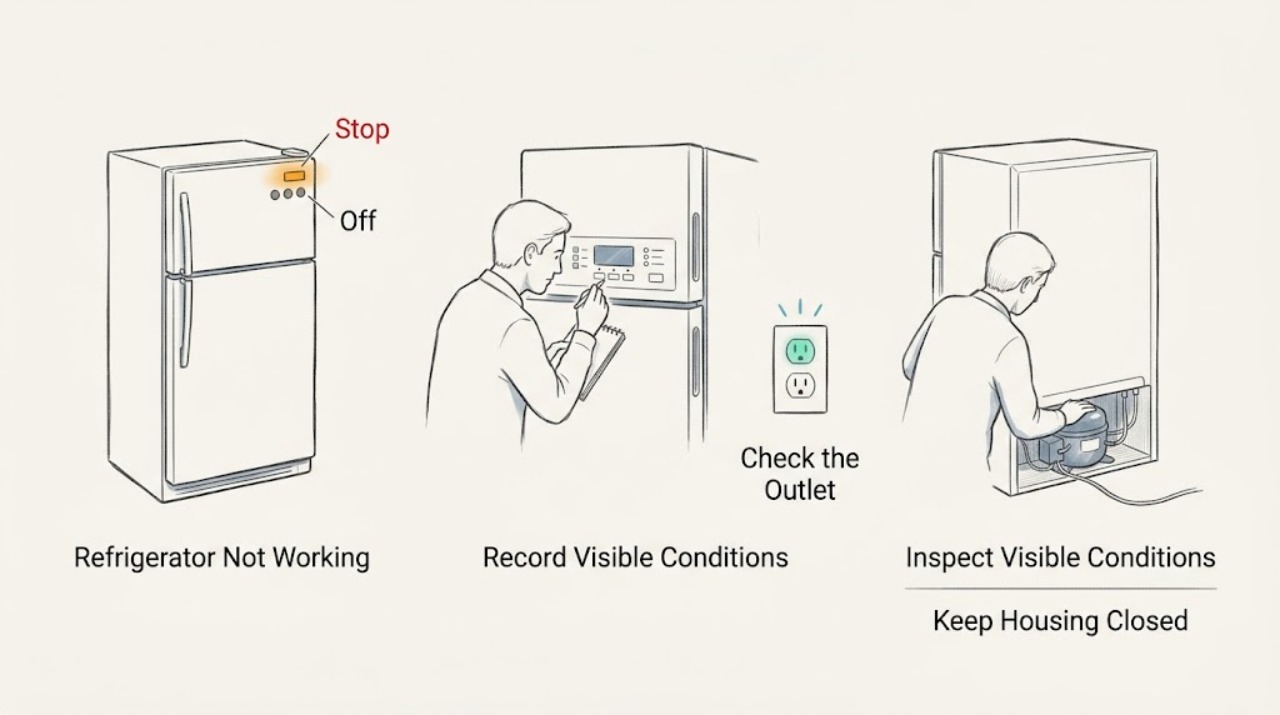
For a KitchenAid refrigerator that appears completely dead, first separate loss of household power from a refrigerator control that is off. Check the outlet, cord, breaker or GFCI, and the refrigerator controls using the owner's manual. If the outlet works but the refrigerator still has no lights, display, sounds, or response, stop before opening panels and arrange service; a powered refrigerator that is merely warm follows a different cooling diagnosis.
Before you begin
Safety first
- Do not remove the ground pin, use an adapter or extension cord, open electrical covers, test live wiring, or open sealed refrigeration components.
Work through in order
Diagnostic checks
Use only checks that match the exact appliance or system and its official guide.
-
Check 1
With the doors closed briefly, identify whether the refrigerator has any interior light, display, alarm, fan/compressor sound, or control response. Record whether it is truly silent and dark or whether it operates but is not cooling.
Expected result: There is no light, display, sound, or control response, or at least one function still works while food is warm.
Next step: For a powered-but-warm symptom, use the cooling-specific diagnosis. For a silent and dark unit, continue with the outlet and circuit checks below.
Why this matters
Why: A completely unresponsive unit belongs first to a power/control path; a powered unit with a warm compartment is not the same failure mode as no operation.
-
Check 2
Inspect the plug and outlet without removing the grounding pin or using an adapter or extension cord. Test the outlet with a small lamp or other appliance, and do not touch exposed wiring.
Expected result: The lamp also fails, the plug is not seated, or the outlet works normally.
Next step: Restore only a loose plug if safe. If the outlet remains dead, stop and call an electrician; if it works, continue to the breaker/GFCI and refrigerator-control check.
Why this matters
Why: A failed test appliance points to the household outlet/circuit rather than proving a refrigerator part failure; a working outlet leaves the refrigerator power path to check.
-
Check 3
Check the household circuit breaker, fuse, or GFCI that supplies the refrigerator. Reset a tripped device once according to household instructions, then observe the refrigerator without repeatedly cycling the circuit.
Expected result: The circuit was tripped and the refrigerator returns, or the circuit trips again / the refrigerator remains dead.
Next step: Stop and call an electrician for a repeated household trip. If the circuit is stable but the refrigerator remains unresponsive, continue only to the model-specific control state.
Why this matters
Why: A one-time trip may interrupt power; a repeated trip is an electrical safety signal and does not justify opening the appliance.
-
Check 4
Use the KitchenAid owner's manual to verify that refrigerator controls are on and that a mode such as vacation, showroom/demo, or another model-specific off state has not been selected. Do not guess at button combinations.
Expected result: The controls were off or a documented mode explains the lack of operation, or the controls are on with no response.
Next step: Restore the documented control state once and observe. If the refrigerator remains completely dead, stop at external checks and provide the model and power-test results to qualified service.
Why this matters
Why: A control state can make a powered appliance appear inactive; controls that are on with no light, display, or sound require service diagnosis rather than a cooling-part guess.
-
Check 5
If the unit stopped during an expected automatic defrost period, wait and recheck operation once; for a new installation, use the manual's startup guidance before judging it failed.
Expected result: Operation resumes after the documented waiting condition, or the refrigerator remains silent and dark.
Next step: Monitor only after a normal restart. If there is still no response, request service and do not remove electrical or sealed-system covers.
Why this matters
Why: KitchenAid manuals note that automatic defrost can temporarily change operation and that new installations need time to cool; persistent total silence is not explained by normal cooling recovery.
Use your observations
Decision map
Find the observation that best matches what you see, then follow the next safe action.
-
PATH 01Next step
What you see
The refrigerator is dark and silent, and a lamp also fails at the outlet.
Do this next
Stop appliance troubleshooting and have the outlet/circuit checked by an electrician.
Why this path and its safety boundary
Why it matters: The immediate fault is likely in the household supply, not yet attributable to a refrigerator component.
-
PATH 02Next step
What you see
The outlet and circuit are stable, but the refrigerator has no light, display, sound, or response after its controls are verified on.
Do this next
Stop before opening panels and arrange qualified KitchenAid appliance service with the model and completed checks.
Why this path and its safety boundary
Why it matters: The appliance's internal power or control path needs diagnosis; the evidence does not identify a replaceable part.
-
PATH 03Next step
What you see
The interior light or controls work, but the refrigerator or freezer is warm.
Do this next
Record which compartment is warm and follow the cooling-specific checks instead of repeating power resets.
Why this path and its safety boundary
Why it matters: This is not complete loss of operation; the symptom belongs to a cooling, airflow, setting, or condenser diagnosis.
-
PATH 04Next step
What you see
The circuit trips again after one reset or there is smoke, burning odor, heat, sparking, or damaged wiring.
Do this next
Stop using the refrigerator, avoid touching exposed wiring, and call an electrician or qualified appliance technician as appropriate.
Why this path and its safety boundary
Why it matters: An electrical hazard is present.
When checks do not resolve it
Need a professional?
Call an electrician for a dead outlet or repeated breaker/GFCI trip. Request qualified appliance service when the outlet and circuit are stable but the refrigerator remains completely unresponsive, or when smoke, burning odor, heat, sparking, or damaged wiring appears.
Safety scope: Do not remove the ground pin, use an adapter or extension cord, open electrical covers, test live wiring, or open sealed refrigeration components.
Have this ready
- Provide the model number, whether lights/display/sounds respond, outlet test result, breaker/GFCI behavior, control state, installation or defrost context, and any hazard observed.
Common questions
FAQ
How do I tell whether my KitchenAid refrigerator is not working or simply not cooling?
Check for an interior light, display, sound, or control response. No response at all calls for an outlet, circuit, and control-state path; a powered refrigerator with a warm compartment calls for cooling and airflow diagnosis.
What should I do if the refrigerator outlet works but the appliance is still completely dead?
Verify the refrigerator controls with the model manual, then stop before opening panels and arrange qualified appliance service. The outlet test alone cannot identify an internal component.
Read the exact guide
Official sources
- TROUBLESHOOTINGKitchenAid · KitchenAid refrigerator will not operate, electrical supply, controls, and defrost behavior
- Both Compartments are Not Cooling - Built-In RefrigeratorKitchenAid Product Help · KitchenAid refrigerator power supply, on/off state, and distinction from cooling symptoms
Community feedback
Share a repair observation
Share a plain-text repair observation. Accepted observations are published automatically; this page may take a moment to update.