
On this page
Start here
Quick answer
Trace a KitchenAid washer noise by phase and location before assuming a failed part. A brief inlet click, sensing hum, drain-pump hum with gurgling, or basket deceleration whir can be normal on the cited KitchenAid washer guidance. Clicking that changes with the load may be clothing hardware, while metallic noise that continues with an empty basket can be a loose object in the drain path or between the basket and tub. Thumping and violent movement during spin point first to a tangled or unbalanced load, an unlevel machine, weak floor, or cabinet contact. Check only ordinary-access areas: the load and pockets, visible basket edge, hoses and floor, leveling and clearance, and accessible drain or inlet conditions. Stop for a leak, severe movement, metal scraping, smoke, burning smell, sparks, hot wiring, or a breaker trip; persistent internal pump, bearing, suspension, or drive noise needs qualified service.
Before you begin
Safety first
- This article covers listening and ordinary-access inspection only. Do not open the cabinet or pump, reach between moving parts, disconnect wet or pressurized hoses, lubricate internal parts, or perform live electrical checks.
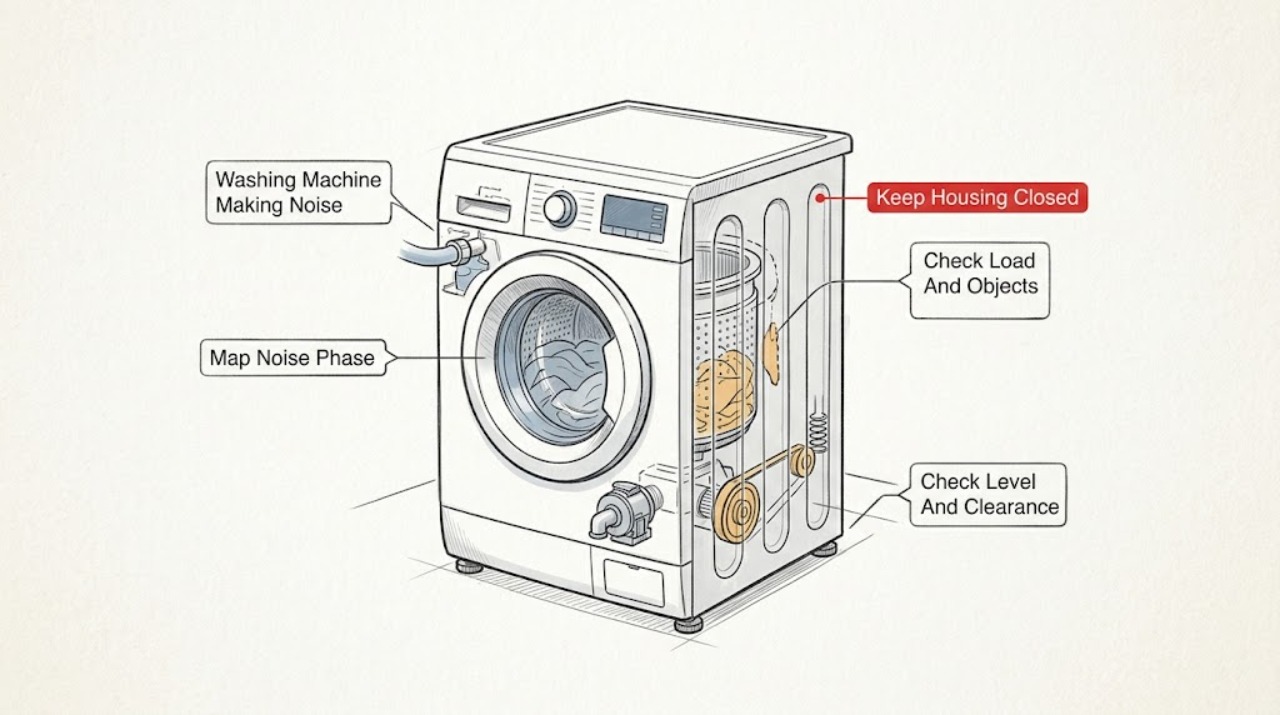
Work through in order
Diagnostic checks
Use only checks that match the exact appliance or system and its official guide.
-
Check 1
From a dry, stable position, note whether the noise occurs during water entry, load sensing, wash or basket movement, drain, final spin, basket slowdown, or after the cycle; compare whether it is loudest at the inlet, front panel, basket, lower pump area, rear hose, or floor.
Expected result: The sound is a brief click, water rush, low hum, gurgle, whir, rhythmic thump, metallic strike, squeal, scrape, or severe vibration tied to one phase.
Next step: Record the phase, location, load size, and whether water was entering or draining. Use the matching branch below before another cycle.
Stop if: Stop immediately for smoke, burning smell, sparks, hot wiring, a serious leak, uncontrolled movement, metal-on-metal scraping, or a breaker trip.
Why this matters
Why: Phase and location separate expected inlet, sensing, drain, and deceleration sounds from load, pump, basket, leveling, or drive concerns. A sound that follows basket rotation is different from one that appears only as water enters or leaves.
-
Check 2
When the basket has stopped, remove the load and check pockets, zippers, snaps, buckles, coins, clips, and other small items; inspect the visible basket edge and door or lid area without reaching into gaps or removing a panel.
Expected result: A garment feature or loose object is visible, the load was tightly packed or balled, the basket edge has a mark or sharp damage, or the accessible areas are clear.
Next step: Remove only a loose object that is plainly accessible, separate the load, and make one brief safe observation. If an item is trapped, the basket is damaged, or the noise remains empty, stop and request service.
Stop if: Do not pry an object from a gap, reach between basket and tub, spin a damaged basket, or run with a sharp edge, scrape, smoke, odor, or loose part.
Why this matters
Why: KitchenAid identifies clothing hardware as a normal source of metallic contact and loose objects as a possible source around the basket, tub, or pump. A clear basket with a repeating rotation noise points toward an internal support or drive path.
-
Check 3
Inspect the washer from outside for rocking, feet that are not firmly planted, a flexible or sloping floor, and cabinet contact with a wall, shelf, hose, or adjacent appliance; do not drag the connected washer.
Expected result: The cabinet rocks or contacts another surface, the floor flexes, the feet are loose or not seated, or the washer is stable with clearance but still noisy.
Next step: If the manual gives an accessible leveling procedure and the washer can remain safely supported, have installation or service personnel correct the feet and clearance. Do not move the washer across a wet floor or disturb hoses to test it.
Stop if: Stop for severe rocking, a damaged floor, strained hoses, a loose drain connection, water under the machine, or any need to access the underside or cabinet.
Why this matters
Why: KitchenAid connects off-balance vibration and excess sound with leveling, feet, floor conditions, tight placement, and load distribution. Stable clearance after those checks makes a load or internal pump, basket, or drive cause more likely.
-
Check 4
If the noise appears during fill or drain, observe the accessible hose and faucet area for a kink, vibration against a surface, leak, or unusual water movement; inspect the visible drain connection without pulling the hose from the machine or opening the pump.
Expected result: A brief inlet click or water rush occurs only during fill, a hum and gurgle occur while water exits, the hose or drain area vibrates or leaks, or a pump-like sound continues while water remains.
Next step: If the sound is the expected short fill or drain pattern and there is no leak, continue to the load and spin checks. If flow is weak, water remains, the pump strains, or a leak is present, stop and arrange qualified washer or plumbing service.
Stop if: Do not disconnect a wet or pressurized hose, reach into standing water near electricity, insert tools into the pump, or run another cycle with a leak.
Why this matters
Why: KitchenAid describes drain-pump hum with periodic gurgling as normal in a drain-and-spin phase, but a loose object can block the pump and a kink, poor drain installation, or obstruction can prolong draining. A leak or standing water is a safety branch.
-
Check 5
If the noise is during wash or spin, distribute dry items loosely around the basket, remove a tightly packed or single bulky item, and check whether the machine is stable before selecting the model's appropriate cycle; do not add water to correct balance.
Expected result: The noise and movement improve with a balanced load, remain with an empty or balanced basket, or the washer continues to walk, strike the cabinet, or leave the load very wet.
Next step: Use the model cycle guide for the load and observe one controlled cycle only if no hazard is present. If movement or noise remains, stop using the washer and provide the technician the phase, load, and location record.
Stop if: Do not restrain the cabinet by hand, run a violently moving washer, add water to alter balance, or continue with metal scraping, impact, leaking, smoke, or odor.
Why this matters
Why: KitchenAid identifies tightly packed or unbalanced loads, oversized items, and poor leveling as causes of vibration and incorrect spin. Persistent noise or movement with a balanced load suggests suspension, basket, motor, bearing, or drive service rather than another load adjustment.
-
Check 6
After the ordinary-access checks, compare the symptom with the exact KitchenAid manual and document whether the sound is still present with a clear basket, stable installation, normal water path, and balanced load; do not remove the cabinet or try to lubricate or test internal parts.
Expected result: The noise is gone after correcting an accessible cause, or it remains as a repeating hum, grinding sound, squeal, metallic scrape, pump strain, or impact from inside the cabinet.
Next step: Leave the washer out of use when the internal sound persists or grows louder. Provide the model number, phase, sound character, location, load state, water result, and any visible leak or movement to a qualified technician.
Stop if: Do not remove panels, reach into moving parts, lubricate the drive or bearing, bridge a safety device, or restart after a hazardous symptom.
Why this matters
Why: A resolved external cause supports load, object, hose, drain, or leveling. A persistent internal sound can involve the pump, basket support, suspension, motor, bearing, or drive and needs model-specific service diagnosis.
Use your observations
Decision map
Find the observation that best matches what you see, then follow the next safe action.
-
PATH 01Next step
What you see
A brief inlet click, sensing hum, drain hum with occasional gurgling, or basket-deceleration whir occurs in its expected phase without leaks, vibration, odor, or damage.
Do this next
Continue using the exact model cycle guide while monitoring for a change in character, duration, or location. Stop if a new scrape, impact, or severe vibration appears.
Why this path and its safety boundary
Why it matters: KitchenAid washer guidance lists these sound patterns as normal operation categories.
-
PATH 02Next step
What you see
Clicking or metallic contact changes with the load, and clothing hardware or a loose accessible item is visible.
Do this next
Remove only the accessible item and redistribute the load. Stop if an object is trapped, the basket is damaged, or the sound remains with an empty basket.
Why this path and its safety boundary
Why it matters: The sound may be coming from the load or an object near the basket or pump rather than a failed drive part.
-
PATH 03Next step
What you see
Thumping or movement occurs during spin and improves when the load is loose and balanced, or the cabinet rocks or contacts nearby surfaces.
Do this next
Follow the model's load and installation guidance and have leveling corrected if needed. Stop for violent movement, floor damage, strained hoses, or water under the machine.
Why this path and its safety boundary
Why it matters: Load distribution, leveling, feet, floor flex, or external contact is more likely than an internal part failure.
-
PATH 04Safety boundary
What you see
The sound is strongest during drain, water remains, flow is weak, a small object may be near the pump, or a hose or drain connection leaks.
Do this next
Keep water away from electricity and arrange qualified washer or plumbing service for persistent drain noise, standing water, blockage, or leakage. Do not open the pump as an owner test.
Why this path and its safety boundary
Why it matters: A pump, drain path, object, hose, or plumbing issue can prolong the drain phase and create hum, gurgling, or strain.
Safety stop: Stop for a leak, standing water near a plug, a wet outlet, or a pump that makes a harsh grinding sound.
-
PATH 05Safety boundary
What you see
A repeating squeal, grinding sound, metal scrape, impact, or pump or drive noise remains with the load, level, clearance, and visible water path checked.
Do this next
Stop running the washer and request qualified KitchenAid appliance service with the model and symptom map.
Why this path and its safety boundary
Why it matters: An internal pump, basket support, suspension, motor, bearing, or drive diagnosis is needed.
Safety stop: Do not remove panels, lubricate internal parts, reach into moving parts, or perform live electrical checks.
-
PATH 06Next step
What you see
Noise occurs with severe movement, metal-on-metal contact, smoke, burning smell, sparks, a hot cord, a water leak near electricity, or a repeated breaker trip.
Do this next
Turn the washer off, keep people away, leave the area when needed, and seek appropriate emergency, electrical, plumbing, or appliance help from a safe location.
Why this path and its safety boundary
Why it matters: This is a mechanical, water, fire, or electrical safety event rather than a routine noise diagnosis.
Helpful context
Understand the symptom
The phase tells you what to listen for
During fill, a short valve click or water entry sound can be expected. During sensing or wash, a low hum may come from load sensing or gentle basket movement. During drain, a pump hum with occasional gurgling can be normal; during final spin, a whir as the basket slows can also be expected. A new scrape, repeated metallic strike, heavy thump, or noise that remains when the basket is still is a different branch.
Load, objects, and installation can imitate a part failure
KitchenAid's washer troubleshooting material connects clicking or metallic sounds with clothing hardware or objects caught around the basket or pump, and connects vibration with load balance, leveling, feet, and floor conditions. Empty pockets, loosen a tightly packed load, and check stable clearance from outside the machine before considering an internal repair. Do not reach between the basket and tub or open the cabinet.
Water or electrical symptoms change the response
A noisy pump with a drain problem, water on the floor, or a hose that shifts needs a water-safety decision before another cycle. Smoke, a burning smell, visible arcing, a hot cord or outlet, or a repeated breaker trip is an electrical stop-use event. Turn the washer off, keep people away, and arrange qualified help rather than trying to reproduce the sound.
Safety boundary
Stop conditions
- Stop use for smoke, a burning smell, visible arcing, a hot or damaged cord or outlet, a repeated breaker trip, severe movement, or metal-on-metal scraping.
- Stop for water leaking or pooling where it can reach a plug, outlet, controls, or wiring; do not reach into standing water near electricity.
- Do not reach between the basket and tub, open the pump or cabinet, insert tools into a drain path, or touch moving parts.
- Do not restrain a walking washer, drag a connected machine, disconnect a wet or pressurized hose, or continue with a damaged floor or strained connection.
- Use only ordinary-access and model-manual checks; persistent internal noise or a returning fault needs qualified service.
Only after diagnosis
Potential parts
- washer drain pump
Consider this category only when qualified diagnosis confirms persistent drain hum, strain, blockage damage, or failure after the visible drain path is clear.
Confirm the exact KitchenAid model and pump arrangement before ordering; do not open a wet pump or use a harsh sound as a test. - washer suspension or basket support
Consider this category only when balanced loading, stable leveling, and clearance checks are complete but spin vibration or repeating basket noise remains.
Confirm the exact model and service diagnosis; do not restrain or disassemble a moving or unstable washer. - washer drive or bearing assembly
Consider this category only when a qualified technician traces rotation-synchronous grinding, scrape, or rumble to the internal drive or bearing path.
Confirm exact model fit and installation requirements through qualified service; no internal disassembly is part of this article.
When checks do not resolve it
Need a professional?
Arrange qualified KitchenAid washer service when noise remains after the accessible load, object, level, clearance, and water-path checks; when it is rotation-synchronous or internal; when the pump strains or water remains; or when the machine walks or damages the floor. Stop immediately and seek appropriate emergency, electrical, plumbing, or appliance help for smoke, burning smell, sparks, hot wiring, serious leakage, severe movement, metal scraping, or an electrical trip.
Safety scope: This article covers listening and ordinary-access inspection only. Do not open the cabinet or pump, reach between moving parts, disconnect wet or pressurized hoses, lubricate internal parts, or perform live electrical checks.
Common questions
FAQ
Which KitchenAid washer sounds can be normal?
KitchenAid washer guidance lists a sensing hum, a drain-pump hum with occasional gurgling, and a whir as the basket slows as normal sound patterns on applicable models. A new grinding sound, metal scrape, repeated impact, severe vibration, or noise with a leak or odor needs a stop-use decision.
Why does my KitchenAid washer make a clicking or metallic sound?
Check clothing snaps, buckles, zippers, pockets, coins, clips, and the visible basket edge after the basket stops. Clothing hardware can touch the basket normally, while a loose object can reach the basket, tub, or pump. Stop if an item is trapped or the sound remains with an empty basket.
Why does the washer thump or move during spin?
A tightly packed, balled, single bulky, or unbalanced load can create thumping and movement. Redistribute the load and check stable leveling and clearance from outside the machine. Persistent movement with a balanced load needs qualified service.
Is a humming or gurgling washer pump always a failure?
No. A drain-pump hum with periodic gurgling can be normal while final water is removed. It is not a normal case when water remains, the sound becomes harsh, the drain path leaks, or the pump strains; keep water away from electricity and arrange service.
Can leveling reduce KitchenAid washer noise?
Yes. KitchenAid connects vibration and excess sound with feet that are not firmly planted, an unlevel or flexible floor, tight cabinet placement, and load distribution. Do not drag a connected washer or disturb its hoses; use the exact installation instructions or qualified service.
When should I stop using a noisy KitchenAid washer?
Stop for smoke, burning smell, sparks, hot wiring, water near electricity, severe movement, metal scraping, a serious leak, or an electrical trip. Also stop for a persistent internal grinding sound or pump strain and provide the model and phase-by-phase symptom record to a qualified technician.
Read the exact guide
Official sources
- Owner's ManualKitchenAid · Official KitchenAid washer manual for an identified model; use the assigned appliance's own manual for exact controls and error meanings.
- TROUBLESHOOTING – WASHERKitchenAid · Official KitchenAid washer/dryer owner manual for the identified model family; exact features and cycle behavior vary by model.
Community feedback
Share a repair observation
Share a plain-text repair observation. Accepted observations are published automatically; this page may take a moment to update.