
On this page
Start here
Quick answer
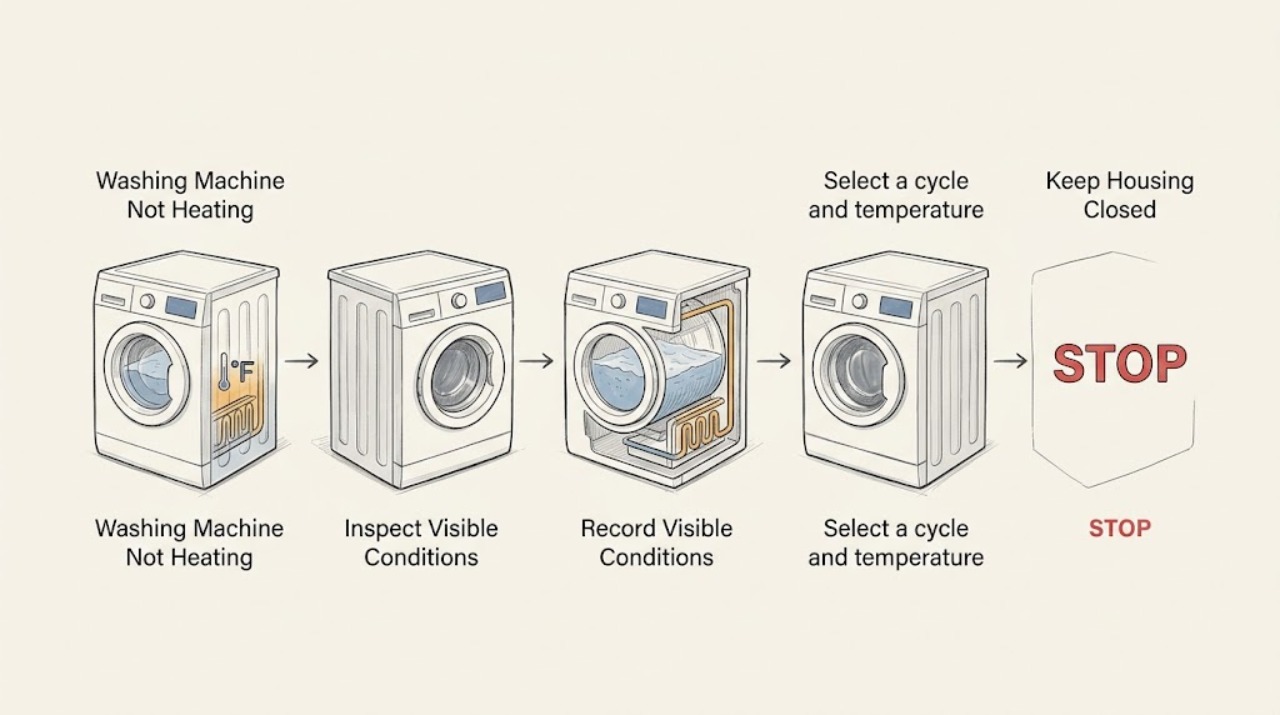
Most KitchenAid washers rely on the home's hot and cold water supply and mix incoming water to the selected wash temperature; an internal heater or steam phase exists only on models whose manual lists that feature. A cool fill does not always mean the washer's heater has failed: the selected cycle, load, household water temperature, hose connections, and temperature-sensing logic all matter. First identify the exact model, choose a cycle and temperature that call for warm or hot water, and check that the hot and cold hoses are connected to the correct open faucets. Run the nearest hot tap until it is hot before starting if the water heater is far away or several loads have used the supply. If the model has a documented heated or steam phase and still shows persistently cold water, an error, leaking water, burning smell, arcing, or a tripped breaker, stop and arrange qualified service. Do not open the washer, test live wiring, or assume an internal heater exists on a model that does not list one.
Work through in order
Diagnostic checks
Use only checks that match the exact appliance or system and its official guide.
-
Check 1
Before testing temperature again, look for leaking water, water near the plug or control, steam or scalding water, smoke, a burning smell, sparks or arcing, a hot or discolored cord, or a breaker that has tripped again.
Expected result: Any leak near electrical parts, wet energized equipment, smoke, burning smell, arcing, heat damage, or repeated trip is present.
Next step: Stop the washer from a dry location if possible, close the water faucets, and disconnect power only without touching wet equipment. Keep clear and arrange qualified appliance or electrical help.
Stop if: Do not run another cycle, touch a wet plug, open the cabinet, or continue testing heat after a safety warning.
Why this matters
Why: This is a water, burn, shock, or fire hazard rather than a normal warm-versus-hot wash question.
-
Check 2
Find the full KitchenAid model number and read its cycle guide or manual to determine whether the washer uses only incoming household hot water or lists an internal heater, heated wash, or steam option; record any temperature-related display or code.
Expected result: The manual lists no internal heating feature, lists a heated or steam phase, or the model and feature cannot be confirmed.
Next step: Use only the temperature and feature names in the same model's manual. If the model is unknown, limit the investigation to supply, hose, cycle, and safety checks and provide the model to service.
Why this matters
Why: A washer without a listed internal heater cannot be diagnosed as having a failed heater merely because a warm cycle feels cool. A listed feature creates a model-specific branch rather than a universal expectation.
-
Check 3
Select a cycle and temperature that the exact manual identifies as warm or hot, confirm the selection, and note whether the machine initially fills cold, alternates temperatures, or shows a normal sensing or heating phase.
Expected result: The cycle reaches its expected phase, the selected cycle is actually cool or cold, or the water remains unexpectedly cold throughout a model-approved heated phase.
Next step: Compare the observed behavior with the exact cycle guide before escalating. If a listed heated or steam phase never warms the water, record the phase and arrange service rather than changing settings repeatedly.
Why this matters
Why: Temperature settings vary by cycle, and the washer may regulate the mixture rather than deliver the raw hot-tap temperature. A heated cycle can also lengthen while the washer reaches its target.
-
Check 4
With the washer off and the area dry, verify that the hot inlet hose is connected to the hot faucet and the cold inlet hose to the cold faucet, that both valves are fully open, and that the visible hose ends show no kink or leak.
Expected result: The hoses are reversed, a faucet is closed, a hose is kinked or leaking, or the connections are correct and dry.
Next step: If safe, close the faucets before correcting a visible connection and restore them slowly, checking for leaks. If a fitting leaks, a hose is damaged, or the supply is correct but temperature remains wrong, stop and arrange service or plumbing help.
Stop if: Do not loosen a pressurized fitting, work near wet electrical parts, or continue if water escapes uncontrollably.
Why this matters
Why: A reversed or restricted inlet can make a warm or hot selection appear cold and can also prevent the washer from filling normally. A leak changes this into a water-safety issue.
-
Check 5
Before a warm or hot load, run the nearest household hot tap until it is hot if the water heater is distant, then start one model-approved cycle; note whether several recent loads have depleted the available hot water.
Expected result: The cycle warms normally after the tap is run, or the water remains cool despite a recovered household supply.
Next step: If only the first fill is cool and the cycle behaves normally, treat it as a supply or usage condition. If a listed heated phase remains cold, record the cycle and request qualified diagnosis.
Why this matters
Why: Distance from the water heater and rapid successive loads can reduce initial inlet temperature without indicating a washer fault. Persistent cool water after the home supply is hot points back to the inlet, sensing, or model-specific heating path.
-
Check 6
If the exact manual lists an internal heater or steam phase, observe one supervised run for its documented indicator, cycle extension, or temperature-related code; do not remove panels or touch the water, heater, wiring, or sensor.
Expected result: The listed phase activates and the cycle proceeds, the phase never activates, or an error or abnormal heat symptom appears.
Next step: If the phase never activates or a code repeats, stop user diagnosis and arrange service with the model, cycle, selected temperature, display, and observations. Do not buy an internal heater based only on a cool load.
Stop if: Stop immediately for scalding, smoke, burning smell, arcing, a breaker trip, or water near electrics.
Why this matters
Why: A heater or steam feature is model-specific, and a control, sensor, inlet, or heater fault can look similar from the outside. An error code must be interpreted using the exact model manual.
-
Check 7
If there is no safety hazard and the exact manual permits a control reset, perform one power reset only, then rerun the same model-approved temperature cycle and compare the display and water behavior with the original observation.
Expected result: The control returns to normal, the cold-water symptom remains, or the same code, leak, heat damage, or trip returns.
Next step: If the symptom or code returns, stop testing and arrange qualified service. Provide the model, feature availability, hoses, selected cycle, household water result, display, and reset result.
Stop if: Do not repeat resets, bypass a thermal device, test live wiring, or open the washer to inspect an internal heater.
Why this matters
Why: A single reset can clear a transient control state but cannot repair a reversed supply, failed inlet, sensor, heater, or wiring fault. A recurring code is useful evidence for service.
Use your observations
Decision map
Find the observation that best matches what you see, then follow the next safe action.
-
PATH 01Next step
What you see
Water reaches electrical parts, a leak is uncontrolled, scalding or abnormal heat is present, smoke, burning smell, arcing, exposed wiring, or a breaker trips
Do this next
Stop safely from a dry location, close water if possible, keep clear, and arrange qualified appliance or electrical help. Do not touch wet energized equipment.
-
PATH 02Next step
What you see
The exact model does not list an internal heater or steam feature
Do this next
Diagnose the household hot-water supply, temperature selection, inlet hoses, and cycle behavior instead of assuming a missing internal heater.
-
PATH 03Next step
What you see
The washer initially fills cool but the selected cycle later reaches its documented temperature behavior
Do this next
Treat the initial fill as a mixing or supply condition and compare with the model cycle guide; no part replacement is indicated by that observation alone.
-
PATH 04Next step
What you see
Hot and cold hoses are reversed, a faucet is closed, or a visible hose is kinked
Do this next
Correct only the accessible connection when dry and safe, restore water slowly, and check for leaks. Persistent supply or plumbing faults need service.
-
PATH 05Next step
What you see
A listed heated or steam phase stays cold or shows a recurring temperature code
Do this next
Stop user diagnosis and request qualified service for the model-specific inlet, sensor, heater, or control path.
-
PATH 06Next step
What you see
A single model-approved reset does not restore expected temperature behavior
Do this next
Do not keep resetting or open the washer. Provide the full model, cycle, temperature, display, supply, and observation record to service.
Helpful context
Understand the symptom
Do not assume every KitchenAid washer has an internal heater
For many washers, the first heat source is the household water heater and the washer regulates the hot and cold inlet streams. Some models add a heated or steam phase, but that feature must be present in the exact model's cycle guide. Water can also feel cooler than expected because the machine initially fills with cold water, mixes to a target, or senses temperature in the tub rather than at the inlet. Check the model literature before calling a missing heater a failure.
Keep water, heat, and electrical work within safe limits
The user-level boundary is the cycle selection, visible hose connections, faucet state, accessible display, and safe external observations. Do not remove panels, measure voltage, bridge a thermostat, or open a wet washer. Stop if water reaches electrical parts, the machine leaks, a breaker trips, smoke or a burning smell appears, or there is an arc or exposed wiring.
Only after diagnosis
Potential parts
- water inlet valve
Only consider this category after the hot and cold supply, hoses, and faucets are correct and qualified testing identifies an inlet-valve fault.
Confirm the full model number and manufacturer fit information before ordering; shut off water and power according to the exact manual. - internal water heater
Only consider this category for a model whose manual lists an internal heater and only after qualified diagnosis confirms that heating path is defective.
Many washers rely primarily on household hot water; confirm the model feature and exact compatibility before any electrical service. - temperature sensor or thermostat
Only consider this category if a listed heated phase and qualified testing point to temperature feedback rather than supply or control settings.
Confirm the exact model and approved replacement information; do not infer compatibility from a similar-looking sensor. - washer control board
Only consider this category after supply, cycle selection, and model-specific heater or sensor checks have been evaluated by qualified service.
Control boards are model-specific and cabinet-level electrical work should be performed by qualified personnel.
When checks do not resolve it
Need a professional?
Have this ready
- The full KitchenAid model and serial numbers, whether the manual lists internal heating or steam, selected cycle and temperature, display or code, hose and faucet arrangement, household hot-water result, cycle stage, and the outcome of one permitted reset.
Common questions
FAQ
Do KitchenAid washing machines heat their own water?
Many models regulate incoming hot and cold household water rather than relying on a built-in heater. An internal heater or steam phase is model-specific, so check the exact manual before diagnosing a missing heater.
Why is a warm KitchenAid washer load initially cold?
The washer may initially dispense cold water, mix hot and cold water to a target, or sense temperature in the tub. A distant water heater or several recent loads can also reduce the initial hot-water supply.
When should I call for service for a KitchenAid washer that does not heat?
Arrange service when a model-approved heated or steam phase stays cold after the hoses, faucets, household hot water, and cycle settings are correct, or when a code repeats. Stop immediately for leaks near electrical parts, scalding, smoke, burning smell, arcing, or a breaker trip.
Read the exact guide
Official sources
- Kitchen Appliance Manuals | KitchenAidKitchenAid · Official KitchenAid manuals page; use the full model number to identify cycles, heating or steam features, and safety procedures.
- Product LookupKitchenAid Product Help · Official KitchenAid lookup tool for manuals and product resources by model number.
- CPSC Urges Flood Victims to Take Steps to Prevent CO Poisoning, Electrocution, Explosion and FiresU.S. Consumer Product Safety Commission · General safety guidance: do not touch wet plugged-in equipment and obtain professional evaluation before reuse.
- Long Cycles on a Front Load WasherWhirlpool Product Help · Official family guidance; only models with the listed heated or steam cycle should be treated as having that feature.
- Getting Cold Water when Warm or Hot was SelectedWhirlpool Product Help · Official family guidance only; inlet count, sensing, and cycle behavior vary by model.
- Water Not Hot or Not Warm EnoughWhirlpool Product Help · Official manufacturer-family guidance used for KitchenAid-family washer principles; confirm the exact KitchenAid manual for model-specific cycles and controls.
Community feedback
Share a repair observation
Share a plain-text repair observation. Accepted observations are published automatically; this page may take a moment to update.