
On this page
Start here
Quick answer
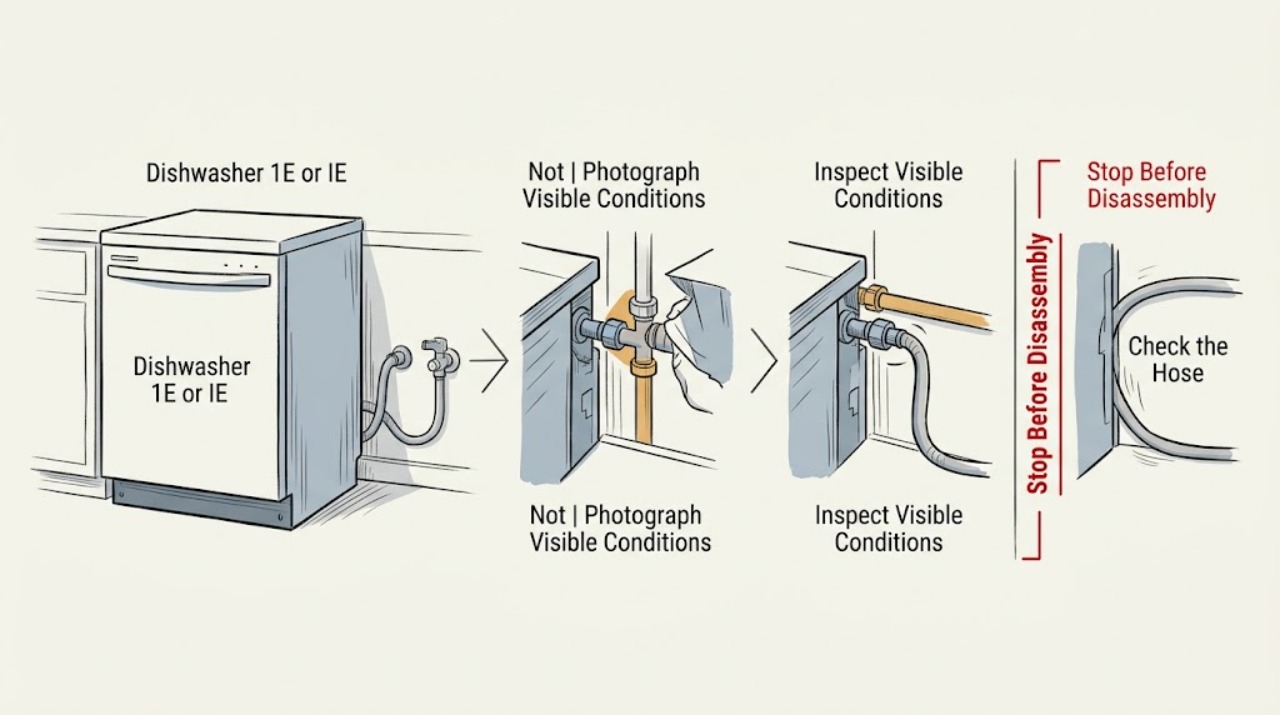
Treat the display as a character-identification issue first: the US owner's manual associated with the LG LDS5040ST support page lists 1E (one-E) as a water inlet problem, while LG's current dishwasher guide uses IE (capital I-E) and explicitly distinguishes it from E1. Photograph the display and confirm the complete model before applying either meaning. Because this dishwasher has never been used, first check the user-accessible shutoff valve under the sink and make sure the inlet hose is not kinked, pinched, frozen, or torn; LG identifies a closed valve after installation as a common reason for a no-water complaint. Check that the household faucet has water, then open the dishwasher valve only if it is plainly closed and the area is dry. Do not disconnect the water line, loosen fittings, remove panels, or run repeated cycles. If the exact code remains, water still does not enter, or there is any leak, leave the dishwasher off and contact the installer or qualified LG service with the code photo, complete model, and installation details.
Work through in order
Diagnostic checks
Use only checks that match the exact appliance or system and its official guide.
-
Check 1
Before pressing Start again, photograph or transcribe the display exactly and record whether it reads 1E, IE, E1, or another sequence. Read the complete rating-plate model and suffix, confirm it is LDS5040ST, and note whether the code appears immediately or after the fill portion of a cycle.
Expected result: The display is clearly 1E on LDS5040ST, it is IE or E1, or the model/code cannot be read reliably.
Next step: Use the complete model-matched manual and keep the photo with the service request. If the code is IE on a later or different model, use the current IE guidance only after confirming the appliance identity; if it is E1 or unclear, stop code-specific troubleshooting.
Stop if: Do not clear or reinterpret the code from a generic LG error list, and do not select an inlet valve or sensor from the characters alone.
Why this matters
Why: The LDS5040ST US owner's manual maps 1E to a water inlet problem. LG's current US article uses IE and explicitly says it is not E1. A different display or uncertain model cannot safely inherit the 1E meaning.
-
Check 2
Because the dishwasher has never been used, open the cabinet under the sink and look at the dishwasher's accessible water shutoff valve. Confirm that the valve is open only if it is plainly visible, the cabinet is dry, and no fitting is leaking. Do not loosen the hose or reach behind the dishwasher.
Expected result: The dishwasher valve is closed, the valve is open, the valve or fitting is wet, or the valve cannot be identified without moving the appliance or disconnecting plumbing.
Next step: If it is safely and obviously closed, open it as directed by the installation arrangement, then proceed to the hose and supply checks. If it is open, wet, damaged, or inaccessible, stop and contact the installer or qualified service.
Stop if: Do not force a stiff valve, remove compression fittings, pull the dishwasher out, or continue if water is escaping.
Why this matters
Why: LG says a valve may be left closed after a new installation to prevent leaks. A closed valve is an installation condition, not proof of a failed inlet component; water at a fitting or an inaccessible valve creates a leak/service boundary.
-
Check 3
Check the kitchen faucet for normal cold-water flow, then inspect the visible portion of the dishwasher inlet hose for a sharp bend, pinch, crushing object, freezing condition, or tear. Make only a gentle visible correction to an obvious bend; do not disconnect the line to inspect an internal screen.
Expected result: The faucet has no water, the inlet hose is kinked or pinched, the hose is torn or frozen, or household supply and the visible hose look normal.
Next step: Restore household water or correct only a plainly visible hose bend, keep the area dry, and proceed to one controlled check. For a torn/frozen hose or normal visible supply with no fill, stop and arrange installation or appliance service.
Stop if: Do not remove the inlet hose, clean an internal valve screen, or make live electrical or water-pressure measurements.
Why this matters
Why: LG lists a water outage, kinked or pinched inlet hose, low pressure, and a closed valve as causes of an IE/no-fill condition. A normal faucet and visible hose make an internal inlet restriction, valve, wiring, or control diagnosis possible but do not identify one part.
-
Check 4
After the accessible valve is open, the visible hose is unrestricted, and there is no leak, run one model-supported short or normal check while remaining nearby. Watch whether water enters the tub, whether the code appears immediately or after the fill period, and whether the dishwasher begins draining instead of filling.
Expected result: Water enters and the code clears, no water enters and 1E/IE returns, or water appears on the floor or the appliance repeatedly drains without filling.
Next step: If the dishwasher fills normally, monitor the first complete cycle for leaks. If it does not fill, stop and contact the installer or LG service with the exact timing and code. If water leaks, shut the water supply off if safe and leave the appliance unused.
Stop if: Do not run repeated cycles, add water by hand, or operate with a leaking line or standing water near electrical parts.
Why this matters
Why: A successful fill after opening the valve or correcting the hose supports an installation restriction. A repeat code with normal visible supply needs a model-specific inlet-path diagnosis; a leak or abnormal drain behavior is a safety/service condition, not a reason to keep cycling.
-
Check 5
For a persistent 1E/IE or no-fill condition after the new-installation checks, prepare a service record: display photo, complete LDS5040ST model and serial, US-market confirmation, date of installation, whether the valve was initially closed, hose observations, faucet flow, and the point in the cycle where filling stopped. Leave the dishwasher off until the diagnosis is arranged.
Expected result: The fault clears after the valve/hose correction, or it persists with normal household supply and no visible installation restriction.
Next step: Ask the installer or qualified LG technician to verify the LDS5040ST inlet path and state the failed test before replacing a valve, sensor, or control. Preserve purchase and installation records because the US support page identifies this model's warranty and service route.
Stop if: Do not open the door panel, access live terminals, bypass an interlock, or keep resetting a fault that returns.
Why this matters
Why: The cleared case is consistent with an installation supply condition. Persistence means an inlet hose, inlet valve, internal screen, wiring, sensor, control, or another model-specific path may need service; the code alone cannot select a replacement part.
Use your observations
Decision map
Find the observation that best matches what you see, then follow the next safe action.
-
PATH 01Next step
What you see
The display photo and model confirm 1E on an LG LDS5040ST, and the dishwasher has never been used.
Do this next
Check the accessible sink-cabinet valve and visible inlet hose before considering any component fault; do not use the E1 interpretation from another code family.
Why this path and its safety boundary
Why it matters: The model-associated owner's manual identifies 1E as a water inlet problem, and the never-used condition makes installation supply state the highest-value first branch.
-
PATH 02Next step
What you see
The dishwasher valve was closed or the inlet hose was visibly kinked, and the code clears after the valve is opened or the bend is corrected.
Do this next
Monitor one complete cycle from a dry cabinet and stop immediately for any leak or returning code; retain the installation record.
Why this path and its safety boundary
Why it matters: The result supports a new-installation or supply restriction rather than a confirmed failed inlet valve or sensor.
-
PATH 03Next step
What you see
The valve is open, the faucet has water, the visible hose is not restricted, and 1E/IE returns with no water entering the tub.
Do this next
Leave the dishwasher off and contact the installer or qualified LG service with the exact display, LDS5040ST identity, timing, and checks already performed; request a test-based diagnosis before authorizing a part.
Why this path and its safety boundary
Why it matters: The obvious supply and installation checks did not resolve the no-fill condition. An internal inlet path or control diagnosis is more likely, but the code does not identify which part failed.
-
PATH 04Next step
What you see
The display actually reads E1, the model is not LDS5040ST, or the code cannot be distinguished between 1E, IE, and E1.
Do this next
Stop code-specific repairs, obtain the complete model and a clear display photo, and use that model's regional manual or qualified service. Do not order an inlet valve, sensor, or control from an ambiguous code.
Why this path and its safety boundary
Why it matters: LG's current dishwasher guidance explicitly distinguishes IE from E1, and the old LDS5040 manual's 1E mapping is not a universal LG code table.
Helpful context
Understand the symptom
The identity matters here because the question says E1, but LG's older LDS5040 manual uses 1E (the digit one followed by E) for a water inlet problem. LG's current US dishwasher help article uses IE (the letter I followed by E) and specifically asks the reader to distinguish it from E1. A segmented or small LED can make 1 and I easy to confuse, so retain a photo of the display instead of rewriting the code from memory.
LDS5040ST is a US-market model whose support page supplies the owner manual and identifies the dishwasher. Since this unit has never completed a cycle, installation state is more informative than a guessed failed part: the water shutoff may still be closed, or the supply line may have been pinched while the dishwasher was pushed into the cabinet.
These are user-accessible checks only. Stop for water on the floor, a leaking fitting, exposed wiring, a burning smell, a breaker trip, or a hose that must be disconnected to inspect. Do not pull the built-in dishwasher out, disconnect its water line, or test a live inlet valve yourself.
Only after diagnosis
Potential parts
- dishwasher water inlet hose
Consider a hose only if the visible hose is torn, crushed, or otherwise confirmed defective, not merely because 1E/IE appears. A closed valve or installation kink should be corrected as an installation condition rather than treated as a failed part.
Confirm the complete LDS5040ST suffix, US-market installation, connection type, and LG fit information before ordering. Do not disconnect plumbing or replace the inlet valve without qualified service diagnosis.
Common questions
FAQ
Is the LG LDS5040ST code E1 or 1E?
The US owner's manual associated with the LDS5040ST support page lists 1E, with the digit one before E, as a water inlet problem. LG's current US dishwasher guide uses IE, with a capital I before E, and explicitly says it is not E1. Photograph the display and match the complete model before choosing a meaning.
Why would an unused LG LDS5040ST dishwasher not fill?
LG says a dishwasher that was newly installed may have its connected water valve left closed to prevent leaks. Check the accessible valve and visible inlet hose, along with household faucet flow, before treating the no-fill condition as an internal component failure.
Should I replace the inlet valve when 1E or IE appears?
Not from the code alone. If the valve is open, the faucet has water, the hose is unrestricted, and the dishwasher still will not fill, request a model-matched diagnosis. Do not disconnect the built-in water line or perform live tests yourself.
Read the exact guide
Official sources
- Dishwasher: No water – ‘IE’ error codeLG USA Support · Current LG US dishwasher guidance; it explicitly distinguishes IE from E1 and notes that the exact display/code conventions can vary by model.
- LDS5040 Dishwasher Owner's ManualLG USA · Opened the PDF from the exact LDS5040ST.ASTEEUS support page; its troubleshooting and error-code table covers the LDS5040 family and US/Canada service context.
- LG LDS5040ST: Front Control Dishwasher with EasyRack PlusLG USA · Exact US product page used to confirm the model and appliance class; it does not define the error-code procedure.
- LG LDS5040ST.ASTEEUS: Support, Manuals, Warranty & MoreLG USA · Exact US product-support identity and owner-manual routing for LDS5040ST; the page states the manual is English/Spanish and the warranty applies to products purchased and used in the United States.
Community feedback
Share a repair observation
Share a plain-text repair observation. Accepted observations are published automatically; this page may take a moment to update.