
On this page
Start here
Quick answer
For the Beko DWD5414S, start with the water tap, the visible inlet hose, the door closure, and any water already standing in the tub. Beko identifies a closed tap, restricted hose, inadequate water supply, or a drainage problem as possible reasons a dishwasher may not fill. This model has a programme knob rather than a time-remaining display and is listed without a time-delay function, so a generic delayed-start or display reset is not the right first branch. If the tap and hose are normal, the door closes, and the tub is not blocked with standing water but the machine still does not take in water, stop using it and contact Beko or an authorised service agent.
Before you begin
Safety first
- Do not open the cabinet, probe live wiring, bypass the door or overflow protection, loosen a pressurised hose, or replace an inlet valve, pump, sensor, or control board based only on a no-fill symptom. Stop immediately for a leak near electrical parts, smoke, burning smell, hot or damaged electrical parts, exposed wiring, or repeated breaker operation.
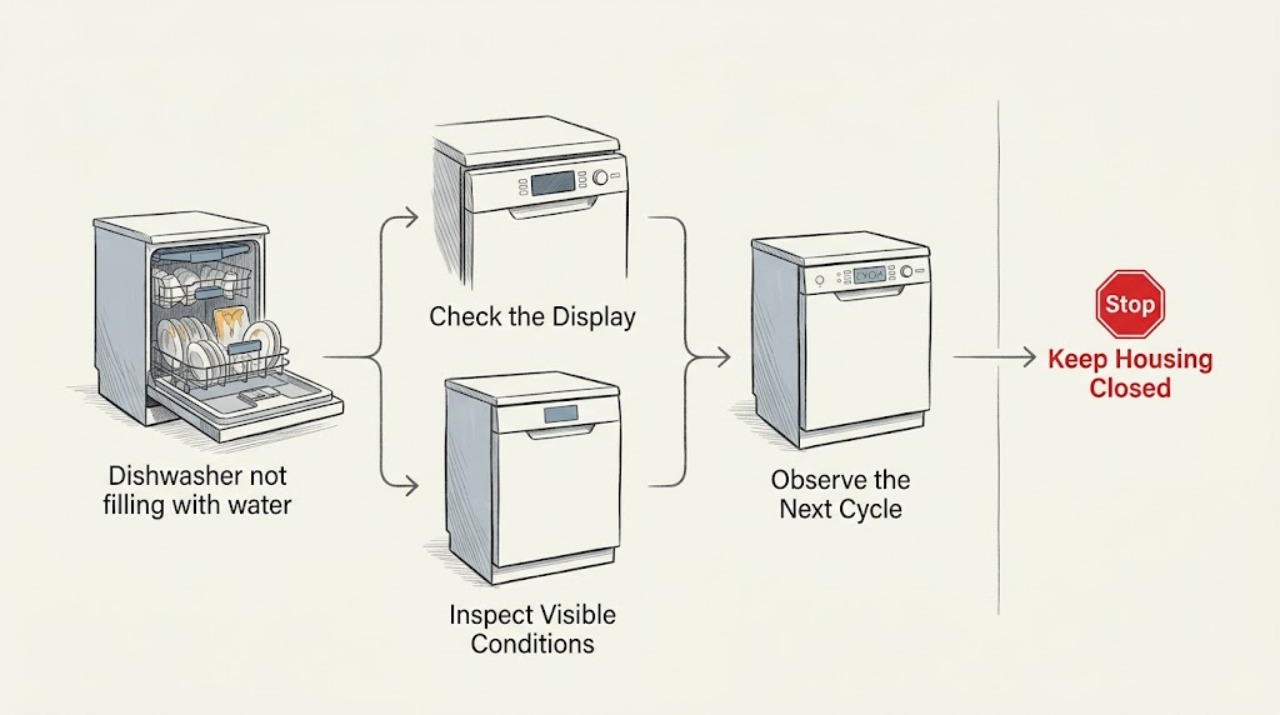
Work through in order
Diagnostic checks
Use only checks that match the exact appliance or system and its official guide.
-
Check 1
Confirm the appliance identity and the start sequence: check that the rating label or manual identifies the unit as Beko DWD5414S, turn the accessible water tap fully on, close the door normally, select a programme with the knob, and press the normal On/Off control. Do not use a reset or delay procedure from another model.
Expected result: The door closes and the programme indicators respond, or the door will not close/lock normally or the indicators remain off.
Next step: If the door and controls respond, continue to the visible water-supply checks. If the door cannot close normally, the indicators do not respond, or the unit shows electrical damage, switch it off and arrange service; do not force the latch or open the control panel.
Why this matters
Why: The DWD5414S is a knob-controlled dishwasher with no listed time-delay function, so a normal start response should be checked before treating the symptom as a water-inlet fault. A door or power/control problem can prevent a fill request from starting at all.
-
Check 2
With the dishwasher stopped, inspect only the accessible water path: confirm the cold-water tap is fully open and look at the visible inlet hose for a kink, crushing, sharp bend, loose connection, or leak. Do not pull an integrated machine out by force or loosen the hose connection while pressurised.
Expected result: The tap was closed, the hose is visibly restricted, or the tap and hose look normal with no leak.
Next step: If the tap was closed or the hose was plainly kinked, restore only that visible condition, check for leaks, and make one supervised start. If the water path looks normal or the problem returns, stop repeating starts and continue with the tub check or arrange service.
Why this matters
Why: Beko lists the tap and a kinked or squashed inlet hose as first checks for a dishwasher that is not filling. A normal-looking external hose does not prove that the internal valve or control circuit is good, but it makes a simple accessible restriction less likely.
-
Check 3
Before another programme, look at the bottom of the tub for standing water. If the appliance is switched off and safe to access, remove and clean only the user-accessible filter assembly as described in the DWD5414 manual, then refit all filters correctly; do not reach into sealed pump or valve areas.
Expected result: The tub is holding water and the filters contain food residue, or the tub is empty and the filters are clear.
Next step: If the filter was blocked, refit it fully and make one supervised test. If water remains, the filter is clear, or the pump runs without clearing the tub, switch the appliance off and arrange authorised service rather than opening panels.
Why this matters
Why: Beko says a dishwasher may appear not to fill when it is not draining correctly. A blocked filter can contribute to poor water movement, while an empty tub and clear filters make that accessible explanation less likely and leave the inlet or control stage unresolved.
-
Check 4
Listen only briefly after one normal start for the first fill attempt and note whether water enters, the machine hums without filling, or it stops silently. Record the model, the selected programme, whether the tap was open, whether the tub was empty, and any leak or warning light.
Expected result: Water enters after the visible checks, the dishwasher hums or stops without taking water, or a leak, burning smell, repeated breaker trip, or exposed wiring is present.
Next step: If there is still no fill, stop using the dishwasher and contact Beko or an authorised service agent with the recorded observations. For smoke, a burning smell, a hot or damaged plug, a leak near electrical parts, or repeated breaker operation, isolate power only if safe and seek prompt qualified help.
Why this matters
Why: A successful fill after correcting a tap, hose, or filter condition supports an accessible water-path issue. No fill with a normal tap, hose, door, and empty tub is more consistent with an internal inlet, valve, sensor, or control problem that the user should not diagnose by live testing.
Use your observations
Decision map
Find the observation that best matches what you see, then follow the next safe action.
-
PATH 01Next step
What you see
The DWD5414S starts normally after the tap is opened or a plainly kinked hose is corrected, and no leak is present.
Do this next
Monitor one supervised programme. If the no-fill symptom returns, stop repeated restarts and provide the model and hose/tap history to Beko service.
Why this path and its safety boundary
Why it matters: The result supports a simple external water-supply restriction rather than proving an internal part failure.
-
PATH 02Next step
What you see
The tap and visible inlet hose are normal, the door closes, the tub is empty or the accessible filters are clear, and the dishwasher still makes no fill attempt.
Do this next
Switch the dishwasher off and arrange Beko or authorised service. Do not remove panels, measure live terminals, bridge a safety device, or order an inlet component from the symptom alone.
Why this path and its safety boundary
Why it matters: The remaining possibilities include an internal inlet valve, sensor, wiring, or control fault; the external checks cannot select a safe replacement part.
-
PATH 03Next step
What you see
Water is already standing in the tub, the pump runs without clearing it, or the machine stops before any fresh water enters.
Do this next
Use only the DWD5414S filter-cleaning step if it can be done safely. If water remains or access would require opening the appliance, stop and book authorised service.
Why this path and its safety boundary
Why it matters: A drainage restriction or drain fault may be blocking the next fill stage, so treating the problem as an inlet-valve diagnosis would be premature.
-
PATH 04Next step
What you see
There is a leak, smoke, burning smell, a hot or damaged plug/cord, exposed wiring, or repeated breaker operation.
Do this next
Stop the dishwasher, keep clear of the hazard, isolate power and water only through normal accessible controls if safe, and obtain qualified service. Do not run another cycle to reproduce it.
Why this path and its safety boundary
Why it matters: This is a water or electrical safety event, not a routine fill adjustment.
Helpful context
Understand the symptom
Why the DWD5414S needs a different first branch
The exact DWD5414 product page identifies DWD5414S as the silver model and lists a programme knob, no time-remaining display, and no time-delay function. That matters here: if the machine is not filling, start with the water path and the door rather than looking for a delayed-start countdown or borrowing a display-reset sequence from another Beko dishwasher.
What not filling can mean
A closed tap or visibly restricted inlet hose can prevent the dishwasher from receiving water. Beko also notes that a dishwasher that will not fill may actually be failing to drain correctly. A tub that is already holding water therefore changes the next safe check; it is not a reason to disconnect internal hoses or guess at an inlet valve.
When checks do not resolve it
Need a professional?
Contact Beko or an authorised service agent when the DWD5414S still does not fill after the tap, visible hose, door, and accessible filter checks; when water remains or the pump runs without clearing it; or whenever a safety hazard is present. Beko's support guidance specifically advises contacting customer service and does not recommend owner self-repair.
Safety scope: Do not open the cabinet, probe live wiring, bypass the door or overflow protection, loosen a pressurised hose, or replace an inlet valve, pump, sensor, or control board based only on a no-fill symptom. Stop immediately for a leak near electrical parts, smoke, burning smell, hot or damaged electrical parts, exposed wiring, or repeated breaker operation.
Have this ready
- Provide the full DWD5414S model, the selected programme, whether the tap was open, the condition of the visible inlet hose, whether the tub was empty or holding water, whether the indicators responded, and any leak, sound, or breaker behavior.
Common questions
FAQ
Does the Beko DWD5414S have a delayed-start setting?
Beko's DWD5414 product page lists the model without a time-delay function and without a time-remaining display. Start with the tap, visible inlet hose, door, and tub checks instead of borrowing a delay-reset procedure from another model.
Why can a Beko dishwasher that is not filling have water in the tub?
Beko says a dishwasher that does not fill may also be failing to drain correctly. Check only the user-accessible filters as described in the DWD5414 manual; persistent standing water or a pump that runs without clearing it needs authorised service.
Can I replace the DWD5414S inlet valve myself?
No. A no-fill symptom does not prove that the inlet valve is the failed component. Beko advises contacting customer service and does not recommend attempting a self-repair; have the exact model and observations assessed before any part is selected.
Read the exact guide
Official sources
- Why is my Beko dishwasher not filling with water?Beko UK · Directly addresses the assigned not-filling symptom and supplies the tap, inlet-hose, pressure, drainage, and no-self-repair boundaries used here.
- Full Size Dishwasher DWD5414Beko UK · Directly identifies DWD5414S as the silver model and lists its programme knob, lack of time-remaining display and time-delay function, cold-water connection, and operating specifications.
- DWD5414 Dishwasher User's ManualBeko · The manual is explicitly titled DWD5414 and supports the normal start sequence, water-hose routing, water-pressure range, filter cleaning, and safety limits used for the DWD5414S variant.
Community feedback
Share a repair observation
Share a plain-text repair observation. Accepted observations are published automatically; this page may take a moment to update.