
On this page
Start here
Quick answer
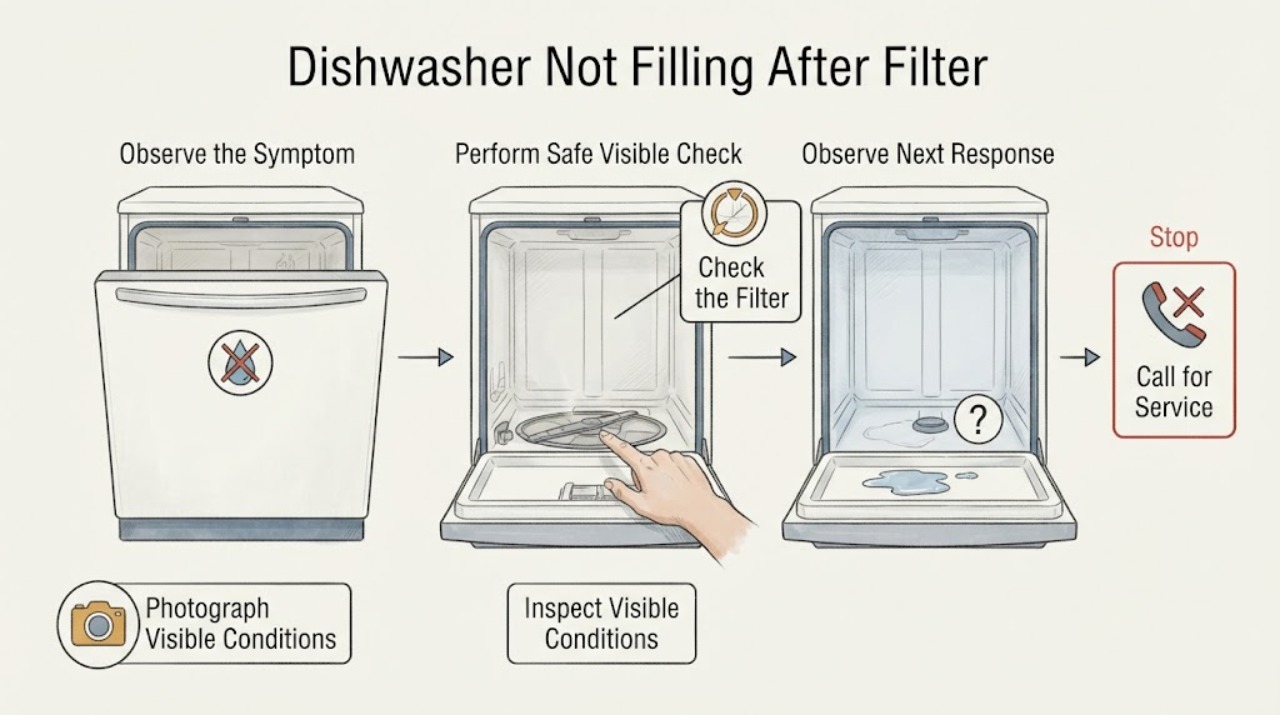
Cleaning the filter assembly does not prove that it caused the no-fill symptom. First confirm the complete FFCD2413US2A model from the dishwasher label, then, with the machine stopped and safe to handle, check that the accessible filter or glass trap is clean, undamaged, and fully seated according to the exact model instructions. Do not reach into a concealed sump or handle broken glass. Next check whether the door closes and START is accepted, and visually confirm that the under-sink water valve is open and the supply hose is not kinked or restricted. If the tub contains standing water, treat that as a drainage or cycle-state clue rather than proof of a bad inlet valve. Do not keep removing parts or use service mode. If the filter is correctly installed but the dishwasher still does not fill, or if there is a leak, electrical hazard, overflow, or damaged hose, keep it off and arrange qualified service; for an installation within 30 days, contact the installer first.
Work through in order
Diagnostic checks
Use only checks that match the exact appliance or system and its official guide.
-
Check 1
Read and photograph the complete model and serial label, normally visible inside the dishwasher door or on the right side of the tub when the door is open. Record whether the no-fill symptom began immediately after cleaning, whether a cycle was already running, and whether water remains in the tub.
Expected result: The label confirms FFCD2413US2A, or the label differs or is incomplete; the machine is empty, has normal residual water, or has water covering the filter or pooling outside the tub.
Next step: Use only the exact model manual for any model-specific reassembly. If the identity cannot be confirmed, keep the advice at visible checks and arrange service rather than guessing the filter design or a replacement part.
Stop if: Do not continue if the tub is overflowing, water is near electrical parts, the label requires reaching into an unsafe area, or broken glass is visible; keep the appliance off and arrange service.
Why this matters
Why: The label determines which filter-seating and start instructions apply. The timing after cleaning is a useful sequence clue but does not establish that the filter caused a no-fill condition; water covering the filter or outside the tub adds a drainage or leak safety branch.
-
Check 2
With the dishwasher stopped, cool, and safe to handle, inspect only the accessible filter, glass trap, and visible spray-arm openings. Rinse or clean the accessible pieces as Frigidaire describes, then replace them exactly as the FFCD2413US2A manual shows; do not reach into a concealed sump, remove a pump cover, or pick up broken glass with bare hands.
Expected result: The filter or glass trap is visibly clogged, loose, cracked, incomplete, or not aligned; the visible parts are clear and seated; or a check would require tools, force, or entry into the sump.
Next step: Correct only a clearly visible seating or debris issue once, following the exact model instructions. If the parts are clear and correctly seated, move to door/start and supply checks; if access requires disassembly, stop and request service.
Stop if: Do not use tools in the sump, dismantle the pump or filter housing, handle sharp debris, or run the appliance with a cracked component or active leak.
Why this matters
Why: A part displaced during cleaning is the most relevant new first-check for this topic, but a clear, correctly seated accessible assembly does not prove an inlet-valve or control failure. A part that cannot be safely accessed is outside ordinary user diagnosis.
-
Check 3
Close the door gently without forcing it, confirm no rack or tall item blocks closure, and press START only as the exact model instructions require. Observe whether the control accepts the command, whether the dishwasher begins its normal start sequence, and whether it stops with a displayed light or code.
Expected result: The door will not close evenly, START is not accepted, the machine starts but never admits water, or it drains and stops instead of filling.
Next step: Correct only visible loading or closure interference. Note the exact light/code and stage, avoid hidden service sequences, and proceed to the visible supply and standing-water checks rather than repeatedly restarting.
Stop if: Do not force the latch, remove the inner door, bypass a door switch, enter service mode, or keep cycling a machine that leaks or stops abnormally.
Why this matters
Why: A cycle that never starts is a door or control-state branch, while an accepted start with no water points more toward supply or an internal fill circuit. Immediate drain behavior or standing water can indicate an unresolved drainage or protection state rather than a filter-caused inlet failure.
-
Check 4
From a dry, stable position under the sink, look at the dishwasher water shutoff valve and the visible supply hose. Confirm the valve is open, the hose is not pinched or sharply bent, and there is no moisture at the visible connection; do not disconnect the hose or loosen a fitting.
Expected result: The valve is closed, the hose is restricted, a connection is wet, or the visible supply path appears open and dry.
Next step: Correct only an obviously closed valve or visible kink if doing so is dry and safe. If a connection leaks or the path is inaccessible, close the supply if safe and contact the installer or qualified service; otherwise continue to the standing-water check.
Stop if: Do not pull the dishwasher out, disconnect plumbing, work in pooled water, or touch wet electrical parts.
Why this matters
Why: Frigidaire identifies an open water valve, an unobstructed valve, and an unrestricted supply line as first no-fill checks. A wet connection is a leak branch; an open, dry supply path means an internal fill fault is possible but cannot be named from this observation alone.
-
Check 5
Without moving the dishwasher, look at the water level below the filter and at any visible drain-side connection, air gap, or garbage-disposal connection. Note whether the filter is covered, water backs up, the drain hose is visibly kinked, or a disposal knockout-plug question remains from a recent installation.
Expected result: The tub is holding water above the normal residual level, water backs up, the hose is visibly kinked, or the drain path looks clear and the tub is not holding water.
Next step: Leave the machine off for significant pooling or uncertain installation and contact the installer or qualified service. Do not tilt, pull out, dismantle, or repeatedly run the machine to force a drain.
Stop if: Do not reach into water containing possible glass, add drain chemicals, remove the disposal, or work near a wet electrical connection.
Why this matters
Why: Frigidaire links standing water and some flashing lights to drainage conditions and calls out hose routing, the glass trap/filter, and a disposal knockout plug. A drainage state can make the dishwasher appear not to fill; it does not identify a pump or valve part.
-
Check 6
Only when there is no active leak, overflow, electrical hazard, standing water covering the filter, or damaged hose, and only after a visible correction, run one model-approved cycle while remaining nearby. If the exact model guidance permits a reset, use the Frigidaire three-minute power reset once; do not repeat resets or use hidden service controls.
Expected result: The cycle accepts START and fills normally, fails to fill again, stops while holding water, or produces a new light, code, leak, odor, or electrical symptom.
Next step: Stop at the first recurrence, leave the unit off, and provide service with the exact model, sequence after cleaning, filter photos, water level, supply observations, and any displayed pattern. For an installation within 30 days, contact the installer first.
Stop if: Do not run this confirmation after a leak, overflow, smoke, burning odor, electrical exposure, or a door that cannot seal; do not repeat the cycle as a diagnostic experiment.
Why this matters
Why: A single normal fill after a correctly restored accessible filter supports a corrected visible condition but does not prove the filter caused the original event. Recurrence, abnormal drainage, or any hazard requires professional diagnosis.
Use your observations
Decision map
Find the observation that best matches what you see, then follow the next safe action.
-
PATH 01Next step
What you see
The no-fill symptom began immediately after cleaning and the accessible filter or glass trap is visibly loose, misaligned, damaged, incomplete, or obstructed, with no active leak.
Do this next
Restore the accessible assembly once using the exact FFCD2413US2A instructions. If it is damaged or cannot be seated without force, stop and request service; do not order a valve or pump from the timing alone.
Why this path and its safety boundary
Why it matters: A cleaning or reassembly issue is the leading first branch for this exact condition, but it remains a sequence-based explanation rather than proof of a failed internal component.
-
PATH 02Next step
What you see
The filter is correctly seated and clear, but the door does not close evenly, START is not accepted, or the control stops before a fill attempt.
Do this next
Remove only visible rack or loading interference, record the exact display or light pattern, and arrange service if the door or controls still do not accept a cycle. Do not force or bypass the latch.
Why this path and its safety boundary
Why it matters: The cycle-start or door-state branch is more likely than a filter obstruction or water-valve diagnosis.
-
PATH 03Next step
What you see
START is accepted but no water enters, the visible supply valve is closed, the hose is pinched, or a supply connection is wet.
Do this next
Correct only a clearly closed valve or visible kink from a dry safe position. For a wet, inaccessible, or unresolved connection, close the supply if safe and contact the installer or qualified service.
Why this path and its safety boundary
Why it matters: A household supply or installation branch is more likely; a wet connection is a leak risk and an open supply path would still not identify an internal part.
-
PATH 04Next step
What you see
The tub holds substantial water, backs up, or the dishwasher stops with a drainage-related light after the filter was cleaned.
Do this next
Keep the appliance off and have the visible drain routing or recent disposal connection checked by the installer or qualified service. Do not tilt the dishwasher, remove the pump, or add chemicals.
Why this path and its safety boundary
Why it matters: The machine may be blocked by a drainage or cycle-state problem, so the no-fill description should not be treated as proof of an inlet-valve failure.
-
PATH 05Next step
What you see
The filter is clear and correctly seated, the door/start and visible water supply are normal, but the dishwasher still will not fill or the symptom returns.
Do this next
Stop testing and arrange qualified Frigidaire or appliance service with the full model, timing, photos, water-level observation, and exact display pattern. Do not buy or replace a part based only on this symptom.
Why this path and its safety boundary
Why it matters: An internal fill, control, or protection problem remains possible, but user-visible checks cannot distinguish a valve, wiring, sensor, or board safely.
-
PATH 06Next step
What you see
There is active leaking, overflow, smoke, burning odor, water near electrical parts, a tripped breaker, or a cracked hose or filter component.
Do this next
Leave the dishwasher off, isolate water or power only from a dry safe position if reachable, keep clear of the hazard, and arrange qualified or urgent help.
Why this path and its safety boundary
Why it matters: This is a water or electrical safety boundary, not a filter-cleaning troubleshooting branch.
Helpful context
Understand the symptom
The cleaning event is a timing clue, not a diagnosis
If the dishwasher stopped filling immediately after the filter assembly was cleaned, begin by checking the work just performed, but do not assume the filter controls the inlet valve. A filter or glass trap that is loose, damaged, or obstructing the accessible sump area can change the cycle or drainage state; a correctly seated filter with no visible debris shifts the decision to door/start acceptance, water supply, and drainage. Confirm the full model label before relying on any diagram, because FFCD2413US2A is the assigned identity and the public Frigidaire filter guide is not a substitute for its exact manual.
Keep the checks visible and reversible
Stop the dishwasher before inspecting it. Only correct a visibly mis-seated user-accessible filter according to the exact model instructions, and do not remove a sump cover, pump, kick plate, or electrical panel. A no-fill report can mean the cycle never started, the supply is restricted, or the machine is holding water from a previous drainage problem. One supervised model-approved cycle may confirm a safe visible correction; repeated disassembly or repeated test cycles cannot identify a hidden valve or control fault safely.
When checks do not resolve it
Need a professional?
Stop and arrange qualified appliance service when the filter cannot be safely seated, the door or controls do not accept a cycle, the supply is open but the dishwasher still does not fill, water remains above the normal residual level, a leak returns, or any internal component would need to be accessed. For an appliance installed within the past 30 days, Frigidaire directs the owner back to the installer. Keep the appliance off for overflow, smoke, burning odor, water near electrical parts, a damaged cord or hose, or a tripping breaker.
Common questions
FAQ
Did cleaning the filter cause the Frigidaire dishwasher to stop filling?
Not necessarily. The timing makes filter seating and displaced debris the first safe check, but Frigidaire's no-fill guidance also points to the water valve and unrestricted supply line. A correctly seated filter does not prove an inlet valve or control failure.
Can I keep removing the filter or pump cover to make it fill?
No. Check only the accessible filter and glass trap as the exact model instructions allow. Do not remove a sump cover, dismantle the pump, handle broken glass with bare hands, or enter service mode.
What if the dishwasher starts by draining but does not fill?
Record the sequence and check for substantial standing water or a drainage-related light. Frigidaire notes that drainage problems can leave water in the unit and may cause flashing indicators on some models; do not tilt or repeatedly run the dishwasher.
Should I reset the dishwasher repeatedly?
No. Frigidaire's no-fill page describes one three-minute power reset when appropriate. Use it only after safe visible checks and exact model guidance, and stop if the no-fill symptom returns or any leak or electrical hazard appears.
Read the exact guide
Official sources
- Dishwasher Glass Trap and Filter GuideFrigidaire · Frigidaire dishwasher glass-trap and filter guidance used for the assigned FFCD2413US2A condition only at the safe accessible-check level; the page describes rinsing and replacing accessible filter components but does not prove every FFCD2413US2A filter layout.
- Dishwashers - How do I start my dishwasher?Frigidaire · Frigidaire dishwasher start guidance for distinguishing a cycle that never starts from a cycle that starts but does not fill; the assigned FFCD2413US2A owner should follow the exact model's control wording.
- Dishwashers - Not DrainingFrigidaire · Frigidaire dishwasher drainage guidance used to separate standing water or a drainage-state stop from the assigned FFCD2413US2A no-fill report; it is not a model-specific pump diagnosis.
- Where can I find my model and serial number?Frigidaire · Frigidaire label guidance relevant to confirming the assigned FFCD2413US2A dishwasher identity; the opened page says dishwasher labels are commonly inside the door or on the right side of the tub, but it does not establish model-specific filter construction.
- Dishwasher - Not FillingFrigidaire · Frigidaire dishwasher guidance applicable to the assigned FFCD2413US2A symptom at the appliance-class level; it covers an open water valve, an unobstructed valve, an unrestricted supply line, a three-minute reset, and installer/service routing without defining an FFCD2413US2A internal part.
- Dishwasher - Not CleaningFrigidaire · Frigidaire dishwasher guidance supporting the safe visible debris boundary for the assigned FFCD2413US2A; it lists filters, the glass trap, and spray arms as user-cleaning locations but does not identify a no-fill component for this exact model.
Community feedback
Share a repair observation
Share a plain-text repair observation. Accepted observations are published automatically; this page may take a moment to update.