
On this page
Start here
Quick answer
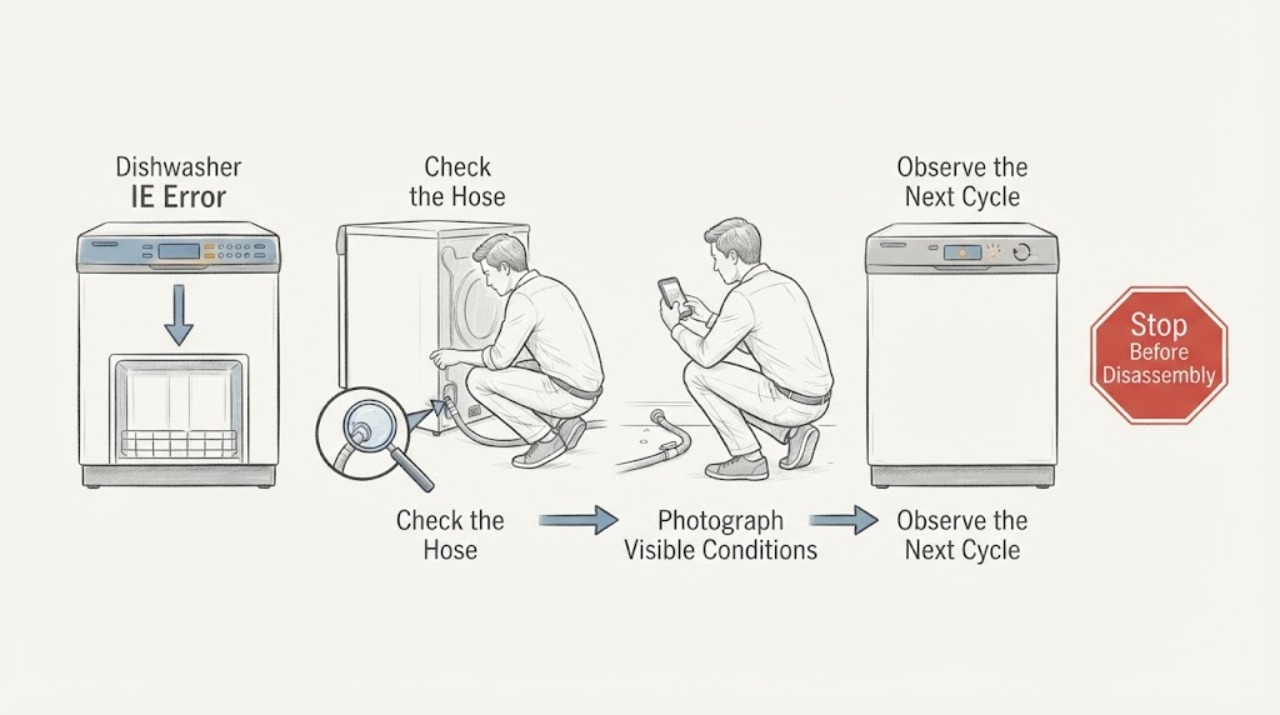
On the LG LDF6920ST, an IE display should be treated first as a water-inlet or insufficient-fill condition, not as proof that the recent detergent change caused a failed part. LG's IE dishwasher guidance says the tub did not receive enough water in the expected time and directs checks of household water, the under-sink valve, a kinked or pinched inlet hose, low pressure, and the inlet filter. Turn the dishwasher off before inspecting anything, and distinguish IE from E1. Record whether any water enters, when IE appears, and whether the tub is empty or contains hot standing water. A detergent switch matters mainly if there are visible suds or residue; it does not replace the water-supply checks. If the accessible supply path is normal and IE returns, stop repeated cycles and arrange service rather than naming an inlet valve, sensor, or control board.
Work through in order
Diagnostic checks
Use only checks that match the exact appliance or system and its official guide.
-
Check 1
Turn the dishwasher off and photograph the display before clearing it. Record whether it says IE exactly rather than E1, when the code appears (at start, during filling, or later), whether you hear an inlet sound, how much water is visible in the tub, and whether the detergent change preceded the first occurrence.
Expected result: The code is IE during the fill stage, it is actually E1 or another code, some water enters before IE, or no water enters at all.
Next step: Keep the photo and continue with the external water checks only if there is no leak or electrical hazard. If the display is not IE, use the exact LDF6920ST manual for that code instead of transferring IE guidance.
Why this matters
Why: LG defines IE as a water-inlet or insufficient-fill condition and specifically asks the reader to distinguish IE from E1. The point at which the code appears separates a fill-time shortage from a later wash or drain symptom; it does not identify a valve or sensor by itself.
-
Check 2
Check the kitchen and bathroom faucets for normal water flow, then inspect the dishwasher's accessible under-sink shutoff valve and inlet hose without moving the built-in unit. Confirm the valve is open and the hose is not pinched, sharply bent, crushed, torn, or trapped under an object.
Expected result: Other faucets also have no water, the dishwasher valve is closed, the inlet hose is visibly restricted or damaged, or household flow and the accessible hose look normal.
Next step: Restore only an accessible, clearly closed valve or straighten an undamaged hose as LG describes, then retry the dishwasher once. Do not move the appliance or repair a damaged hose in place; contact the installer or service if the restriction, leak, or IE remains.
Why this matters
Why: LG lists a household water outage, closed valve, and kinked, pinched, bent, or torn supply hose as direct IE causes. A normal external path makes a restricted inlet filter, low pressure, or an internal fault more likely, but it still does not prove which component failed.
-
Check 3
If the faucet and valve are open and the hose is clear, check the water pressure situation without disconnecting a pressurized line: note weak flow at several fixtures, recent plumbing work, a shutoff that will not open fully, or an installation where the hose is difficult to access. Do not use a guessed pressure value to authorize unsafe work.
Expected result: Household flow is weak, the problem began after plumbing or installation work, the hose is inaccessible, or household flow appears normal.
Next step: Have the installer or a qualified technician check pressure and the appliance connection when flow is weak or access requires moving the unit. If the external supply is normal and IE returns, stop repeated cycles and request service rather than changing a valve or sensor.
Why this matters
Why: LG's IE guidance includes low water pressure and points to an installation or water-supply problem when a newly installed or relocated dishwasher cannot fill. Normal faucet flow does not prove dishwasher pressure at the inlet; restricted plumbing, a filter, or an internal appliance fault can remain.
-
Check 4
After the dishwasher is off and cool, inspect only for visible detergent effects: unusually persistent suds, a slippery residue, an overflow or leak at the door, or a normal-looking tub with no foam. Do not add more detergent, dish soap, rinse chemicals, or water, and do not run another cycle to make foam.
Expected result: There are excessive suds or residue after the detergent change, a leak is visible, or there is no visible foam and the IE fill symptom remains.
Next step: Stop using the new detergent until the exact owner's manual and product label confirm dishwasher use; let the unit cool and follow only model-approved cleanup. For a leak or recurring IE, keep the dishwasher off and arrange service. Do not mix cleaners or open the pump area.
Why this matters
Why: The detergent change may be a concurrent oversudsing or leak clue, but the opened LG IE guidance defines IE by insufficient tub fill and directs water-supply checks. Visible foam cannot establish that detergent caused the inlet error, and no foam does not rule out a supply restriction.
-
Check 5
If the model instructions permit an inlet-filter inspection, first turn the dishwasher off, disconnect power by the safe manufacturer-described method, and close the water valve; inspect the accessible inlet-hose filter and gasket for sediment or damage only if the connection is safely reachable. Do not loosen a pressurized fitting, force a built-in unit forward, or use tools to test a valve.
Expected result: The filter is visibly obstructed or damaged, the gasket is misplaced, the connection leaks after a permitted reseat, or the filter and connection look clean and intact.
Next step: Perform only the exact manual-supported cleaning and reseat, then restore water slowly and stop at the first leak. If IE returns, the connection leaks, or access is unsafe, leave the dishwasher off and request qualified service; do not replace a part from this observation.
Why this matters
Why: LG's IE video identifies a clogged water-supply filter as a possible restriction and describes a clean-and-refit procedure, while its exact LDF6920ST support page confirms that the older model has model documentation. A clean filter does not distinguish the inlet valve, pressure sensing, wiring, or control path.
Use your observations
Decision map
Find the observation that best matches what you see, then follow the next safe action.
-
PATH 01Next step
What you see
IE appears during filling, the household supply is available, the under-sink valve is open, and the accessible inlet hose is clear and undamaged.
Do this next
Stop repeated cycles and arrange qualified LG or appliance service with the code timing, water amount, model, and supply observations. Do not order an inlet valve or sensor without model-specific diagnosis.
Why this path and its safety boundary
Why it matters: The basic external supply checks have not explained the insufficient fill. A restricted inlet filter, low pressure at the appliance, or an internal appliance fault remains possible; IE does not identify a valve or sensor by itself.
-
PATH 02Next step
What you see
The IE event began after installing or relocating the dishwasher, or the under-sink valve is closed or the inlet hose is visibly kinked, pinched, or crushed.
Do this next
Correct only the accessible valve or hose condition described by LG, without moving or dismantling the built-in unit, and retry once. If the code or a leak remains, contact the installer or qualified service.
Why this path and its safety boundary
Why it matters: An installation or accessible water-supply restriction is more likely than a confirmed appliance part failure.
-
PATH 03Next step
What you see
The detergent change produced persistent suds, slippery residue, or a door-area leak, but the water supply has not yet been verified.
Do this next
Stop adding the new product, let the machine cool, and follow only the model-approved cleanup. Keep the unit off for a leak, then verify the supply path or arrange service; do not mix chemicals or repeat a foaming cycle.
Why this path and its safety boundary
Why it matters: Detergent misuse or oversudsing may be a separate problem or a contributor to leakage, but the opened LG IE material still defines IE by inadequate water entering the tub. It is unsafe to use detergent as a substitute for the inlet diagnosis.
-
PATH 04Next step
What you see
IE returns after the accessible valve, hose, pressure, and permitted inlet-filter checks are normal, or no water enters despite normal household flow.
Do this next
Leave the dishwasher off and request qualified LG service with the exact model suffix, code photo, fill-stage timing, and checks already performed. Do not enter service mode, test live wiring, or replace a guessed component.
Why this path and its safety boundary
Why it matters: A persistent fill fault needs appliance diagnosis. The remaining possibilities can include an internal inlet path, valve, sensing, wiring, or control issue, and the code alone cannot select among them.
-
PATH 05Next step
What you see
Water leaks, collects in the base, reaches electrical connections, or the appliance has smoke, burning odor, exposed wiring, hot standing water, or a breaker that trips again.
Do this next
Stop the dishwasher, close the accessible water valve if safe, keep clear of wet electrical areas, and arrange qualified appliance or electrical service. Do not pull out the built-in unit, reach into hot water, or reset a tripping circuit repeatedly.
Why this path and its safety boundary
Why it matters: The immediate water or electrical hazard overrides normal IE troubleshooting.
Helpful context
Understand the symptom
LG's product support identifies LDF6920ST as a discontinued, fully integrated dishwasher and provides an English owner manual for the exact model family. LG's dishwasher IE guidance applies the code to insufficient water entering the tub; the displayed IE must not be confused with E1. Start by recording the display and fill-stage timeline, then inspect only the accessible supply path.
Switching detergent brands is a useful timing clue but is not an IE diagnosis. Do not add extra detergent, dish soap, or water to compensate. If the recent product change produced visible suds, residue, a leak, or a strong chemical smell, stop the cycle and let the dishwasher cool before any visible cleanup; do not reach into hot water or mix cleaning chemicals.
Stop immediately for a leak, water in the base or near electrical connections, smoke, burning odor, repeated breaker trips, exposed wiring, or hot standing water. Do not pull out a built-in dishwasher, dismantle the door or pump, enter service mode, or order an inlet valve or sensor from the IE label alone.
When checks do not resolve it
Need a professional?
Request qualified LG or appliance service when IE returns after the accessible water valve, hose, pressure, and model-permitted inlet-filter checks are normal; when no water enters despite normal household flow; or when access would require moving the built-in LDF6920ST, opening panels, or diagnosing a valve, sensor, wiring, or control. Stop immediately for leaks, water in the base or near electrical connections, smoke, burning odor, exposed wiring, hot standing water, or repeated breaker trips. Do not use a detergent change, extra soap, service mode, live test, or guessed replacement part as an IE repair.
Common questions
FAQ
Does IE mean the new detergent caused the LG dishwasher problem?
Not by itself. LG defines IE as insufficient water entering the dishwasher and directs checks of the water supply, valve, hose, pressure, and inlet filter. Treat suds, residue, or a leak after a detergent change as a separate clue and stop adding the product until the water path is resolved.
What should I check first for IE on an LDF6920ST?
Record IE exactly and when it appears, then turn the dishwasher off and check household water, the under-sink dishwasher valve, and the accessible inlet hose for a kink, pinch, crush, tear, or closed valve. If those checks are normal, stop repeated cycles and arrange service rather than guessing an inlet valve or sensor.
Can I keep running the dishwasher after an IE error?
Do not keep repeating cycles. LG's IE guidance treats the code as an insufficient-fill condition; perform only the safe, accessible supply checks and retry once after a clearly corrected valve or hose condition. A recurring code, leak, hot standing water, or electrical symptom needs service.
Read the exact guide
Official sources
- Dishwasher: No water – IE error codeLG USA · Official LG dishwasher guidance opened for IE meaning, IE-versus-E1 distinction, fill timing, water outage, valve, hose, pressure, installation, and service branches; it states the guide covers all dishwasher models and images may differ.
- LG Dishwasher - IE errorLG USA · Official LG video transcript opened for the IE water-pressure, valve, hose, and inlet-filter checks; it is not used to identify a particular LDF6920ST component.
- LDF6920ST Dishwasher - LDF6920STLG Canada · Exact-model product page opened to confirm the dishwasher identity, discontinued status, built-in design, inlet-water capability, and service/manual links.
- LG LDF6920ST.ASTEECI Product SupportLG USA · Exact-model LG product-support page opened to confirm the LDF6920ST identity, model suffix, owner-manual availability, and service route.
Community feedback
Share a repair observation
Share a plain-text repair observation. Accepted observations are published automatically; this page may take a moment to update.