
On this page
Start here
Quick answer
Do not keep starting a Viking DFUD042-PSS dishwasher that has been idle for about 10 years just to see whether it fills. First keep the appliance off, check from a dry position that the under-sink water shutoff is available and that the visible supply line is not kinked, and look for leakage or corrosion without loosening a fitting. Viking's DFUD042 troubleshooting guidance lists a firmly closed door, controls being on, a crimped water feed line, and the water supply being off as separate no-fill checks. A long vacancy adds a commissioning risk: an old shutoff, hose, connection, or stagnant plumbing can leak as soon as water is restored, so do not force a stiff valve or run repeated cycles. If the cabinet or floor stays dry but the sink, trap, air gap, or household drain backs up, use a plumber. If the supply is available, the door and controls are normal, and the dishwasher still does not fill on a single authorized test, leave it off and arrange Viking appliance service; do not assume the inlet valve or another part has failed.
Before you begin
Safety first
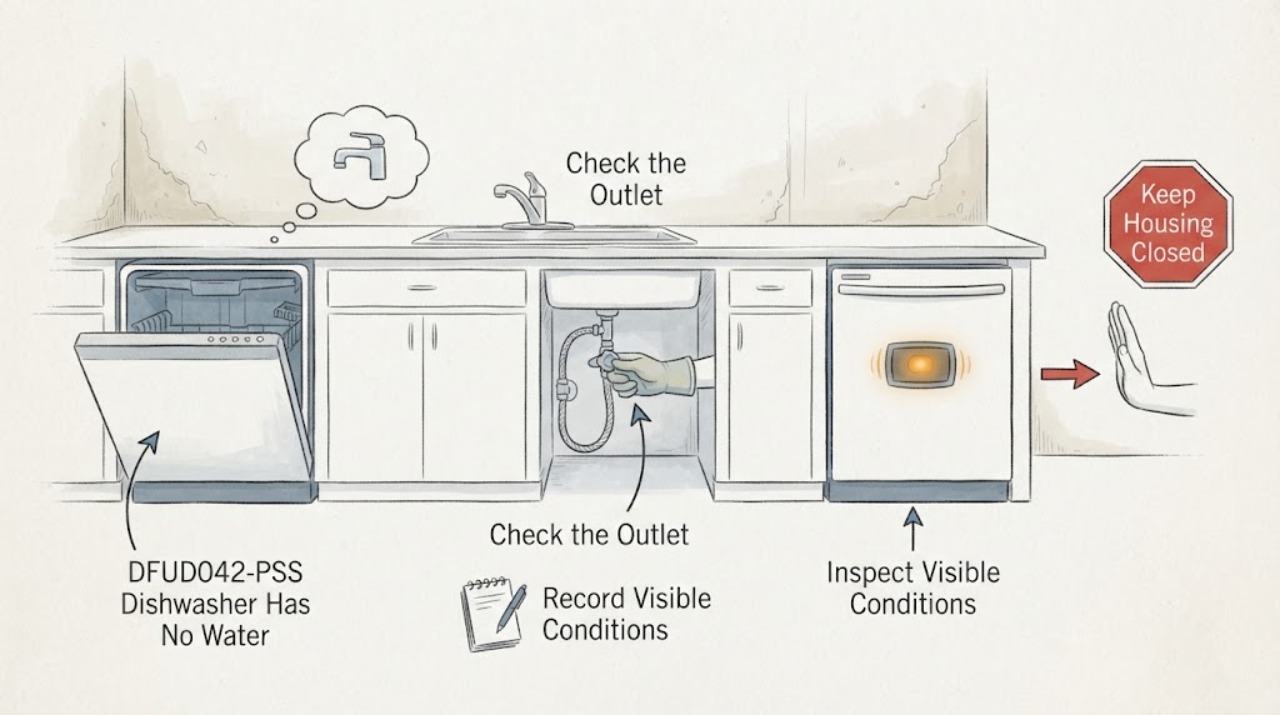
- For a Viking DFUD042-PSS that has sat unused for about 10 years, keep it off until the visible supply path, shutoff, floor, and electrical area are safe. Do not force a valve, disconnect a pressurized line, remove panels, bypass the door, enter service mode, measure live voltage, or repeat cycles to test an inlet component.
Work through in order
Diagnostic checks
Use only checks that match the exact appliance or system and its official guide.
-
Check 1
Leave the dishwasher off and do not start another cycle while preparing the inspection. From a dry position, identify the accessible under-sink water shutoff and check the floor, cabinet base, and nearby outlet for moisture, corrosion, smoke, or a burning smell. If water is near electrical parts, do not reach through it to isolate power.
Expected result: The shutoff is already closed, the valve is stiff or damaged, moisture appears, the floor is dry, or there is an electrical warning sign.
Next step: Leave the water off if it is already off; if a reachable shutoff can be closed without force, keep it closed. Use a plumber for a faulty supply-side valve or connection and qualified appliance or electrical service for appliance-side leakage or electrical danger.
Stop if: Do not force the shutoff, disconnect a pressurized line, run the dishwasher, or touch wet wiring.
Why this matters
Why: After a long vacancy, restoring water can expose a deteriorated valve, line, or connection. Moisture or electrical warning signs make repeated operation unsafe and do not identify an internal component.
-
Check 2
With the door open and the appliance unpowered by its normal controls, read the model and serial label on the inner door. Record the complete DFUD042-PSS identity, serial or production information, country, and any installation or plumbing work done before the property was left vacant.
Expected result: The complete identity is legible and matches DFUD042 documentation, or only a partial model, a panel label, or a different family is available.
Next step: Give the full identity and history to Viking service or the installer. Until the identity is confirmed, use only the external water and safety boundary in this article.
Stop if: Do not remove labels, pull the dishwasher out, enter service mode, or borrow a button sequence from another Viking model.
Why this matters
Why: The DFUD042/142 family documentation is useful for external checks, but a suffix or production change can affect service documentation. A family name alone cannot select a valve, pressure device, control, or repair sequence.
-
Check 3
Inspect the visible water path without loosening anything: look for a closed or inaccessible shutoff, a kinked or visibly aged feed line, drips at the cabinet or under-sink area, and a supply connection that has shifted. Do not force a seized valve or test pressure by disconnecting the line.
Expected result: The shutoff is closed, the feed line is kinked or visibly damaged, the valve or connection drips when water is present, or the visible supply path looks intact and dry.
Next step: For a stiff valve, damaged line, or supply-side drip, keep the water off and call a plumber or qualified installer. If the path is dry and accessible, do not proceed to internal testing; use the exact identity for the next service decision.
Stop if: Do not cut, clamp, loosen, or replace the line, and do not repeatedly open and close an old valve to make the dishwasher fill.
Why this matters
Why: Viking lists water availability and a non-crimped feed line as no-fill checks. A supply-side defect is a plumbing/installation lead; an intact dry exterior does not prove that the appliance inlet path is working.
-
Check 4
Check the door and controls from the user side: the door should close firmly, the controls should respond normally, and no panel should be cracked, wet, or stuck. Note whether the original attempt showed a normal control response, an immediate stop, a drain sound, or no response, without starting another cycle if there is any leak or electrical concern.
Expected result: The door is not fully closed, controls are off or unresponsive, the display or indicators behave normally, or the appliance stopped after a prior start with no water entering.
Next step: Correct only a plainly unlatched door or inactive control selection. If the controls remain abnormal, stop and use appliance service; do not enter diagnostics or bypass the door interlock.
Stop if: Do not force the door, bypass its latch, remove the control panel, or keep starting cycles to obtain a different symptom.
Why this matters
Why: Viking separates door and controls from the water-feed checks. A door or control condition can prevent a fill request without proving a failed inlet valve; a normal user-side response with no fill moves the question toward supply or appliance service.
-
Check 5
Separate a plumbing backup from a no-fill event by observing the sink, trap, air gap, and disposal area while the dishwasher remains off. Look for prior backup, standing water, odor, or a drain connection that was altered during the vacancy; do not pour chemicals into the dishwasher or disconnect the drain hose.
Expected result: The sink-side plumbing backs up while the dishwasher and cabinet stay dry, or the sink remains normal and the dishwasher itself previously showed no water entering.
Next step: Use a plumber or building-drain professional for a sink, trap, air-gap, disposal, or household-drain problem. Use Viking appliance service when the sink is normal but the appliance does not fill after safe external checks.
Stop if: Do not use caustic drain cleaner, remove plumbing connections, or run the dishwasher to reproduce a backup.
Why this matters
Why: Viking separately lists water backing up in the sink and no-fill causes. A clear household-plumbing backup is not evidence that the dishwasher inlet valve is bad; a dry, normal sink does not rule out an appliance-side no-fill fault.
-
Check 6
If the supply path is dry and confirmed available, the door closes, controls respond, and there is no electrical or leakage warning, use at most one normal start attempt only if the matching manual or a qualified installer authorizes it. Stop immediately if water does not enter promptly, leaks, the unit hums without filling, or a warning appears.
Expected result: Water enters normally, no water enters, water leaks, the appliance stops, or a breaker trips during the single attempt.
Next step: If it fills normally, stop and inspect for leaks after the property is safely recommissioned. If it does not fill, leave it off and contact Viking appliance service with the full identity and observations. For a leak or breaker operation, close the accessible water supply if safe and obtain qualified service.
Stop if: Do not repeat the cycle, enter service mode, measure live voltage, bypass the door, or order an inlet valve from the symptom alone.
Why this matters
Why: A single controlled result distinguishes an external commissioning issue from a persistent appliance-side no-fill symptom, but it cannot identify a valve, pressure device, control, or wiring fault. A trip or leak raises the safety boundary.
-
Check 7
Prepare a service handoff instead of dismantling the dishwasher. Provide the full model and serial information, country, vacancy duration, whether the shutoff was closed, visible line and valve condition, door/control response, exact start-stage behavior, sink/backflow observations, photos, and whether water or a breaker event occurred.
Expected result: A plumber sees a supply or drain-side problem, or an appliance technician receives a dry external installation with a persistent no-fill result.
Next step: Ask the provider to document the first failed point, verify the exact model documentation, inspect the supply and drain interfaces, and explain the evidence before recommending a part or repair.
Stop if: Do not authorize a valve, pressure sensor, control, or pump replacement solely because the dishwasher did not fill once.
Why this matters
Why: The history helps separate recommissioning and household plumbing from an appliance-side fill fault. Viking's manual calls for model, serial, purchase, dealer, and a clear problem description when service is required; it does not support naming an internal part from no-fill alone.
Use your observations
Decision map
Find the observation that best matches what you see, then follow the next safe action.
-
PATH 01Next step
What you see
The under-sink shutoff is closed, stiff, damaged, or the visible supply line or connection leaks when water is available.
Do this next
Keep the water off and call a plumber or qualified installer. Do not force the valve, disconnect the line, or operate the dishwasher.
Why this path and its safety boundary
Why it matters: The first failed point is on the supply or installation side. A ten-year vacancy makes a plumbing inspection more important, but it does not prove that the dishwasher inlet valve is defective.
-
PATH 02Next step
What you see
The supply area is dry and available, the door closes, controls respond, the sink remains normal, and a single authorized start still produces no incoming water.
Do this next
Leave the dishwasher off and contact Viking appliance service with the full DFUD042-PSS identity and the recorded stage. Do not choose a part or enter service diagnostics.
Why this path and its safety boundary
Why it matters: An appliance-side no-fill fault remains possible, but the observation does not distinguish an inlet path, sensing, control, or other internal cause.
-
PATH 03Next step
What you see
The dishwasher cabinet and floor stay dry, but the sink, trap, air gap, disposal connection, or household drain backs up.
Do this next
Call a plumber or building-drain professional. If the sink is cleared but the dishwasher still does not fill, route the remaining problem to Viking appliance service.
Why this path and its safety boundary
Why it matters: The observed symptom is more consistent with a plumbing or building-drain restriction/backflow than with a dishwasher inlet fault. The dishwasher should remain off while the backup can overflow.
-
PATH 04Next step
What you see
Water appears beneath the dishwasher, at the door or tub, or near electrical parts; a breaker trips, smoke appears, or there is a burning smell.
Do this next
Stop using the dishwasher, stay clear of wet electrical areas, close the accessible water shutoff only if it can be reached safely, and obtain qualified appliance/electrical or emergency help.
Why this path and its safety boundary
Why it matters: This is a water-damage, electrical, or fire-safety boundary, not a routine no-fill check. Closing the water supply does not make wet electrical areas safe to touch.
-
PATH 05Next step
What you see
Only the label DFUD042-PSS or a partial family name is available, or the label does not match the DFUD042/142 documentation.
Do this next
Photograph the inner-door identity label and give it to Viking service or a qualified installer. Keep the appliance off if the water path or symptom is unresolved.
Why this path and its safety boundary
Why it matters: The model-specific identity is unresolved. The family manual can support external safety checks, but it cannot establish a suffix-specific procedure or compatible component.
Helpful context
Understand the symptom
Ten years idle changes the first check
A dishwasher that has been unused in a vacant property should be treated as a controlled recommissioning, not as a machine to cycle repeatedly until water appears. Before any start attempt, confirm the exact identity, keep the floor and under-sink area dry, and inspect only what is visible: the shutoff handle, the accessible supply line, the connection area, the door, and the controls. A shutoff that is stuck, a line that is brittle or kinked, or moisture appearing as the supply is restored is a plumbing and water-damage concern before it is an appliance-part diagnosis.
No fill is not the same as a blocked drain
The DFUD042 manual lists no-fill checks for the door, controls, water feed line, and water supply. It separately describes sink backup and drain-hose problems. If the dishwasher cabinet remains dry while the sink, trap, air gap, disposal connection, or household drain backs up, the plumbing path deserves attention from a plumber. If water appears under the dishwasher or from its door or tub, stop using it and send it to appliance service; do not use a blocked-pipe explanation to justify another cycle.
Confirm the suffix before anyone names a part
The official Viking material covers DFUD042/142 configurations, while the task identity says DFUD042-PSS. Read the model and serial label on the inner door and record the country and installation history. The family documents support safe external checks, but they do not prove that a particular inlet valve, pressure device, control, or service procedure applies to every suffix or production date.
When checks do not resolve it
Need a professional?
Use a plumber or qualified installer for the supply shutoff, visible line, sink, air gap, disposal, trap, or building drain. Use Viking appliance service for a persistent no-fill result with a dry normal supply path, an appliance-side leak, or unresolved model-specific behavior. Use qualified electrical or emergency help for smoke, burning odor, breaker operation, flooding near electrics, or unsafe access.
Safety scope: For a Viking DFUD042-PSS that has sat unused for about 10 years, keep it off until the visible supply path, shutoff, floor, and electrical area are safe. Do not force a valve, disconnect a pressurized line, remove panels, bypass the door, enter service mode, measure live voltage, or repeat cycles to test an inlet component.
Have this ready
- Provide the complete DFUD042-PSS model and serial information from the inner door, country, vacancy duration, purchase or installation history if known, shutoff state, visible line/connection condition, door and controls response, exact cycle stage, sink/backflow observations, photos, and whether water continued or a breaker operated.
Common questions
FAQ
Should I keep trying cycles until the Viking dishwasher fills?
No. After a long vacancy, repeated starts can turn a supply or aged-connection problem into a leak or electrical event. Check the dry external supply path and door/controls first; if one authorized start still produces no fill, leave it off and arrange service.
What does Viking list for a dishwasher that will not fill?
The DFUD042 troubleshooting table separates a firmly closed door, controls being on, a crimped water feed line, and water being available and turned on. Those checks do not authorize opening the machine or replacing a valve based only on the symptom.
When is this a plumber problem instead of a dishwasher problem?
Use a plumber when the shutoff or visible supply connection leaks, the sink/trap/air gap/disposal backs up, or the household drain is the clear wet source while the dishwasher cabinet stays dry. Use Viking appliance service for a dry normal supply path with a persistent appliance no-fill result or an appliance-side leak.
Is DFUD042-PSS enough to order a replacement inlet valve?
No. Confirm the complete model and serial label on the inner door and let Viking service or a qualified provider match the exact documentation. No-fill alone does not establish that the inlet valve, pressure device, control, or pump is the failed part.
Read the exact guide
Official sources
- Viking DFUD042/142 Use & Care ManualViking Range, LLC · Official Viking manual opened for the DFUD042 family. It lists no-fill checks for door, controls, water feed line, and water supply; separately discusses sink backup; and places model/serial information on the inner door. The assigned PSS suffix still needs confirmation against its label.
- Viking DFUD042/142 Undercounter Dishwasher Planning and Design GuideViking Range, LLC · Official Viking planning guide opened for the DFUD042/142 family. It identifies the supplied water line, recommended water temperature, inlet-pressure range, and drain high-loop requirements; these are installation/provider reference points, not instructions to open a pressurized line.
- Viking DFUD042/142 Cycle Data and Installation DataViking Range, LLC · Official Viking DFUD042/142 data opened for provider-side reference to the water-supply and drain interface. It is not used to infer a failed component or to direct a homeowner to measure pressure or dismantle plumbing.
Community feedback
Share a repair observation
Share a plain-text repair observation. Accepted observations are published automatically; this page may take a moment to update.