
On this page
Start here
Quick answer
An LG dryer can leak from different water paths depending on the model: a steam dryer may have a water-supply hose, while condenser or heat-pump models may collect condensed water in a container or send it through a drain hose. Stop the cycle and, from a dry safe position, locate whether water is at the supply connection, container, drain hose, door, drum, or floor. On applicable models, an empty and correctly seated container or an obviously kinked drain hose is an external check; do not open the cabinet or guess at an internal pump or seal. If water reaches the outlet, cord, controls, or another electrical part, the tank or hose is damaged, the leak is active or recurring, or an error remains after the model-specific check, stop using the dryer and arrange LG service.
Before you begin
Safety first
- Do not operate with an active or unexplained leak, water near electrical equipment, a damaged water-supply hose, tank, drain hose, cap, cord, or concealed water path. Do not open panels, move a stacked dryer, dismantle the pump, or test energized parts.
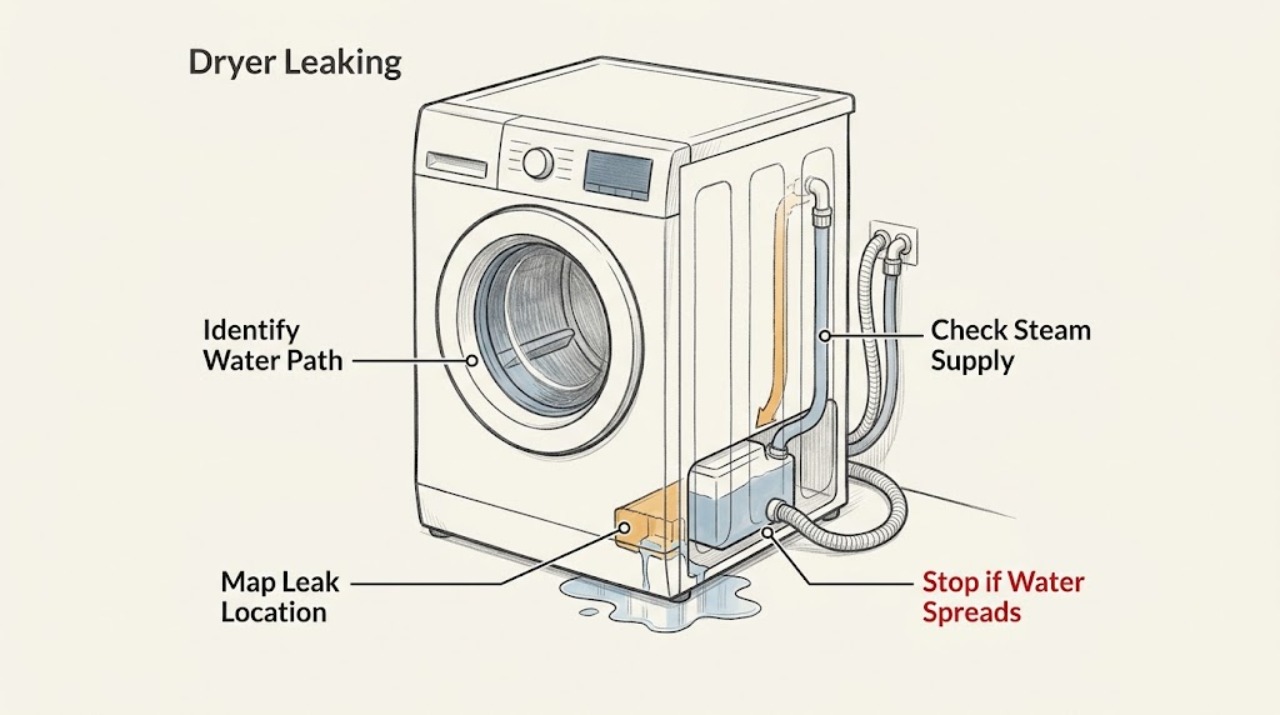
Work through in order
Diagnostic checks
Use only checks that match the exact appliance or system and its official guide.
-
Check 1
Read the LG model number from the door frame, rating label, or records and determine from the exact manual whether the dryer has a steam water-supply hose, a removable water container, a direct drain hose, a condenser or heat-pump system, or none of these.
Expected result: Record the model, dryer type, visible container, visible hose connections, and any water-related indicator or code; do not remove panels or pull out a stacked appliance.
Next step: Use the exact model guide for the applicable external check and keep the model information for service. If the design or water path cannot be established safely, stop and contact LG support.
Stop if: Do not move a stacked or tightly installed dryer, open the cabinet, or reach behind wet electrical equipment to identify the system.
Why this matters
Why: The correct check depends on the model’s water path. Steam-hose checks do not apply to a non-steam dryer, and container or residual-water checks do not establish a leak on a vented model.
-
Check 2
Stop the cycle and inspect from a dry, stable position around the front, door edge, visible water container, accessible hose connection, and floor; do not put hands into standing water or move the machine.
Expected result: Record whether water is at the faucet or steam hose, under the front or rear, beneath the container, at a drain-hose connection, inside the drum, or near the outlet, plug, cord, or controls.
Next step: Photograph the location without touching wet electrical parts. Continue only with the matching model-specific check when the area is dry and safe; otherwise arrange service.
Stop if: If water is near electrical equipment, the leak is active or spreading, the floor is unsafe, or the source is concealed, keep away and stop using the dryer.
Why this matters
Why: The location separates a steam-supply connection, container or drain path, condensation or residual water, and an electrical stop condition. A floor puddle does not by itself prove that the dryer’s internal parts are leaking.
-
Check 3
Only for an LG steam dryer with a water-supply hose, turn off the faucet from a dry safe position and visually inspect the faucet connection, hose, and machine connection for looseness, kinks, cracks, or wetness; do not force a connection or work behind a stacked unit.
Expected result: Water is between the faucet and hose, along the hose, at the machine connection, or absent from the steam path; the hose is kinked, damaged, or difficult to access.
Next step: Follow the exact LG model procedure for a safe connection check. If the hose remains wet after the faucet is off, is damaged, or the connection cannot be safely reached, leave the dryer off and arrange LG service.
Stop if: Do not operate with a damaged hose, remove a hose from a stacked or cramped installation, adjust household water pressure without appropriate help, or continue if water reaches electrical parts.
Why this matters
Why: LG identifies faucet or hose connections, hose damage, and excessive water pressure as possible steam-dryer leak causes. A damaged hose or inaccessible connection is not a reason to keep operating or improvise a repair.
-
Check 4
For an LG model that uses a water container or direct drain, check only the normal user access: empty and correctly reinsert an intact container, or visually inspect an accessible drain hose for a twist, bend, submersion, loose connection, or obvious blockage; do not dismantle the pump or drain assembly.
Expected result: The container is full, not fully inserted, cracked, or wet; the hose is kinked, pressed, submerged, disconnected, or damaged; or the model has no such user-accessible path.
Next step: Empty and reseat only an intact container, or correct only an obvious accessible hose position allowed by the manual. If the leak persists, the hose or container is damaged, or an error returns, stop using the dryer and request LG service.
Stop if: Do not pour water into an unknown opening, extend or seal a drain hose by guesswork, open the cabinet, or run a cycle to test an active leak.
Why this matters
Why: LG links a full or misinserted container and a kinked, pressed, or poorly connected drain hose with drainage stops and leaks on applicable models. A damaged component, an unresolved water indicator, or a model without that path requires model-specific service.
-
Check 5
If the report is water inside the drum or a small amount left after drying rather than a spreading floor leak, compare the model guide’s residual-water guidance with the observed amount, location, recurrence, and any water-container or drain indication.
Expected result: There is only a small residual amount in an applicable condenser system with no floor puddle or error, or there is recurring water, a floor puddle, an error, a loose stopper, or moisture that appears after a drain or container check.
Next step: Do not treat a spreading or recurring leak as normal. Record the model and pattern and arrange service when the amount, source, or model applicability is uncertain.
Stop if: Do not remove internal filters or a drain cap unless the exact model guide explicitly makes that a user step and the appliance is safely isolated; do not continue operation near water or electrical equipment.
Why this matters
Why: LG notes that some residual condensed water can remain in the bottom of a condenser dryer, but recurring or excessive water, an unsealed drain path, or a water-container error is a fault path rather than a normal residue explanation.
-
Check 6
Prepare a service handoff with the exact LG model and serial information, dryer type, leak location, water-path setup, container and hose observations, door or drum moisture, amount and timing of water, and any displayed code.
Expected result: The leak stops after one permitted external correction, recurs, comes from damaged or concealed hardware, or is accompanied by an error or electrical warning.
Next step: Give the record to LG support or a qualified appliance technician. Keep the dryer out of normal use until an unresolved, recurring, damaged, or unsafe leak is assessed.
Stop if: Do not remove panels, test live parts, bypass a water or door safety, or replace a pump, sensor, seal, or hose solely from the word “leaking.”
Why this matters
Why: A one-time full container or loose accessible connection differs from an active recurring leak or a model-specific drain, pump, sensor, or seal fault. The record prevents a steam, condenser, and vented design from being treated as interchangeable.
Use your observations
Decision map
Find the observation that best matches what you see, then follow the next safe action.
-
PATH 01Next step
What you see
The exact dryer is a steam model and water is localized to the faucet, water-supply hose, or machine connection, with no electrical contact.
Do this next
Turn off the faucet and follow the exact LG connection guidance. Leave the dryer off and arrange service for a damaged hose, persistent wetness, excessive-pressure concern, inaccessible connection, or a leak that returns.
-
PATH 02Next step
What you see
The model has a water container or direct drain, and the container is full or misinserted, or the hose is kinked, pressed, submerged, loose, blocked, or damaged.
Do this next
Empty and reseat an intact container or correct only an obvious accessible hose position allowed by the model guide. Stop and request LG service if water remains, a code returns, or the path is damaged or uncertain.
-
PATH 03Next step
What you see
There is only a small amount of water in the bottom or drum of an applicable condenser system, with no floor puddle, no recurring increase, and no water or drain alert.
Do this next
Check the exact model guide’s residual-water guidance and monitor without opening the cabinet. Treat any spreading, recurring, or unexplained water as unresolved and arrange service.
-
PATH 04Next step
What you see
Water reaches the outlet, plug, cord, controls, or another electrical part; the source is concealed; a tank, hose, seal, or cap is damaged; the leak is active or recurring; or an error remains after the applicable external check.
Do this next
Do not operate or investigate further. Keep people away, isolate power only from a dry and safe location if possible, and contact LG or qualified appliance service; use emergency help for an immediate electrical or fire hazard.
Helpful context
Understand the symptom
Identify the water system before checking it
LG dryers do not all use the same water path. A steam model can be connected to a household faucet; a condenser or heat-pump model may collect water in a container or use a drain hose; some models have no user-accessible container or hose. Use the model number and its manual to identify the design. A small amount of residual water in a condenser dryer can be normal, but a spreading puddle or repeated leak is not explained by that alone.
The leak location is more useful than the word “leaking”
Water at a steam hose connection, underneath a container, at a drain-hose connection, inside the drum, and near the power connection lead to different decisions. Record the location without moving a stacked unit or reaching behind wet electrical parts. A container or hose correction is only appropriate when the exact model uses that path and the external access is dry and safe.
Keep a water leak from becoming an electrical or moisture hazard
Do not run the dryer to reproduce an active leak. Keep the area dry, stop using the appliance when water is near electrical equipment, and do not open panels or test internal components. LG’s own guidance sends unresolved container, drain, thermistor, pump, and recurring fault conditions to service rather than a universal part replacement.
When checks do not resolve it
Need a professional?
Arrange LG or qualified appliance service when the leak persists after the permitted model-specific tank, drain, door, or steam-hose checks; a component is damaged or inaccessible; an error returns; or water reaches electrical equipment.
Safety scope: Do not operate with an active or unexplained leak, water near electrical equipment, a damaged water-supply hose, tank, drain hose, cap, cord, or concealed water path. Do not open panels, move a stacked dryer, dismantle the pump, or test energized parts.
Have this ready
- Exact LG model and serial information
- Dryer design and whether steam, container, condenser, or direct drain features are present
- Leak location, amount, timing, and whether water was in the drum or on the floor
- Container, drain hose, supply hose, door, and error-code observations
Common questions
FAQ
Do all LG dryers have a water container or drain hose?
No. LG dryer water paths vary by model: steam dryers may use a supply hose, condenser or heat-pump models may use a container or drain, and some models use another design. Identify the exact model before applying a container or hose procedure.
Can a small amount of water inside an LG condenser dryer be normal?
LG says a small amount of residual condensed water may remain in the bottom of applicable condenser dryers. A spreading floor puddle, recurring water, a full-container or drain indication, or an unexplained amount should be treated as a leak or drainage problem and assessed.
What should I do if water is leaking from the steam hose?
Turn off the faucet from a dry safe position and inspect only the accessible connection described by your model guide. Do not run the dryer with a wet or damaged hose, and arrange LG service if reconnecting is not clearly safe or the leak continues.
Can I keep running the dryer to find the leak?
No. Do not reproduce an active or unexplained leak, especially near the outlet, plug, cord, or controls. Record the location and model from a dry position and request qualified service when the permitted external check does not clearly resolve it.
Read the exact guide
Official sources
- [LG Dryer leakage] [Steam TROMM] Water is leaking from the faucet and the water supply hose.LG USA Support · LG steam dryer water-supply hose and faucet connection leak checks
- LG Dryer - Error Code List(New)LG USA Support · LG dryer water-container, drain-hose, residual-water, and service error guidance
- [LG Dryer] Is there a lot of water left after drying?LG USA Support · LG condenser dryer residual condensed water and drain-pump behavior
- “Empty Water” Container IndicatorLG USA Support · LG dryer water-container and drain-hose indicators, container seating, hose bends, and drainage checks
Community feedback
Share a repair observation
Share a plain-text repair observation. Accepted observations are published automatically; this page may take a moment to update.