
On this page
Start here
Quick answer
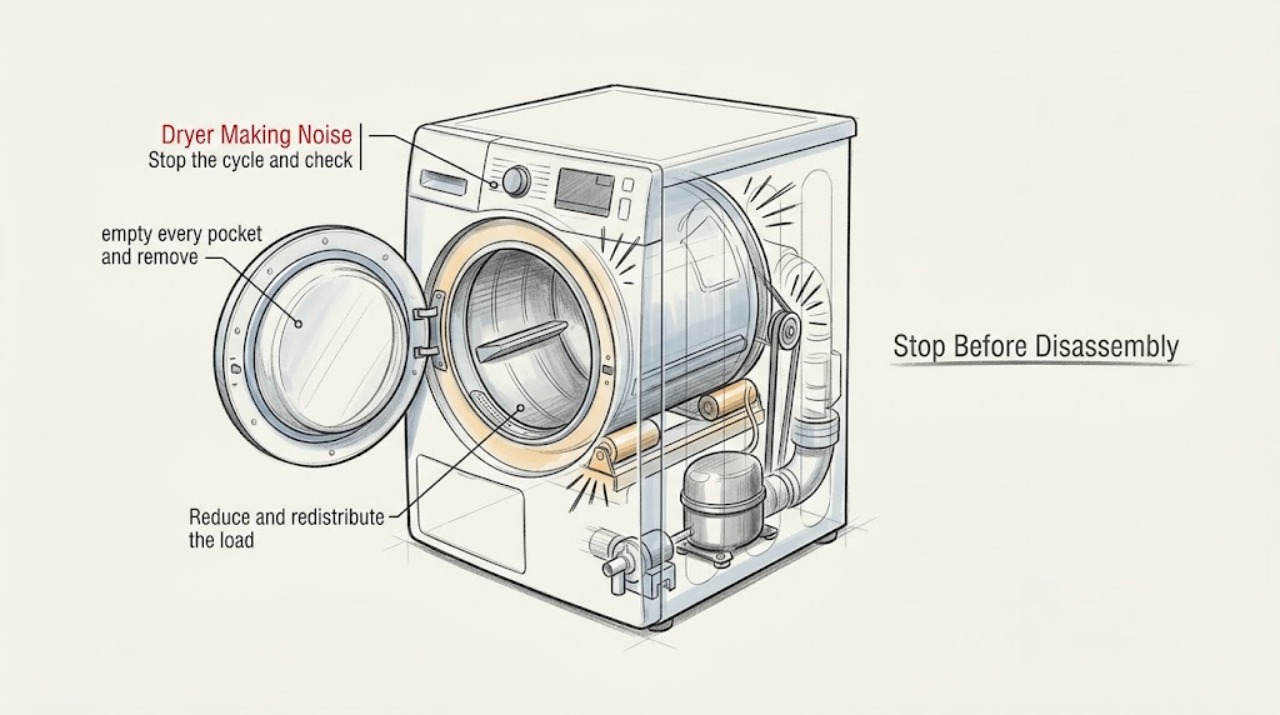
First match the sound to when it happens. LG says brief clacking or rattling can come from zippers, buttons, coins, or keys; a thump can come from rollers or an uneven load; and low humming or gurgling can come from the compressor, fan, or drain pump. A brief click timed with a gas dryer's heat call may be a gas control cycling, but only treat it as normal when the exact model guidance supports it and there is no gas smell or ignition problem. Stop using the dryer for continuous metallic scraping, loud grinding, persistent squealing, smoke, scorching, abnormal heat, sparks, gas odor, or a breaker that trips. Empty pockets, fasten closures, redistribute the load, and verify the dryer is stable before requesting service for a noise that remains.
Work through in order
Diagnostic checks
Use only checks that match the exact appliance or system and its official guide.
-
Check 1
Stop the cycle and check for smoke, scorching, burning odor, abnormal heat, sparks, gas odor, exposed damage, or a breaker that has tripped.
Expected result: Any of these safety symptoms is present, or the noise is accompanied by a flame or ignition problem on a gas model.
Next step: Stop using the dryer. For gas odor, do not operate switches or phones inside; leave the area and contact the gas supplier or emergency service from a safe location. For smoke, sparks, or electrical symptoms, isolate power only when safe and arrange qualified service.
Why this matters
Why: The sound is no longer an ordinary noise complaint; it may indicate fire, electrical, gas, heat, or mechanical danger.
-
Check 2
With the dryer off and cool, empty every pocket and remove coins, keys, lighters, loose fasteners, and other hard objects; inspect the drum opening for anything visibly loose.
Expected result: A hard object is found, or the clicking/rattling disappears when the drum is empty.
Next step: Remove the object, fasten zippers and buttons, turn those items inside out, and test only with a safe load. If the noise remains with an empty drum, continue to the load and stability checks.
Why this matters
Why: The object or a garment fastener was striking the drum; some objects can also damage the appliance or create a fire hazard.
-
Check 3
Reduce and redistribute the load so it is not packed tightly, then run a short test with similar fabrics and no loose hard items.
Expected result: The thump or temporary pounding diminishes as the load tumbles, or it continues with a small, balanced load.
Next step: Use a smaller, evenly distributed load if the sound resolves. If the same thump, knock, or vibration continues, stop and inspect the installation and visible exterior before requesting service.
Why this matters
Why: A heavy or uneven load can temporarily press the drum against the rollers. Persistence with a small balanced load makes a load-only cause less likely.
-
Check 4
Check that the dryer stands firmly on a solid, level floor and that it is not touching a wall, pedestal, washer, or loose item that could transmit vibration; do not move a gas dryer by pulling on its gas line.
Expected result: The cabinet rocks, shifts, or contacts another object, or the dryer is stable and clear of nearby objects.
Next step: Correct only accessible external clearance or leveling according to the model instructions. If the unit remains unstable or moving it would disturb gas or electrical connections, stop and have the installer or qualified technician inspect it.
Why this matters
Why: An unstable or contacting installation can amplify a normal roller or drum sound and create vibration that is not coming from an internal failure.
-
Check 5
Classify a low hum, brief high-pitched startup sound, or gurgle by timing: note whether it occurs at compressor start, drum reversal, fan operation, or water drainage and whether it fades as the cycle progresses.
Expected result: The sound is brief or cycle-timed and fades, or it is continuous, increasingly loud, or accompanied by poor operation.
Next step: If the exact model guidance supports the brief sound and no safety symptom exists, monitor normally. If it is continuous, loud, or paired with a performance or heat issue, stop and request service rather than opening the appliance.
Why this matters
Why: LG describes compressor, belt, fan, and drain-pump sounds that can be normal for a short period. A continuous or worsening sound is outside that simple pattern.
-
Check 6
On a gas model only, compare a brief click during a heat call with the exact owner's manual and observe from outside the appliance whether ignition and drying proceed normally; do not remove panels or inspect the burner directly.
Expected result: The click is brief and repeatable with normal heating and no gas odor, or the click is loud/repeated without normal ignition, or gas odor is present.
Next step: For a gas odor, leave the area and follow gas emergency guidance. For failed ignition or a loud/repeated click without odor, stop using the dryer and arrange qualified gas-appliance service; do not adjust the gas valve.
Why this matters
Why: A model-confirmed brief control sound may be normal. A click without normal ignition or with gas odor can indicate a gas-supply or service issue and cannot be diagnosed safely by listening.
-
Check 7
After the low-risk checks, run one short supervised test with an empty or safe balanced load and listen for rubbing, scraping, grinding, squealing, or a noise that follows every drum rotation.
Expected result: The noise disappears or is limited to a brief normal pattern, or persistent scraping, squealing, grinding, or striking remains.
Next step: Use the dryer only if it operates normally and safely. Stop for persistent abnormal noise and request service; do not lubricate, tension, or replace internal parts as a sound-only DIY diagnosis.
Why this matters
Why: A clean test supports a clothing, load, or installation cause. LG associates persistent sharp metallic scraping or squealing with worn or damaged internal parts such as rollers, a shaft, or belt.
-
Check 8
Record the sound description, when it starts, whether it changes with load or drum direction, the dryer model, fuel type, and any display or drying symptoms for the service request.
Expected result: The pattern is reproducible and can be described or recorded safely, or it changes unpredictably or is accompanied by a safety symptom.
Next step: Give the technician the model, sound timing, load condition, and safety observations. If any hazard appears while documenting, stop recording and follow the immediate stop boundary.
Why this matters
Why: Timing and operating context help distinguish clothing contact and normal compressor or pump sounds from a mechanical, gas, or electrical fault without unsafe disassembly.
Use your observations
Decision map
Find the observation that best matches what you see, then follow the next safe action.
-
PATH 01Next step
What you see
Smoke, scorching, burning odor, abnormal heat, sparks, gas odor, ignition trouble, or repeated breaker trip occurs
Do this next
Stop immediately and follow the applicable gas, fire, or electrical safety path; do not run another test.
-
PATH 02Next step
What you see
A coin, key, lighter, zipper, button, or other hard item is found and the noise stops when removed
Do this next
Keep pockets empty, fasten closures, turn items inside out, and use a safe short test.
-
PATH 03Next step
What you see
A thump improves with a smaller, evenly distributed load
Do this next
Continue with balanced loads and monitor; a thump that persists with a small load needs service.
-
PATH 04Next step
What you see
The cabinet rocks or contacts nearby equipment
Do this next
Correct accessible external stability or clearance according to the manual; do not disturb gas or electrical connections.
-
PATH 05Next step
What you see
A brief hum, gurgle, fan sound, or startup squeak matches the model's normal cycle timing and fades
Do this next
No repair is indicated by sound alone; monitor for a change or accompanying performance symptom.
-
PATH 06Next step
What you see
A gas-model click is brief, model-confirmed, and accompanied by normal ignition with no gas odor
Do this next
Treat it as a possible normal operating sound for that model, not as proof that every gas sound is safe.
-
PATH 07Next step
What you see
A gas-model click is loud or repeated without normal ignition, or its status is unclear
Do this next
Stop using the dryer and arrange qualified gas-appliance service; do not adjust gas controls.
-
PATH 08Next step
What you see
Scraping, grinding, sharp squealing, or striking continues with an empty or balanced load
Do this next
Stop and request service for possible worn or damaged internal parts; do not open the dryer.
Helpful context
Understand the symptom
Start with timing and sound character
A click or rattle that follows each drum rotation usually points toward clothing hardware or an object in a pocket. A thump at startup can be the rollers returning to shape, while an uneven or heavy load can press the drum against them. Humming, a brief high-pitched start sound, and gurgling can be part of compressor, belt, fan, or drain-pump operation. A sound that is metallic, scraping, grinding, or steadily getting worse deserves a different path from a brief cycle-related sound.
Gas models need an extra boundary
A gas dryer may make a short control or ignition click when heat is requested, but LG's public noise guidance does not make every gas-valve sound universal across models. Use the exact owner's manual and the surrounding behavior: a brief repeatable sound without gas odor or an ignition problem may be normal for that model; a gas smell, failed ignition, flame anomaly, or repeated loud click is not something to diagnose by sound. Leave gas work to the gas supplier or qualified service.
Keep checks external
Perform the checks with the dryer stopped. Empty pockets, fasten zippers and buttons, redistribute the load, and inspect the floor and visible exhaust area. Do not remove panels, reach through openings, lubricate internal parts, or test with a guard or belt removed. LG directs owners toward service when a sharp metallic scraping sound continues, because rollers, a belt, a shaft, or another internal part may need inspection.
When a noise is also a safety symptom
Coins, keys, and lighters can make noise and can also damage a dryer or create a fire hazard. Stop rather than listening longer if the noise comes with smoke, scorching, burning odor, abnormal heat, sparks, a gas odor, or a repeat electrical trip. For suspected gas, do not operate switches or use a phone inside the building; clear the area and call the gas supplier or emergency service from a safe location.
Only after diagnosis
Potential parts
- dryer drum roller
Only consider this part if a qualified diagnosis links persistent thumping, squealing, or scraping to a worn roller after load and installation causes are excluded.
Confirm the complete dryer model and manufacturer's fit information before ordering. - dryer drive belt
Only consider this part when service diagnosis confirms belt wear or damage as the source of persistent noise.
Do not open the dryer or infer belt fit from the sound; verify model-specific compatibility and repair procedure. - dryer gas valve or ignition component
Only consider gas-side parts after a qualified technician confirms a gas-model ignition or valve fault; a click alone is not enough evidence.
Gas-system diagnosis and installation must follow the model manual and qualified-service requirements.
When checks do not resolve it
Need a professional?
Call LG or qualified appliance service for continuous metallic scraping, grinding, persistent squealing, a noise that remains with an empty or balanced load, instability that cannot be corrected externally, gas-model ignition trouble, or any noise accompanied by poor operation. Stop immediately for smoke, scorching, burning odor, abnormal heat, sparks, gas odor, or a repeated electrical trip. Never remove panels, adjust gas controls, lubricate internal parts, or continue using a dryer whose noise suggests unsafe mechanical or gas operation.
Common questions
FAQ
Why is my LG dryer making a clicking or rattling noise?
Check pockets and the drum for coins or other hard objects, and fasten or turn inside out garments with zippers and buttons.
Is a thumping sound from an LG dryer normal?
A brief startup thump can come from the rollers, and a heavy or uneven load can make temporary noise. Persistent thumping with a small balanced load needs service.
Is humming or gurgling normal on an LG dryer?
LG describes compressor humming and drain-pump gurgling as possible normal operating sounds. They should match the cycle and not be accompanied by a safety or performance problem.
Is a gas-valve click normal on an LG gas dryer?
A brief click may be a model-specific gas-control sound, but use the exact manual and normal ignition as the check. Gas odor, failed ignition, or loud repeated clicking requires service.
What does a squealing or scraping LG dryer noise mean?
A brief startup squeak can be belt friction, but persistent sharp squealing or metallic scraping may indicate worn or damaged internal parts. Stop and request service.
Can an uneven load make an LG dryer noisy?
Yes. An uneven or heavy load can press the drum against its rollers. Redistribute or reduce the load; if the noise remains, check stability and arrange service.
When should I stop using an LG dryer because of noise?
Stop for smoke, scorching, burning odor, abnormal heat, sparks, gas odor, repeated breaker trips, continuous grinding or scraping, or a noise that remains with an empty balanced drum.
Read the exact guide
Official sources
- LG Dryer - How to Reduce Dryer NoiseLG USA Support · LG dryer clothing hardware, load impact and normal airflow/fan noise guidance
- LG Dryer - Common Noises During the Dry CycleLG USA Support · LG dryer fan airflow and high-frequency operating sounds
- LG Dryer - Error Code ListLG USA Support · LG gas dryer gas-supply display, valve-state check and service escalation
- LG Dryer - What to Do If You Smell Gas Around Your LG DryerLG USA Support · LG gas dryer odor response and qualified gas service boundary
- [LG dryer - sound] [Electric heat pump] When it starts operation, a noise is heard while drum rotation is being reversedLG USA Support · LG electric heat-pump dryer brief belt-friction squeak during startup or direction reversal
- [LG Dryer] Noise From the DryerLG USA Support · LG dryer noise causes, normal compressor/pump/roller sounds, clothing objects and persistent scraping boundary
- Installation Check - Laundry DryerLG USA Support · LG dryer installation and stable setup checks
Community feedback
Share a repair observation
Share a plain-text repair observation. Accepted observations are published automatically; this page may take a moment to update.