
On this page
Start here
Quick answer
On an LG condenser, hybrid condensing, or heat-pump-style dryer, not draining usually means the water container is full or not seated, the drain hose is kinked, crushed, blocked, submerged, or routed too high, or the pump cannot move condensed water. LG maps d r n/OE to a full container, restricted hose, or an air-filled drain pump, and reserves E13 for Hybrid Condensing Dryers where the hose or sump water may be frozen. A small amount of water left in the bottom after drying can be normal on some condenser models. First identify the dryer architecture and code, empty and reseat the container if fitted, inspect the visible hose routing, and use only the model-specific residual-water or defrost procedure. A conventional vented dryer does not use the same condensate path; if it has no tank or drain hose, do not force a drain procedure. Stop for a leak, water near electrical parts, a damaged hose, or a repeated code after the safe checks.
Before you begin
Safety first
- This article covers architecture identification and ordinary-access checks only. Do not energize a wet dryer, open panels, test live circuits, dismantle a pump or sump, force a frozen fitting, detach a pressurized connection, or improvise defrost heat.
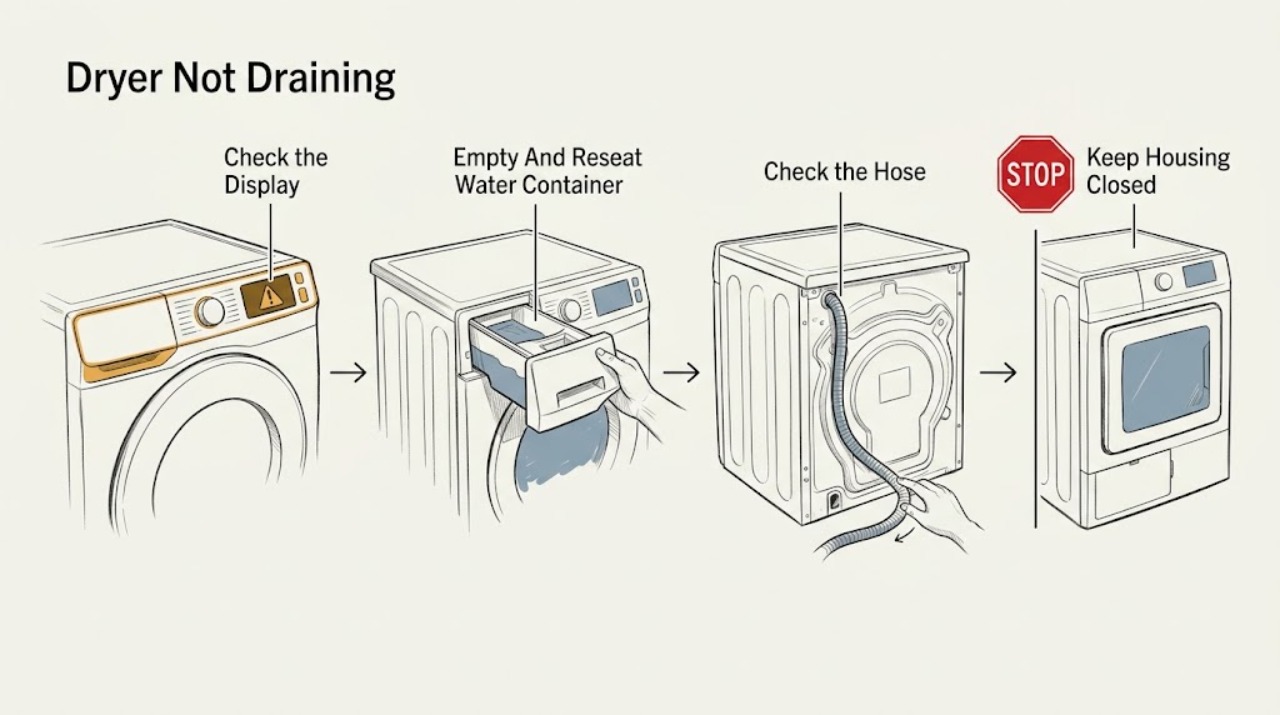
Work through in order
Diagnostic checks
Use only checks that match the exact appliance or system and its official guide.
-
Check 1
Stop the dryer and photograph the display, model label, and water-handling arrangement from ordinary access. Determine whether the unit has a removable water container, a dedicated drain hose, a Hybrid Condensing designation, a Steam water connection, or only an outdoor exhaust duct. Record whether the display says d r n, OE, Drain, Empty Water Tank, or E13.
Expected result: The dryer has a tank or drain hose and a drain-related code, has an E13 code, has a Steam-only water connection, or has only a conventional exhaust duct with no condensate container.
Next step: Use the exact owner's manual and the matching branch below. If the design or code is unclear, leave the dryer off and request model-specific support rather than guessing.
Stop if: Do not open panels, remove a compressor or pump cover, or operate a wet appliance to identify its architecture.
Why this matters
Why: The drainage checks depend on architecture. LG associates d r n/OE with container, hose, and pump conditions, and E13 only with Hybrid Condensing Dryers; a Steam supply hose is not automatically a condensate drain. A vented dryer without a tank should not be forced through a condenser-drain procedure.
-
Check 2
If the LG dryer has a removable water container and shows d r n, OE, Drain, or Empty Water Tank, turn the dryer off and slowly remove the container with both hands while keeping it level. Empty it, inspect it for visible damage, and push it fully back into its compartment until the model's seating indication is reached.
Expected result: The container was full or not seated, the container is empty and correctly seated, or water returns and the same code remains.
Next step: Run one supervised test only if the floor and appliance are dry and the model guide permits it. If the code returns or water escapes, stop use and arrange LG service.
Stop if: Do not force a stuck container, operate without the container, spill water into the cabinet, or continue testing with water near electrical parts.
Why this matters
Why: LG lists a full or incorrectly inserted water container as a drain-error cause. If the empty, correctly seated container does not clear the error, the hose, pump, air in the drain path, sensor, or another model-specific condition remains possible.
-
Check 3
With the dryer off, inspect the visible drain hose from the dryer to its drain point. Straighten a kink or crush point, confirm the end is not submerged, and verify the height and routing against the exact LG installation guide; do not extend the hose or change a connection that requires moving a stacked unit without help.
Expected result: The hose is clear, correctly supported, and within the model's routing limits, or it is twisted, crushed, blocked at the end, installed too high, submerged, disconnected, or leaking.
Next step: Restore only the model-specified routing, secure the connection without force, and perform one supervised cycle if no water or electrical hazard remains. Request service if the hose is damaged, inaccessible, or the error returns.
Stop if: Do not pull a stacked dryer, detach a pressurized Steam supply, force a drain connection, or run the dryer with a leaking or damaged hose.
Why this matters
Why: LG says a pressed, kinked, twisted, crushed, clogged, submerged, or overly high hose can prevent drainage; its E13 guidance also warns that an extended hose can add resistance. A correct visible hose with continued no-drain behavior points beyond an ordinary routing correction.
-
Check 4
If a cycle stopped mid-way and water remains, use only the exact LG model procedure for residual water. Where the guide explicitly provides an Air Dry or manual drain routine, turn the dryer off before opening any cap, place a shallow container where directed, drain without splashing, close the cap securely, and reinstall the hose or container; skip this step when the model has no user-accessible drain point.
Expected result: The documented routine removes the residual water and the error clears, or the water cannot be contained, the cap or hose is inaccessible, or the error returns after the procedure.
Next step: Dry the accessible area and observe one supervised cycle only when the model guide permits. If the code persists, water returns, or the drain point is inaccessible, leave the dryer out of service and request service.
Stop if: Do not open a cap with hot or contaminated water, pour water into an unapproved opening, tilt the dryer, or use a drain routine from another model.
Why this matters
Why: LG provides model-dependent Air Dry and drain-hose routines for residual water after an interrupted cycle. A successful one-time drain does not prove the pump or hose is healthy; recurring water or a returning code needs inspection.
-
Check 5
If the no-drain code appeared after the dryer, drain hose, or sump was exposed to freezing weather, keep the dryer off and identify whether the model is covered by LG's frozen-dryer guidance. Thaw only the externally accessible frozen hose, faucet, or connection using the exact model procedure; do not apply flame, a heat gun, boiling water, or improvised direct heat.
Expected result: The model's guidance identifies a frozen hose or sump, the external hose thaws and drains normally, or the error remains after the documented defrost attempt.
Next step: Run only the model's supervised post-defrost test. If the code returns, water leaks, or the dryer was visibly damaged by freezing, stop use and arrange LG service.
Stop if: Do not energize a visibly cracked or leaking dryer, force frozen fittings, or pour warm water into the cabinet unless the exact LG procedure explicitly requires it and the appliance is safely positioned.
Why this matters
Why: LG identifies frozen drain paths as a cause of E13 on Hybrid Condensing Dryers and of OE or drn behavior on some cold-weather models. A thawed exterior does not establish that the internal pump or sump is undamaged.
-
Check 6
After a completed cycle on a condenser model, inspect only the accessible bottom or container area described by the owner's guide. Compare a small, contained residual amount with the model's normal guidance, and distinguish it from a full tank, standing water that does not drain, water on the floor, or a persistent display error.
Expected result: Only a small contained amount remains with no error and it clears at the beginning of the next Dry cycle, or water accumulates, leaks, triggers a code, or remains unchanged across cycles.
Next step: Monitor one supervised cycle if the appliance is dry and the guide permits it. If accumulation or leakage continues, provide the records to a qualified LG technician rather than replacing the pump by guesswork.
Stop if: Do not remove internal covers, probe the sump, or continue operating when water reaches wiring, the base, or the floor.
Why this matters
Why: LG says a small amount of residual water can remain in some condenser dryers and drain during the next cycle. Accumulation, leakage, or a returning error is a no-drain condition rather than normal residual water.
-
Check 7
Before arranging service, record the exact model, dryer architecture, code, water-container state, hose routing, weather history, cycle stage, and whether the problem recurs after one model-approved correction. Keep the dryer off if any water remains in an unsafe location.
Expected result: The container and visible hose are correct but the code or no-drain symptom returns, or the leak, pump, sump, sensor, or internal hose cannot be assessed without disassembly.
Next step: Request qualified LG service and provide photos, code history, architecture, and the checks performed. Do not continue cycles to collect more water or attempt live electrical tests.
Stop if: Stop immediately for water near electrical parts, a damaged power cord, smoke, burning smell, a gas odor, flooding, or a cabinet leak.
Why this matters
Why: LG directs owners to request service when drain errors persist after the container and hose checks. A recurring fault needs model-specific inspection; the symptom alone cannot identify a pump, sensor, valve, hose, or control replacement.
Use your observations
Decision map
Find the observation that best matches what you see, then follow the next safe action.
-
PATH 01Safety boundary
What you see
A condenser model has only a small, contained residual amount after a completed cycle, no code, no floor leak, and the amount clears during the next Dry cycle.
Do this next
Monitor one supervised cycle and follow the model guide; arrange service if the amount grows, remains unchanged, or reaches the floor.
Why this path and its safety boundary
Why it matters: This matches LG's documented possibility of a small amount of residual water rather than a failed drain.
Safety stop: Stop for a persistent code, standing water, leakage, or water near electrical components.
-
PATH 02Safety boundary
What you see
The dryer displays d r n/OE, Drain, or Empty Water Tank, and the container is full, not seated, or the hose is kinked, crushed, submerged, or routed too high.
Do this next
Empty and reseat the container or restore hose routing exactly as the model guide specifies, then test once under supervision; call service if the code returns.
Why this path and its safety boundary
Why it matters: The documented container or external drain path is the first safe distinction; an internal pump failure is not yet established.
Safety stop: Do not force the container, extend the hose, open the pump, or run with a leak.
-
PATH 03Safety boundary
What you see
A Hybrid Condensing Dryer displays E13, especially after freezing weather, and the drain hose is kinked, crushed, blocked, extended, or the sump may be frozen.
Do this next
Follow only the model-specific hose or defrost instructions, then run the permitted supervised test; do not improvise heat or internal access.
Why this path and its safety boundary
Why it matters: LG defines E13 for this architecture as a drain-hose or frozen-sump condition; the same code returning after the documented check requires service.
Safety stop: Stop for cracked fittings, leakage, a visibly damaged cabinet, or an error that returns after defrosting.
-
PATH 04Safety boundary
What you see
The dryer has Steam, but the observed issue is an Add or Refill Steam Water message or a frozen water-supply hose rather than an OE, drn, Drain, or E13 drain condition.
Do this next
Use the exact model's Steam water-supply guidance and stop if a supply connection leaks or cannot be safely thawed; do not classify it as a generic no-drain fault.
Why this path and its safety boundary
Why it matters: The Steam supply path is different from the condensate drain path; opening or replacing a drain pump will not address an unverified Steam supply issue.
Safety stop: Do not detach a pressurized hose, force a frozen faucet, or operate with water near electrical parts.
-
PATH 05Safety boundary
What you see
The container is empty and seated, the visible hose is clear and correctly routed, but a drain code, standing water, repeated stop, or floor leak remains.
Do this next
Leave the dryer off and request qualified LG service with the model, architecture, code, water state, photos, and weather history.
Why this path and its safety boundary
Why it matters: A pump, sump, internal hose, sensor, installation, or control condition is possible, but no component is proven by the symptom.
Safety stop: Do not open panels, test live wiring, tilt the dryer, or keep running it to force drainage.
Helpful context
Understand the symptom
Not every LG dryer has a drain path
A condenser or hybrid condensing LG dryer turns moisture from clothes into water and routes it to a container, hose, pump, or sump. A conventional vented dryer sends moist air outdoors and may not have a condensate tank or drain hose. LG also publishes separate behavior for washer-dryer combos and Steam-equipped models. Find the model number and identify the design before interpreting an OE, drn, Empty Water Tank, or E13 message.
A little residual water can be different from a no-drain fault
LG says some condenser dryers can retain a small amount of water in the bottom after a cycle, with the pump removing it during the next Dry cycle. A full container, water on the floor, a persistent code, a pump that never moves water, or a dryer that stops repeatedly is not the same as that documented residual amount.
Cold weather can block a condenser drain
LG's frozen-dryer guidance links cold-weather drain failures to a frozen drain hose or sump and describes model-specific defrost procedures. Do not substitute a hair dryer, flame, or boiling water, and do not pour water into a filter or tank opening unless the exact LG guide for that model directs it.
Use service when the external water path is clear
If the container is empty and seated, the visible hose is correctly routed, and the drain error returns, LG directs owners to request service. A pump, sump, sensor, internal hose, or control may be involved, but the code and symptom do not identify a replacement part by themselves.
Safety boundary
Stop conditions
- Stop using the dryer for water near the receptacle, power cord, controls, wiring, motor area, or cabinet base; disconnect power only when the area is safe.
- Do not open panels, test energized wiring, tilt a stacked or heavy dryer, force a tank or cap, or substitute a pump, sensor, hose, or control from another model.
- Do not extend or deeply reroute a drain hose, detach a pressurized Steam connection, or operate with a kinked, crushed, damaged, disconnected, or leaking hose.
- Do not thaw frozen components with flame, heat gun, boiling water, or improvised direct heat; follow only the exact model's LG defrost procedure.
- Arrange qualified LG service when the error or no-drain symptom returns after the container and visible hose checks, the source is inaccessible, or water reaches the floor or electrical parts.
Only after diagnosis
Potential parts
- LG dryer drain hose
Consider this category only if the exact model's guide and inspection confirm that the existing drain hose is contaminated, crushed, kinked beyond recovery, disconnected, or damaged.
Confirm the exact LG model, connector, routing, and approved hose design; do not extend the hose or substitute a visually similar hose without the model instructions. - LG dryer drain pump
Consider this category only after the exact model's container, hose, residual-water, and cold-weather checks are complete and a qualified diagnosis identifies a pump fault.
Confirm the exact dryer architecture and model fitment with LG or the technician; an OE, drn, or E13 code alone does not prove the pump is defective.
When checks do not resolve it
Need a professional?
Request qualified LG service when the water container is empty and correctly seated but d r n/OE, Drain, Empty Water Tank, or E13 returns; the drain hose and visible routing are clear but water remains; a leak reaches the floor, cabinet base, electrical parts, or a stacked-unit connection; a frozen dryer remains faulty after the exact model procedure; or the pump, sump, internal hose, sensor, or control would require disassembly. Provide the exact model, architecture, code, water location and amount, hose and container observations, weather history, cycle stage, and photos.
Safety scope: This article covers architecture identification and ordinary-access checks only. Do not energize a wet dryer, open panels, test live circuits, dismantle a pump or sump, force a frozen fitting, detach a pressurized connection, or improvise defrost heat.
Common questions
FAQ
Why does my LG dryer say OE, drn, or Empty Water Tank?
LG associates these drain-related messages with a full or incorrectly seated water container, a kinked or pressed drain hose, or air in the drain pump. Empty and reseat the container if your model has one, inspect the visible hose routing, and request service if the code returns.
Is a small amount of water left in an LG condenser dryer normal?
LG says a small amount may remain in the bottom of some condenser dryers and be drained during the next Dry cycle. Water that accumulates, leaks onto the floor, triggers a code, or remains unchanged is not the same as that documented residual amount.
What does E13 mean on an LG dryer?
LG says E13 appears on Hybrid Condensing Dryers when the drain hose is kinked, crushed, clogged, extended, or the sump water is frozen. Check only the hose and model-approved procedure; if E13 returns, the dryer needs service.
Can cold weather stop an LG dryer from draining?
Yes, LG documents frozen drain hoses or sump water as cold-weather causes of drain-related errors on applicable models. Use only the exact model's defrost instructions and do not use flame, a heat gun, boiling water, or improvised direct heat.
Does a Steam hose cause an LG dryer's drain error?
Not necessarily. A Steam water-supply hose is a different path from the condensate drain. Match the code and dryer architecture first; use the model's Steam guidance for Add or Refill Water messages and the drain guidance for OE, drn, Drain, or E13.
Read the exact guide
Official sources
- LG Dryer - Error Code List(New)LG USA Support · Official LG USA support article for LG dryer error codes; the article notes that exact content and controls can vary by model.
- [LG dryer drainage] I would like to replace the drain hose.LG USA Support · Official LG USA support article for dryer drain hose replacement; locations and images vary by model, and stacked or tight installations may require an LG technician.
- [LG Dryer] Troubleshooting Frozen DryersLG USA Support · Official LG USA support article for LG dryers and washer-dryer combos affected by cold weather; the guide says functions and images may vary by model.
- [LG Dryer Condenser Care] How to use the condenser care functionLG USA Support · Official LG USA support article for LG dryers and washer-dryer combos with the Condenser Care function; the article excludes some gas and electric dryer types and instructs owners to consult the model manual.
- [LG Dryer] Is there a lot of water left after drying?LG USA Support · Official LG USA support article for LG condenser dryers; residual-water behavior and internal layout vary by model.
Community feedback
Share a repair observation
Share a plain-text repair observation. Accepted observations are published automatically; this page may take a moment to update.