
On this page
Start here
Quick answer
A five-minute shutdown does not identify a thermal fuse, motor, or control board. First confirm the full LG DLE2101W model and whether the dryer comes back on after stopping. If it restarts, compare the load and cycle: LG says a very small load may stop early when it does not contact the moisture sensors, and sensor residue can also end a cycle early. If the drum is warm, the load is normal, and the dryer stops again, check the lint filter and accessible exhaust for restriction without opening the cabinet. If it will not restart, the breaker or supply is abnormal, the cord is hot or damaged, there is a burning smell, smoke, or the drum stalls, leave it off and arrange qualified service; do not replace a part based on the five-minute timing.
Before you begin
Safety first
- Do not remove the cabinet, heater, blower, motor, belt, thermal device, or terminal-block cover; do not bridge the door switch or thermal protection, probe live circuits, bypass the lint filter, or repeatedly restart a hot or stalled dryer. Stop immediately for smoke, sparks, burning electrical/rubber odor, melted material, a hot or damaged cord/outlet, uncontrolled heat, or a breaker that trips again.
Work through in order
Diagnostic checks
Use only checks that match the exact appliance or system and its official guide.
-
Check 1
Read the complete model and serial label from the front of the dryer behind the door, including the suffix and rating information. Confirm whether the appliance is the U.S. electric DLE2101W family shown in LG's support record; do not rely on a shortened listing or a similar DLG gas model.
Expected result: The label matches DLE2101W with a complete suffix, or the suffix/type/market is different or unreadable.
Next step: Save a photo of the label and use the matching LG product page/manual. If identity remains uncertain, limit diagnosis to the safe external checks and do not order a thermal device, motor, heater, or control.
Why this matters
Why: LG's product record identifies DLE2101W.ABWEEUS as a 7.3 cu. ft. electric dryer, while the related manual covers multiple electric and gas models. The heat source, supply, controls, and service literature depend on the exact identity.
-
Check 2
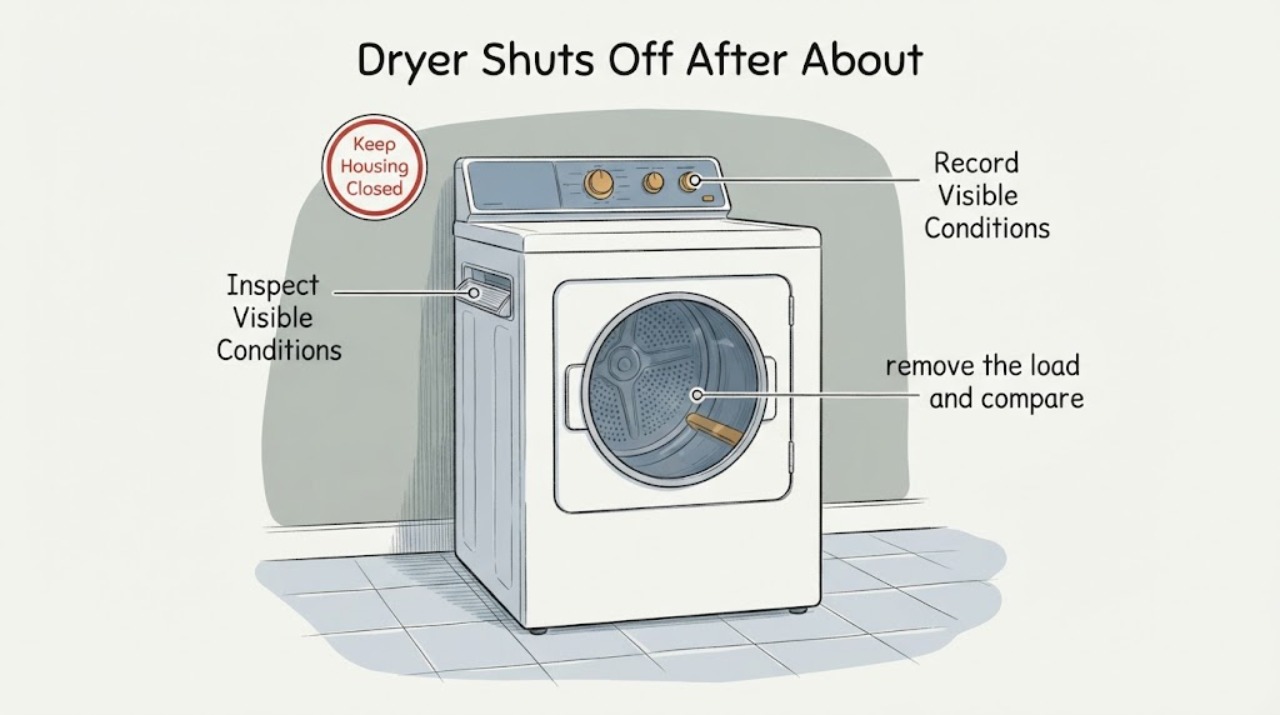
After the shutdown, observe from outside whether the display and drum light return immediately, whether the dryer is completely dark, and whether it starts again only after the appliance has sat for a while. Record the cycle, elapsed time, load, and any displayed code; do not repeatedly restart it as a test.
Expected result: The dryer powers back on, stays dark, returns only after a delay, or shows a code/door indication.
Next step: If it remains dark, stop and have the power path and dryer assessed. If it restarts, continue with one cool load/sensor/airflow review rather than assuming a heat fuse or board. Do not clear an unfamiliar code with a guessed sequence.
Why this matters
Why: LG treats a unit that powers back on after an abnormal shutdown differently from one that does not. A restart pattern can fit interrupted power, small-load sensing, or sensor residue; a dark unit points to supply or service, while a door indication requires the door to be closed and the cycle resumed according to the manual.
-
Check 3
With the dryer off and cool, remove the load and compare a small handful of items with a normally sized load. Inspect the front moisture-sensor area for visible residue and wipe only the accessible sensor surface as the exact manual allows; do not run a cycle solely to reproduce the stop.
Expected result: The load is very small, the sensor area has residue, the load is bulky/overfilled, or the load and sensor area appear normal.
Next step: For a safe, normal load, follow the manual and use a manual/time-based cycle only if the manual supports it; do not keep running the dryer if it stops again. If the load and sensor area are normal, continue to the external airflow and supply checks.
Why this matters
Why: LG says a small load may fail to contact the sensors and can make the displayed time drop before the cycle ends; sensor residue can prevent correct load detection. An overloaded or bulky load can also interfere with tumbling. These patterns support a load/sensing branch, not an internal part diagnosis.
-
Check 4
With power off and the dryer cool, clean the lint filter and inspect only the visible exhaust connection, flexible duct for crushing, outside hood for a closed flap or lint, and laundry-room clearance. Do not push a tool into the duct or dismantle the cabinet/blower.
Expected result: The filter is packed, the visible duct is crushed or disconnected, the outside hood is obstructed, or the accessible path is clear.
Next step: Correct only a clearly accessible filter or duct connection and have a vent professional inspect concealed restrictions. Do not continue heated cycles while the dryer repeatedly stops or the vent remains restricted.
Why this matters
Why: LG's installation guidance says a slowly increasing temperature during its installation check indicates restricted airflow and lists a dirty filter, crushed exhaust, blocked outside hood, or duct blockage as possible causes. A clear accessible path does not prove that the heater, motor, thermal device, or control is sound.
-
Check 5
From a dry, safe location, check whether the dedicated dryer supply remains on and whether the breaker has tripped; note that LG says electric dryers generally use two fuses or breakers. Do not open the terminal block, perform electrical measurements, or reset a breaker that trips again.
Expected result: The dryer is dark, a breaker/fuse is tripped, the supply remains stable, or the cord/outlet is hot, damaged, loose, or smells burned.
Next step: Restore one obvious tripped protection device only when the area is dry and there is no odor, smoke, heat, or damage. If it trips again or the connection is unsafe, leave the dryer off and call a qualified electrician/appliance technician.
Why this matters
Why: A supply interruption can stop a cycle and may leave the unit able to restart later. A repeated trip, hot/damaged connection, or persistent loss of power is an electrical/service condition, not evidence of one failed dryer part.
-
Check 6
Document whether the drum turns normally at startup, stops with a door opening, stalls, hums, scrapes, or becomes unusually hot; make no hand test unless the appliance is fully disconnected and the manual/service provider specifically permits it. Record any burning odor, smoke, scorch mark, or clothing damage.
Expected result: The drum runs normally and the dryer simply ends, the door was opened or a door indication appears, the drum stalls/makes abnormal noise, or there is smoke, burning odor, or uncontrolled heat.
Next step: For a normal drum with an early end, retain the load/sensor/airflow record and stop if the event repeats. For stalling, abnormal noise, smoke, odor, scorch marks, or uncontrolled heat, disconnect from a safe location if possible, do not re-energize, and arrange qualified service.
Why this matters
Why: LG says opening the door stops the drum for safety, while a stalled or abnormal drum and any heat or odor event require more than a timing-based diagnosis. Smoke, burning odor, damaged material, or uncontrolled heat is an immediate stop condition.
Use your observations
Decision map
Find the observation that best matches what you see, then follow the next safe action.
-
PATH 01Next step
What you see
The dryer powers back on after stopping, the load is very small or does not contact the moisture sensors, and the displayed time drops sharply before ending.
Do this next
Use a normal load and clean only the accessible sensor surface as the manual permits; if the cycle still ends early, stop relying on the timing and request service with the recorded cycle and load details.
Why this path and its safety boundary
Why it matters: LG identifies small-load sensing and sensor residue as causes of an early end when the dryer restarts. This pattern is more consistent with load detection than a confirmed thermal fuse or motor failure.
-
PATH 02Next step
What you see
The dryer is dark after the five-minute stop, will not restart, or the breaker/fuse trips again.
Do this next
Do not open wiring or repeatedly reset protection. Leave the dryer off and arrange qualified electrician/appliance service, especially for a hot, damaged, or loose cord/outlet.
Why this path and its safety boundary
Why it matters: This is a supply or service branch rather than a normal short sensor cycle. LG directs service when the unit does not power back on after its hard-reset/power checks; a repeated trip can also indicate an electrical hazard.
-
PATH 03Next step
What you see
The dryer restarts but stops again with a packed filter, crushed/blocked exhaust, weak outside venting, or a Flow Sense/restriction indication.
Do this next
Clean the filter and correct only an obvious accessible duct problem; have a vent professional inspect concealed ductwork. Do not continue heated cycles with persistent restriction or early shutdown.
Why this path and its safety boundary
Why it matters: Restricted airflow can make temperature rise and cause the dryer to stop or protect its heating operation. A vent restriction does not prove that the heater, thermal device, or control is the failed part.
-
PATH 04Next step
What you see
The load is normal, accessible airflow and supply are normal, the dryer is warm, and it still shuts off after about five minutes; or the drum stalls, hums, scrapes, or the odor is electrical/rubber.
Do this next
Stop using the dryer and arrange qualified appliance service. Provide the exact model suffix, cycle, load, restart behavior, temperature/airflow observations, noise, and any display or odor; do not order a part from the timing alone.
Why this path and its safety boundary
Why it matters: An internal drive, heater, thermal, wiring, or control condition remains possible, but the elapsed time and symptom do not select one component. Abnormal noise, odor, or heat increases the safety concern.
Helpful context
Understand the symptom
What the five-minute pattern does and does not prove
The DLE2101W is an electric dryer in LG's U.S. support record, but the full suffix and rating label still matter for service. A cycle that ends after a short time can be a normal sensor decision caused by too few items, an interrupted cycle, or sensor residue; a dryer that loses power and stays off is a different path. Timing alone cannot distinguish airflow, supply, door, motor, heater, thermal protection, or control problems.
Keep the checks external
Use only cool, accessible checks: label, display, load, lint filter, visible exhaust connection, and the breaker or outlet from a safe location. Do not remove panels, bridge a door switch, defeat thermal protection, probe the terminal block, or run a test with the cabinet open. A vent professional may be needed for a concealed or restricted household duct, and an appliance technician should assess internal electrical or drive parts.
When checks do not resolve it
Need a professional?
Arrange qualified LG appliance service when a normal load and safe external filter/airflow/supply checks do not prevent the five-minute shutdown, when the dryer will not restart, when the drum stalls or makes abnormal noise, or when an internal cause is suspected. Arrange qualified vent service for a concealed or persistent exhaust restriction and qualified electrical help for supply or breaker problems.
Safety scope: Do not remove the cabinet, heater, blower, motor, belt, thermal device, or terminal-block cover; do not bridge the door switch or thermal protection, probe live circuits, bypass the lint filter, or repeatedly restart a hot or stalled dryer. Stop immediately for smoke, sparks, burning electrical/rubber odor, melted material, a hot or damaged cord/outlet, uncontrolled heat, or a breaker that trips again.
Have this ready
- Provide the complete DLE2101W label and suffix, market/electrical type, cycle and options, load size and fabric mix, elapsed time to stop, whether the display/light returns, breaker behavior, drum movement/noise, filter and visible exhaust findings, temperature/airflow observations, and any code, odor, smoke, or scorch mark.
Common questions
FAQ
Does stopping after five minutes prove the thermal fuse is bad?
No. LG documents interrupted power, small loads, and sensor residue as possible early-shutdown causes when the dryer powers back on. Check the load, sensor area, visible airflow, and supply safely, then use service if the pattern repeats; do not order a fuse from timing alone.
Why does the LG dryer stop early with only a few items?
LG says a small load may not brush the moisture sensors, so the cycle can shorten and end. A normal load and a clean accessible sensor area are useful observations, but repeated early shutdown still needs service rather than a guessed part.
What if the DLE2101W is completely dark after it stops?
Treat that as a power or service branch. Check the accessible breaker/fuse and outlet only from a dry safe location; do not open the terminal block or repeatedly reset protection. If power does not return or trips again, leave the dryer off and arrange qualified electrical/appliance service.
Read the exact guide
Official sources
- LG Dryer – Why Does My Dryer Turn Off Abnormally?LG Electronics USA · Opened official LG support guidance for dryers generally; it supports restart/load/sensor/power distinctions but does not identify a DLE2101W internal part.
- LG DLE2101W: Support, Manuals, Warranty & MoreLG Electronics USA · Opened official LG product page; it identifies DLE2101W.ABWEEUS and links the owner manual. The supplied task model is normalized as DLE2101W with a space and still requires the full label suffix for service.
- Power Issues - Laundry DryerLG Electronics USA · Opened official LG dryer guidance; it supports accessible light, breaker, restart, door, drum, and no-live-disassembly boundaries without diagnosing the supplied model's internal parts.
- Owner's Manual DLE2101/DLG2102 DryersLG Electronics USA · Opened official LG PDF; it explicitly lists DLE2101W among covered models but also covers related variants, so exact label and electrical type remain required.
- [LG Dryer] Dryer Drum Not TurningLG Electronics USA · Opened official LG dryer guidance; it supports the door/load/sensing interpretation but warns that images and content may differ by model.
- Installation Check - Laundry DryerLG Electronics USA · Opened official LG guidance; it supports visible filter/duct and professional vent boundaries, not a DLE2101W-specific component conclusion.
Community feedback
Share a repair observation
Share a plain-text repair observation. Accepted observations are published automatically; this page may take a moment to update.