
On this page
Start here
Quick answer
On the GE GFD65GSSVWW gas dryer, E20 after a wet down comforter is a stop-and-check event, not proof that a thermistor or control board has failed. An exact-model community report describes a saturated comforter, a wet lint-trap area, water in the exhaust duct, an E20 display, and a dryer that would not run; a reply interpreted the code as extreme heat sensed, but GE's public model pages do not publish a universal E20 repair meaning. Keep the dryer off and unplugged when safe, remove the wet load, let accessible moisture dry without adding heat or opening the cabinet, clean the lint filter, and inspect the connected external vent and outside hood for blockage or moisture. Do not operate a gas dryer without its vent, bypass the door or code, open gas parts, or replace a sensor from the code alone. If E20 returns after the model-approved reset or the dryer shows heat, gas, electrical, or vent danger, arrange qualified GE service.
Before you begin
Safety first
- Owner checks are limited to recording E20, removing the wet load, unplugging from a dry safe position, cleaning the accessible lint filter, allowing accessible moisture to dry naturally, inspecting the connected external vent and outside hood, and checking door, plug, breaker, cycle, and normal external gas-shutoff state. Do not operate a gas dryer without its vent, open the cabinet or gas fittings, bypass the door switch, apply heat to wet parts, or make live electrical or combustion tests.
Work through in order
Diagnostic checks
Use only checks that match the exact appliance or system and its official guide.
-
Check 1
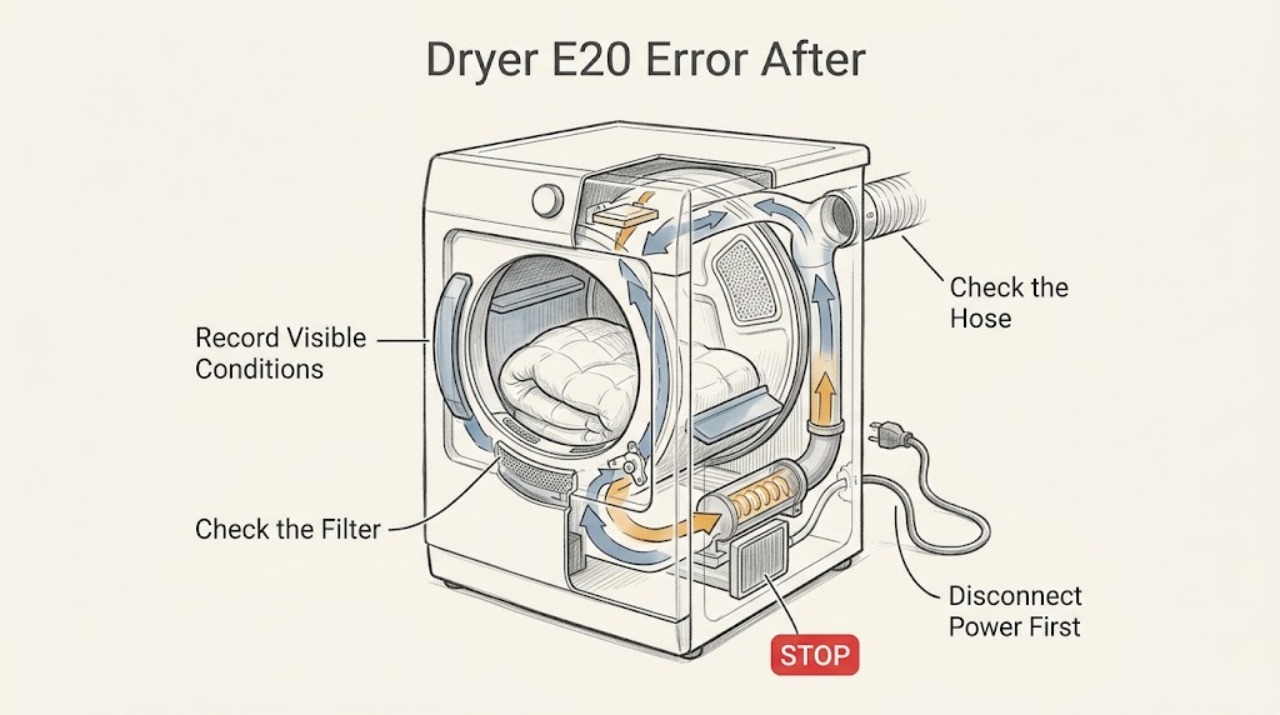
Record the full display exactly as E20, the beep or other behavior, the cycle and heat setting, whether the drum tumbles, and that a down comforter was the preceding load. Stop the dryer, remove the load, and disconnect the plug only from a dry, safe position; keep the gas supply and cabinet untouched.
Expected result: E20 remains while the dryer is idle; it clears after power is removed; the drum never starts; or the dryer starts but stops again with E20.
Next step: Do not repeatedly reset or start the dryer. Preserve the display and load history, then continue only with the safe external moisture and vent checks below; arrange service if the code persists with the dryer dry and vent connected.
Stop if: Stop immediately for smoke, burning odor, abnormal cabinet heat, sparks, gas odor, a hot cord, or water near electrical parts. Leave a gas-smell situation and seek help from a safe location.
Why this matters
Why: A code that returns while idle or immediately after a wet bulky load is different from ordinary long drying. The exact-model report connects this pattern with moisture in the lint/exhaust path, but the code alone cannot separate moisture, airflow, overheat sensing, control, or wiring.
-
Check 2
With the dryer unplugged, cool, and not being operated, remove the comforter and inspect only the accessible lint filter, filter opening, drum surface, and visible door area for water, heavy lint, or condensation. Wipe accessible moisture with a dry cloth and leave the door open to air-dry naturally; do not use a heat gun, hair dryer, flame, or cabinet disassembly to speed drying.
Expected result: The lint filter is wet, the filter opening or drum has condensation, lint is packed, or the accessible areas are dry.
Next step: Clean the filter as GE directs and allow the accessible area to dry completely. If moisture is substantial, returns after drying, or is inside protected areas, leave the dryer off and arrange service rather than opening the cabinet.
Stop if: Do not insert tools into the filter cavity, vacuum around exposed wiring, energize the dryer to evaporate water, or open the cabinet.
Why this matters
Why: Wet lint or condensation after a saturated comforter supports a moisture/airflow trigger and must be allowed to dry before another powered test. Dry accessible surfaces do not prove that the internal heater, sensor, wiring, or exhaust path is dry.
-
Check 3
After the dryer is unplugged, inspect the connected external vent hose for a crush, kink, collapse, disconnection, or visible water and check the outside wall hood from outdoors for a blocked or stuck damper. Keep the vent connected and do not pull the gas dryer out or disconnect a gas fitting.
Expected result: The vent is restricted, wet, disconnected, or crushed; the wall hood has weak airflow or a nest/debris; or the external path appears open and dry.
Next step: Correct only an obvious safe external obstruction or arrange professional vent cleaning. Do not run the gas dryer with the vent disconnected; if the path is clear but E20 returns, use qualified appliance service.
Stop if: Do not enter the duct, use a temporary indoor vent, install plastic ducting, bypass the wall cap, or operate this gas dryer without its vent.
Why this matters
Why: GE says restricted exhaust traps heat and humidity, lengthens drying, can collect lint, and may create a safety issue. A clear external path lowers but does not eliminate an internal moisture, sensor, heater, or control problem.
-
Check 4
Check external start conditions without opening the dryer: the plug is fully seated, the dedicated circuit has not tripped, the door closes firmly without clothing in the seal, and the cycle and temperature are appropriate for the load. On this gas model, look only at the normal external gas shutoff; do not loosen a connector or test gas pressure.
Expected result: The door was obstructed, the breaker is open, the plug or cord is hot or damaged, the gas shutoff is unknown or closed, or all visible external conditions are normal.
Next step: Correct only a clear door, cycle, or external supply condition and make no more than one model-approved retry after the dryer is dry and vented. For a repeated trip, damaged cord, gas uncertainty, or recurring E20, leave the unit off and arrange qualified service.
Stop if: Do not tape down or bypass the door switch, reset a breaker repeatedly, reconnect damaged wiring, open gas fittings, or perform live voltage or combustion testing.
Why this matters
Why: GE lists the plug, closed door, cycle setting, Start control, and dedicated circuit among no-start checks, and lists the gas line as an external condition for gas drying. A normal display does not prove that a wet or overheated internal circuit is safe.
-
Check 5
Only after the accessible area is dry, the filter is clean, the vent is connected and unobstructed, and no hazard is present, follow the exact GFD65GSSVWW manual's reset or service procedure. If a single supervised normal cycle is permitted, use a smaller suitable load rather than another wet comforter and remain nearby.
Expected result: The dryer completes a normal cycle without E20; E20 returns immediately; it runs but does not heat; it overheats or stops; or a gas, vent, electrical, or moisture warning appears.
Next step: Use the dryer only if it completes normally and the vent remains connected. Otherwise unplug when safe, preserve the code and observations, and schedule GE or qualified appliance service; do not order a thermistor, board, heater, or gas part from E20 alone.
Stop if: Stop the test at the first return of E20, abnormal heat, smoke, burning odor, sparks, gas odor, unusual noise, or breaker trip.
Why this matters
Why: One successful cycle after removing a wet load and correcting an external condition supports that condition as the immediate trigger, not a guaranteed repair. A returning E20 or no-run condition keeps overheat sensing, moisture damage, airflow, control, wiring, and gas-heating diagnosis in the professional boundary.
Use your observations
Decision map
Find the observation that best matches what you see, then follow the next safe action.
-
PATH 01Next step
What you see
E20 appeared immediately after a very wet down comforter, the lint-filter area or exhaust showed water/condensation, and the code does not return after the accessible dryer is fully dry and the connected vent path is clear.
Do this next
Keep the vent connected, use a suitable smaller load only if the model manual permits one supervised test, and stop if E20 or any hazard returns.
Why this path and its safety boundary
Why it matters: Moisture and airflow are the leading immediate triggers supported by the exact-model report and GE's vent guidance; this does not prove an internal part failure.
-
PATH 02Next step
What you see
The vent, filter, accessible area, door, power, and external gas-shutoff conditions are normal, but E20 returns while the dryer remains idle or on the first restart.
Do this next
Leave the dryer off and schedule GE or qualified appliance service with the exact model, code timing, wet-load history, and moisture/vent observations. Do not open the cabinet or bypass the code.
Why this path and its safety boundary
Why it matters: A persistent protected-system fault remains possible, including temperature sensing, moisture damage, control, wiring, or gas-heating circuitry. The exact E20 characters are not a license to choose one component.
-
PATH 03Next step
What you see
The dryer runs but does not heat after E20, or it heats unevenly while the vent, load, filter, and door checks are normal.
Do this next
Keep the dryer off and have qualified service assess ignition, gas heating, temperature sensing, control, and wiring. Do not open the gas train or operate without the vent.
Why this path and its safety boundary
Why it matters: GE separates gas-dryer heat selection, airflow, dedicated power, and gas supply from internal heating diagnosis. A gas dryer that still does not heat after those external checks needs service, not a user gas test.
-
PATH 04Next step
What you see
Smoke, burning odor, abnormal heat, sparks, gas odor, a hot or damaged cord, water near electrical parts, or repeated breaker operation occurs.
Do this next
Stop using the dryer and leave the area if there is immediate danger. Contact qualified gas, electrical, vent, or appliance help from a safe location; do not restart the dryer to reproduce the event.
Why this path and its safety boundary
Why it matters: This is a fire, combustion, electrical, or moisture hazard boundary rather than a code-clearing opportunity.
Helpful context
Understand the symptom
The down-comforter detail changes the first decision. A very wet, bulky load can leave moisture in the lint-filter cavity or exhaust path, while restricted venting can retain heat and humidity. GE also says load size, fabric, lint, vent condition, and power or door controls affect dryer operation. Treat E20 as a reason to stop and remove the moisture and airflow questions from the table before considering an internal part.
The exact model matters: GFD65GSSVWW is a GE gas dryer, and its public owner center points to the model manual and service path. GE's general vent guidance warns that a gas dryer must not be operated without its vent because combustion products can enter the room. No owner check here opens the cabinet, tests a gas valve, bypasses a door switch, or applies heat to wet internal parts.
Only after diagnosis
Potential parts
- dryer temperature sensor or overheat-sensing assembly
Consider only if qualified service reproduces E20 after the dryer is dry and the vent, load, filter, door, power, and gas conditions are verified, then confirms a sensing fault.
Confirm the exact GFD65GSSVWW model and service findings before ordering; E20 alone does not prove sensor failure. - dryer electronic control or wiring assembly
Consider only after service finds persistent E20 with dry accessible areas and clear venting and confirms moisture damage, control, or wiring failure.
Do not open the cabinet or select a board from a generic GE code list; verify exact model and technician diagnosis. - gas dryer ignition or heat assembly
Consider only if qualified gas-appliance service confirms a no-heat or ignition fault after external gas supply, power, cycle, airflow, and moisture conditions are safe.
Gas components require professional diagnosis and exact model fitment; never test or replace them as an owner response to E20.
When checks do not resolve it
Need a professional?
Use GE or qualified appliance service for a recurring E20/no-run condition, persistent moisture, no heat, abnormal heating, or suspected sensor, control, wiring, ignition, or gas issue. Use qualified vent service for a blocked, damaged, or inaccessible exhaust path.
Safety scope: Owner checks are limited to recording E20, removing the wet load, unplugging from a dry safe position, cleaning the accessible lint filter, allowing accessible moisture to dry naturally, inspecting the connected external vent and outside hood, and checking door, plug, breaker, cycle, and normal external gas-shutoff state. Do not operate a gas dryer without its vent, open the cabinet or gas fittings, bypass the door switch, apply heat to wet parts, or make live electrical or combustion tests.
Have this ready
- Provide GFD65GSSVWW, E20, whether it beeped while idle, the down-comforter load history, wet filter or duct observations, drying time, vent and wall-hood condition, door and power behavior, gas-shutoff observation, and any smoke, odor, heat, spark, or breaker symptom.
Common questions
FAQ
What does E20 mean on a GE GFD65GSSVWW dryer?
GE's public model pages identify the exact dryer but do not publish a universal E20 component definition. An exact-model report associates E20 with a wet comforter, wet lint area, water in the exhaust, and a no-run condition; a commenter interpreted it as extreme heat sensed. Treat it as a stop-and-check protection event, not proof of one part.
Can a wet down comforter cause this dryer E20 condition?
It can be a relevant trigger. The exact-model report describes water in the lint and exhaust areas after the comforter was put in the dryer, while GE explains that retained heat and humidity from poor airflow can create unsafe dryer conditions. Let accessible areas dry naturally, inspect the connected vent, and do not heat or open the cabinet to speed drying.
Can I run the GE gas dryer with the vent disconnected to clear E20?
No. GE explicitly cautions not to operate a gas dryer without its vent because combustion products can enter the room. Inspect the connected external path and wall hood, and use qualified vent or appliance service for a restriction.
Should I replace the thermistor when E20 appears?
Not from the code alone. Let the accessible area dry, verify the vent and external conditions, and arrange service if E20 returns. A technician must distinguish sensing, moisture damage, airflow, control, wiring, and gas-heating causes before selecting a part.
Read the exact guide
Official sources
- Dryer - How to Clean Lint FilterGE Appliances · Opened GE's lint-filter guidance. It recommends cleaning after each use, periodic warm-soapy washing for residue, and unplugging before cleaning the filter opening.
- Dryer - Will Not Run or StartGE Appliances · Opened GE's no-start guidance. It covers the external plug, closed door, cycle and Start controls, door-switch condition, dedicated circuit, and gas/electric model setting boundary.
- Dryer - Check Vent Sensor AlertGE Appliances · Opened GE's check-vent guidance. It explains that low exhaust airflow retains hot moist air, can increase drying time and safety risk, and gives unplugged external duct and wall-cap checks.
- GE ENERGY STAR 7.8 cu. ft. Capacity Smart Front Load Gas Dryer with Steam and Sanitize Cycle - GFD65GSSVWWGE Appliances · Opened GE's official product page. It identifies the exact model number, 7.8 cu. ft. Smart Front Load Gas Dryer product, and the owner's manual/support links.
- Dryer - Things To Check For A Venting IssueGE Appliances · Opened GE's venting guidance. It covers kinked or collapsed ducts, wall-cap airflow, retained heat and humidity, and the explicit prohibition on operating a gas dryer without its vent.
- GE Dryer E20 Error CodeReddit r/appliancerepair · Exact Reddit post opened because it names GFD65GSSVWW and the assigned down-comforter/E20/no-run situation. It is used only for symptom context and community uncertainty, not as an official code definition or repair instruction.
- Gas Dryer - Runs But Does Not HeatGE Appliances · Opened GE's gas-dryer no-heat guidance. It separates cycle and airflow, dedicated 120-volt power, and external gas-line status from the need for service when the unit still does not heat.
- User Manual & Care for GFD65GSSVWW | GE AppliancesGE Appliances · Opened GE's model-specific support page. It identifies GFD65GSSVWW as a Smart Front Load Gas Dryer and links the owner's manual, installation/support resources, and service path; it does not publish a universal E20 component definition.
Community feedback
Share a repair observation
Share a plain-text repair observation. Accepted observations are published automatically; this page may take a moment to update.