
On this page
Start here
Quick answer
A small amount of frost can form when humid air or moisture from food freezes, but recurring or heavy frost usually means warm air is entering or defrost water is not draining. First note where the frost is concentrated, then remove anything blocking the LG freezer door or drawer, reseat drawers and shelves, and inspect the gasket for dirt, gaps, looseness, or damage. Cool food before storing it and seal moist food in airtight containers. If a sheet of ice is blocking the freezer drain, move food to safe cold storage, disconnect power, and allow a complete model-appropriate defrost; never chip frost with a knife or ice pick. If frost returns quickly, the door will not seal, the freezer is warming, water leaks, a fan is obstructed, or a defrost fault is suspected, stop and arrange qualified refrigerator service.
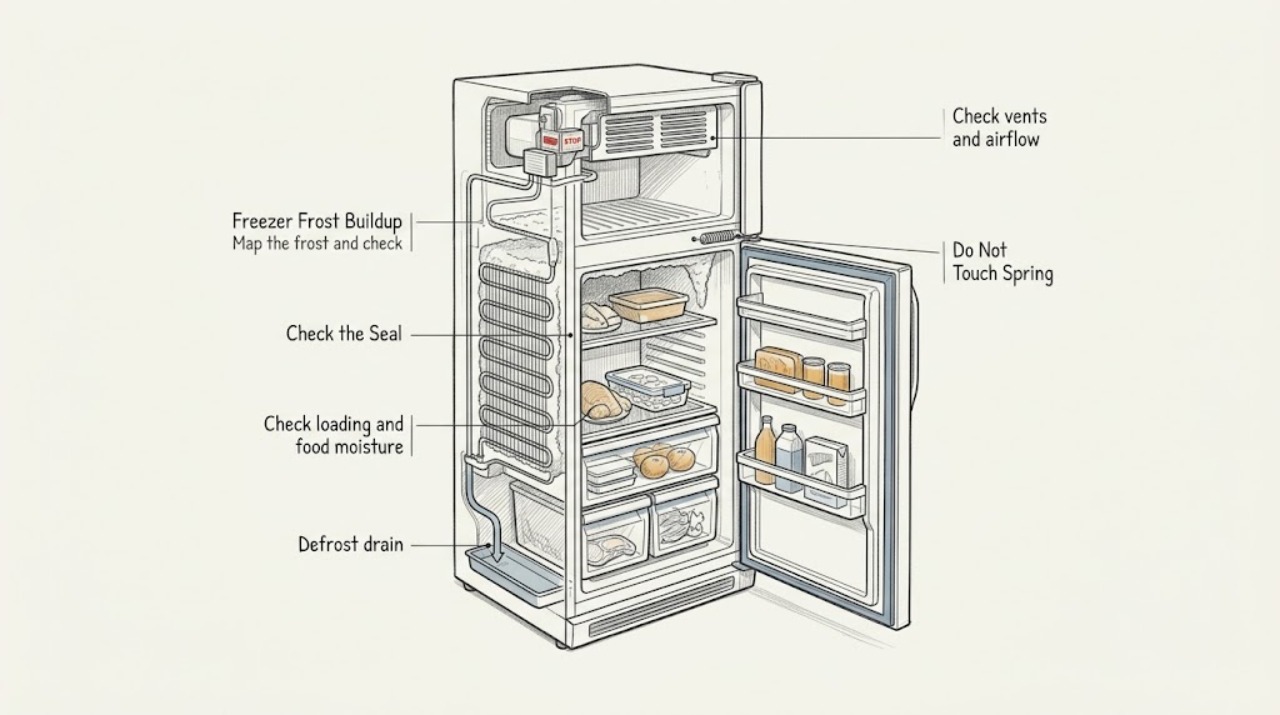
Work through in order
Diagnostic checks
Use only checks that match the exact appliance or system and its official guide.
-
Map the frost and check whether the freezer is still cold
Without scraping the ice, photograph the frost location and note whether it is a light coating, a thick mass, a ring around the door, a plug at an air vent, or a sheet on the bottom. Check whether food remains properly frozen and whether the freezer has an unusual fan sound, water, or temperature change.
Expected result: Light frost after humid conditions or recent power restoration can be moisture-related. Frost at the door edge suggests a seal leak; a bottom ice sheet suggests drainage trouble; frost at a vent can restrict airflow. Softening food, repeated alarms, or a warming cabinet makes food preservation and service more urgent.
Next step: Continue with the door, loading, and moisture checks for edge or widespread frost. Move food to safe cold storage and use the defrost-and-drain branch for a bottom ice sheet or a warming freezer.
Why this matters
Why: The pattern separates moisture entering through the door from a defrost-drain or circulation problem and tells you whether a long defrost may risk food.
-
Check the freezer door or drawer seal
Close the freezer normally and inspect all visible edges for a drawer, shelf, bag, container, or food package protruding into the seal. Confirm drawers, baskets, shelves, and the door assembly are seated as the model guide shows. Look for a gasket that is dirty, folded, loose, torn, or leaving a visible gap; clean residue with a warm damp cloth and dry the seal.
Expected result: If an obstruction or misplaced drawer prevents closure, warm humid air can enter and freeze. A clean gasket that seals evenly supports a different branch; a loose or damaged gasket, persistent gap, or door that will not close needs service or model-specific adjustment.
Next step: Remove only the visible obstruction, reseat the drawer or shelf, clean and dry the gasket, and monitor the freezer with the door fully closed. Arrange service if the gasket cannot seal or frost returns at the same location.
Why this matters
Why: A door seal is the main barrier against moisture-laden room air. Frost concentrated beside the leaking area is evidence of air entry, not proof that the cooling system has failed.
-
Check loading and food moisture
Look for hot food, uncovered or wet food, leaking packages, and an overpacked drawer that blocks air vents or the door. Let hot food cool before placing it inside, seal moist food in airtight containers or bags, and rearrange items so the door and vents can close and circulate as the model requires.
Expected result: Frost on shelves or food after hot or uncovered items indicates moisture entering from the contents rather than necessarily a component fault. Frost near the door after overpacking indicates the load may have held the door open. Frost that continues with cool, sealed food and a clear door moves the diagnosis toward sealing, drain, or defrost service.
Next step: Correct the loading condition and keep the door closed while monitoring the pattern. If the freezer is warming or heavy frost remains, preserve food first and continue to the complete-defrost or service branch.
Why this matters
Why: Food releases water vapor as it cools, and that moisture freezes on cold surfaces. Correcting the source can stop new frost without replacing a part.
-
Inspect visible air vents and circulation paths
With food kept safely cold and the door open only briefly, identify the visible freezer air vents from the model manual and check whether frost, packages, or containers cover them. Do not remove an interior panel or insert an object into a vent or fan opening.
Expected result: A vent blocked by packages or frost can reduce cold-air movement and create uneven frost or soft food. Clear packaging that is visibly in the way; a vent that remains iced over after the external cause is corrected suggests a defrost or circulation fault.
Next step: Rearrange items without forcing them against the vents. If ice repeatedly blocks a vent or the fan makes scraping or abnormal noise, move food to safe cold storage, disconnect only if safe, and arrange service.
Why this matters
Why: Freezer cooling depends on unobstructed air movement; a vent symptom is not a safe reason to test a fan or defrost heater under power.
-
Look for a bottom ice sheet or blocked defrost drain
If frost has become a hard sheet on the freezer floor, remove food and drawers only as the model allows and look for ice covering the bottom drain area. Do not poke the drain, remove a rear panel, or pour boiling water into the cabinet. Protect food and the floor before any complete defrost.
Expected result: LG explains that when melted frost cannot drain because the freezer drain is blocked by ice or foreign material, water can run back and freeze on the bottom. A bottom sheet with wet or recurring water supports a drain branch; no bottom ice but repeated door-edge frost supports a seal branch.
Next step: Use the complete-defrost procedure only when food can be protected and the exact model guidance permits it. If the bottom ice returns, water leaks, or the drain remains blocked, arrange qualified service.
Why this matters
Why: The location of the ice can distinguish a drainage problem from moisture entering at the door, but the internal drain and defrost system are not ordinary-user repair points.
-
Complete one safe manual defrost when ice is obstructing the drain
If the freezer has a substantial ice blockage and food has been moved to suitable cold storage, disconnect the refrigerator power plug only when safe and leave the freezer doors or drawer open as LG's guidance describes. Allow the ice to melt completely, collect water, wipe the interior dry, and restore power according to the model manual. Never chip the ice or use sharp tools or concentrated heat.
Expected result: A clear drain path and dry bottom after complete melting can confirm that ice was obstructing drainage. If a thick layer remains, the refrigerator is not cooling, the drain leaks, or the same ice sheet returns, the underlying defrost or drain problem remains.
Next step: Run the model-approved recovery and monitor once the freezer is stable. Arrange service for recurrence, a warming freezer, persistent drain blockage, or any sign of damage or water near electrical parts.
Why this matters
Why: A full defrost can remove an ice blockage but does not prove the automatic defrost system or drain has been repaired; partial melting can leave the restriction in place.
-
Account for humidity, leveling, and recent power restoration
Note whether the appliance is near a window, balcony, or other humid location, whether the room is unusually humid, whether the refrigerator was recently moved or cleaned, and whether power was restored after an outage. Check from the outside that the cabinet is stable and the door closes easily; use only the exact model's leveling instructions for adjustments.
Expected result: LG identifies humid air, recent power restoration, and a door or cabinet that does not close properly as conditions that can create frost. After a power outage, some frost may dissipate as the cabinet stabilizes; frost that grows rapidly or persists in one location needs more investigation.
Next step: Reduce door-open time, allow hot food to cool, keep food sealed, and monitor after the cabinet stabilizes. Arrange service if the door remains misaligned, cannot seal, or frost continues despite a dry, unobstructed cabinet.
Why this matters
Why: A temporary moisture event can look like a failure, while a continuing seal or leveling problem keeps admitting warm air and recreating frost.
-
Run one supervised confirmation after the correction
After correcting an obstruction, gasket, loading, vent, or complete-defrost condition, close the freezer fully and observe one normal cooling period without repeatedly opening the door. Check for a returning frost pattern, water at the front or bottom, abnormal fan noise, food softening, or a temperature alarm. Do not continue operating through a burning smell, electrical warning, leak, or unsafe temperature.
Expected result: No new localized frost and stable frozen food support a resolved moisture or obstruction condition. Frost returns quickly, water reappears, the fan scrapes, the freezer warms, or an alarm returns support an unresolved seal, drain, fan, defrost, or sealed-system fault.
Next step: Move food to safe cold storage and arrange qualified refrigerator service for recurrence or warming. Preserve the frost location, defrost history, water evidence, alarm, and model number for the technician.
Why this matters
Why: A single controlled observation tests whether the external correction changed the cause; repeated warm operation can spoil food and obscure the original evidence.
Use your observations
Decision map
Find the observation that best matches what you see, then follow the next safe action.
-
PATH 01Next step
What you see
Frost is concentrated at the door edge, a drawer will not close, or the gasket has a gap, tear, looseness, or persistent deformation.
Do this next
Remove visible obstructions, reseat drawers and shelves, and clean the gasket. Arrange qualified service if the seal still leaks or frost returns in the same location.
-
PATH 02Next step
What you see
The freezer floor has a hard ice sheet, meltwater returns, or the visible drain area is blocked by ice.
Do this next
Protect food, disconnect only when safe, and complete the model-appropriate defrost without sharp tools. Arrange service if the drain or ice sheet recurs.
-
PATH 03Next step
What you see
Frost is widespread after hot or uncovered food, high humidity, cleaning, moving, or recent power restoration, while the door seals and food remains frozen.
Do this next
Cool and seal food, reduce warm-air entry, keep the door closed, and monitor as the cabinet stabilizes. Escalate if frost grows rapidly or the freezer warms.
-
PATH 04Next step
What you see
Frost blocks a vent, the fan scrapes or is abnormal, the freezer is warming, or an alarm returns.
Do this next
Move food to safe cold storage, do not reach into the fan or remove panels, and arrange qualified refrigerator service for airflow or defrost diagnosis.
-
PATH 05Next step
What you see
There is water near electrical parts, a damaged cord or outlet, smoke, burning odor, sparks, a refrigerant concern, or the freezer cannot keep food safely frozen.
Do this next
Stop using the appliance, disconnect only if safe, keep clear, protect food, and seek qualified appliance or electrical help. Do not restart or dismantle the cabinet.
Helpful context
Understand the symptom
Frost location changes the diagnosis
A light, widespread coating after a humid day, loading wet food, or restoring power can be moisture that will settle as the cabinet stabilizes. Frost concentrated around the door edge or one side points toward an air leak, while a hard sheet at the freezer floor points toward melted frost failing to reach the drain tray. Frost around an air vent can restrict circulation. Photograph the pattern before defrosting so the pattern is not lost.
Defrost without puncturing the sealed system
Move food to a suitable cold location before a prolonged defrost and protect the floor from meltwater. Disconnect the refrigerator only when the plug and floor are dry and the model guidance permits it. Use a cloth or the model-approved gentle method to melt ice; never use a knife, ice pick, drill, open flame, or concentrated heat. Do not remove an interior panel to reach the defrost heater, fan, or drain.
Only after diagnosis
Potential parts
- freezer door or drawer gasket
Consider this only when a visible gap, damaged seal, or qualified inspection confirms that the gasket cannot maintain an even seal after cleaning and correct loading.
Gaskets vary by exact LG model and door design; verify the model before ordering and never use a substitute that prevents closure. - defrost drain or drain-heater component
Consider this only when a recurring bottom ice sheet or water return remains after a complete safe defrost and qualified testing identifies a drain or drain-heater fault.
The drain and heater are inside the appliance and may involve water and mains electricity; use trained service and model-specific fitment. - defrost heater, sensor, or control
Consider this only when frost repeatedly returns across the evaporator area and qualified testing confirms an automatic defrost or sensing fault.
Defrost components are model-specific and require safe electrical and refrigeration diagnosis; do not infer fit from symptoms alone. - evaporator or circulation fan
Consider this only when airflow remains abnormal or the fan is confirmed faulty after safe external checks and qualified diagnosis.
Do not reach into the fan or remove panels; confirm exact model fitment through qualified service.
When checks do not resolve it
Need a professional?
Arrange qualified LG refrigerator service when frost returns quickly after a complete safe defrost, the door or gasket cannot seal, a bottom ice sheet or drain blockage recurs, the freezer warms, a fan is noisy or obstructed, an alarm returns, or water leaks from inside the cabinet. Protect food and stop immediately for smoke, burning odor, sparks, water near electrical parts, a hot or damaged cord or outlet, or any unsafe temperature. Do not chip ice with sharp tools, remove interior panels, test energized defrost components, or replace a part from the frost pattern alone.
Common questions
FAQ
Why is my LG freezer building up frost?
Common causes include humid air entering through a door that is blocked or not sealing, hot or uncovered food, blocked vents, recent power restoration, and ice blocking the defrost drain. The frost location helps select the next check.
How do I remove frost from an LG freezer safely?
Protect the food, disconnect power only when safe and when the model guidance permits, and allow the ice to melt with the freezer open. Wipe the cabinet dry and never use a knife, ice pick, drill, open flame, or concentrated heat.
Why is there a sheet of ice on the bottom of my LG freezer?
LG explains that melted frost can return to the floor when the freezer drain is blocked by ice or foreign material. A complete safe defrost may clear the ice, but recurrence or water leaks need qualified service.
Can a bad freezer door seal cause frost buildup?
Yes. A protruding package, misplaced drawer, dirty or loose gasket, or misaligned door can let warm moist air enter and freeze. Clear visible obstructions, reseat parts, clean the gasket, and arrange service if it still cannot seal.
When should I call for LG freezer frost buildup?
Arrange service when frost returns quickly after a complete model-appropriate defrost, the freezer warms, the fan is abnormal, water returns, the door will not seal, or a drain or defrost fault is suspected. Stop immediately for smoke, sparks, damaged electrical connections, or water near electrical parts.
Read the exact guide
Official sources
- [LG Refrigerator] Refrigerator Door Seal IssuesLG USA Support · Obstructions, misplaced shelves or racks, gasket cleaning, loose gasket seating, and closure improvement
- LG Refrigerator – How to Level a FridgeLG USA Support · Leveling, rear tilt, self-closing doors, frost relation, and service boundary
- LG Refrigerator - Troubleshooting Frost or Moisture Buildup In Your LG RefrigeratorLG USA Support · Moisture condensation, food temperature and packaging, door closure, gasket cleaning, and post-power-restoration frost
- LG Refrigerator - Frost Buildup - FREEZER ONLYLG USA Support · Door sealing, gasket condition, loading, hot food, temperature setting, and visible air-vent checks
- [LG refrigerator frost build-up] There is frost build-up and icicles in the freezer compartmentLG USA Support · Moisture, hot or uncovered food, door closure, gasket, humidity, power restoration, safe frost removal, and no-sharp-tools guidance
- LG Refrigerator - Troubleshooting Ice Buildup in an LG RefrigeratorLG USA Support · Bottom ice sheet from blocked drainage, food protection, unplugged defrost, complete melt, and service escalation
Community feedback
Share a repair observation
Share a plain-text repair observation. Accepted observations are published automatically; this page may take a moment to update.