
On this page
Start here
Quick answer
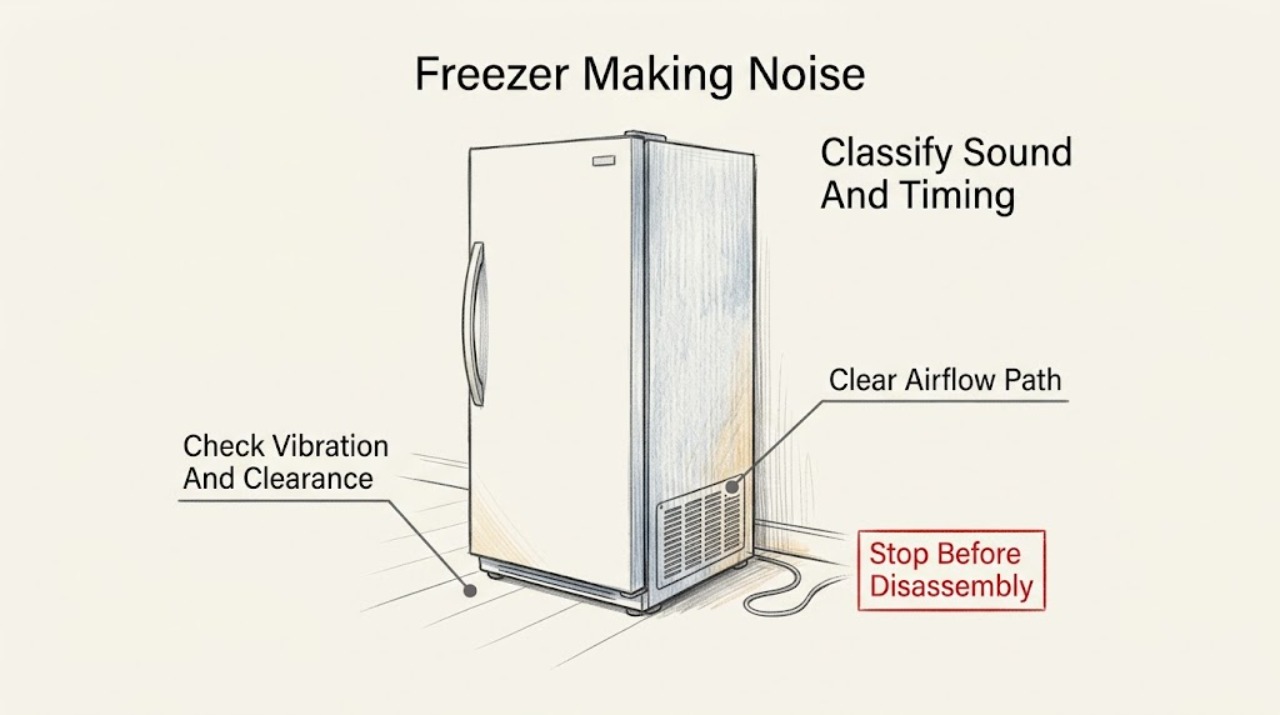
Some LG freezer sounds are normal: a fan or compressor may hum, the ice maker may rattle while harvesting, and clicking, cracking, dripping, or whooshing can occur as temperatures and air pressure change. First identify when and where the sound occurs, then check for vibration, contact with nearby objects, blocked airflow, or frost around a fan. If the noise is a continuous scrape, grinding, repeated hard knocking, or is accompanied by poor cooling, smoke, a burning odor, a damaged cord, or a breaker trip, stop using the freezer and arrange service. Do not remove sealed-system covers or make live electrical measurements.
Work through in order
Diagnostic checks
Use only checks that match the exact appliance or system and its official guide.
-
Check 1
From a safe distance, record the sound as humming, buzzing, clicking, cracking, dripping, rattling, whirring, scraping, or knocking. Note whether it occurs continuously, only during a cooling cycle, after a door closes, or during ice making; do not touch the fan or reach inside a moving mechanism.
Expected result: The sound is a brief hum or buzz during cooling, a short click or crack as temperature changes, a rattle when ice drops, a periodic ice-maker motor sound, or a continuous scrape, grind, or hard knock.
Next step: For a brief sound that matches a normal cycle, continue observing while checking installation. For a continuous scrape, grind, hard knock, smoke, burning odor, or poor cooling, stop the freezer and arrange service.
Why this matters
Why: LG describes fan and compressor hum, thermal expansion sounds, and many ice-maker sounds as normal. A persistent mechanical sound or a sound that is substantially louder than before is not identified by sound alone and needs the next checks.
-
Check 2
With the appliance safely stationary, check whether the cabinet rocks, touches a wall or cabinet, or has objects on top or leaning against its sides. Check that shelves, bins, and drawers are seated correctly and that stored containers are not touching one another or the interior walls.
Expected result: The freezer rocks, a panel or object touches it, an item is vibrating on top, or an interior bin or shelf is loose; or the unit is stable with clear surrounding space and correctly seated storage parts.
Next step: Remove only loose objects and reseat removable bins or shelves. If the cabinet is unstable, follow the exact LG leveling instructions with help from another adult; do not tilt or move a full appliance alone. If the noise persists, continue with airflow and ice-maker checks.
Why this matters
Why: LG says an uneven refrigerator or contact with nearby objects amplifies normal compressor and fan vibration, and loose interior items can rattle. If no contact or instability is found, the noise is less likely to be only an installation vibration.
-
Check 3
After protecting perishable food and disconnecting power when safe, inspect only the visible freezer air outlets and accessible surfaces for heavy frost, packaging, or a loose object near an opening. Do not remove internal covers or insert tools into a fan path.
Expected result: Heavy frost or a visible obstruction is present near an airflow path; the sound changes when a door opens; or the visible air path is clear but the fan-like noise continues.
Next step: If the model instructions allow a complete manual defrost, move food to safe cold storage, leave the appliance unplugged with doors open until frost melts, and never chip ice or use a heat gun. If frost returns, the sound remains, or access requires disassembly, stop and request service.
Why this matters
Why: LG identifies thick frost or a foreign object contacting a fan as a cause of continuous tapping, thudding, or whirring. A sound that changes with door position can also point toward a fan, but the source cannot be safely confirmed by reaching into the assembly.
-
Check 4
If the freezer has an ice maker, note whether the noise occurs as ice falls, while the ejector motor runs, or when water is supplied. Confirm the ice maker is connected to water if it is enabled; if there is no water supply, use the model-specific control to turn the ice maker off rather than letting it run dry.
Expected result: The sound is a short rattle as cubes fall, a periodic motor sound during harvest, a brief water-valve vibration, or a louder repeated sound while the ice maker is enabled without a water supply.
Next step: Use the manual's ice-maker switch or setting for a no-water installation and observe one cycle. If there is unusual knocking during water fill, a leak, a jam, or noise outside the cycle, keep the ice maker off and arrange service.
Why this matters
Why: LG says ice dropping, ice-maker motor operation, and water-valve sounds can be normal, and an enabled ice maker without water can make the sound louder. A sound that does not follow an ice-making cycle or is accompanied by a leak needs further diagnosis.
-
Check 5
After the safe visible checks, confirm whether the freezer is maintaining its normal food-safe cold condition and record the model number, sound description, timing, any error display, and whether the sound changes after leveling or a documented defrost. Do not open the compressor compartment, sealed system, or electrical control area.
Expected result: Cooling is normal and the sound has stopped or matches a documented operating cycle; cooling is weak; the noise returns after defrost; or there is scraping, grinding, smoke, burning odor, damaged wiring, unusual heat, or a repeated breaker trip.
Next step: Keep the freezer in service only when cooling and operation are normal and the sound matches documented behavior. Otherwise protect food, disconnect power only if safe, and arrange qualified LG or appliance service with the recorded evidence.
Why this matters
Why: LG allows that some compressor and fan noise may be temporary, but directs owners to service when unusual noise persists or cooling is not normal. Recurring frost or a persistent mechanical sound needs component-level diagnosis by a qualified technician.
Use your observations
Decision map
Find the observation that best matches what you see, then follow the next safe action.
-
PATH 01Next step
What you see
The freezer produces a soft hum or buzz only while cooling, and it maintains temperature without abnormal vibration.
Do this next
Treat the sound as a likely normal fan or compressor operating sound, keep the unit clear, and monitor for a change in pattern or cooling.
-
PATH 02Next step
What you see
The cabinet rocks or touches a wall, cabinet, stored item, or object on top vibrates when the compressor starts.
Do this next
Remove the contact and reseat loose storage parts. Follow the model-specific leveling guidance with help; request service if the floor or installation cannot be made stable.
-
PATH 03Next step
What you see
A continuous thudding, whirring, or rattling sound is accompanied by heavy frost around a visible fan path.
Do this next
Protect food and perform only the complete defrost procedure allowed by the model manual. Never chip the frost or disassemble the fan; request service if the sound or frost returns.
-
PATH 04Next step
What you see
The sound occurs during ice harvest, ice dropping, or water fill and the ice maker has a water supply.
Do this next
Compare the timing with the model manual. A brief rattle or valve vibration may be normal; unusual knocking, a jam, or a leak means turn the ice maker off and request service.
-
PATH 05Next step
What you see
The ice maker is enabled but has no water supply.
Do this next
Turn the ice maker off using the model-specific control and do not keep restarting it dry. If the noise continues, inspect no further and arrange service.
-
PATH 06Next step
What you see
Noise is persistent or newly severe, cooling is weak, or there is a scraping or grinding sound, smoke, burning odor, damaged cord, unusual heat, or repeated breaker trip.
Do this next
Stop using the freezer, disconnect power only if safe, protect the food, and arrange qualified service. Do not open the sealed system or make live electrical measurements.
Helpful context
Understand the symptom
Start by separating normal sounds from a fault
An LG freezer can make a soft hum or buzz while its fan and compressor maintain temperature. Ice dropping into the bin, the ice-maker motor cycling, water-valve operation, and plastic contracting as temperatures change can also sound like rattling, drilling, clicking, cracking, or dripping. A sound that is new, markedly louder, continuous, or linked with poor cooling deserves a structured check rather than a guessed part replacement.
The timing and location are useful evidence
Listen from a safe distance with the doors closed, then note whether the sound follows a compressor cycle, changes when a door is opened, occurs during ice harvesting, or begins after moving or cleaning the appliance. Do not put fingers or tools near a fan. The exact model manual matters because freezer layout, ice-maker controls, and clearances vary.
Use service as the stopping point
A frost-obstructed fan may need a complete, safe defrost, but repeated frost, a loud fan or compressor, a burning smell, smoke, electrical arcing, damaged wiring, a repeated breaker trip, or loss of cooling is not a do-it-yourself diagnosis. Protect the food, disconnect power only when safe, and have a qualified technician inspect the appliance. Do not open the sealed refrigeration circuit or make live electrical measurements.
Only after diagnosis
Potential parts
- evaporator or freezer fan motor
Consider this category only if qualified service confirms that a fan is obstructed, frost-free but noisy, not running, or unable to circulate air after installation and defrost causes are excluded.
Confirm the complete LG model and serial information and the authorized parts listing before ordering or installing a fan motor. - compressor start device
Consider this category only if qualified service links repeated clicking, abnormal compressor starting, or loss of cooling to the start circuit rather than normal cycling or installation vibration.
Start components are model-specific and require qualified electrical diagnosis; do not test or replace them with the appliance energized. - ice maker or water inlet valve
Consider this category only if service confirms that noise occurs during an ice-maker or water-fill cycle and a jam, missing water supply, hose vibration, or setting does not explain it.
Verify the exact LG model and water-system configuration before selecting any ice-maker or valve component.
When checks do not resolve it
Need a professional?
Arrange qualified service when an LG freezer's noise persists after safe visible installation, airflow, and documented ice-maker checks; returns after a complete permitted defrost; accompanies weak cooling, a leak, or an error; or sounds like continuous scraping, grinding, or hard knocking. Stop immediately for smoke, burning odor, damaged wiring or cord, unusual heat, or a repeated breaker trip. Disconnect power only if safe, and do not open the sealed refrigeration system, bypass a safety device, or make live electrical measurements.
Common questions
FAQ
Is a humming sound from an LG freezer normal?
Often. LG says the fan and compressor can hum or buzz during normal cooling. It needs attention when the sound is persistent and newly severe, cooling is weak, or it is accompanied by scraping, grinding, smoke, burning odor, or abnormal vibration.
Why does my LG freezer rattle when the ice maker runs?
Ice dropping, the ice-maker motor, and the water valve can make brief rattling or vibration sounds. If the ice maker has no water supply, turn it off with the model-specific control; unusual knocking, a jam, or a leak calls for service.
Can frost make an LG freezer fan noisy?
Yes. LG identifies thick frost or a foreign object at the fan as a possible cause of continuous thudding or whirring. Follow only the model-approved complete defrost procedure; do not chip ice or disassemble the fan, and request service if the condition returns.
What should I do if my LG freezer is making a grinding noise?
Stop using it if the grinding is continuous or the freezer is not cooling normally. Protect the food, disconnect power only if safe, and arrange qualified service; do not open the sealed system or make live electrical measurements.
Read the exact guide
Official sources
- Vibrating NoiseLG USA Support · LG refrigerator vibration, clearance, storage contact, and ice-maker water-valve sounds
- LG Refrigerator – How to Level a FridgeLG USA Support · LG refrigerator leveling, stability, vibration prevention, and frost-related installation guidance
- [LG refrigerator - noise] A noise is heard during operationLG USA Support · LG refrigerator fan, compressor, refrigerant valve, frost, and rear mechanical-compartment noise guidance
- How to Troubleshoot Unusual Noises From Your LG RefrigeratorLG USA Support · LG refrigerator and freezer normal sounds, fan obstructions, vibration, and service guidance
- LG Refrigerator - Troubleshooting Refrigerator Noises After It Was Moved or CleanedLG USA Support · LG refrigerator noise after moving or cleaning, stabilization, balance, and floor vibration
- LG Refrigerator - Troubleshooting Ice Maker Noises On My LG RefrigeratorLG USA Support · LG refrigerator ice-maker sounds, water supply, fan clues, and service guidance
Community feedback
Share a repair observation
Share a plain-text repair observation. Accepted observations are published automatically; this page may take a moment to update.