
On this page
Start here
Quick answer
For the LG LSG4511ST, turn the oven off normally and let the door, glass, racks, and hinge area cool completely. Do not hold the door shut, force a hot latch, bypass a switch, or keep cooking while a door light or warning sounds. This US model is a gas slide-in range with a door lock, glass-touch oven controls, and a smart buzzer; the exact model support page provides the applicable manual. Once cool, check only for a clearly loose rack, tray, foil, food, or residue at the threshold, then look at the gasket, frame, hinges, and latch from outside. Record whether the warning begins only after heat builds and whether it clears after cooldown. If the door closes evenly but the warning returns when hot, the timing is a clue for a heat-sensitive door-recognition, latch, switch, or control condition—not proof of one failed part—and recurring use should be stopped until qualified LG service checks it. Smoke, gas odor, suspected carbon monoxide, burning smell, abnormal flame or uncontrolled heat requires immediate safety escalation.
Before you begin
Safety first
- Do not operate the gas oven with a door warning or partly closed door. Do not force the hot door, press it harder to silence the warning, bypass a door switch or latch, enter service mode, remove panels, or perform live electrical or gas tests. Stop for smoke, fire, gas odor, suspected carbon monoxide, burning smell, abnormal flame, uncontrolled heat, damaged glass, or an electrical hazard.
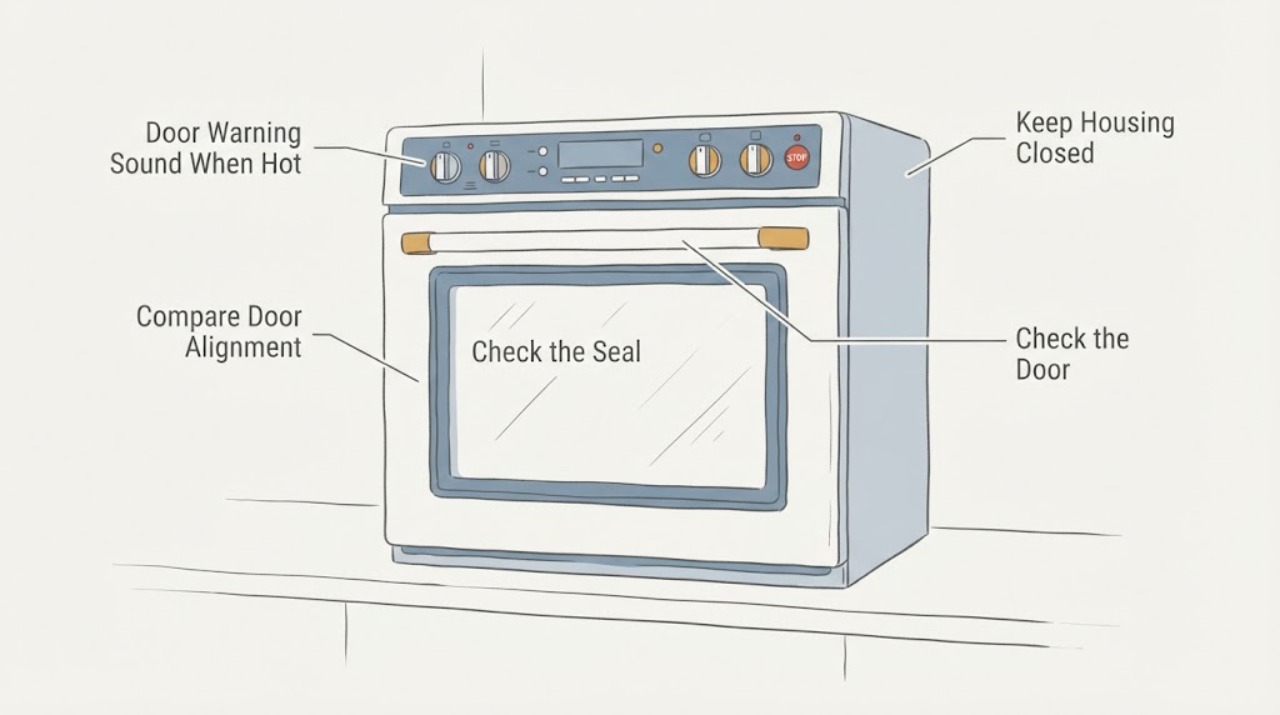
Work through in order
Diagnostic checks
Use only checks that match the exact appliance or system and its official guide.
-
Check 1
Turn the oven function off normally and move away from the hot door. Let the cavity, door glass, racks, and hinge area cool fully before touching the fit. If there is smoke, fire, gas odor, suspected carbon monoxide, a burning smell, abnormal flame, or uncontrolled heat, leave the area as appropriate and contact emergency or gas professionals from a safe location.
Expected result: Record whether the warning occurred during bake, broil, convection, or cleaning; whether the oven light came on; whether the door felt stuck or merely closed; and whether any smoke, odor, abnormal flame, or excessive heat was present.
Next step: Keep the oven off until it is cool and decide whether the event is a safety escalation or a recurring door-recognition symptom to document for service.
Stop if: Do not force the door, hold it shut during cooking, reach near hot hinges, or restart a cycle solely to reproduce the sound.
Why this matters
Why: A safety symptom overrides ordinary door checks. Without a hazard, the fact that the indication is heat-linked is still important, but a hot door cannot be safely used for a fit or latch test.
-
Check 2
With the oven cool, inspect the threshold, frame, and rack positions from outside. Remove only a rack, tray, foil, food, spill, or residue that is plainly loose and reachable without tools or force; then close the door gently once.
Expected result: The door closes farther after a loose item is removed, or it remains tilted, springy, or stopped before the seal meets the frame.
Next step: If the door still does not close evenly, keep the oven off and arrange qualified LG appliance service. If it closes normally, continue with a visual seal and timing record rather than a hot test.
Stop if: Do not pry near a hinge or latch, pull trim, remove screws, or use the handle as leverage against a rack or pan.
Why this matters
Why: An accessible obstruction can explain a door-not-recognized state. Persistent resistance or an unequal gap makes alignment, hinge, latch, frame, or seal trouble more likely; it does not establish which component failed.
-
Check 3
From outside the cool oven, inspect the visible gasket, mating frame, glass, inner panel, and trim. Look without pulling, reshaping, or removing the gasket, and use only the exact LSG4511ST manual for any permitted surface cleaning.
Expected result: The gasket is folded, torn, displaced, hardened, or uneven; glass or trim is loose or cracked; or the gap is confined to one corner rather than uniform.
Next step: Keep the oven off and request qualified service for any seal, glass, frame, or trim damage. If only permitted residue was removed and the door is even, record that result and do not keep operating through a returning warning.
Stop if: Do not use oven cleaner, sharp tools, adhesive, tape, clamps, or makeshift packing on the door or gasket.
Why this matters
Why: A damaged seal or door structure can prevent even closure and heat containment. A damaged seal is not a generic push-back repair, and a uniform cool appearance does not rule out a hot-state recognition fault.
-
Check 4
From outside the cool appliance, compare the left and right hinge positions, door angle, latch or catch alignment, and handle-to-frame gap. Stop at visual inspection if the door was removed, impacted, or cleaned recently; do not reset a hinge or latch.
Expected result: One side is lower, the gap is unequal, the door springs back, a hinge looks bent or different from the other side, or the latch misses its receiver. Alternatively, the door looks aligned when cool but the warning returns only after heat builds.
Next step: For either pattern, stop repeated cooking tests and give service the exact timing, photos, model suffix, and any history of impact, door removal, cleaning, or self-clean. Do not order a part from the timing alone.
Stop if: Do not put fingers into a hinge, release a hinge lock, bend hardware, remove the door, press the door harder to silence the warning, or bypass a switch.
Why this matters
Why: A persistent cool misalignment points toward door hardware or frame work. A normal-looking cool door with a hot-only warning is a timing clue for a heat-sensitive door-recognition path, but it is not proof of a switch or control failure.
-
Check 5
Record the hot-state sequence without deliberately recreating it: selected mode, approximate point when the door light and warning began, whether the oven was still heating, whether the warning stopped after the oven cooled, and whether any LOCK, error, or other display message appeared.
Expected result: The warning appears only after heat builds and clears when fully cool; appears immediately; persists with a cool, aligned door; or occurs together with abnormal heating, flame, smoke, gas odor, or a lock indication.
Next step: Arrange qualified LG service for a recurring hot-only or persistent warning. Provide the event log and ask the technician to check door alignment/seal, latch or door-recognition behavior, controls, and heating/combustion symptoms as applicable to the exact variant.
Stop if: Do not run the oven with a warning or partly closed door, enter a service mode, disconnect or bypass a safety interlock, or open the console while powered.
Why this matters
Why: The first pattern supports a heat-linked observation branch but does not identify a part. Immediate or persistent indications make a simple thermal-timing explanation less likely, while abnormal heat or combustion symptoms require a safety stop.
-
Check 6
Use the LSG4511ST.BSTELGA support page to obtain the matching owner's manual and verify the complete model suffix and market before following any door, lock, cleaning, or error-code instruction. If the warning persists, prepare a service handoff instead of testing another hot cycle.
Expected result: The manual matches the rating label and describes the observed control message, or the suffix/market is different, unavailable, or does not document this warning.
Next step: Keep the oven off when the warning recurs and arrange qualified LG appliance service. Include the model and serial information, photos, timing, display text, and any recent door removal, impact, cleaning, self-clean, or overheating event.
Stop if: Do not apply another LG range's door-removal steps, remove glass or panels, defeat a lock, or purchase a latch, switch, gasket, or control before diagnosis and fitment are confirmed.
Why this matters
Why: A matching manual can narrow the permitted user controls; a mismatch leaves insufficient evidence for a model-specific door procedure. The LG support page and specification establish this product identity but do not prove a generic meaning for the user's warning sound.
Use your observations
Decision map
Find the observation that best matches what you see, then follow the next safe action.
-
PATH 01Safety boundary
What you see
There is smoke, fire, gas odor, suspected carbon monoxide, a burning smell, abnormal flame, uncontrolled heat, or damaged glass.
Do this next
Stop using the range. Leave the area as appropriate for active smoke, fire, gas odor, or suspected carbon monoxide and contact local emergency or gas professionals from a safe location. Keep the appliance off and arrange qualified service for damage or abnormal heat.
Why this path and its safety boundary
Why it matters: This is a fire, combustion, thermal, or glass-injury branch, not an ordinary door-warning diagnosis.
Safety stop: Do not operate controls in a gas-odor area, restart to reproduce the event, reach near a hot hinge, or continue cooking.
-
PATH 02Next step
What you see
After the oven is fully cool, the door closes evenly and the gasket and frame look intact, but the light and warning return only after the oven becomes hot and clear after cooldown.
Do this next
Stop repeated use and arrange qualified LG service. Give the technician the cool-door photos, exact onset timing, mode, display text, and whether pressing the door was avoided; ask for a model-specific diagnosis before authorizing a part.
Why this path and its safety boundary
Why it matters: The hot-only timing is a distinct observation from a permanently open or visibly misaligned door. It makes a heat-sensitive door-recognition, latch, switch, or control path worth professional assessment, but it does not prove any one part or make continued cooking safe.
-
PATH 03Safety boundary
What you see
The door is visibly uneven, does not meet the frame when cool, springs back, has a torn or displaced gasket, or the latch misses its receiver.
Do this next
Keep the oven off and arrange qualified LG appliance service. Provide photos and state whether the issue followed impact, door removal, cleaning, installation, or self-clean.
Why this path and its safety boundary
Why it matters: A physical seal, alignment, hinge, latch, glass, or frame problem is more likely than a warning caused only by heat timing, and forcing the door can worsen the hazard.
Safety stop: Do not force the handle, manipulate hinge springs, insert fingers into hinges, remove the door, or improvise a gasket repair.
-
PATH 04Safety boundary
What you see
The warning appears immediately, stays on after full cooldown, occurs with a lock or error message, or the display and oven behavior are abnormal.
Do this next
Use only the matching manual's documented user control once, if the appliance is cool and safe; otherwise keep it off and arrange qualified service with the exact display text and model suffix.
Why this path and its safety boundary
Why it matters: A simple heat-expansion explanation is less likely, and the exact control or lock meaning cannot be safely inferred from a generic LG range page.
Safety stop: Do not enter service diagnostics, repeatedly power-cycle, defeat the lock, bypass a door switch, or run a heating cycle with an unresolved indication.
Helpful context
Understand the symptom
The exact US support identity is LSG4511ST.BSTELGA, while the specification identifies LSG4511ST as a gas slide-in range. LG lists a glass-touch oven control, smart buzzer, oven light, and door lock. Confirm the full rating-label suffix and market before using a manual from another LG range; the product page itself provides the applicable literature.
The new clue is the hot-state timing: the door light and warning sound appear when heat has built, even though the door may look closed. That pattern is useful evidence to record, but it does not prove that the latch, door switch, hinge, gasket, or control is bad. LG's gas-range guidance says not to cook with the door open because heat loss can delay or restart operation, so the warning should be treated as a stop-and-document event rather than something to silence by pressing on the door.
Only after diagnosis
Potential parts
- oven door latch or door-recognition switch assembly
Consider only if a qualified technician confirms that the exact model's door-recognition state changes incorrectly with a properly aligned, cool and hot door.
Do not order a latch or switch from the warning sound, model prefix, or a similar LG range; verify the full LSG4511ST suffix and connector/fitment first. - oven door hinge or frame hardware
Consider only when service confirms a bent hinge, unequal alignment, latch-receiver mismatch, or frame damage that explains the closure symptom.
The door and hinge mechanism can be hazardous; do not release hinge locks or remove the door as a generic user repair. - oven door gasket or seal
Consider only when the exact variant's seal is visibly damaged or a technician confirms that it prevents safe, even closure.
A gasket should not be stretched, glued, taped, or substituted from another LG range without exact fitment confirmation.
When checks do not resolve it
Need a professional?
Call qualified LG appliance service for a recurring hot-only warning, a physically closed door that is not recognized, any unequal gap or seal damage, a persistent lock or display indication, or any need to inspect the latch, switch, wiring, controls, hinges, or gas-oven internals.
Safety scope: Do not operate the gas oven with a door warning or partly closed door. Do not force the hot door, press it harder to silence the warning, bypass a door switch or latch, enter service mode, remove panels, or perform live electrical or gas tests. Stop for smoke, fire, gas odor, suspected carbon monoxide, burning smell, abnormal flame, uncontrolled heat, damaged glass, or an electrical hazard.
Have this ready
- Provide the full rating-label model and serial details, US-versus-other-market information, selected mode, approximate warning onset, whether the oven light changed, the exact display text, cooldown result, door-gap photos, and any recent impact, door removal, cleaning, self-clean, installation, or overheating event.
Common questions
FAQ
Does the warning sound prove the door switch is bad?
No. A hot-only warning with a door that looks aligned is a useful timing clue, but it does not distinguish a switch, latch, hinge alignment, seal, control, or heat-related condition. Do not hold the door shut or bypass the interlock; have the exact model assessed.
Can I keep cooking if the door still closes?
No if the door light or warning returns. LG says the gas oven is not designed for open-door cooking and that heat loss from opening the door can delay or restart operation. Stop repeated hot tests and arrange service, especially if the warning is accompanied by abnormal heat or combustion symptoms.
Why does it happen after the range has been used almost every day?
Frequent use makes the timing worth documenting, but it does not establish wear in a particular part. Compare the mode and time to warning, the cool-door fit, and whether the indication clears after cooldown; recurring symptoms need a model-specific diagnosis rather than a guessed replacement.
What should I do if the warning clears after the oven cools?
Record that it clears, but do not treat cooldown as a repair. Keep the oven out of repeated use until qualified service checks the door alignment, seal, latch or recognition path, and any abnormal heating condition.
Read the exact guide
Official sources
- LG LSG4511ST.BSTELGA: Support, Manuals, Warranty & More | LG USA Product Support PageLG Electronics USA · Opened LG US support page identifies LSG4511ST.BSTELGA as a 6.3 cu. ft. gas single-oven slide-in range and lists the model's English/Spanish owner's manual. The warranty text is US-specific, so it is not used to generalize other markets.
- LSG4511ST Gas Slide-In Range SpecificationLG Electronics USA · Opened LG specification sheet names LSG4511ST and identifies the gas slide-in range, glass-touch oven control, VFD display, smart buzzer, oven light, and door lock. It does not define the user's door-warning sound.
- Oven Not Heating - Gas Ranges | LG USA SupportLG Electronics USA · Opened LG gas-range support guidance used for the general closed-door and heat-loss principle, not for a model-specific definition of the LSG4511ST warning. It also notes that gas shutoff and igniter details vary by model.
- LG Range - Error Codes List | LG USA SupportLG Electronics USA · Opened LG range error-code list is used only for the boundary that a displayed code must be matched to the exact model and escalated when it persists; it is not used to map the user's door-warning sound to a code.
Community feedback
Share a repair observation
Share a plain-text repair observation. Accepted observations are published automatically; this page may take a moment to update.