
On this page
Start here
Quick answer
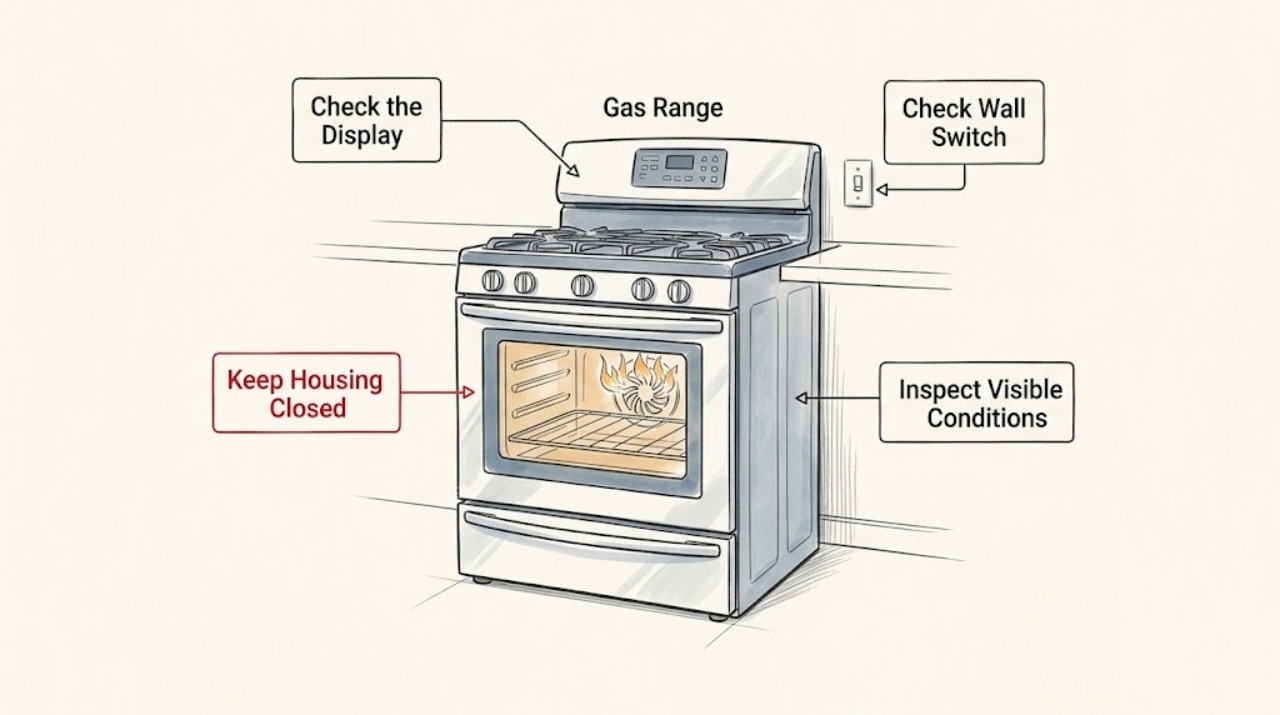
Flames coming out of an LG LSGL6335 convection-fan opening are not a normal fan-noise or oven-temperature question. Stop using the range immediately: do not relight it, open the oven door to look, run another bake or convection cycle, adjust a burner, or remove a panel. From a safe position, turn the oven control and other gas controls off only if doing so does not bring you near flame, smoke, or a suspected gas leak; if you smell gas, hear escaping gas, see continuing flame, or cannot shut it off safely, leave the area and follow local gas-emergency instructions. Do not rely on smell alone to rule out a leak. Contact the gas supplier or emergency service as appropriate, then an authorized LG appliance or licensed gas professional. The supplied LSGL6335 identity still needs its complete suffix and natural-gas/LP setup confirmed, but no suffix changes the immediate stop decision.
Before you begin
Safety first
- Do not relight the oven, open the door to observe the flame, run another bake/convection/self-clean cycle, adjust a burner or regulator, convert gas type, remove a fan guard or panel, disconnect gas, test live wiring, or attempt a leak/combustion test. Keep away from switches and ignition sources when gas may be present. Stop and leave immediately for continuing flame, gas odor or hissing, smoke, sparks, rapid heat, damaged wiring, or uncontrolled combustion.
Work through in order
Diagnostic checks
Use only checks that match the exact appliance or system and its official guide.
-
Check 1
Stop the bake/convection cycle without approaching the flame. Do not open the oven door, relight the oven, turn on another burner, or run a second test. If the controls are reachable from a safe position away from flame, smoke, and suspected escaping gas, turn the oven and cooktop controls off once; do not force a control that does not respond.
Expected result: The flame stops and the area is clear, flame continues, smoke or heat spreads, a control does not respond, or the source cannot be approached safely.
Next step: If flame continues, smoke spreads, or the controls cannot be shut off safely, leave immediately and contact local emergency/fire or gas response. Do not return to the appliance to inspect it.
Why this matters
Why: A flame at the convection opening is an active combustion/fire condition, not evidence of a normal fan cycle. Continuing to ignite or observe it can worsen gas accumulation, heat damage, or fire spread.
-
Check 2
From outside the immediate area, assess whether there is a gas odor, hissing, visible continuing flame, smoke, or a hot/burning smell. Do not operate electrical switches, phones located in the suspected gas area, matches, lighters, or other ignition sources while gas may be present.
Expected result: Gas is suspected, hissing or flame continues, smoke/heat is present, or no gas warning is noticed after the appliance is safely isolated.
Next step: Leave the area and follow local gas-emergency or fire-service instructions. Do not re-enter to close a hidden valve or retrieve items; responders can isolate the installation safely.
Why this matters
Why: LG warns that gas leaks may not be detectable by smell alone, so absence of odor does not make the range safe. Any continuing flame, hissing, smoke, or heat requires emergency handling rather than appliance troubleshooting.
-
Check 3
Only after the range is off, the area has been declared safe by the appropriate responder, and the appliance is cool, record the external facts without opening the oven: the exact location and color/shape of the flame if previously observed, the selected 350°F mode, whether the fan was running, which controls were on, and any display code or visible exterior damage.
Expected result: The event was limited to one mode, occurred during preheat or steady bake, continued after controls were off, or its timing/location cannot be confirmed safely.
Next step: Give the responder and LG service the recorded facts and any safe exterior photo taken after the event. Do not power the range to reproduce the flame or open the door for a better view.
Why this matters
Why: Mode and timing help a qualified provider distinguish a report involving the convection path from a broader gas or combustion event, but they do not identify a fan, burner, regulator, or control part. Do not infer normal preheat from a flame escaping an opening.
-
Check 4
Read the complete rating label only when it can be reached without moving or opening the appliance. Record every suffix, the serial number, and whether the installation uses natural gas or LP; do not remove a regulator cover, adjust an orifice, or change gas connections.
Expected result: The label identifies an LSGL6335F, LSGL6335D, another LSGL6335 suffix, a different model, or the gas type is unknown.
Next step: Provide the full label to LG or the licensed gas/appliance professional. If the model or fuel setup is different or unknown, keep the range isolated and do not use a nearby model's burner or fan instructions.
Why this matters
Why: LG lists LSGL6335F and LSGL6335D as separate gas slide-in range variants, and the official builder sheet describes natural-gas/LP capability and ProBake Convection for the LSGL6335 family. A suffix or conversion difference can affect the correct service literature, but it cannot make an escaping flame user-serviceable.
-
Check 5
Do not inspect or adjust the convection fan, fan guard, bake burner, ignitor, regulator, or combustion openings yourself. Tell the provider whether the range was recently installed, moved, converted to LP, cleaned, or serviced, and whether any control, knob, grate, or panel was disturbed.
Expected result: There was recent installation/movement/conversion/service, no such work is known, or the history is unknown.
Next step: Leave the range out of service and have an authorized LG service agency, licensed installer, or gas supplier inspect it. Do not attempt a burner adjustment, conversion correction, leak test, or internal repair.
Why this matters
Why: LG states that gas connection, installation, and LP conversion require qualified professionals. Recent work is relevant context for service but is not proof that a particular burner, fan, regulator, or fitting caused the flame.
-
Check 6
Protect people, pets, and nearby combustible materials from a safe location while waiting for help. Do not use the oven, cooktop, self-clean, convection, or warming functions, and do not reconnect or relight the range after a breaker or gas control has been changed by someone else until the professional clears it.
Expected result: The range remains isolated and cool, or heat/smoke/fire damage, damaged wiring, or a continuing gas concern remains.
Next step: For any continuing heat, smoke, damage, or gas concern, use emergency/fire/gas response. Otherwise schedule qualified LG appliance/gas service and do not resume use until the cause and safety of the complete installation are assessed.
Why this matters
Why: A gas range can have both gas and electrical hazards, and the visible flame does not reveal whether heat has damaged insulation, wiring, fan housing, or combustion parts. A safe-looking exterior is not a clearance to operate.
Use your observations
Decision map
Find the observation that best matches what you see, then follow the next safe action.
-
PATH 01Next step
What you see
A flame is still visible, gas is suspected, there is hissing, smoke, rapid heat, or the controls cannot be turned off safely.
Do this next
Leave immediately, keep away from ignition sources and switches, and follow local gas-emergency or fire-service instructions. Do not return to close a hidden valve or open the oven door.
Why this path and its safety boundary
Why it matters: This is an active gas/fire emergency. It is not a convection-fan diagnosis and must not be tested again.
-
PATH 02Next step
What you see
The visible flame stopped after a safe external control-off action, but it came through the fan opening at 350°F during bake or convection.
Do this next
Keep the range isolated and arrange authorized LG appliance service or licensed gas-professional inspection. Do not relight, open the door to inspect, or adjust the fan or burner.
Why this path and its safety boundary
Why it matters: The immediate flame may be out, but the range remains unsafe to operate. A stopped flame does not show whether the combustion path, fan area, gas control, regulator, ignitor, or wiring was damaged.
-
PATH 03Next step
What you see
The event followed installation, movement, LP conversion, cleaning, or other service, or the fuel type and full LSGL6335 suffix are unknown.
Do this next
Give the complete label and history to an authorized LG service agency, licensed installer, or gas supplier. Leave all gas connections, regulator settings, orifices, and fan/burner parts untouched.
Why this path and its safety boundary
Why it matters: Installation or fuel-configuration history is an important service clue, but it does not establish a failed part or make user gas adjustment safe. LG requires qualified gas installation and LP conversion.
-
PATH 04Next step
What you see
No flame, smoke, odor, or heat remains, but any attempt to determine the cause would require opening the door for viewing, removing a panel/guard, or running another cycle.
Do this next
Keep the range out of service until qualified LG/gas service verifies the installation and combustion path. Provide the mode, setting, flame location, exact model, fuel type, and recent work history.
Why this path and its safety boundary
Why it matters: The absence of a current warning does not establish a safe appliance. The required next step is controlled professional inspection, not a fan or burner experiment.
Helpful context
Understand the symptom
Treat visible flame at the fan opening as a gas and fire emergency
The baseline fan guidance covers normal hums, rattles, scraping, and fan-related codes. A flame appearing through an opening is a different first decision: stop operation before trying to identify the convection fan, burner, regulator, control, or airflow path. The LSGL6335 family is a gas range with ProBake Convection, but the visible symptom does not establish which gas or combustion component is involved and should not be reproduced.
Do not test the oven by opening the door or relighting it
LG says gas-range installation and service belong to an authorized licensed installer, service agency, or gas supplier. It also warns that gas leaks may not be detected by smell alone. Keep people away, avoid switches or ignition sources when gas may be present, and give the responder the exact model suffix, gas type, temperature setting, location of the flame, and whether controls were turned off from a safe position.
When checks do not resolve it
Need a professional?
Contact local emergency/fire or gas response immediately for continuing flame, suspected gas leak, hissing, smoke, rapid heat, or any unsafe shutoff situation. Once the area is safe, keep the range isolated and arrange an authorized LG appliance service agency, licensed gas installer, or gas supplier before any further use, even if the flame stopped.
Safety scope: Do not relight the oven, open the door to observe the flame, run another bake/convection/self-clean cycle, adjust a burner or regulator, convert gas type, remove a fan guard or panel, disconnect gas, test live wiring, or attempt a leak/combustion test. Keep away from switches and ignition sources when gas may be present. Stop and leave immediately for continuing flame, gas odor or hissing, smoke, sparks, rapid heat, damaged wiring, or uncontrolled combustion.
Have this ready
- Provide the complete LSGL6335 suffix and serial number, market, natural-gas or LP setup, selected 350°F mode, whether convection was enabled, exact fan-opening location, flame appearance and duration if safely observed, control response, display code, recent installation/movement/conversion/cleaning/service, smoke/odor/heat evidence, and whether anyone isolated the gas or power.
Common questions
FAQ
Is a flame coming from the LG LSGL6335 convection opening normal at 350°F?
No. Do not treat it as normal convection or preheating. Stop using the range, do not open the door or relight it, and obtain emergency/gas help for any continuing flame or suspected leak, followed by qualified LG service.
Can I open the oven door to see where the flame is coming from?
No. Do not open the door to observe or reproduce the event. A visible flame at an opening can involve gas, fire, and heat hazards that cannot be identified safely from the user side.
Does the LSGL6335 suffix or LP conversion change the immediate response?
It changes which manual and gas configuration a professional must verify, but not the immediate response: stop use and do not adjust the regulator, burner, or conversion yourself. LG says gas installation and LP conversion require qualified professionals.
Read the exact guide
Official sources
- LG Range – How to Install a Gas RangeLG Electronics USA · Opened official LG gas-range guidance used for the immediate stop/professional boundary; it does not diagnose the LSGL6335 flame path.
- Burner Flames Uneven, Large, Small - Gas Cooktops - Ranges | LG USA SupportLG Electronics USA · Opened official LG gas-range flame guidance; it concerns surface-burner flame quality and is used only to reinforce qualified LP/conversion and abnormal-combustion boundaries, not to infer an oven fan part.
- LSGL6335_ LG BUILDERLG Electronics USA · Opened official LG builder specification for the LSGL6335 family. It supports family-level gas/LP and convection identity, not a diagnosis or permission to inspect combustion parts.
- Oven Not Heating - Gas Ranges | LG USA SupportLG Electronics USA · Opened official LG gas-range guidance used only to distinguish ordinary heating checks from the emergency flame symptom; it does not support opening or testing the supplied range.
- LG LSGL6335F.BRSELGA: Support, Manuals, Warranty & MoreLG Electronics USA · Opened official LG support page for an LSGL6335 suffix variant; it confirms the LSGL6335 family is a gas slide-in range with ProBake Convection and supplies model-linked manuals. The task omits the complete suffix, so no suffix-specific procedure is applied.
Community feedback
Share a repair observation
Share a plain-text repair observation. Accepted observations are published automatically; this page may take a moment to update.