
On this page
Start here
Quick answer
An older LG oven that smells like burning plastic and sends smoke from below the control panel during preheating should be taken out of service. The opened case reports a previously serviced oven and a visibly burned wire at the relay-board area, but it does not establish an exact model or prove which component failed. Do not run another preheat, remove panels, patch a wire, replace a relay, or work on powered wiring. If it is safe to do so, disconnect the oven at its plug or breaker, keep clear of continuing smoke or heat, and arrange qualified appliance service with the complete model and serial information.
Before you begin
Safety first
- Do not continue heating, self-cleaning or troubleshooting cycles. Do not remove panels, touch scorched wiring, patch or crimp a wire, replace a relay, bypass a control or work on powered wiring. If smoke, flame or dangerous heat continues, leave and contact emergency services.
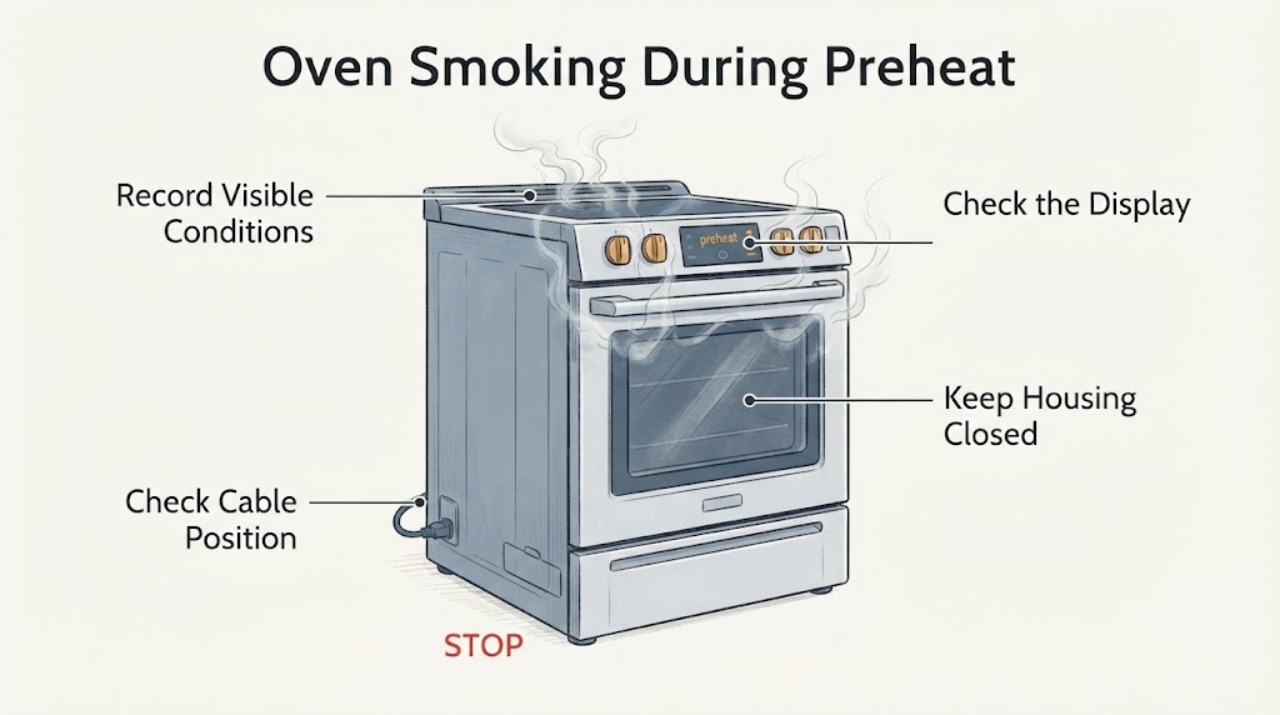
Work through in order
Diagnostic checks
Use only checks that match the exact appliance or system and its official guide.
-
Check 1
Stop the oven and note the symptom without starting another cycle. From a safe position, record whether the odor is plastic/electrical, where smoke emerged, whether the control area is unusually hot, and whether a breaker operated.
Expected result: The smoke or odor is from below the control panel or another electrical area, or there is visible heat, soot or continuing smoke.
Next step: Stop using the oven and proceed to safe power isolation and service; do not run a test bake or self-clean cycle.
Why this matters
Why: That pattern is consistent with a potentially damaged electrical connection or control-area component, and it cannot be treated as ordinary food residue or a normal new-range smell. The opened case reported this same preheat/control-panel pattern and a burned wire, but did not prove the failed part.
-
Check 2
Compare the event with the operating context only from the controls and the visible oven cavity: determine whether the oven is genuinely new and in first-use break-in, whether Self-Clean was active, whether EasyClean was active, or whether this happened during ordinary preheating on an older unit.
Expected result: The unit is older or the event occurred during ordinary preheating, with burning-plastic odor or smoke under the control panel rather than light vapor from a cleaning cycle.
Next step: Treat the event as a stop-use service issue and do not repeat the cycle to see whether the smoke returns.
Why this matters
Why: LG's normal smoke explanations cover new-range materials, Self-Clean smoke/odor and EasyClean water vapor. They do not explain a repeated electrical-smelling event from the control area on an older oven.
-
Check 3
If there is no active flame, spreading smoke or hot surface that makes approach unsafe, disconnect the oven's power using the normal plug or household breaker. Keep people away from the appliance and leave any damaged cover, wire or board untouched.
Expected result: The appliance is de-energized safely and no smoke or heat continues, or the area remains unsafe to approach.
Next step: For continuing smoke, flame or an unsafe electrical area, leave the area and contact local emergency services as appropriate. Otherwise keep the oven out of service and arrange qualified appliance repair.
Why this matters
Why: Removing power prevents another heating cycle while the condition is assessed. If power cannot be isolated safely or smoke/heat continues, the situation exceeds a user inspection and may be a fire emergency.
-
Check 4
Give the technician the complete model and serial information, the preheat setting if known, the timing of the smoke, any prior relay-board service, and clear exterior photos taken only while the appliance is cool and de-energized.
Expected result: The exact model is readable, or only a broad LG/EasyClean family description is available.
Next step: Ask LG support or a qualified appliance technician to identify the range and inspect the wiring/control area. Do not order a relay or harness from the symptom or a visually similar listing.
Why this matters
Why: An exact model is required to select the correct manual, wiring information and parts. The original case supplied a family-like description but no verified model, so its relay-board observations cannot establish fitment for every LG range.
Use your observations
Decision map
Find the observation that best matches what you see, then follow the next safe action.
-
PATH 01Next step
What you see
The range is genuinely new, the odor is light and temporary, and there is no burning-plastic smell, control-area smoke or visible damage.
Do this next
Follow the exact owner's manual for first-use ventilation and removal of packaging. Stop and seek service if the odor becomes strong, persists, or smoke comes from the control area.
Why this path and its safety boundary
Why it matters: LG says new-range insulation, leftover packaging and factory oil can cause temporary odor or smoke during break-in.
-
PATH 02Next step
What you see
Smoke or odor appears only during Self-Clean, or water vapor appears at the vents during an EasyClean cycle, with no electrical odor or control-area smoke.
Do this next
Use the exact model manual and the LG cleaning guidance; do not apply this explanation to ordinary preheating or a burned-plastic smell.
Why this path and its safety boundary
Why it matters: LG documents smoke/odor during Self-Clean and vapor during EasyClean as expected cleaning-cycle effects.
-
PATH 03Next step
What you see
An older LG oven produces burning-plastic odor or smoke during ordinary preheating, especially from below the control panel, or has a burned wire, soot or heat damage.
Do this next
Keep the oven out of service, isolate power only when safe, and arrange qualified appliance service. Do not remove covers, patch wiring, change a relay or re-energize the oven for a test.
Why this path and its safety boundary
Why it matters: This is outside the normal new-range and cleaning-cycle explanations. The opened case reports this exact symptom pattern and a burned relay-board-area wire, but not a confirmed universal cause.
-
PATH 04Next step
What you see
Smoke continues after the control is off, flames appear, the panel is dangerously hot, or the electrical area cannot be approached safely.
Do this next
Leave the area, keep others away, and contact local emergency services. Do not use water on an energized electrical appliance and do not return the oven to service until it has been assessed.
Why this path and its safety boundary
Why it matters: The event may be an active fire or electrical hazard rather than a routine appliance fault.
Helpful context
Understand the symptom
Why this smoke is not ordinary oven odor
LG documents a narrow set of normal odor and smoke situations: a new range can release odor from insulation, leftover packaging or factory oil, while Self-Clean can produce smoke and odor and EasyClean can release water vapor that looks like smoke. The opened case is different: the oven was older, the odor was described as burning plastic, the smoke appeared below the control panel during preheating, and the user reported a burned wire at the relay-board area. Treat that pattern as an electrical or heat-damage warning, not as a break-in cycle.
What the original case does and does not establish
The Reddit post confirms the symptom sequence and the user's observation, not a universal LG failure mode. It does not give a complete model number, a region, a verified wiring diagram, a confirmed relay failure or a successful repair. Comments suggest board and wire work, but those are unverified community suggestions and are not safe instructions for a reader. Use the case to recognize the stop-use threshold, then let a qualified technician identify the exact range and damage.
What to provide for service
Before contacting LG or an appliance technician, record the complete model and serial labels if they can be read without moving a hot or damaged appliance. Note whether smoke is still present, whether the control area became hot, whether a breaker operated, and whether the oven stopped heating. Do not open the rear cover or touch a scorched connector to collect more information. The complete model is needed before anyone can discuss a board, harness or other model-specific part.
When checks do not resolve it
Need a professional?
Safety scope: Do not continue heating, self-cleaning or troubleshooting cycles. Do not remove panels, touch scorched wiring, patch or crimp a wire, replace a relay, bypass a control or work on powered wiring. If smoke, flame or dangerous heat continues, leave and contact emergency services.
Have this ready
- Provide the complete model and serial labels, appliance type and age if known, the preheat setting, when the smoke started, whether the breaker operated, prior service records, and safe exterior photos. Tell the technician that the smoke appeared below the control panel and that a burned relay-board-area wire was reported in the case.
Common questions
FAQ
Could this just be normal smoke from a new LG oven?
Only if the appliance is genuinely new and the odor is the temporary break-in odor described by LG. An older oven with burning-plastic odor, smoke under the control panel or visible burned wiring does not fit that normal context and should remain off.
Should I run Self-Clean to burn the smell away?
No. LG documents smoke during Self-Clean as a cleaning-cycle effect, but that does not make it a safe test for smoke from an electrical control area during preheat. Do not run another cycle when the event involves burning plastic, visible smoke or a burned wire.
Can I replace the relay or reconnect the burned wire myself?
The opened case does not establish an exact model, wiring design or root cause. Do not open the oven, repair the wire or replace a relay based on a forum suggestion; keep the oven de-energized and have qualified service identify and repair the damage.
Read the exact guide
Official sources
- LG Range - EasyClean FAQLG USA Support · LG describes EasyClean as a low-temperature, water-based cleaning cycle and contrasts it with Self-Clean. This helps separate water-vapor cleaning behavior from an electrical-smelling preheat event; it does not provide relay or wiring instructions.
- General Maintenance and Cleaning - Ranges and CooktopsLG USA Support · LG's opened range maintenance page says EasyClean can release water vapor that looks like smoke and that smoke/odor may occur during Self-Clean. It establishes cleaning-cycle context and does not diagnose smoke from a control-panel wire during preheat.
- LG New Range - Strong Odor or SmokeLG USA Support · LG says a new range may smell or smoke because of ceramic-fiber insulation, leftover films/packaging or factory oil, and gives first-use steps. It is a contrast source for a genuinely new unit, not evidence that an older oven's electrical smoke is normal.
- LG Oven Smoking \ burned out relay board wireReddit r/appliancerepair · The opened post identifies an older LG electric range similar to an EasyClean freestanding range, burning-plastic odor during preheat, smoke below the control panel, prior relay-board service and a reported burned wire. It does not establish a complete model, official diagnosis, compatible part or repair outcome.
- New LG Microwave Burning Smell or Noise: Causes and SolutionsLG USA Support · Although the page title is microwave-focused, the opened LG support text explicitly includes an oven in the first-use discussion and says that continuing strong burning smell or visible smoke requires immediate stop, unplugging and LG service. It supports the safety boundary, not a model-specific relay diagnosis.
Community feedback
Share a repair observation
Share a plain-text repair observation. Accepted observations are published automatically; this page may take a moment to update.