
On this page
Start here
Quick answer
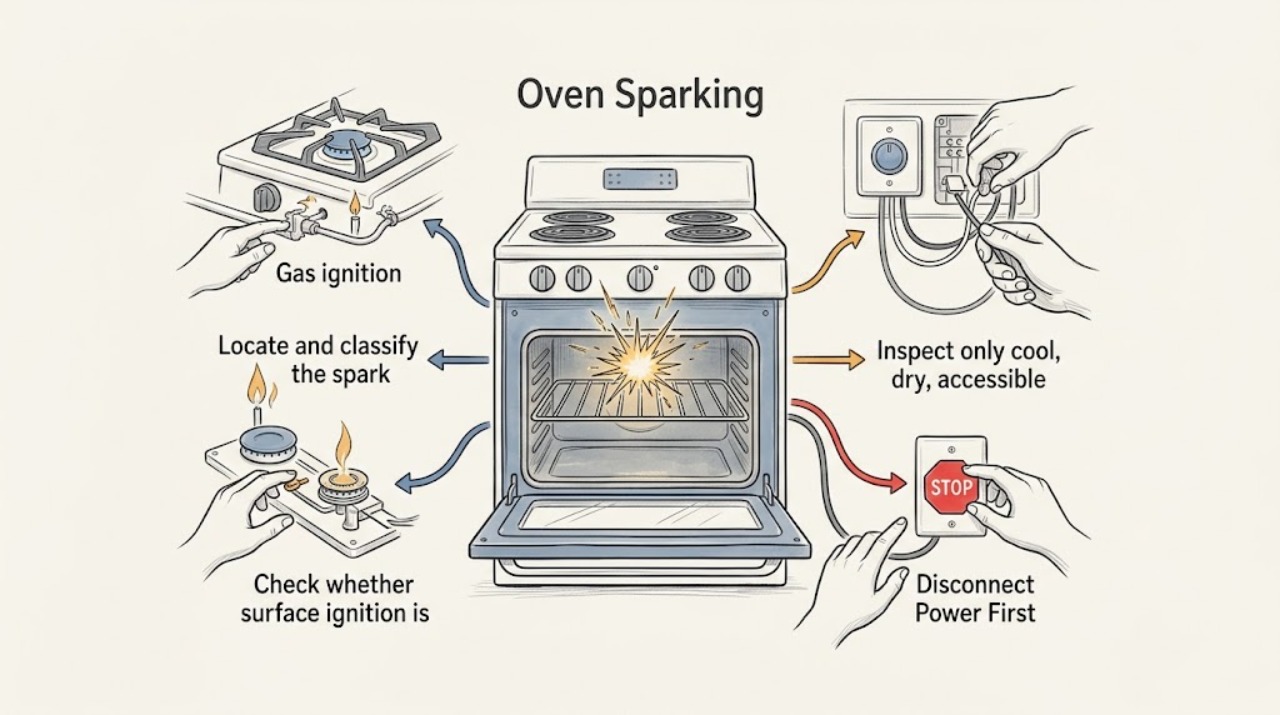
First locate the spark. On an LG gas range, a brief click and spark at a surface-burner electrode while a knob is turned to LITE can be normal ignition behavior; it should stop after the burner lights and the control is returned from LITE. A spark, flash, arc, or repeated clicking inside the oven cavity, at the control, or when no burner is being lit is not a normal user test. Turn the control off and stop. For a gas model, never keep trying to ignite when gas odor, delayed ignition, popping, an abnormal flame, smoke, or carbon-monoxide concern is present. For an electric oven, any visible arc or electrical crackle is a stop condition, not a normal heating sound. With the appliance cool and off, record the exact model, location, timing, controls, and error display; only clean an accessible, dry surface-burner area when the LG guide explicitly supports that low-risk step. Do not open panels, remove covers, or perform repeated ignition or live electrical tests.
Work through in order
Diagnostic checks
Use only checks that match the exact appliance or system and its official guide.
-
Locate and classify the spark
If there is no gas odor, smoke, heat damage, or active arc, turn all controls off and observe only from a safe distance. Record whether the spark was at a surface-burner electrode during LITE, inside the oven cavity, behind or near the control panel, at the plug or cord, or present without any control selected. Do not touch the appliance or open its panels.
Expected result: A brief spark occurs only at a gas surface burner during LITE; clicking or sparking continues after ignition; a flash or arc appears inside the oven; or the spark occurs at a control or power connection.
Next step: Follow the matching branch. For any oven-cavity or electrical spark, stop immediately and arrange qualified service; for gas odor, smoke, or flame abnormality, leave the area and seek emergency or gas-safety help from a safe location.
Why this matters
Why: LG identifies a brief surface-electrode spark during LITE as normal ignition behavior. A spark in an oven cavity or electrical area, or continued sparking after the intended ignition event, requires the appliance to stop rather than receive more tests.
-
Check whether surface ignition is within its normal window
Only for a gas surface-burner spark that occurs while the knob is intentionally at LITE and with no hazard symptom, observe whether the burner lights promptly and whether clicking stops when the control is moved from LITE to the intended setting. Do not repeat the sequence if the burner does not light, gas odor develops, or the flame is delayed or abnormal.
Expected result: The burner lights and sparking stops normally; clicking continues; the burner does not light; or there is gas odor, a pop, or an abnormal flame.
Next step: If ignition is not prompt and normal, turn the control off and arrange qualified gas-appliance service. Do not manually light, adjust gas flow, or keep cycling the knob.
Why this matters
Why: A short ignition spark at the electrode can be normal. Continued clicking or failed ignition can involve power, moisture, debris, burner assembly, gas availability, or a control fault; it is not a reason for repeated ignition.
-
Inspect only cool, dry, accessible burner surfaces
With the range off and cool, inspect the visible surface-burner cap, head, and electrode area for moisture, food residue, or a visibly misseated cap. If the LG guide for the exact model supports it, wipe or brush only the accessible dry surface and let it dry fully before any single normal use. Do not insert tools into gas openings, remove oven panels, or clean a hot or energized part.
Expected result: Moisture or residue is visible; the surface cap or head is visibly out of position; the accessible area is clean and dry; or the spark is not from a surface burner.
Next step: Correct only a clearly accessible, model-supported surface condition. If the spark persists, moves to an electrical or oven area, or the cap cannot be safely identified, stop and arrange service.
Why this matters
Why: LG identifies moisture, debris, and incorrect burner-cap or burner-head assembly as possible surface-ignition causes. These observations do not explain an oven-cavity arc or justify gas-line or electrical work.
-
Separate gas ignition from electric-oven arcing
Use the complete model number and LG manual to identify whether the oven is gas, electric, or a combination appliance. For gas equipment, note whether the symptom coincides with a documented ignition event; for electric equipment, note any arc, flash, or crackle at the cavity, element area, controls, cord, or outlet. Do not remove racks or covers to get closer to a suspected arc.
Expected result: The model is gas and the spark is limited to a surface burner; the gas oven shows an ignition-related flash or pop; the model is electric and an arc occurs; or fuel type is uncertain.
Next step: For any uncertainty, arc, flash, or pop, stop using the oven and arrange qualified service. Do not apply gas ignition checks to an electric oven or electric tests to a gas appliance.
Why this matters
Why: A gas surface-electrode spark can be part of normal ignition, while an electric-oven arc or a spark outside the intended gas ignition point is not a routine operating sound. Fuel identity determines the safe service path.
-
Check external power and error information without live testing
When the appliance is cool, dry, and free of gas odor or active electrical symptoms, record the displayed error, breaker position, and whether the surface controls respond. Check only the accessible plug and household breaker as the LG support guidance allows; do not use a meter on live parts, open the control area, or repeatedly reset a breaker.
Expected result: A breaker is open; the outlet or cord appears damaged; an error returns; power is normal but the spark or arc continues; or no code is shown.
Next step: Leave a damaged, wet, or repeat-tripping power path out of service and arrange qualified service. Provide the exact code, model, spark location, and timing; do not guess a replacement part.
Why this matters
Why: LG notes that inadequate power can prevent a range from sparking, while a returning code or persistent spark after external power is normal points to a control, ignition, or electrical fault.
-
Escalate an oven-cavity spark or persistent ignition fault
Stop all testing and record the model, fuel type, control position, spark location, sound, odor, flame behavior, code, and whether the problem happened during Bake, Broil, preheat, or a surface-burner start. Keep the oven out of service and request qualified LG repair for any oven-cavity spark, electrical arc, continued clicking, delayed ignition, or failed ignition.
Expected result: The symptom was a single normal surface-ignition spark and no longer occurs; the spark or clicking returns; an arc or flash is visible; or any gas, smoke, heat, or electrical hazard occurred.
Next step: Do not restart the oven to verify the diagnosis. Arrange qualified service; for persistent gas odor, smoke, or immediate fire or electrical danger, leave the area and seek local emergency help from a safe location.
Why this matters
Why: Normal surface ignition is limited to the intended gas-burner event. Recurrence, an oven-location spark, or any hazard symptom requires diagnosis of controls, wiring, ignition, burner, element, or safety systems by a professional.
Use your observations
Decision map
Find the observation that best matches what you see, then follow the next safe action.
-
PATH 01Next step
What you see
A brief spark occurs only at a gas surface-burner electrode while the control is at LITE, the burner lights promptly, and sparking stops normally.
Do this next
Treat that brief ignition spark as normal operation. If clicking continues, the burner fails to light, or any odor or abnormal flame appears, turn the control off and stop testing.
-
PATH 02Next step
What you see
Clicking or sparking continues after a gas surface burner lights, or the burner does not ignite promptly.
Do this next
Turn the control off and do not repeat ignition. Arrange qualified gas-appliance service for the ignition, burner, gas, or control path.
-
PATH 03Next step
What you see
A spark, flash, or arc appears inside the oven cavity, near an electric heating area, behind a control, at the cord, or when no burner is being lit.
Do this next
Stop using the oven immediately and do not open panels or restart it. Arrange qualified appliance service and keep people away from the hazard.
-
PATH 04Next step
What you see
A gas oven makes a delayed ignition, popping sound, abnormal flame, or gas odor occurs.
Do this next
Turn controls off, do not attempt another ignition, leave the area for persistent odor, and obtain qualified gas-appliance or emergency gas-safety help from a safe location.
-
PATH 05Next step
What you see
Moisture, debris, or a visibly misseated surface-burner cap is found and the LG model guide supports a cool, dry surface clean.
Do this next
Correct only that accessible surface condition and allow it to dry fully. If the spark persists or is not at the surface burner, stop and arrange service.
-
PATH 06Next step
What you see
A breaker trips, the cord or outlet is damaged or wet, smoke or burning odor occurs, or abnormal heat, arcing, or carbon-monoxide concern is present.
Do this next
Stop using the appliance and do not reset or retest it. If safe and dry, disconnect power without touching wet equipment; otherwise keep away and obtain qualified or emergency help.
Helpful context
Understand the symptom
Where the spark occurs changes the answer
A gas surface burner can make a short ignition spark at its electrode when its control is placed at LITE. That is different from a spark inside the oven cavity, at a control, from a cord, or when no burner is being lit. The location, timing, and whether gas is present matter more than the word sparking alone.
Do not treat an oven arc as a routine test
LG describes normal oven humming, clicking, and temperature-related popping, but a visible electrical arc, crackle, flash, or repeated spark in an oven is not a cue to keep testing. Turn controls off and stop. On a gas-capable model, gas odor, delayed ignition, popping, or an abnormal flame needs an immediate safety response.
Use model-specific guidance for any cleaning or reset
LG's burner guidance allows limited cleaning of dry, accessible burner surfaces for some surface-ignition complaints, but it does not make that a safe procedure for an oven cavity, wiring, igniter, or gas train. Record the model and exact symptom, then use the manual or qualified service for any persistent spark or arc.
Safety boundary
Stop conditions
- Stop immediately for any spark or arc inside the oven cavity, behind controls, at the cord or outlet, or when no intended gas ignition is occurring.
- For a gas appliance, stop for persistent gas odor, delayed ignition, popping, abnormal flame, smoke, carbon-monoxide concern, or repeated clicking after ignition; leave the area and seek emergency or gas-safety help as appropriate.
- Do not open panels, access live wiring, adjust gas pressure, loosen gas fittings, manually light the oven, or repeat an ignition test to reproduce a spark.
- Do not reset a breaker repeatedly or restart the appliance after smoke, burning odor, heat damage, electrical arc, or a returning error.
Only after diagnosis
Potential parts
- surface-burner electrode or igniter
Consider only when qualified diagnosis confirms a persistent surface-ignition fault after the accessible cap, head, moisture, debris, and power checks.
Confirm the complete model and manufacturer fit information; do not access energized ignition parts or repeat ignition tests. - oven ignition component
Relevant only for a gas model when qualified service traces an oven ignition failure or delayed ignition to the model-specific ignition path.
Do not open the oven or adjust gas components; use qualified gas-appliance service and exact model information. - electric heating element or terminal component
Relevant only when qualified diagnosis identifies an arc or heating fault in an electric or combination oven's element circuit.
Do not perform live tests or handle an arcing element; verify the exact model before service. - spark or electronic control module
Consider only when qualified diagnosis links continued ignition or control-area sparking to the model's control module.
A spark symptom alone does not identify this part; do not open the control area or defeat a safety system.
When checks do not resolve it
Need a professional?
Arrange qualified LG appliance or electrical service for any oven-cavity spark, electric-oven arc, persistent gas ignition clicking, delayed ignition, abnormal flame, recurring code, failed burner ignition, or spark that continues after the intended surface-burner event. Stop immediately for gas odor, smoke, carbon-monoxide concern, burning odor, heat damage, cord or outlet damage, arcing, or a repeated breaker trip.
Common questions
FAQ
Is a spark from an LG gas burner normal?
A brief spark at a surface-burner electrode while the control is at LITE can be normal ignition. It should stop after the burner lights and the control leaves LITE. Continued clicking, failed ignition, gas odor, delayed ignition, popping, or abnormal flame requires stopping and qualified service.
What if the spark is inside my LG oven?
Stop using the oven and do not restart it to check again. An oven-cavity flash or electrical arc is different from a brief surface-burner ignition spark and requires qualified diagnosis. Smoke, burning odor, heat damage, or an active arc is an immediate stop condition.
Can moisture or debris cause an LG range spark problem?
LG identifies moisture, debris, and a misseated burner cap or head as possible surface-ignition causes. Only when the range is cool and the model guide supports it should an accessible dry surface be cleaned. Do not access gas openings, oven panels, or energized parts.
Should I keep trying to ignite a gas LG oven?
No. Do not repeat ignition after a failed or delayed attempt, especially if there is gas odor, popping, an abnormal flame, smoke, or carbon-monoxide concern. Turn controls off, leave the area for persistent odor, and seek qualified or emergency gas-safety help.
What information helps LG service diagnose sparking?
Provide the complete model number, fuel type, exact spark location, control position, cycle stage, whether a surface burner was being lit, clicking or popping sound, flame behavior, odor, error code, breaker and outlet result, cord condition, and any smoke, heat, arc, or carbon-monoxide concern.
Read the exact guide
Official sources
- LG Range - Troubleshooting a Burner Not Igniting On My LG RangeLG USA Support · LG range power, breaker, and accessible burner-igniter cleaning guidance
- LG Electric Range / Gas Range: Power IssuesLG USA Support · LG electric and gas range external power, breaker, settings, and service guidance
- LG Range - Why Won't My Burner LightLG USA Support · LG gas-range supply, burner-cap, moisture, debris, electrode, and ignition guidance
- LG Range – Troubleshooting the Control PanelLG USA Support · LG range control-panel error, lock, reset, and service guidance
- LG Range – Troubleshooting Noises During OperationLG USA Support · LG range gas ignition clicking, normal oven sounds, burner cleaning, overheating, and service guidance
- Oven Not Heating - Gas Ranges | LG USA SupportLG USA Support · LG gas-range gas valve, error, hot-surface igniter, and model-manual guidance
Community feedback
Share a repair observation
Share a plain-text repair observation. Accepted observations are published automatically; this page may take a moment to update.