
On this page
Start here
Quick answer
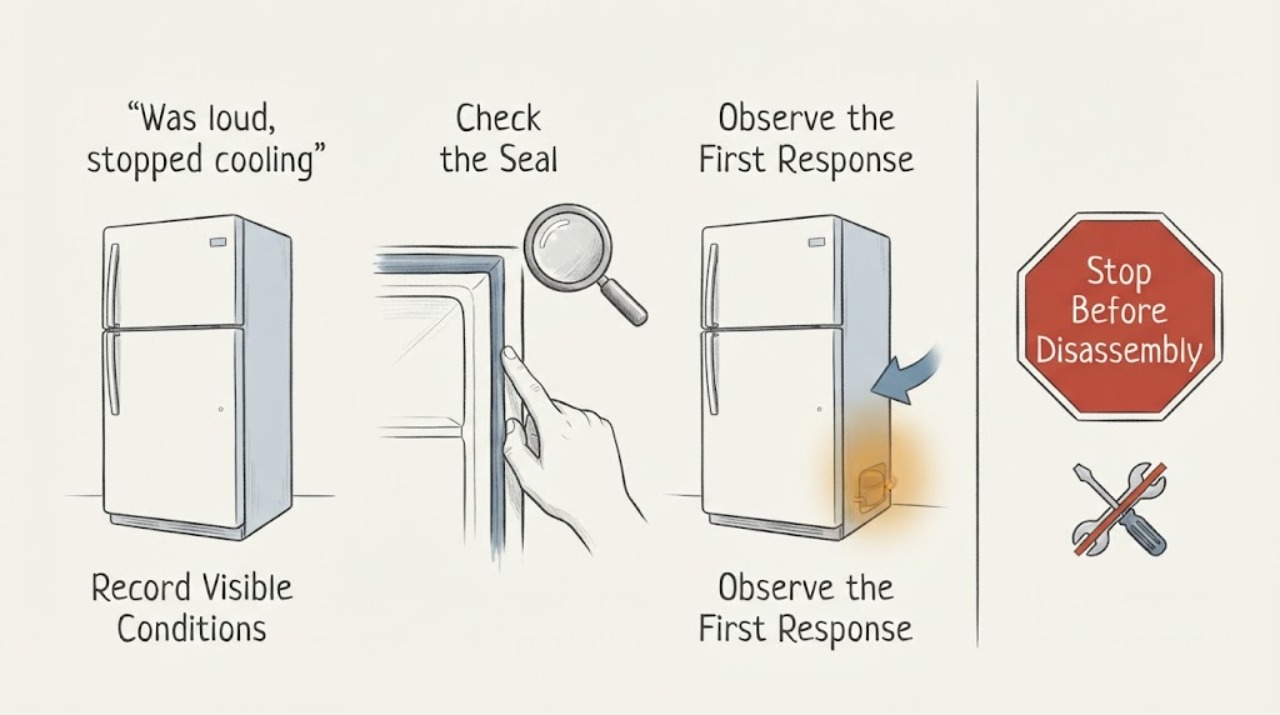
Do not treat a return to quiet operation or a temporarily cold cabinet as proof that the LG LSXS26386S/00 is repaired. First protect the food, then measure the refrigerator and freezer with an appliance thermometer, record the loud/no-cooling episode and check only the external settings, air vents, doors and accessible airflow. LG identifies this model as a side-by-side refrigerator with a Linear Compressor, Multi-Air Flow and LoDecibel operation, but those specifications do not identify the cause of an intermittent noise or cooling loss. If either compartment is still above the safe range, the loud event returns, or cooling drops again after recovery, stop relying on it for perishables and arrange qualified service without opening the sealed system.
Work through in order
Diagnostic checks
Use only checks that match the exact appliance or system and its official guide.
-
Check 1
Place an appliance thermometer in the middle of the refrigerator compartment and another in the freezer, keep both doors closed as much as practical, and record the actual readings, the time, the control settings and whether food is soft or warming. Use the label to confirm LSXS26386S/00 before saving the notes.
Expected result: The refrigerator is at or below 40°F (4°C) and the freezer is at or below 0°F (-18°C), or one or both compartments are warmer than those limits; the readings may also be changing rather than stable.
Next step: Move perishable food to a known-safe cold appliance if a compartment is above its safe range. If the time food spent warm is uncertain, discard it rather than relying on appearance or smell; preserve the temperature log for service.
Why this matters
Why: FDA treats 40°F or below for the refrigerator and 0°F for the freezer as the safety targets and recommends an appliance thermometer. A normal reading now shows the current condition only; it does not erase the earlier loss of cooling or establish that an intermittent fault is gone.
-
Check 2
Write a short event log without opening the appliance: when the noise began, whether it was a hum, buzz, scrape, click, vibration or another sound, where it was loudest (inside a compartment, rear lower area or cabinet), whether both compartments warmed, and whether the sound stopped before cooling returned. Record whether the noise changes when a door is opened normally, but do not hold a door switch or reach behind panels.
Expected result: The sound was a one-time event with stable safe temperatures, or it returns during a temperature rise, becomes louder, is accompanied by repeated clicking/vibration, or the refrigerator becomes quiet while temperatures rise.
Next step: If the loud/no-cooling combination returns, stop using the unit for perishables and request qualified service with the recording, temperature log, model suffix and event timing. Do not repeatedly restart the refrigerator to chase the sound.
Why this matters
Why: The exact LG specification calls this model LoDecibel, so a new disruptive sound is useful evidence to preserve, but neither the specification nor the symptom alone identifies a compressor, fan, relay or sealed-system part. Noise and cooling loss occurring together are a different service signal from a refrigerator that is simply audible while maintaining safe temperatures.
-
Check 3
With the controls unlocked if necessary, compare the displayed refrigerator and freezer settings with the LSXS26386S/00 owner documentation, then look from inside for packages blocking the cold-air outlets. Check that shelves, drawers and door bins do not prevent either door from closing fully and that the gaskets contact evenly; do not remove an interior panel.
Expected result: A setting is warmer than intended, an outlet is blocked, a container holds a door open, or a gasket has a visible gap; alternatively, settings, outlets and doors are all normal while temperatures remain high.
Next step: Correct only the visible setting, food placement or door obstruction and monitor the actual temperatures with the doors closed. If the external conditions are already correct or the temperatures fall again, stop changing settings and arrange service.
Why this matters
Why: LG's troubleshooting guidance links high settings, blocked air circulation and warm air entering through an incompletely closed door to weak cooling. Correcting one of those external conditions can explain a temporary warm reading, but it does not explain away a repeat loud event with renewed temperature loss.
-
Check 4
If the rear lower area can be viewed without moving the refrigerator, check for an obvious accumulation of dust or debris around the exterior mechanical-compartment cover. If cleaning is permitted by the model instructions and can be done safely, unplug the refrigerator before gently vacuuming accessible dust; do not remove the cover, pull the unit out, or touch moving or sealed-system parts.
Expected result: The accessible rear area is heavily dusty, or it is clear while the unit still has the loud/no-cooling history; there may also be a damaged cord, water, burning odor or a breaker trip.
Next step: After safe external cleaning, make one normal observation rather than repeated test cycles. If temperatures do not remain safe, the noise returns, or any electrical or water hazard is present, keep the refrigerator off and obtain service.
Why this matters
Why: LG says dust around the rear mechanical compartment can weaken cooling and specifically calls for removing power before cleaning. That is an external airflow check, not evidence that a dirty area caused the full event, and it cannot rule out an intermittent internal fault.
-
Check 5
After any visible obstruction or setting correction, continue the temperature log and note whether cooling remains stable through normal compressor cycling and ordinary door use. Do not use a short period of cold air, a quiet cabinet or a single successful restart as a repair test, and do not open the refrigeration circuit.
Expected result: Both compartments remain within the safe measured range and the noise does not recur, or the temperature rises again, the loud event recurs, the unit repeatedly stops and starts, or only one compartment recovers.
Next step: For recurrence, stop storing perishables in the refrigerator and request model-specific diagnosis. Provide the exact suffix, both temperature logs, the noise description or recording, power history, and what external checks were completed.
Why this matters
Why: Stable measured temperatures reduce the immediate food-safety risk but do not identify why the earlier event happened. A repeat temperature rise or noise/cooling pairing is evidence that the problem is intermittent or unresolved and is more useful to a technician than a guessed component name.
Use your observations
Decision map
Find the observation that best matches what you see, then follow the next safe action.
-
PATH 01Next step
What you see
Both measured compartments are at safe temperatures, the doors and air outlets are clear, and the loud event does not recur during ordinary observation.
Do this next
Keep the temperature log for a qualified technician and continue to verify with thermometers; do not buy a compressor, fan or control from the temporary recovery alone.
Why this path and its safety boundary
Why it matters: The refrigerator is currently operating within the measured safety targets, but the previous loud/no-cooling episode remains an unresolved history rather than a confirmed repair.
-
PATH 02Next step
What you see
The refrigerator or freezer is above its safe temperature, food has already warmed, or the time above the safe range cannot be established.
Do this next
Transfer only food with a documented safe temperature history, discard uncertain perishables according to FDA guidance, and arrange service while keeping the affected appliance from being relied on for storage.
Why this path and its safety boundary
Why it matters: This is first a food-safety problem, not a parts-identification problem. A cold reading later cannot make previously unsafe food safe.
-
PATH 03Next step
What you see
The unusual noise returns together with a temperature rise, repeated clicking or vibration, or a quiet period in which cooling is lost.
Do this next
Stop using the refrigerator for perishables, save the sound and temperature record, and request qualified LG or appliance service. Do not remove panels, test live terminals, touch the compressor or add refrigerant.
Why this path and its safety boundary
Why it matters: The combination is a repeatable service symptom, but it does not distinguish a fan, compressor, start device, control or sealed-system cause from user-visible observations alone.
-
PATH 04Next step
What you see
A package or shelf blocks an outlet, a door does not seal, or the setting is warmer than intended, and the measured temperature improves after the visible correction.
Do this next
Leave the vents and doors clear, continue measuring, and call for service if the noise or loss of cooling returns.
Why this path and its safety boundary
Why it matters: The external condition can account for the immediate weak-cooling observation, consistent with LG's general guidance, but it does not prove that the earlier loud event was caused by that condition.
-
PATH 05Next step
What you see
There is a burning odor, smoke, arcing, a damaged cord, water near electrical parts, a repeated breaker trip, or the cabinet becomes abnormally hot.
Do this next
Stop using the refrigerator and isolate power only if it can be done without contact with water or damaged wiring; keep clear and obtain appropriate qualified or emergency help.
Why this path and its safety boundary
Why it matters: This is an electrical, water or fire-safety stop condition beyond a user cooling check.
Helpful context
Understand the symptom
This is an intermittent-cooling decision, not a confirmed compressor diagnosis. The exact LG support page identifies LSXS26386S as a 26 cu. ft. Door-in-Door refrigerator and provides the model's documentation route. Confirm that the label really ends in /00 before using any model-specific document; a nearby suffix can have different instructions.
Because food was already lost, keep the doors closed while you move only food that is clearly safe to a known-cold appliance. Do not taste food to decide whether it is safe. A refrigerator thermometer is more useful than the control-panel target because the display is a setting, not proof of the current internal temperature.
LG's specification lists Linear Compressor, Multi-Air Flow and LoDecibel operation. Those features provide context for recording a new loud event, but they do not prove that the compressor, fan, relay, refrigerant charge or control has failed. Do not remove a rear cover, touch the compressor, add refrigerant, or keep power-cycling the unit to reproduce the symptom.
When checks do not resolve it
Need a professional?
Request qualified service if the exact LSXS26386S/00 remains warm after the visible setting, airflow and door checks; if either compartment repeatedly rises above the safe measured range; if the loud event returns with cooling loss; or if the unit needs a panel removed, a component tested, the compressor or fan accessed, or the refrigeration circuit opened. Stop immediately for smoke, arcing, a burning odor, damaged wiring or cord, water near electrical parts, abnormal heat or repeated breaker trips. Do not add refrigerant, test live terminals, remove the rear cover, or keep power-cycling the refrigerator to reproduce the symptom.
Common questions
FAQ
If the LG refrigerator is quiet and cold again, is it fixed?
Not necessarily. Verify actual refrigerator and freezer temperatures and watch for a recurrence of the noise or temperature rise. A temporary recovery is evidence about the current state, not a component diagnosis.
Can I replace the compressor or add refrigerant because it was loud and stopped cooling?
No. The symptom does not identify a part or confirm a sealed-system problem. Keep the appliance closed and arrange qualified diagnosis; do not open the refrigeration circuit or perform live testing.
What should I do with food after the cooling failure?
Use an appliance thermometer and the known temperature history. FDA says the refrigerator should be 40°F or below and the freezer 0°F; if the duration above the safe range is uncertain, do not take a chance with the food.
Read the exact guide
Official sources
- If Your LG Refrigerator Is Not Cold EnoughLG USA · Opened LG's official help article; it says high temperature settings, blocked air vents and doors that do not close fully can reduce cooling, and directs support if the issue persists. It notes that settings may vary by model.
- LSXS26386 Ultra Large Side-By-Side Refrigerator with Door-in-Door — SpecificationLG Electronics USA · Opened LG's official specification PDF for the LSXS26386 series; it identifies the side-by-side design and lists Linear Compressor, Multi-Air Flow, five temperature sensors and LoDecibel operation. It does not diagnose an intermittent noise.
- LG LSXS26386S.ASTCNA0 — Support, Manuals, Warranty & MoreLG USA · Opened LG's official product-support page; it identifies the LSXS26386S 26 cu. ft. Door-in-Door refrigerator, provides owner-manual links, and lists the model-family warranty terms. Verify the /00 suffix on the appliance label before applying model-specific documents.
- LG Refrigerator — Why Isn't My Freezer Cooling Properly?LG USA · Opened LG's official help article; it links dust around the rear mechanical compartment with weak freezing and tells the reader to remove power before accessible vacuuming. The article warns that content can differ by model.
- Refrigerator Thermometers — Cold Facts about Food SafetyU.S. Food and Drug Administration · Opened the FDA consumer guidance; it recommends an appliance thermometer, refrigerator temperature at or below 40°F and freezer at 0°F, and discarding food when the time above the safe range is uncertain.
Community feedback
Share a repair observation
Share a plain-text repair observation. Accepted observations are published automatically; this page may take a moment to update.