
On this page
Start here
Quick answer
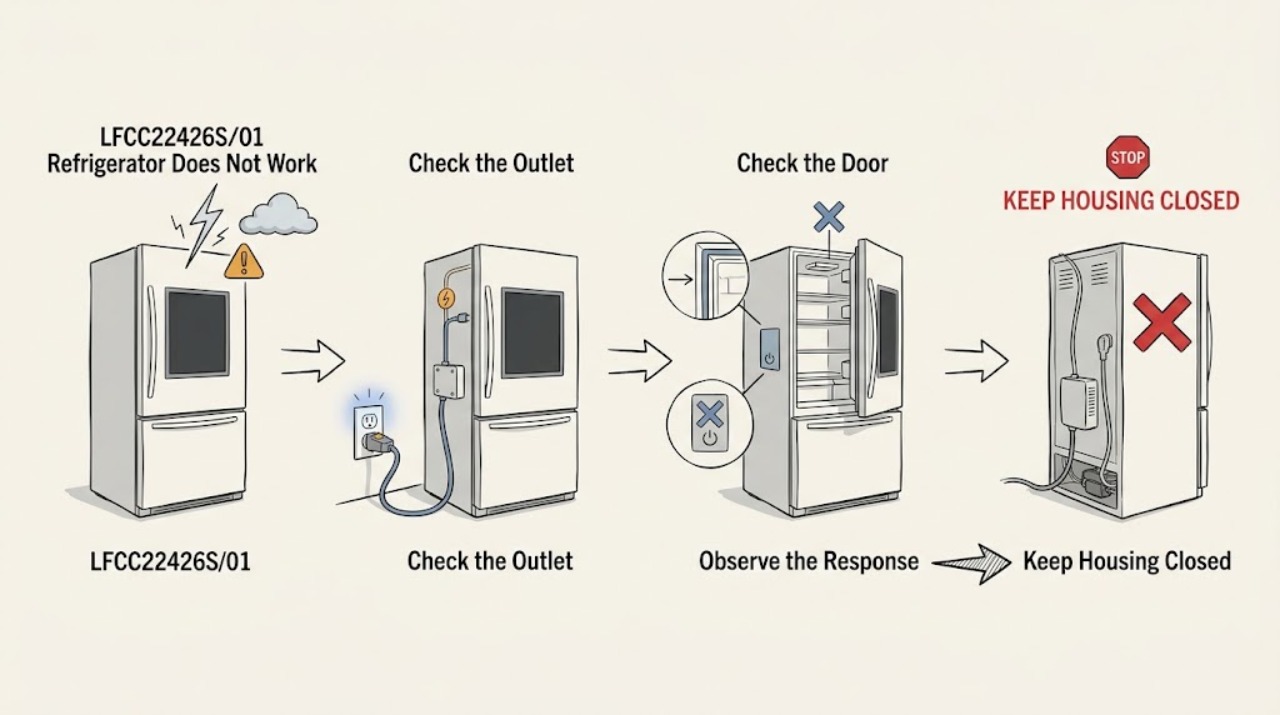
If the LG LFCC22426S/01 stopped working after a lightning strike, treat it as a possible electrical and food-safety event, not as proof that one control board or compressor failed. Keep the refrigerator and freezer doors closed, do not repeatedly restore power, reset the breaker, or open the cabinet, and keep away from a wet, hot, scorched, sparking, or smoking connection. From a dry safe location, record when the strike occurred, whether the home or outlet also lost power, whether the breaker trips, and whether any lights or display were already on before the event. Do not touch a plug or outlet with wet hands or perform a live test. LG's no-power guidance separates a loose plug, power strip, faulty outlet, and building electrical problem, and directs service when the breaker trips as the refrigerator is connected or turned on. After a lightning event, have a licensed electrician assess the supply and a qualified LG appliance technician assess the refrigerator before normal re-energizing if there is any trip, heat, odor, scorch mark, or complete loss of operation. Protect food separately: keep doors closed, use a food thermometer if available, and follow FDA power-outage guidance rather than relying on appearance or smell.
Work through in order
Diagnostic checks
Use only checks that match the exact appliance or system and its official guide.
-
Check 1
Stop using the refrigerator after the lightning event. From a dry, safe position, look only for smoke, sparks, heat, a melted or scorched plug, a damaged cord, water near the outlet, or a breaker that will not remain on. Do not touch the plug, outlet, breaker, or cabinet if wet or damaged.
Expected result: There is smoke, sparking, heat, a scorch mark, a burning odor, water near electrical parts, a damaged cord, or the breaker trips again; or there is no visible hazard and the failure is limited to no display, no interior light, or no cooling.
Next step: Keep people away and obtain emergency or electrical help for smoke, fire, sparking, or heat. If the area is dry and safe, isolate power only by a safe accessible method; otherwise leave the area untouched and ask a licensed electrician and qualified LG appliance technician to assess it.
Stop if: Do not repeatedly reset the breaker, reinsert the plug to see whether it starts, pull a plug through water, open an electrical panel, remove covers, or perform a live electrical test.
Why this matters
Why: A visible electrical hazard or repeated trip makes this an immediate stop-use condition. A clean-looking exterior does not clear surge damage, so the refrigerator's complete failure after the strike still needs professional assessment rather than a guessed component.
-
Check 2
Preserve food while the refrigerator is off. Keep both doors and drawers closed, note the time of the lightning or power loss, and read an appliance thermometer if one is already available without prolonged door opening. Do not taste food or use smell alone to decide whether it is safe.
Expected result: The refrigerator has stayed closed and the compartment is at or below 40°F; the outage duration is known to be 4 hours or less; or the temperature is above 40°F, the duration is uncertain, or food may have been warm longer.
Next step: Move perishable food to a safe cooler with ice or follow current FDA food-disposal guidance when the safe time or temperature cannot be established. Keep the refrigerator off until the electrical and appliance assessments are complete.
Stop if: Do not repeatedly open the doors to check coldness, operate the refrigerator to save food after an electrical hazard, or keep food that has an uncertain unsafe temperature solely because it looks or smells normal.
Why this matters
Why: FDA uses temperature and elapsed time, not appearance or odor, to guide food decisions during a power outage. Food preservation is separate from determining whether the refrigerator can be safely powered again.
-
Check 3
From a dry position, document the home's power pattern without touching wiring: whether nearby lights or other appliances work, whether the refrigerator was on a power strip or dedicated wall outlet, whether the outlet appears damaged, and whether the breaker is currently off or has tripped. Do not use the refrigerator itself as the test load.
Expected result: The whole circuit or room is without power; other loads work but the refrigerator outlet is dead; the outlet works but the refrigerator remains completely dark; or the breaker trips only when the refrigerator is connected or turned on.
Next step: Use a licensed electrician for a dead or damaged outlet, a breaker that will not hold, or a circuit affected by the strike. Use qualified LG appliance service for a working supply with a refrigerator that remains dead; provide the timeline and observations rather than asking for a part from the symptom.
Stop if: Do not reset a breaker repeatedly, move the refrigerator to another outlet, use an extension cord or power strip as a workaround, open the outlet, or measure energized wiring.
Why this matters
Why: A wider outage or dead outlet keeps the building supply, outlet, or breaker first. A working outlet with a completely dead refrigerator makes internal surge or power-entry damage possible, but does not identify a board or compressor. A trip tied to the refrigerator is a stop-use signal.
-
Check 4
Record the refrigerator's post-event state from outside: interior light or display status if visible without opening the door for long, compressor or fan sound only as an observation from a safe distance, temperature trend from an existing thermometer, and any error or alarm that appears without restoring power repeatedly. Include the complete rating-plate model and serial information.
Expected result: The unit is completely dark, the light works but cooling is absent, an error or alarm returns, temperatures rise, or the exterior shows no obvious damage but operation does not return after a professional confirms the supply is safe.
Next step: Keep the refrigerator off when the supply has not been cleared or any hazard remains. Give LG service the event time, power pattern, model suffix, temperature record, displayed message, and visible damage; ask the technician to assess surge-related damage before any part recommendation.
Stop if: Do not remove the rear cover, touch the compressor or start device, bypass protection, open control compartments, or continue operation to make a noise or failure recur.
Why this matters
Why: Different power and cooling states require different service paths. A dark unit suggests power-entry or control-path investigation; a lit but warm unit leaves controls, fan, sealed-system, and other possibilities open. None of these observations proves a single failed part after a lightning event.
-
Check 5
Prepare a service handoff instead of attempting a repair. Photograph the rating label, outlet and plug only from a dry safe position, note the lightning and power timeline, breaker behavior, whether other household circuits work, food temperatures, and any odor, scorch, smoke, or alarm.
Expected result: The electrical supply is cleared but the refrigerator stays off, the supply cannot be cleared, the model suffix is uncertain, or the event left visible damage or a recurring trip.
Next step: Use a licensed electrician for the outlet, circuit, breaker, grounding, and surge aftermath, and qualified LG appliance service for the LFCC22426S/01. Keep the refrigerator disconnected until the responsible professional says it is safe to energize.
Stop if: Do not open the cabinet, replace a fuse, install a surge workaround, bypass a protective device, or reconnect the refrigerator for a trial after a lightning strike.
Why this matters
Why: A lightning event can involve both household wiring and appliance electronics. The correct next decision is coordinated electrical and appliance assessment, not a board, compressor, fuse, or harness diagnosis from the outside.
Use your observations
Decision map
Find the observation that best matches what you see, then follow the next safe action.
-
PATH 01Next step
What you see
The lightning event was followed by smoke, sparking, heat, scorch marks, a burning odor, water near the electrical connection, a damaged cord, or a breaker that will not remain on.
Do this next
Keep people away, leave the refrigerator off, and obtain emergency or licensed electrical help as appropriate. Do not reset or reconnect it for a test; appliance service follows only after the supply is safe.
Why this path and its safety boundary
Why it matters: This is an active electrical or fire hazard. The sequence is enough to stop use, but not enough to identify which internal component was damaged.
-
PATH 02Next step
What you see
Other household loads are also dead or the refrigerator's outlet is dead, while the LFCC22426S/01 has no display or light.
Do this next
Use a licensed electrician to assess the affected circuit and outlet. Keep the refrigerator doors closed for food safety and do not move it to another outlet or use an extension workaround.
Why this path and its safety boundary
Why it matters: A building, circuit, outlet, or breaker problem is more likely than an immediately proven refrigerator part failure. The lightning timeline still makes repeated energizing unsafe.
-
PATH 03Next step
What you see
The outlet and household supply are professionally cleared, but the refrigerator remains completely dark after the lightning event.
Do this next
Keep the refrigerator off and request qualified LG appliance service using the full LFCC22426S/01 rating-plate identity. Ask for an assessment of surge-related damage before any part is specified.
Why this path and its safety boundary
Why it matters: Internal power-entry, protection, or control damage is possible, but the external symptom does not distinguish a board, harness, fuse, or compressor path.
-
PATH 04Next step
What you see
The interior light or display returns, but the compartments warm or an alarm/error persists after the supply is cleared.
Do this next
Keep doors closed as much as practical, record the temperature and any message, and arrange qualified LG appliance service. Do not touch the compressor, start device, control board, or refrigerant circuit.
Why this path and its safety boundary
Why it matters: Power is present, but cooling, control, fan, or sealed-system behavior remains unresolved. The strike timing is relevant history, not a component diagnosis.
-
PATH 05Next step
What you see
Food has been above 40°F for 4 hours or more, the duration or temperature is uncertain, or the refrigerator or freezer was repeatedly opened during the outage.
Do this next
Follow FDA power-outage food guidance and discard perishable food when the safe temperature history cannot be established. Keep the appliance off until electrical and appliance professionals clear it.
Why this path and its safety boundary
Why it matters: Food safety takes priority over recovering the appliance. Appearance and odor cannot establish that perishable food is safe after an extended warm period.
Helpful context
Understand the symptom
Treat the lightning timeline as an electrical stop signal
A refrigerator that dies immediately after a lightning event has a different first decision from an ordinary no-power complaint: preserve food, avoid re-energizing a potentially damaged circuit, and separate the home's supply from the refrigerator's internal fault. The event timing is important evidence, but it does not identify a board, compressor, fuse, or other part.
Confirm LFCC22426S/01 before service uses a variant document
LG's product page identifies the LFCC22426S counter-depth French-door refrigerator family and links manuals and support. The task identity includes the /01 suffix, so give the technician the complete rating-plate model and serial details; do not assume that a document for another LFCC22426S suffix proves the same internal protection or service procedure.
When checks do not resolve it
Need a professional?
Use a licensed electrician for the home's outlet, circuit, breaker, grounding, or surge aftermath. Use qualified LG appliance service after the supply is safe for a refrigerator that remains dead, warms, alarms, or shows visible damage. Coordinate both providers when the timing indicates that the home supply and appliance may both be affected.
Have this ready
- Provide the complete LFCC22426S/01 rating-plate identity and serial information, lightning and power timeline, breaker and outlet behavior, whether other household loads work, plug or cord observations, interior-light/display state, temperature record, food-storage duration, and photographs taken from a dry safe position.
Common questions
FAQ
Should I reset the breaker to see if the refrigerator starts after lightning?
Do not repeatedly reset or reconnect the refrigerator after a lightning event. If the breaker trips, will not hold, or the refrigerator trips it when connected, leave the appliance off and use a licensed electrician and LG appliance service. A single no-power symptom does not identify a safe reset or a replacement part.
Can I move the LFCC22426S/01 to another outlet?
Do not use another outlet, extension cable, or power strip as a workaround after a lightning event. First have the affected supply assessed. LG's support guidance distinguishes a faulty outlet or building electrical problem from a refrigerator fault; moving the appliance can hide the original hazard and does not diagnose internal damage.
How should I handle the food while the refrigerator is off?
Keep the refrigerator and freezer doors closed. Use an appliance thermometer if one is available and follow FDA power-outage guidance: refrigerated food should be discarded when it has been above 40°F for 4 hours or more, and appearance or odor is not a reliable safety test.
Does the lightning strike prove the control board or compressor is bad?
No. The strike is an important time-linked clue, but a complete no-power condition can involve the home supply, outlet, breaker, power entry, protection, controls, or other appliance paths. Have the supply cleared first and let qualified LG service identify the internal fault with the full model suffix.
Read the exact guide
Official sources
- LG LFCC22426S: Support, Manuals, Warranty & MoreLG Electronics · Opened LG USA product-support page identifies LFCC22426S.ASTCNA1, links its manuals and repair route, and shows the LFCC22426S family. It does not independently prove that the task's /01 suffix is identical, so the complete rating label remains required.
- Food and Water Safety During Power Outages and FloodsU.S. Food and Drug Administration · Opened FDA emergency food-safety guidance used only for food handling after the lightning-related power loss, not for diagnosing or repairing the refrigerator.
- If Your LG Refrigerator Has No Power or the Circuit Breaker TripsLG Electronics · Opened LG refrigerator support guidance for external no-power triage. It is not used to infer a lightning-damaged internal part or to authorize repeated reconnection after a strike.
Community feedback
Share a repair observation
Share a plain-text repair observation. Accepted observations are published automatically; this page may take a moment to update.