
On this page
Start here
Quick answer
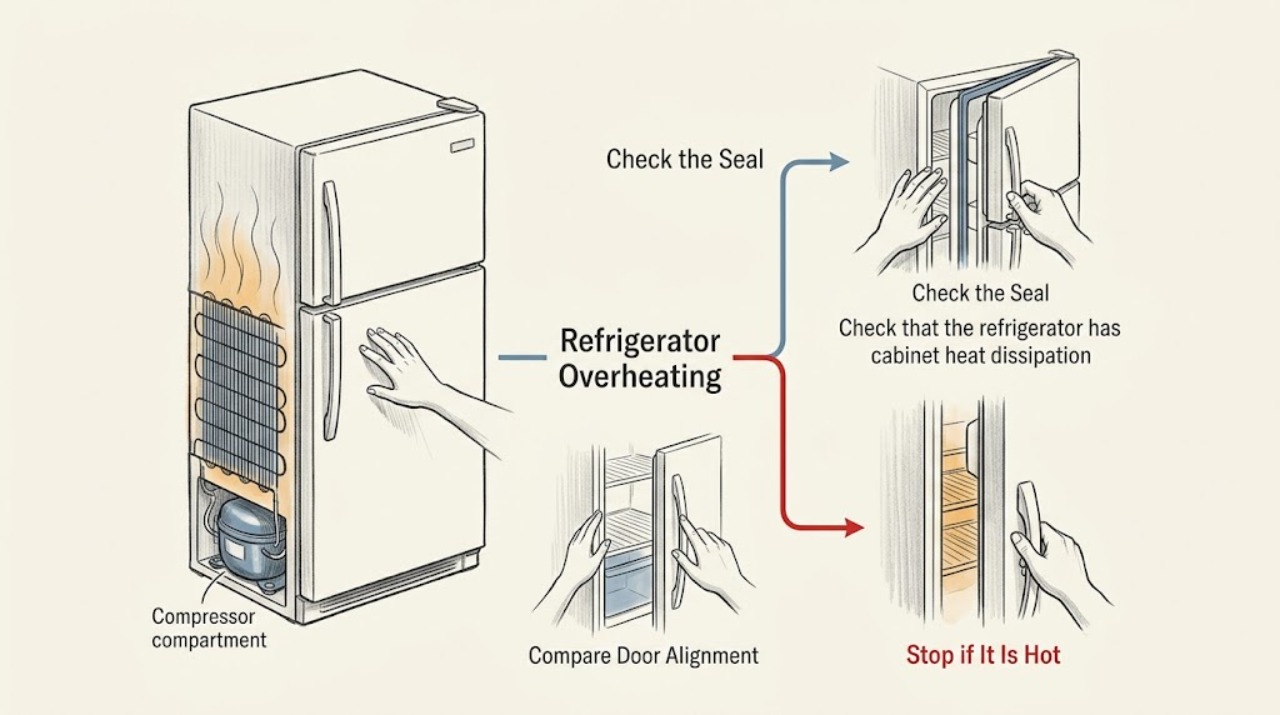
Warm sides, a warm front frame, or warm air under an LG refrigerator can be part of normal heat rejection. Check whether cooling is normal, whether the unit has ventilation clearance, and whether the heat is accompanied by an odor, damaged cord, or rising food temperature. Those accompanying symptoms—not warmth alone—determine the need for service.
Work through in order
Diagnostic checks
Use only checks that match the exact appliance or system and its official guide.
-
Check 1
Identify where the heat is felt: front frame and door gasket perimeter, side panels, bottom/rear air outlet, plug, or wall outlet.
Expected result: The cabinet frame or sides are warm while the plug is normal, or the plug/outlet is unusually hot.
Next step: Keep hands away from a hot or damaged connection and arrange electrical help if that occurs.
Why this matters
Why: LG describes heat around the cabinet and warm air from the bottom as part of compressor and anti-condensation operation; heat at the connection is a separate electrical warning.
-
Check 2
Check that the refrigerator has space around its sides and back and is not pressed against a heat-producing appliance.
Expected result: Clearance is restricted or the refrigerator is beside a range/dishwasher, or clearance is adequate.
Next step: Restore only safe external clearance; do not move a large appliance alone.
Why this matters
Why: Restricted ventilation makes heat rejection harder and can lengthen compressor operation.
-
Check 3
Verify cooling by checking cold food and freezer performance, then look for a door gap or blocked vent that would make the compressor run longer.
Expected result: Cooling is normal, or temperature is rising while the cabinet feels increasingly hot.
Next step: Correct accessible loading or door issues and arrange service if temperature does not recover.
Why this matters
Why: Normal cooling with warm panels supports expected heat dissipation; heat plus weak cooling points toward an airflow, door, or refrigeration problem.
-
Check 4
Listen for abnormal cycling and check for burning odor, smoke, liquid near electricity, or a breaker that trips during operation.
Expected result: No warning appears, or one of these safety signals is present.
Next step: Stop using the refrigerator when a safety signal appears and obtain qualified service.
Why this matters
Why: Warm cabinet surfaces can be normal, but electrical or cooling warning signs change the risk and should not be investigated by opening panels.
Use your observations
Decision map
Find the observation that best matches what you see, then follow the next safe action.
-
PATH 01Next step
What you see
Sides or front frame are warm, the plug is normal, and food stays cold
Do this next
Keep ventilation clear and monitor normal operation.
-
PATH 02Next step
What you see
Warmth comes from the bottom/rear and cooling is weak
Do this next
Check clearance, vents, and door closure, then request service if temperatures remain high.
-
PATH 03Next step
What you see
The plug or outlet is hot, there is an odor, or the breaker trips
Do this next
Disconnect only if safe and obtain qualified electrical or LG service.
Helpful context
Understand the symptom
Start with the symptom
The compressor removes heat from inside the refrigerator and releases it through the cabinet and lower mechanical area. The practical split is normal operating warmth versus heat plus a cooling or electrical warning.
When checks do not resolve it
Need a professional?
Request qualified service for an unusually hot plug or outlet, odor or smoke, repeated breaker trips, rising food temperature, damaged wiring, or heat that persists with abnormal cooling.
Common questions
FAQ
Are warm LG refrigerator sides normal?
Often, yes. LG explains that compressor heat is dispersed through the cabinet and that a heater around the front perimeter helps prevent condensation. Warmth plus poor cooling or electrical warning signs is different.
Why does warm air come from underneath an LG refrigerator?
LG says the compressor generates heat and a fan helps cool it, so warm air may leave through the bottom or sides. Check cooling performance and clearance if the heat seems excessive.
Read the exact guide
Official sources
- [LG refrigerator power] Power is not supplied.LG USA Support · LG refrigerator power supply
- LG Refrigerator - Why is Warm Air Coming From the Bottom of the Refrigerator?LG USA Support · LG refrigerator bottom and side warm air
- Troubleshooting an LG refrigerator not cooling properlyLG USA Support · LG refrigerator cooling performance
- LG Refrigerator - Why are the Front and Sides of my Refrigerator Hot?LG USA Support · LG refrigerator exterior warmth
- [LG refrigerator power] The circuit breaker suddenly tripped.LG USA Support · LG refrigerator electrical protection
Community feedback
Share a repair observation
Share a plain-text repair observation. Accepted observations are published automatically; this page may take a moment to update.