
On this page
Start here
Quick answer
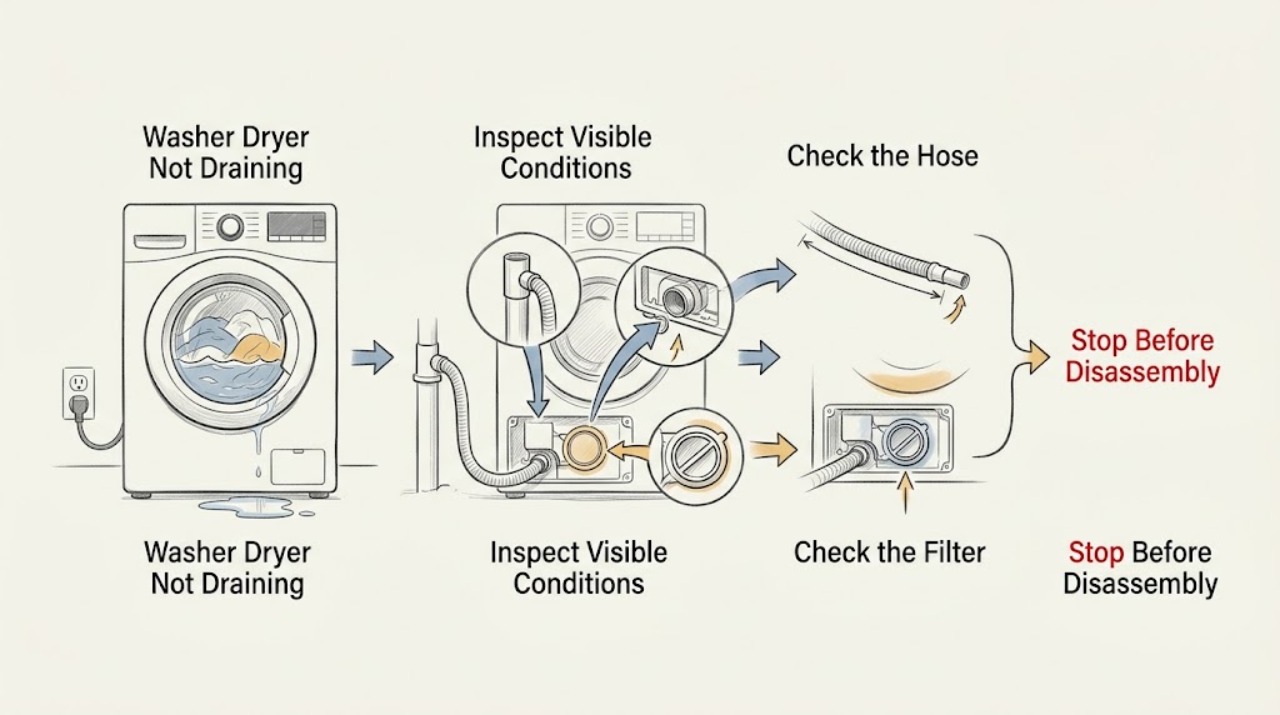
If an LG washer dryer is not draining, first stop the cycle and determine whether the tub still contains water. Check the drain hose for kinks, compression, freezing, or an installation that prevents free flow, then use the exact model instructions for the lower service cover and drain pump filter. Prepare for residual water and possible hot water before opening any filter access. Once the water path is safe and clear, run the model's documented spin or drain test. If the pump does not drain, the unit leaks, the door remains locked with water inside, wiring or power is unsafe, or the problem returns after the hose and filter checks, leave the combo appliance out of service and arrange qualified LG service.
Work through in order
Diagnostic checks
Use only checks that match the exact appliance or system and its official guide.
-
Check 1
Stop the cycle and look at the tub, display, and door or lid without reaching into moving parts. Note whether water is pooled, draining slowly, or already gone, and record any displayed code such as an outlet or drain code.
Expected result: The tub is full or slow to empty, the door remains locked because of water, or the tub is empty but the clothes are still wet.
Next step: For standing water, continue with the hose and pump-filter checks. For an empty tub, use the model's documented spin or drain-and-spin cycle and investigate balance or settings if it does not reach spin.
Why this matters
Why: Standing water makes the drain path the first decision; an empty tub shifts attention toward load balance, cycle selection, or a spin fault rather than a blocked outlet.
-
Check 2
With the combo appliance stopped and safely isolated, inspect the visible drain hose for a kink, crushing against the wall, freezing, submersion, or an incorrectly high or low installation. Do not pull a hose sharply or disconnect it while the tub could release water unexpectedly.
Expected result: The hose is bent, compressed, frozen, submerged, or positioned contrary to the model guide; or the hose is correctly routed and the household drain is open.
Next step: Correct only the accessible hose-routing issue described by the exact model instructions. If the hose and household drain appear clear but the tub remains full, stop repeated cycles and continue only with the documented filter procedure or service.
Why this matters
Why: A restricted or poorly routed hose can stop or slow drainage. A correctly routed hose makes a pump filter, pump, or household drain restriction more likely.
-
Check 3
If the exact LG model has a lower service cover and a user-accessible residual-water hose or drain-pump filter, turn the appliance off, disconnect power when safe, protect the floor, and follow the manual's draining sequence. Check the filter opening for foreign objects without putting hands or tools into inaccessible areas.
Expected result: Residual water drains through the documented hose, the filter contains debris, or little water comes out and the filter is clear.
Next step: Clean and reseat the filter only as the model guide directs, close the cover fully, and clean up any water. If access is not provided, the water is hot, the filter will not reseat, or the issue persists, request service.
Why this matters
Why: Debris at the filter can block drainage; little flow with a clear filter can indicate a pump, hose, or other internal restriction. Hot water or a large spill changes this into a stop condition.
-
Check 4
After the hose and any model-directed filter check are complete, run the exact model's approved drain, spin-only, or rinse-and-spin test with no added detergent. Stay nearby and stop if water backs up, leaks, the pump sounds harsh, or the appliance becomes hot or unsafe.
Expected result: Water exits normally and the drum spins, water exits through the hose but backs up at the household drain, or the appliance still does not drain.
Next step: For household backup, have the drain inspected. For persistent appliance-side no-drain, stop using the machine and arrange qualified LG service rather than opening the cabinet.
Why this matters
Why: Normal discharge points away from an active blockage; discharge through the hose with household backup points toward plumbing; no discharge after the safe checks points toward a pump or internal control problem.
-
Check 5
Record the complete model number, any code, water level, hose and filter findings, selected cycle, and whether the pump hums or remains silent during the approved test. Do not use a live electrical test or bypass a door or lid safety.
Expected result: The symptom repeats with a clear hose, a correctly reinstalled filter where provided, and a known-open household drain, or the machine shows a leak, hot smell, power trip, or lock fault.
Next step: Leave the washer dryer out of service and give the record to qualified LG service. Keep the door closed if water remains and follow the model guidance for safe residual-water handling.
Why this matters
Why: A repeatable no-drain condition after accessible checks needs model-specific pump, control, wiring, or door-lock diagnosis; hazard symptoms require an immediate stop.
Use your observations
Decision map
Find the observation that best matches what you see, then follow the next safe action.
-
PATH 01Next step
What you see
The drain hose is kinked, compressed, frozen, submerged, or installed incorrectly.
Do this next
Correct the routing only as the model guide directs, then run one approved drain or spin test. If the hose cannot be safely corrected or the issue remains, request service.
Why this path and its safety boundary
Why it matters: The external drain path can explain the no-drain symptom.
-
PATH 02Next step
What you see
The filter contains foreign objects and the model's documented clean-out procedure can be completed without a hot-water or spill hazard.
Do this next
Clean and reseat the filter, close the service cover, and run the prescribed test. Stop if it leaks or still will not drain.
Why this path and its safety boundary
Why it matters: The filter restriction is a plausible cause.
-
PATH 03Next step
What you see
Water exits the appliance hose during the approved test but backs up in the standpipe or household drain.
Do this next
Stop the test and have the household drain inspected; do not continue sending water into a backing-up drain.
Why this path and its safety boundary
Why it matters: The building drain is more likely restricted than the washer-dryer pump.
-
PATH 04Next step
What you see
The hose and model-directed filter check are clear, the household drain is open, and the combo appliance still does not drain.
Do this next
Leave the appliance out of service and arrange qualified LG service. Do not remove cabinet panels or replace a part from the symptom alone.
Why this path and its safety boundary
Why it matters: An internal pump, control, wiring, or related component requires model-specific diagnosis.
-
PATH 05Next step
What you see
There is a major leak, hot water spill, smoke, burning smell, sparking, repeated power trip, or a door or lid safety fault.
Do this next
Stop the appliance, isolate power and water only when safe, keep clear of electrical hazards, and seek qualified service. Do not bypass the door or lid safety.
Why this path and its safety boundary
Why it matters: This is a safety stop, not a routine drain check.
Helpful context
Understand the symptom
Start with the water and the hose
A washer-dryer combo cannot complete a wash or spin when it cannot move water out. A full tub points toward the drain path, while a tub that empties but leaves clothes wet may instead involve load balance or the selected cycle. LG's official guidance covers washer-dryer combos as well as washers, but the service-cover location, control names, and filter procedure can differ by model.
Treat filter access as a water and heat check
The pump filter can collect foreign objects and lint, but opening it can release residual water and, if the tub is hot, cause a burn. Turn the appliance off and disconnect power only when safe, place a suitable shallow container or towels as the model guide directs, and use only the documented residual-water hose or filter access. If the design does not provide that user procedure, stop and request service instead of removing panels.
Separate the appliance from the household drain
If the hose can discharge water during an approved test but the standpipe or household drain backs up, the building drain is the likely restriction. If the hose itself does not discharge and the filter is clear, the pump or another internal component needs model-specific diagnosis. Do not keep repeating cycles with standing water or a leak.
Only after diagnosis
Potential parts
- drain pump or pump filter assembly
Consider this category only if a qualified diagnosis confirms that the hose and household drain are open but the appliance cannot pump water after the model-directed filter check.
Confirm the complete LG model and the manufacturer's fit information before ordering; a no-drain symptom alone does not identify a pump. - drain hose or hose connection
Consider this category only if the exact model's hose is damaged, frozen beyond recovery, or confirmed by service to be restricted or leaking.
Verify model-specific routing and fitment; do not substitute a hose based only on appearance. - door-lock or control component
Consider this category only when the appliance has a repeatable lock or control symptom after the drain path is clear and a qualified technician identifies the failing circuit or assembly.
Never bypass the safety interlock. Confirm exact model compatibility through the manual or qualified diagnosis.
When checks do not resolve it
Need a professional?
Call qualified LG appliance service when the washer dryer remains full after the hose and exact model filter procedure, fails an approved drain test with an open household drain, cannot confirm the door or lid safety, or requires cabinet access. Stop immediately for a major leak, hot-water burn risk, smoke, burning smell, sparking, repeated power trips, or unsafe wiring.
Common questions
FAQ
Why is my LG washer dryer full of water and not draining?
The drain hose may be kinked or compressed, the pump filter may be blocked, or the household drain may be restricted. Check only the visible hose and the exact model's safe filter procedure, preparing for residual or hot water.
Can I open the pump filter while water is still in the LG combo?
Only if the exact model documents that access and you have safely stopped and isolated the appliance, prepared for residual water, and ruled out hot-water and spill hazards. Otherwise leave it closed and request service.
What if water drains from the hose but the washer dryer still reports a drain problem?
If the hose discharges normally but the standpipe or household drain backs up, the building drain may be restricted. If the household drain is open and the appliance still fails, arrange qualified LG service for pump or control diagnosis.
Read the exact guide
Official sources
- [LG Front load washing machine rinsing] Washing machine stops operating during rinsing. (Water cannot be drained)LG USA Support · LG combo lower service-cover filter access, foreign objects, residual water, and hot-water warnings
- [LG Washing Machine] Water Not Draining (OE Error)LG USA Support · LG washer dryer combo pump filter, hose, household drain, and frozen-hose checks
- LG Washer - Troubleshooting Washer Does Not Drain or Spin (Clothes Too Wet)LG USA Support · LG washer dryer combo drain hose, load, pump-filter, and drain-and-spin checks
- [LG top load washing machine drain] Water is not drained during washing and the washing machine stops.LG USA Support · LG washer drain hose elevation, crushing, clogging, freezing, submersion, and service boundary
Community feedback
Share a repair observation
Share a plain-text repair observation. Accepted observations are published automatically; this page may take a moment to update.