
On this page
Start here
Quick answer
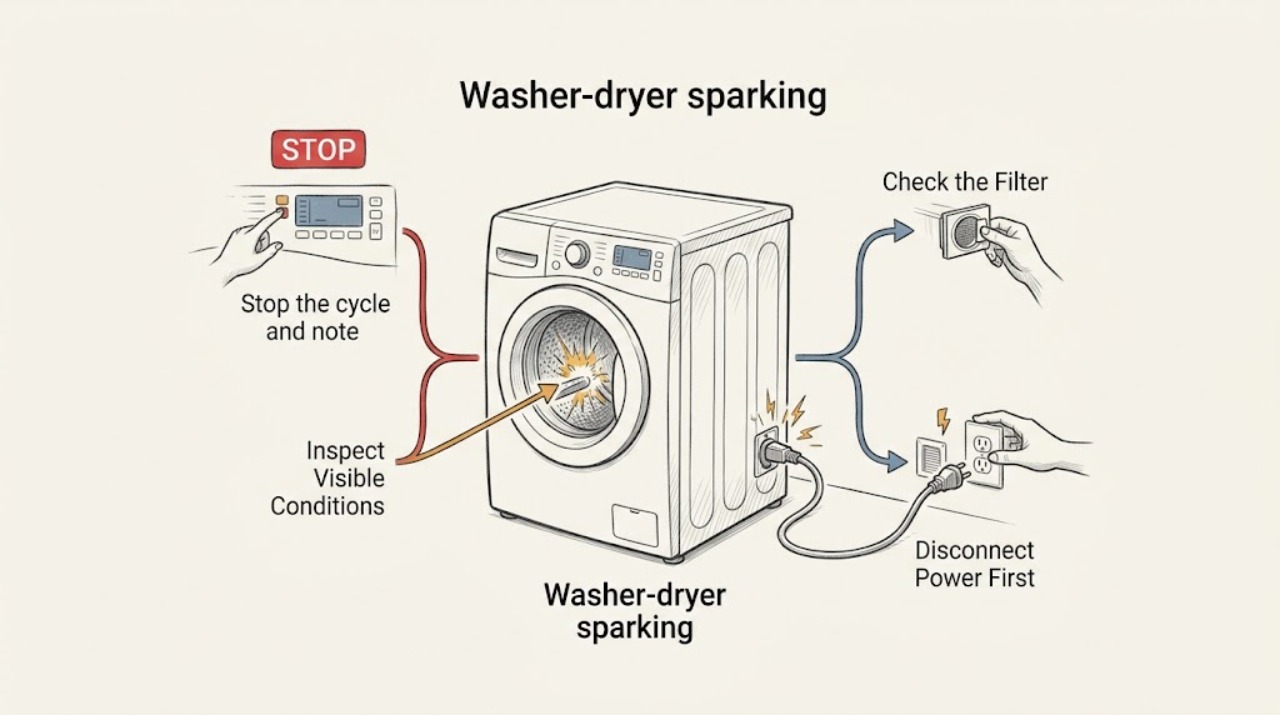
Stop the LG washer dryer as soon as you see a spark or arc. Do not keep restarting it to see whether the spark returns. If the spark came from the plug, cord, or wall outlet, or if there is smoke, a burning smell, heat, or a tripped breaker, isolate power only if you can do so without reaching through smoke or touching damaged equipment and arrange qualified electrical or appliance service. With the appliance disconnected and cool, you may check for a loose object or debris at the door gasket, filter, or wash tub, but recurring or internal sparking requires service.
Work through in order
Diagnostic checks
Use only checks that match the exact appliance or system and its official guide.
-
Check 1
Stop the cycle and note where the spark occurred without opening panels or reaching toward the machine. If there is smoke, a strong burning or rubber odor, a hot plug, visible flame, repeated arcing, or water near electrical equipment, keep people away and use the home's breaker or other safe external disconnect only when it can be reached without contact with the damaged appliance; call emergency services for an active fire.
Expected result: The event is either at the wall outlet/plug/cord, inside the drum or door area, or behind the cabinet/control area; the machine may also have tripped a breaker or stopped with smoke or odor.
Next step: Follow the matching branch below and leave the washer dryer disconnected until the branch gives a safe reason to inspect it.
Why this matters
Why: A plug, cord, outlet, smoke, or repeated-arc event is not a resettable operating fault. An internal or moving-area spark can indicate a foreign object, damaged insulation, a motor/heater/control fault, or another condition that needs professional inspection.
-
Check 2
After the appliance is disconnected, cool, and dry, visually examine the plug, the accessible cord jacket, and the wall outlet from a safe position. Look for scorching, melting, cracks, looseness, bent or exposed metal, or a plug that does not fit snugly; do not remove the outlet cover or open the washer-dryer terminal block.
Expected result: There is either visible damage or looseness at the outlet/plug/cord, or the connection looks intact with no heat or marks.
Next step: For any damaged or loose connection, keep the appliance off and have a qualified electrician or repair professional assess the receptacle and cord. If the connection is intact, continue only with the disconnected drum-area check; do not bypass grounding or use an extension cord.
Why this matters
Why: Damage, looseness, heat marks, or odor points to a cord/plug or receptacle problem and can cause arcing. An intact-looking connection does not clear an internal fault, especially if the appliance already sparked.
-
Check 3
With power still disconnected, inspect only the accessible door gasket, drum opening, filter area, and wash tub for a coin, key, metal item, toy fragment, or small rubber item. Remove only loose debris that is plainly reachable without tools, and check whether the gasket or filter shows melted, cut, or scorched material.
Expected result: A foreign object or debris is present, or the accessible rubber, gasket, filter, or tub shows heat or electrical damage; alternatively, nothing unusual is visible.
Next step: If debris is removed and there is no damage, keep the appliance disconnected and arrange service before a cautious test cycle because the machine already produced a spark. If any component is melted, cut, scorched, or inaccessible, stop inspection and provide those details to the technician.
Why this matters
Why: Loose debris can rub, heat, or contact moving parts, but melted or scorched material suggests the spark caused damage rather than a simple obstruction. No visible debris does not rule out an internal motor, heater, wiring, or control fault.
-
Check 4
Check the recent load and location of the event from your notes: determine whether the spark occurred only when the drum moved, during heating/drying, while the plug was being moved, or when water was present. Do not add a different load or restart the appliance as an experiment.
Expected result: The event has a repeatable operating context, or its timing and location are uncertain.
Next step: Record the cycle, load, display behavior, breaker response, odor, and exact spark location for service. Leave the appliance off until a qualified professional has assessed it.
Why this matters
Why: Drum movement or heating can point service toward the motor, heater, belt, drum area, or trapped item; plug movement points toward the cord or receptacle; water plus arcing raises an electrical shock concern. Uncertain timing is not evidence that the appliance is safe.
Use your observations
Decision map
Find the observation that best matches what you see, then follow the next safe action.
-
PATH 01Safety boundary
What you see
The spark came from the wall outlet, plug, cord, or rear power connection, or the plug is hot, loose, melted, or scorched.
Do this next
Stop using the appliance. Do not pull on the cord or plug it into another outlet. Have a qualified electrician assess the receptacle and a qualified appliance repair professional assess the cord and appliance before reuse.
Why this path and its safety boundary
Safety stop: Do not restore power until the damaged connection and appliance have been cleared by the appropriate professional.
-
PATH 02Safety boundary
What you see
The spark appeared at the drum, door gasket, filter, or tub area and a loose object is plainly visible with the power disconnected.
Do this next
Remove only the loose accessible item, document any melted or scorched material, and arrange service before running another cycle.
Why this path and its safety boundary
Safety stop: Stop immediately if the item is embedded, the area is damaged, or safe access would require tools or panel removal.
-
PATH 03Safety boundary
What you see
There was smoke, flame, a strong persistent burning smell, water near electrical parts, repeated sparking, or a breaker that trips again.
Do this next
Keep the appliance isolated, move people away, and contact emergency services for an active fire or smoke emergency; otherwise arrange qualified electrical/appliance service.
Why this path and its safety boundary
Safety stop: Do not reset the breaker repeatedly, spray water, or restart the washer dryer.
-
PATH 04Safety boundary
What you see
No spark source can be identified, or the only explanation is an assumed static discharge.
Do this next
Treat the event as unresolved and keep the machine out of service until a qualified professional checks it; a lack of a second spark is not a safety test.
Why this path and its safety boundary
Safety stop: Do not use repeated cycles to reproduce or dismiss the event.
Helpful context
Understand the symptom
A spark is different from a harmless new-appliance odor or a one-time static snap. The safe diagnosis starts by locating the event: the wall outlet and plug, the cord or rear connection, or the moving drum, door, and control area. Keep the machine out of service until the source is known.
LG notes that debris or small rubber items trapped in the door gasket, filter, or wash tub can heat during operation, while a persistent electrical or burning-rubber smell calls for repair. That guidance does not make visible arcing safe to repeat; a washer-dryer that actually sparks should be treated as an electrical or fire risk.
Only after diagnosis
Potential parts
- power cord or plug assembly
Consider this only if a qualified inspection confirms damage at the cord or plug and identifies the correct repair for the exact model.
Confirm the complete model number, electrical configuration, and manufacturer fit information before ordering any part. - door gasket or filter component
Consider this only if service finds that a heat-damaged or torn accessible component contributed to the event after the electrical fault has been ruled out.
Confirm model-specific fitment and have a professional determine whether the component or a deeper fault caused the damage. - motor, heater, wiring, or control component
Consider internal parts only after a qualified technician identifies the failed circuit or component; sparking alone does not identify a replaceable part.
Use the exact model information and the technician's diagnosis to confirm compatibility; do not buy a component based only on the symptom.
When checks do not resolve it
Need a professional?
Call a qualified appliance repair professional for any visible spark, internal arcing, scorched or melted part, persistent electrical smell, repeated breaker trip, loss of power after the event, or any condition that requires opening the cabinet. Call a qualified electrician when the outlet, plug fit, receptacle, or household circuit is involved. For smoke or an active fire, leave the area and contact emergency services.
Have this ready
- LG model and serial information
- The exact location and timing of the spark, including cycle and whether the drum was moving or heating
- Photos of accessible damage only after power is isolated and the area is cool
- Whether there was smoke, burning odor, water, a hot plug, or a tripped breaker
- Any loose object or debris found in the accessible gasket, filter, or tub
Common questions
FAQ
Can I run my LG washer dryer once more to see where the spark comes from?
No. A visible spark is not a safe diagnostic test. Leave the appliance disconnected and document what you already observed for a qualified professional.
What if the spark was only at the outlet?
Keep the appliance off and do not move the plug to another outlet. A loose, damaged, hot, or scorched outlet or plug needs qualified electrical assessment before reuse.
Could a coin or small item cause sparking inside the drum?
A foreign object can rub or heat in the drum, gasket, filter, or tub area, but it does not prove that no electrical damage occurred. Remove only a loose accessible item with power disconnected, then arrange service before another cycle.
Is a burning smell from a new LG washer dryer always a fault?
LG says a new motor or insulation odor can fade over the first 10 to 20 full cycles, but visible sparking, smoke, heat, or a persistent electrical or burning-rubber smell is a stop-use condition and needs service.
Read the exact guide
Official sources
- CPSC Guide to Home Wiring HazardsU.S. Consumer Product Safety Commission · Consumer electrical cord, plug, outlet, arcing, smoke, and overheating safety
- Power Issues - Laundry DryerLG USA Support · LG laundry dryers and electrical power troubleshooting
- Appliance and Electrical Fire SafetyU.S. Fire Administration · Home appliance and electrical fire safety
- LG Washer – Troubleshooting an Electrical or Burning Rubber SmellLG USA Support · LG washers, washer-dryer combos, and related laundry appliances
Community feedback
Share a repair observation
Share a plain-text repair observation. Accepted observations are published automatically; this page may take a moment to update.