
On this page
Start here
Quick answer
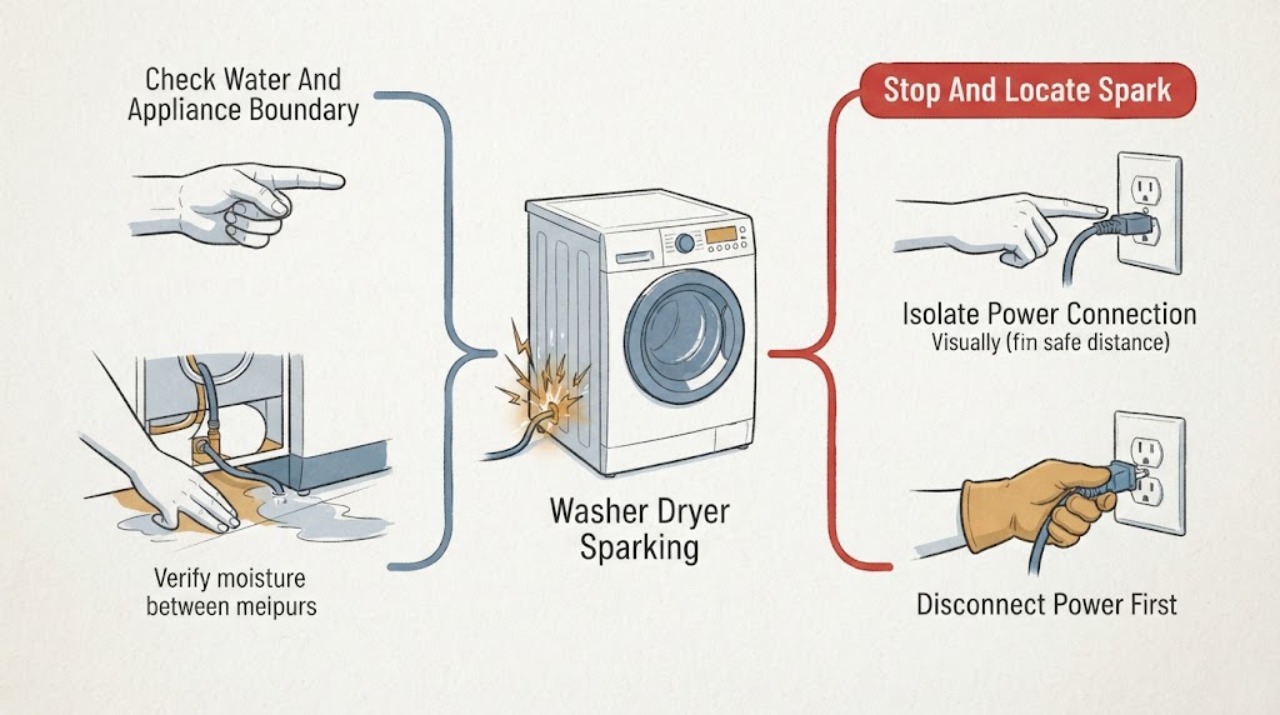
Visible sparks from a Samsung washer-dryer are an immediate stop condition, not a normal cycle symptom. Stop the washer or dryer, keep people away, and disconnect power only from a safe position; if there is smoke, a burning or electrical smell, scorch marks, heat, or an active fire, use local emergency guidance and do not operate switches or reinsert the plug. Once the area is safe and the breaker is off, make only a visual check for a damaged cord, plug, outlet, loose-looking connection, water near electrical parts, or a code. Samsung directs damaged power connections and continuing burning or electrical odors to an electrician or service. Do not run another test cycle, reset the appliance repeatedly, remove panels, or make live electrical measurements.
Work through in order
Diagnostic checks
Use only checks that match the exact appliance or system and its official guide.
-
Check 1
Stop the cycle and move away from the appliance. From a safe distance, note whether the spark came from the washer or dryer section, the plug or outlet area, the drum or door area, or an unseen internal location. Do not open the door or lid if there is smoke, heat, arcing, or water nearby.
Expected result: There was a single visible flash with no smoke, repeated arcing occurs, the spark came from the plug or outlet, water is present, or smoke, a burning or electrical smell, scorching, heat, or fire appears.
Next step: Keep clear and disconnect power only from a safe position. For smoke, fire, water at electrical parts, or an unsafe outlet, do not operate switches or reinsert the plug; use local emergency guidance or contact a licensed electrician. For any other visible spark, keep the appliance off and arrange qualified service.
Why this matters
Why: The location helps the professional separate a household connection from an appliance fault, but a visible spark is not safe to diagnose by repeated operation. Smoke, heat, water, or odor increases the immediate fire or shock risk.
-
Check 2
After the circuit is safely de-energized, make only a visual check of the cord, plug, outlet face, and accessible connection area for burn marks, melted plastic, discoloration, looseness, exposed conductors, or an incorrect installation. Do not remove an outlet cover, tighten terminals, plug in another appliance, or touch a damaged connection.
Expected result: Burn marks, melted material, an exposed conductor, a loose or incorrect power connection, a damaged outlet, or no visible damage is found.
Next step: Leave a damaged or questionable connection de-energized and contact a licensed electrician or qualified appliance service. If no exterior damage is visible, do not re-energize the appliance merely to look for another spark; provide the symptom and timing to service.
Why this matters
Why: Samsung says to stop and contact an electrician when a dryer's cord or outlet shows burn marks or damage or when the power-cord installation is loose or incorrect. A clean exterior does not rule out an internal arc or control fault.
-
Check 3
Without moving or opening the machine, look for standing water, a leaking hose, wet flooring, or moisture around the appliance's plug and control area. Record whether the washer or dryer was running and whether the spark occurred during filling, draining, tumbling, spinning, or heating; do not reach behind a wet appliance.
Expected result: Water is near the electrical connection, a hose or seal is leaking, the floor is dry and the spark was isolated to a dry connection, or the source cannot be seen safely.
Next step: If water is near electrical parts, do not touch the appliance or plug; isolate power only if safe and arrange electrical and appliance service. If dry, keep the unit de-energized and preserve the cycle details for a technician.
Why this matters
Why: Water can create a shock path and changes the safe isolation response. A dry floor does not make a visible spark acceptable, because the fault may still be in a cord, motor, heater, control, or connection.
-
Check 4
From outside the de-energized appliance, record any display code or flashing-light pattern, the function in use, and whether the smell is burning, electrical, sulfur-like, mildew-like, or absent. Do not clear a code, reset the appliance, or power it again after sparking just to reproduce the symptom.
Expected result: A code is present, a burning or electrical smell continues, the odor occurred only on the first cycles of a new washer, or there is no odor or display information.
Next step: Keep the washer-dryer off and provide the code, odor, timing, and appliance section to service. Never treat a visible spark as a normal first-use odor or use a reset to erase the evidence.
Why this matters
Why: Samsung notes that a short-lived odor can occur during the first couple of washer cycles, but says a burning smell afterward requires service; an electrical smell or visible smoke is an immediate stop condition. A code can help service but does not make a spark safe.
-
Check 5
Prepare the model information, installation type, circuit behavior, photos taken only from a safe distance, and the exact spark and odor description for a licensed electrician or qualified Samsung appliance technician. Do not remove panels, bypass an interlock, inspect a motor or heater while energized, or make live electrical measurements.
Expected result: The professional identifies a supply or outlet fault, a damaged cord or connection, water-related damage, or an internal appliance component or control fault; or the source remains undetermined.
Next step: Keep the appliance isolated until the professional declares the connection and appliance safe. If the spark source remains uncertain, do not reconnect it for convenience or continue using the other function of a combined unit until service advises that it is safe.
Why this matters
Why: A visible spark can involve the home electrical installation or several appliance subsystems. Only a qualified professional with the correct model and safety procedure can distinguish these possibilities without creating another arc or shock hazard.
Use your observations
Decision map
Find the observation that best matches what you see, then follow the next safe action.
-
PATH 01Next step
What you see
A visible spark, arc, or flash came from the washer-dryer, its plug, or its outlet.
Do this next
Stop use, isolate power only if safe, do not reinsert the plug or run a test cycle, and arrange qualified electrical or appliance service.
-
PATH 02Next step
What you see
Smoke, a burning or electrical smell, scorching, melted plastic, damaged wiring, or unusual heat is present.
Do this next
Keep clear, do not operate switches or reconnect power, use local emergency guidance for active smoke or fire, and arrange professional service after the area is safe.
-
PATH 03Next step
What you see
Water or a leaking hose is near the cord, plug, outlet, or appliance controls.
Do this next
Do not touch the wet appliance or connection. Isolate the circuit only if safe and arrange qualified electrical and appliance service.
-
PATH 04Next step
What you see
The plug, outlet, or cord has burn marks, melted material, an exposed conductor, or a visibly loose or incorrect connection.
Do this next
Leave the circuit de-energized and contact a licensed electrician or qualified installer. Do not replace a plug, tighten terminals, or use another outlet as a workaround.
-
PATH 05Next step
What you see
There is no visible external damage, but a spark occurred inside the appliance or its location cannot be determined safely.
Do this next
Keep the complete washer-dryer de-energized and request qualified Samsung appliance service. Do not reopen the door, reset the machine, or test the other function.
-
PATH 06Next step
What you see
A breaker trips again after the event or the appliance continues to show a power fault.
Do this next
Do not keep resetting the breaker. Leave the circuit off and have a licensed electrician and qualified appliance technician assess the installation and appliance.
Helpful context
Understand the symptom
Sparking is not a reset problem
A visible spark from a washer-dryer, plug, outlet, cord, control, or motor area indicates an electrical or mechanical hazard. Do not treat it like a temporary display glitch or try another programme to see whether it repeats. The safe goal is to remove power without approaching an unsafe connection, preserve evidence, and have the appliance and electrical installation assessed.
Separate the appliance from the supply
A spark may originate in the appliance, its cord or plug, the outlet, or the home's circuit. Samsung recommends switching off the circuit breaker before interacting with a dryer's power connection and says burn marks or an incorrect or loose installation need an electrician. A combined washer-dryer may also have distinct washer and dryer controls, so record which function was running without energizing the unit again.
Water and electricity require a hard stop
If water is leaking toward a plug, outlet, cord, or control, do not touch the water or appliance to unplug it. Keep clear, isolate the circuit only if it can be done safely, and arrange qualified electrical or appliance service. Do not remove covers, bypass door or lid locks, or probe a powered component.
Only after diagnosis
Potential parts
- power cord or terminal connection
Consider this category only if a licensed electrician or qualified technician confirms that the spark originated at a damaged or loose appliance power connection after the circuit is made safe.
Power connections are installation- and model-specific; have a qualified professional verify the correct component and connection method. - door or lid lock assembly
Consider this category only if qualified service confirms arcing or a lock feedback fault at the door or lid assembly after external power and water causes are excluded.
Never bypass a Samsung safety lock; confirm the exact model and have the component installed by a qualified technician. - motor, heater, or electronic control assembly
Consider this category only when qualified service locates the spark inside the appliance and diagnoses the specific motor, heater, suppression, or control component.
Internal electrical parts are model-specific and require de-energized, qualified diagnosis and installation; do not order a part from the spark symptom alone.
When checks do not resolve it
Need a professional?
Every visible spark from a Samsung washer-dryer warrants professional assessment. Keep the appliance off and arrange qualified electrical or appliance service, with immediate emergency guidance for active smoke or fire. Do not reconnect a damaged cord or outlet, operate switches near a gas smell or fire, bypass a lock, remove panels, or make live electrical measurements. If water is near electrical parts, do not touch the appliance or connection; isolate power only if safe.
Common questions
FAQ
What should I do if my Samsung washer dryer sparks?
Stop immediately, keep clear, and disconnect power only from a safe position. Do not reconnect the plug or run a test cycle. Arrange qualified electrical or appliance service; use local emergency guidance for smoke or fire.
Can I reset a Samsung washer dryer after it sparks?
No. A reset cannot make a visible spark safe and can destroy evidence of a fault. Keep the appliance de-energized and provide the timing, function, code, and connection observations to a qualified professional.
What if the spark came from the Samsung washer dryer outlet?
Leave the circuit off and do not touch a damaged or wet connection. Samsung says burn marks, damage, or a loose or incorrect power installation should be handled by a licensed electrician or qualified installer.
When is a Samsung washer dryer spark an emergency?
Treat smoke, active fire, a burning or electrical smell, scorching, melted material, water near electrical parts, exposed wiring, unusual heat, or repeated breaker trips as an immediate stop condition. Do not operate switches near a fire or gas smell; use local emergency guidance and wait for professionals.
Read the exact guide
Official sources
- Samsung washing machine or laundry smells badSamsung Support US · Samsung washer burning odor, first-use boundary, drain, cleaning, and service guidance
- Samsung dryer loses power or won't turn onSamsung Support US · Samsung dryer power isolation, cord and outlet damage, breaker, and electrician boundaries
- Samsung dryer smells or smokesSamsung Support US · Samsung dryer smoke, burning odor, electrical smell, lint and vent safety, and service escalation
- Power issues with Samsung washing machineSamsung Support US · Samsung washer cord, grounded connection, dedicated circuit, breaker, unexpected stopping, and service guidance
Community feedback
Share a repair observation
Share a plain-text repair observation. Accepted observations are published automatically; this page may take a moment to update.