
On this page
Start here
Quick answer
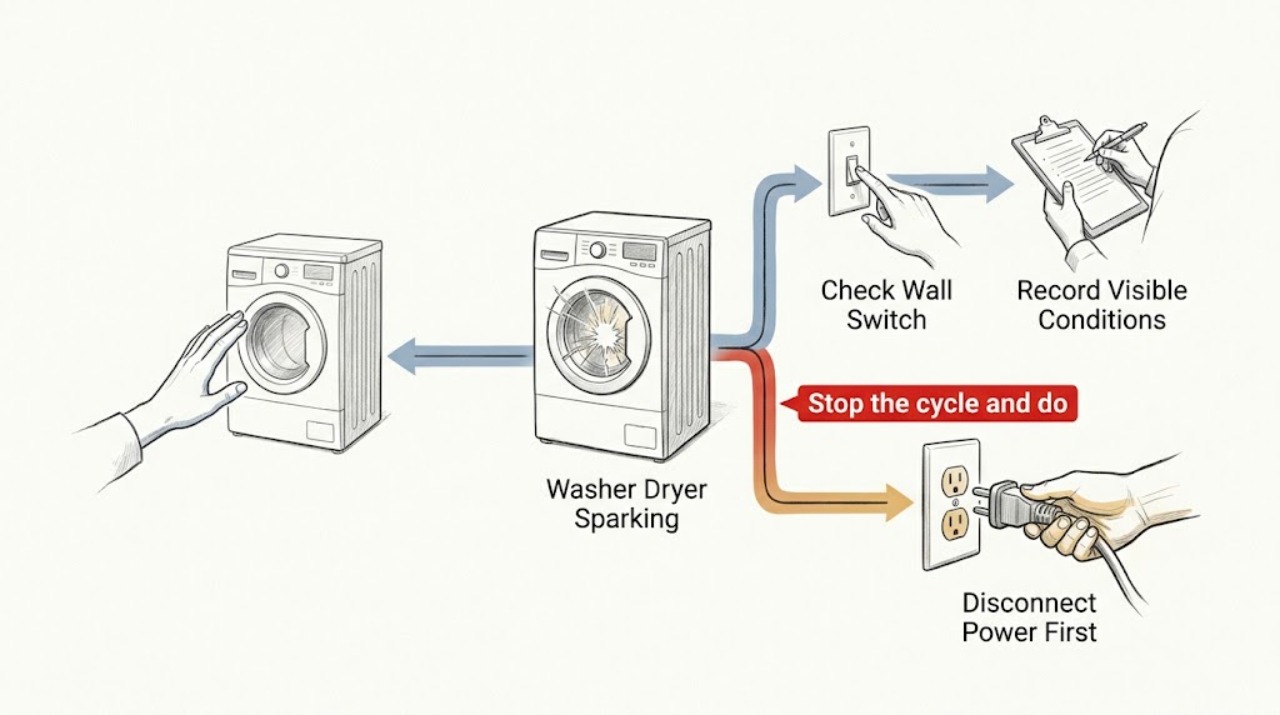
Treat visible sparks, an arc, smoke, a burning smell, or a tripped breaker on a Whirlpool washer-dryer as an electrical and fire hazard. Do not run another cycle, repeatedly reset the breaker, or open the cabinet. If there is no active arcing, the floor is dry, and the plug, cord, and receptacle show no damage, switch the appliance off and use the normal accessible disconnect; otherwise keep away and obtain urgent help. Once the appliance is safely isolated, record whether the flash came from the wall connection, power cord, control area, washer side, or dryer side, and whether water was present. A qualified technician or electrician must diagnose the appliance before it is used again.
Work through in order
Diagnostic checks
Use only checks that match the exact appliance or system and its official guide.
-
Check 1
Stop the cycle and do not touch the appliance if there is active arcing, flame, smoke, a strong burning odor, a hot or melting plug, a damaged cord, or water across the floor. Move people away and use local emergency procedures for an active fire; do not approach an energized or wet appliance.
Expected result: The spark is continuing, smoke or flame is present, the plug/receptacle is hot or charred, or water is near the electrical connection.
Next step: Leave the area or appliance isolated as appropriate and obtain emergency or qualified electrical help. Do not reset a breaker or re-enter a wet area to disconnect it.
Why this matters
Why: The immediate hazard is greater than a troubleshooting question and another attempt could intensify fire or shock risk.
-
Check 2
If there is no active spark, the floor is completely dry, and there is no visible damage, switch the appliance off and use only the normal accessible disconnect. Do not handle a hot, loose, wet, melted, or visibly damaged plug or receptacle.
Expected result: The appliance is safely isolated without touching damaged parts, or safe isolation is not possible from a dry accessible location.
Next step: Keep the washer-dryer out of service. If it cannot be isolated safely, keep clear and contact a qualified electrician or emergency service as appropriate.
Why this matters
Why: A safe external shutdown preserves the situation for diagnosis; inability to isolate safely requires professional help rather than improvisation.
-
Check 3
From a safe, dry position and without moving the machine, identify the apparent spark location: wall receptacle, plug or cord, front control area, door area, underneath, or behind the cabinet. Record whether the flash happened when starting, filling, tumbling/spinning, heating, draining, or stopping.
Expected result: The event is clearly at the wall connection/cord, or it appears to come from the appliance; the operating phase is known or unknown.
Next step: Photograph damage only from a safe distance, record the exact model, and give the location and phase to the electrician or appliance technician. Do not energize it to reproduce the spark.
Why this matters
Why: A wall/cord event points first to electrical installation or connection assessment, while an appliance-side event needs appliance service. The phase helps the technician prioritize circuits without requiring a live test.
-
Check 4
Separate the wash and dry symptom from the timeline. Note whether the spark occurred during water intake, wash or spin movement, draining, a dry cycle, or while the unit was idle; note whether the washer-dryer then lost all power or only one function.
Expected result: The event is associated with water or spin, only with drying/heat, or with both sides and the complete appliance.
Next step: Keep water valves closed if a leak is present and leave the unit isolated. Give the timing and remaining symptoms to service rather than selecting a replacement part from the symptom alone.
Why this matters
Why: Water or movement raises a wet-area or motor/mechanical service question; a dry-cycle-only event raises heater, blower, thermal, or supply concerns; total loss of power raises the supply or main-control path.
-
Check 5
Check the surrounding area without opening the machine: look for a fresh leak, standing water, scorch marks, melted plastic, lint or debris outside the appliance, a blocked or damaged accessible vent path, or a breaker that has operated. Do not move the machine to reach the rear connection.
Expected result: Water, scorching, melted material, lint/heat damage, or a tripped breaker is visible; or the exterior appears normal.
Next step: Do not clean inside, remove panels, or reset the breaker to test. Arrange the appropriate qualified inspection and mention each visible condition.
Why this matters
Why: Moisture and heat damage can create repeat faults and must be addressed before power is restored. A normal exterior does not rule out an internal arc.
-
Check 6
Record the model and serial information, any display or error code, the cycle and load, whether water was present, and whether the breaker or fuse operated. Use Whirlpool's model-specific manual/support path only for identification and service guidance, not to justify another run.
Expected result: A code is present, the unit has no display, the code is unknown, or the event cannot be reproduced safely.
Next step: Provide the complete record to qualified service. Do not clear the code by cycling power or continue testing after a spark.
Why this matters
Why: Codes and operating context help distinguish a control response from an electrical event, but no code clears the need for a safety inspection after sparking.
Use your observations
Decision map
Find the observation that best matches what you see, then follow the next safe action.
-
PATH 01Next step
What you see
There is active arcing, flame, smoke, a strong burning odor, a hot/charred plug, water near the connection, or a repeated breaker trip.
Do this next
Stop immediately, keep away, do not reset or re-run the appliance, and use emergency or qualified electrical help appropriate to the hazard.
-
PATH 02Next step
What you see
The flash appears at the wall receptacle, plug, or power cord rather than inside the washer-dryer.
Do this next
Leave the circuit isolated if safe and have a qualified electrician inspect the receptacle, cord, and supply. Do not substitute a cord, adapter, or extension lead as a test.
-
PATH 03Next step
What you see
The spark appears appliance-side during filling, washing, spinning, or draining, or there is any water leak.
Do this next
Keep the appliance isolated, close the water supply if that can be done safely away from electrical damage, and arrange appliance service; do not remove panels or try to dry internal parts.
-
PATH 04Next step
What you see
The event occurs only during drying or heating, or the dryer side loses power while the washer side remains available.
Do this next
Do not select another dry cycle. Provide the phase, load, odors, heat symptoms, and display state to qualified appliance service; supply concerns require a qualified electrician.
-
PATH 05Next step
What you see
The complete appliance is dark or the breaker/fuse operated after the event.
Do this next
Do not repeatedly reset it. Record which accessible circuit operated and obtain a qualified electrical/appliance assessment before restoring use.
-
PATH 06Next step
What you see
No damage is visible and the event cannot be located safely.
Do this next
Do not reproduce the spark. Keep the appliance out of service and give the technician the model, cycle, load, timing, code, and location uncertainty.
Helpful context
Understand the symptom
A spark is not a normal washer-dryer sound or a harmless reset condition. The same symptom can originate at the receptacle or cord, in a wet washer area, in a motor or heater circuit, or in a control connection. The safest useful diagnosis is therefore to preserve the evidence without energizing the machine: note where the spark occurred, what the unit was doing, and whether there was water, heat, smoke, or a code.
This page covers low-risk observation only. It does not provide a live-voltage test, cover removal, terminal tightening, heater or motor access, or a procedure for bypassing a door, thermal, or electrical safety device.
Safety boundary
Stop conditions
- Stop immediately for active sparks/arcing, flame, smoke, strong burning or electrical odor, a hot or charred plug, damaged cord/receptacle, water near electrical connections, or a repeated breaker trip.
- Do not run another cycle, repeatedly reset the breaker, bypass a safety device, open the cabinet, remove panels, tighten terminals, or perform live-voltage measurements.
- Do not move the appliance or reach behind it when the floor is wet or when the cord, plug, or receptacle is damaged.
Only after diagnosis
Potential parts
- power cord or terminal connection
Only relevant after a qualified electrician or technician confirms damage at the cord or connection and rules out a receptacle or supply fault.
Confirm the exact model, installation requirements, and approved replacement method; never select a cord or connector from appearance alone. - main control or wiring harness
Only relevant if qualified diagnosis identifies an appliance-side arc or heat-damaged control/wiring path after moisture and supply causes are assessed.
Internal electrical work is not a live consumer check; confirm model fitment and service procedure with qualified personnel. - dryer heater or thermal safety component
Only relevant when the spark is associated with the dry/heat phase and a technician isolates the heater or thermal circuit.
Do not assume the heater is the cause from a dry-cycle symptom; confirm the exact model and diagnostic result first.
When checks do not resolve it
Need a professional?
Use emergency help for an active fire, sustained arcing, or a hazard that cannot be safely isolated., Use a qualified electrician for a spark at the wall connection, damaged receptacle or cord, supply concerns, or a breaker that operates again., Use qualified appliance service for an appliance-side spark, water-related event, a dry-cycle-only event, or any spark whose location is uncertain.
Have this ready
- Whirlpool model and serial information
- Exact spark location or whether it could not be located safely
- Wash, spin, drain, dry, heating, start, or idle phase when it occurred
- Any water, smoke, odor, scorch, melting, code, or breaker/fuse operation
- Whether the entire unit or only one function lost power
Common questions
FAQ
Should I run my Whirlpool washer-dryer again to find where it sparks?
No. Do not reproduce an electrical spark or repeatedly reset the breaker. Record the safest available observations and have the appliance or supply assessed by qualified personnel.
What if the spark came from the outlet or plug?
Keep the appliance out of use and have the receptacle, cord, and supply checked by a qualified electrician. Do not handle a hot, loose, wet, melted, or charred connection.
Does it matter whether the washer or dryer side was running?
Yes. Note whether it happened during filling, spinning, draining, drying, heating, starting, or while idle. That context helps separate water/movement, dry-heat, control, and supply paths without opening the machine.
When is a Whirlpool washer-dryer spark an emergency?
Treat active arcing, smoke, flame, a strong burning odor, a hot or charred connection, water near electrical parts, or a hazard that cannot be safely isolated as urgent. Keep away and use appropriate emergency or qualified electrical help.
Read the exact guide
Official sources
- Dry Cycle Will Not Run - All-In-One Washer DryerWhirlpool · Whirlpool all-in-one washer-dryer dry-cycle, breaker/fuse, water-supply, door, and model-manual checks
- Overheated Clothes Dryers Can Cause FiresUnited States Consumer Product Safety Commission · Consumer safety context for clothes-dryer overheating and fire risk
- Dryer Not Heating - All-In-One Washer DryerWhirlpool · Whirlpool all-in-one washer-dryer heating and electrical-supply guidance
- All-In-One Washer Dryer - Product HelpWhirlpool · Whirlpool all-in-one washer-dryer troubleshooting categories, manuals, and service routing
Community feedback
Share a repair observation
Share a plain-text repair observation. Accepted observations are published automatically; this page may take a moment to update.