
On this page
Start here
Quick answer
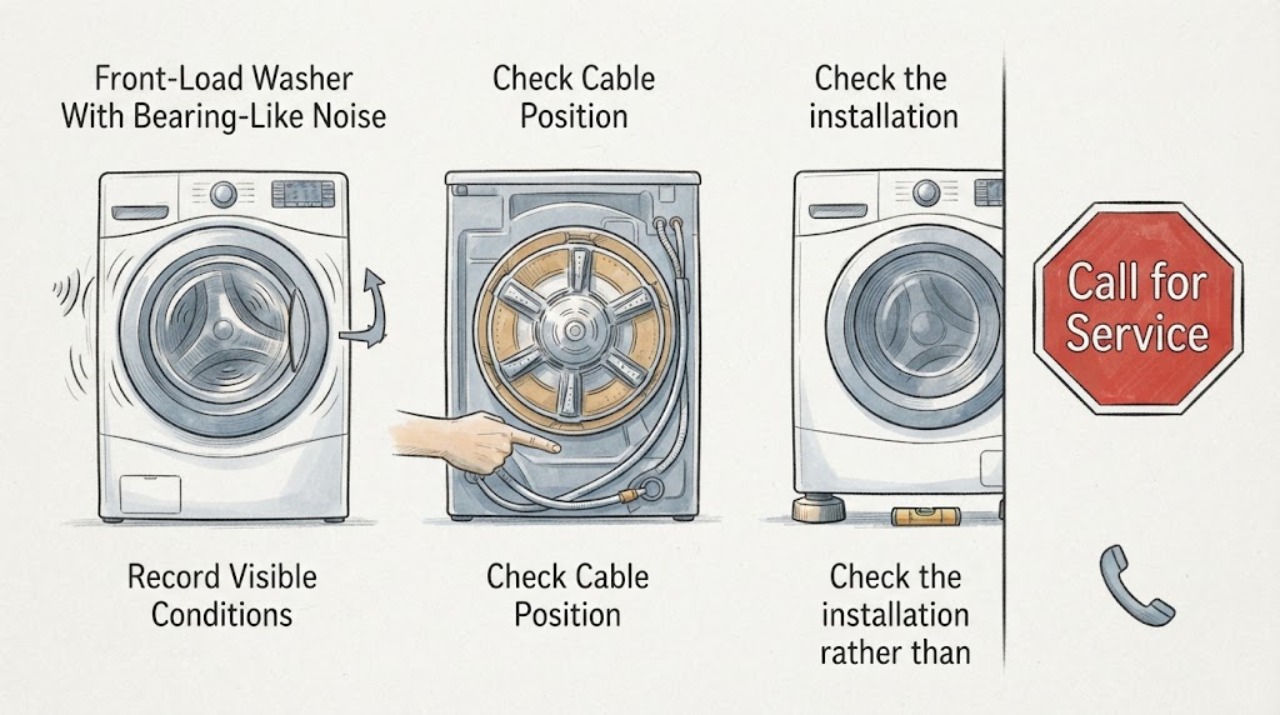
Four years of use and small household loads do not prove that the bearings in an LG front-load washer have failed. First note whether the sound occurs during wash, drain, or spin; LG says spin noise can come from an unbalanced load, foreign objects, or an unlevel washer, and that a small load can be unbalanced. With power off and the tub empty, check the drum for a visible object, then check the washer's level and feet and run only the model-appropriate test described in its manual. If a rumble or grinding sound remains with an empty, level drum, stop repeated high-speed use and request LG service: the public guidance supports service for persistent noise, but it does not identify a bearing, tub, spider, or other internal part from age or sound alone.
Work through in order
Diagnostic checks
Use only checks that match the exact appliance or system and its official guide.
-
Check 1
Record when the sound occurs without opening the cabinet: during wash agitation, while draining before spin, only during high-speed spin, or even when the empty drum is moved by hand with the washer powered off. Note whether the washer rocks, bangs, hums or grinds.
Expected result: The sound is limited to draining, appears only with a particular load, occurs during spin, or remains with an empty drum.
Next step: Use the timing and sound description to choose the next external check. Do not run repeated high-speed cycles just to make the noise louder or use energized tests to distinguish parts.
Why this matters
Why: LG identifies normal drain-pump humming, load imbalance, foreign objects and an unlevel washer as different noise paths. A sound that persists with an empty drum deserves service evaluation, but the timing still does not identify a failed bearing by itself.
-
Check 2
With the washer stopped and safe to approach, remove the laundry and look inside the drum for a coin, hair pin, wire, or another visible object. Rotate the empty drum slowly by hand only; do not pry the door seal, remove panels, or reach into a moving washer.
Expected result: A visible object is present, or the drum still makes the same noise while empty and being turned by hand.
Next step: Remove only an accessible object without dismantling the washer. If the noise remains, stop the test and arrange model-specific service rather than selecting an internal part from the sound.
Why this matters
Why: LG lists foreign objects in the tub as a cause of clacking or rattling and says that continued noise with the clothing removed requires service. A clear drum does not prove a bearing fault; it only removes one visible alternative.
-
Check 3
Check the installation rather than the internal mechanism: place a level on the washer if available, push gently at the front, back and sides to see whether it rocks, and confirm that all four feet contact the solid floor. Adjust the feet only as the LG manual describes and tighten their lock nuts afterward.
Expected result: The washer rocks, a foot is not firmly planted, the floor is not solid and level, or the machine remains stable in every direction.
Next step: Correct an obvious leveling issue using the exact model's instructions, then make one controlled observation. If the machine is already level or noise persists after leveling, move to the load comparison and service boundary rather than repeatedly adjusting parts.
Why this matters
Why: LG says a washer that is not level can make excessive noise and vibration during spin, while a stable installation makes that explanation less likely. Leveling can correct thumping or movement but cannot confirm or exclude an internal bearing problem.
-
Check 4
Compare a small load with a balanced, model-appropriate load and observe the washer during the documented rinse-and-spin or other test cycle. Pause the washer before spreading laundry that has gathered on one side; do not force a single heavy item or use a load outside the manual's guidance.
Expected result: The noise or vibration occurs only with the small load, the laundry clumps to one side, or the same noise occurs with an empty or balanced test.
Next step: Use the exact manual's loading and test guidance. If the empty or balanced comparison remains noisy, stop repeated spin use and request LG service with the model number, cycle, load size and sound description.
Why this matters
Why: LG states that a load can be unbalanced when it is too small, contains large items, or mixes fabrics, and its general noise guidance recommends about two-thirds capacity so items can move. Quiet operation with a suitable load points toward balance or loading; persistence with no laundry points toward an unresolved machine or installation issue, not a confirmed bearing diagnosis.
-
Check 5
Before requesting service, inspect only the external surroundings for a drain or inlet hose tapping the cabinet or a nearby shelf or cabinet touching the washer. Keep hands away from the rear and do not remove covers or test wiring.
Expected result: A hose or nearby structure contacts the washer during vibration, or the surroundings are clear while the washer still makes the sound.
Next step: Move only the accessible hose or nearby object so it cannot strike the cabinet, then make one supervised observation. If the noise remains, leave internal diagnosis to LG or a qualified appliance technician.
Why this matters
Why: LG lists hose contact, cabinet or shelf contact and leveling among possible spin-noise causes. Clearing an external contact can remove a tapping sound, but a clear surrounding area does not identify a bearing or any other internal component.
Use your observations
Decision map
Find the observation that best matches what you see, then follow the next safe action.
-
PATH 01Next step
What you see
The noise appears only with a very small or particular load, and the washer is quiet during an empty or suitable balanced test.
Do this next
Follow the exact model's loading guidance, avoid repeatedly spinning the same one-sided load, and monitor whether the noise returns with ordinary balanced loads. Request service if it becomes present without laundry or across normal loads.
Why this path and its safety boundary
Why it matters: LG's load guidance makes an unbalanced load a supported explanation; this pattern does not establish bearing failure.
-
PATH 02Next step
What you see
The sound is a hum while water drains before spin, and the washer otherwise drains and spins normally.
Do this next
Follow the exact model manual for any user-safe filter check, without opening panels or using a high-speed test. If the hum is unusually loud, drainage is poor, or the sound persists after the documented check, arrange service.
Why this path and its safety boundary
Why it matters: LG describes humming with draining as normal drain-pump operating noise; an unusually loud version can be associated with debris in the drain filter.
-
PATH 03Next step
What you see
A rumble, grinding or clacking remains with the drum empty, the washer level and the surrounding hoses or cabinet clear.
Do this next
Stop repeated high-speed cycles and request LG or qualified appliance service. Provide the exact model, when the sound starts, whether it is present when empty, and any video or observation; do not buy or install an internal part from the symptom alone.
Why this path and its safety boundary
Why it matters: The common external causes have not explained the sound, so an internal drum or spin-system issue remains possible. The result still does not identify a bearing, spider, tub or motor part.
-
PATH 04Next step
What you see
The washer rocks or vibrates on every load, or it continues to move after the feet are adjusted on a solid floor.
Do this next
Stop using the washer if movement is severe, keep it clear of surrounding cabinets and arrange service with the leveling result and any displayed error. Do not add shims, bypass controls or open the cabinet as a substitute for model-specific service.
Why this path and its safety boundary
Why it matters: LG treats leveling, floor stability and load distribution as installation and vibration checks; persistent movement after those checks requires service rather than an assumed bearing replacement.
Helpful context
Understand the symptom
Treat bearing failure as a question to verify, not a conclusion
The original description identifies a four-year-old LG front loader and suspected bearings, but it does not establish a model or a confirmed internal diagnosis. LG's own noise guide starts with the cycle, load distribution, foreign objects and level of the washer. A small load can concentrate its weight on one side, so a noise that appears only with a few items can be a load or installation symptom rather than a failed bearing.
The exact model controls any internal repair decision
LG publishes family-level checks, but the task does not include a model number. Use the rating-plate model when consulting the owner's manual or arranging service. Do not order a bearing kit or assume that a drum, tub, spider, seal or motor part fits because the washer is an LG front loader; the observed sound is not enough to identify a compatible component.
When checks do not resolve it
Need a professional?
Request LG or qualified appliance service when noise remains with an empty drum after the documented external checks, occurs on every load, is accompanied by severe movement, scraping, a leak or a failure to complete spin, or cannot be scoped using the exact model manual. Stop repeated high-speed use if the sound is persistent or worsening.
Have this ready
- Provide the model and serial information from the rating plate, the washer's age, the cycle and point at which the sound starts, whether it occurs with an empty drum, load size and type, leveling result, any visible object or hose contact, and any displayed code. Do not claim that the bearings are failed unless a technician confirms that diagnosis.
Common questions
FAQ
Does an LG washer being four years old mean its bearings have failed?
No. Age is not a diagnosis. LG's public noise guidance starts with load balance, foreign objects, leveling and surrounding contact, and sends persistent noise to service without identifying a particular internal part from age alone.
Can living alone and washing small loads cause the bearing failure?
LG says a load can be unbalanced when it is too small, so small loads can explain vibration or pounding that appears only with those loads. That supported load explanation is not proof that small loads caused a bearing failure.
Should I buy an LG bearing kit before calling service?
No. The task has no model number, and the official symptom guidance does not establish a compatible bearing, tub, spider, seal or motor part. Obtain the exact model-specific diagnosis before selecting any internal part.
Read the exact guide
Official sources
- LG Front Load Washing Machine - Vibrations LoadLG Electronics USA · LG's front-load load-size guidance stating that a load that is too small, contains large items or mixes fabrics can be unbalanced and cause vibration.
- LG Washer - Troubleshooting Noises During the CycleLG Electronics USA · LG's official cycle-specific noise guidance for front-load washers, including small or unbalanced loads, foreign objects, leveling, empty-drum observation and service when noise continues.
- [LG Front Loader] Noise During Spin DryLG Electronics USA · LG's front-loader spin-noise guidance for load distribution, drain filter noise, hose or cabinet contact, leveling and visible foreign objects.
- LG Washer – Troubleshooting Vibration IssuesLG Electronics USA · LG's installation and vibration guidance for solid flooring, level feet, shipping material and a light Rinse & Spin test.
Community feedback
Share a repair observation
Share a plain-text repair observation. Accepted observations are published automatically; this page may take a moment to update.