
On this page
Start here
Quick answer
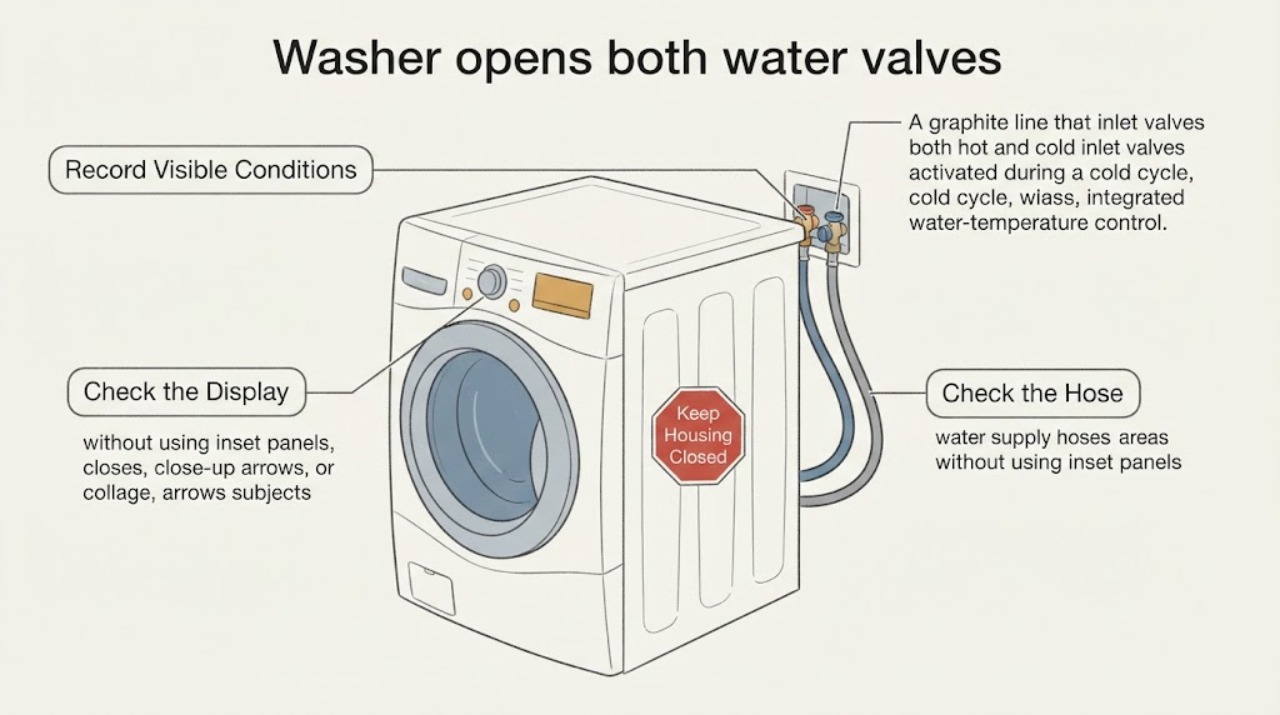
First separate an LG `Tap Cold` test from a model-specific `Cold` cycle. LG says that when `Tap Cold` is selected, only the cold-water valve should be energized and only water from the cold pipe should enter the washer. If the water feels warm, the first check is usually hose identification or reversed hot/cold connections—not proof that both valve coils are faulty. Facing the back of an LG washer, LG's support guidance places the hot inlet on the right and the cold inlet on the left, while other brands may use the opposite layout. Turn off both supply faucets before touching a hose, and use the exact model guide. If the hoses are correctly routed and a genuine `Tap Cold` test still causes hot water or both valves to open, stop experimenting: the control, inlet-valve assembly, wiring, or model-specific temperature logic needs qualified diagnosis. Do not jump the solenoids, probe live wiring, or order a valve from the symptom alone.
Work through in order
Diagnostic checks
Use only checks that match the exact appliance or system and its official guide.
-
Check 1
Record the full LG model number, market, whether the washer is front-load or a combo, the exact temperature label selected (Tap Cold, Cold, or another option), and whether the observation is based on valve clicks, visible hose flow, or the actual water temperature.
Expected result: The test used Tap Cold, a generic Cold setting, a cycle with heating or steam options, or the exact model/market is not known.
Next step: Use the exact manual and repeat only the controlled Tap Cold observation if the model permits it. If the setting or model cannot be identified, stop at documentation rather than applying a different LG model's valve sequence.
Stop if: Do not open the control panel, access the valve wiring, or run an unknown cycle repeatedly to infer its logic.
Why this matters
Why: LG distinguishes Tap Cold from other temperature settings and says cycle-specific behavior can vary by model. Hearing two clicks alone cannot prove that both valves are supplying water or that either valve is stuck.
-
Check 2
With both supply faucets open and the washer stable, select Tap Cold or the exact model's documented Tap Cold-equivalent. Start the fill and pause only using the normal controls; if the door can be safely released according to that model, check whether the incoming water is actually cold. Do not put hands near moving parts or a locked door.
Expected result: The water is cold, the water is warm or hot, no water enters, or the control cannot be paused/released safely.
Next step: If the water is warm, inspect hose routing from a dry position. If it is cold but both valves still appear energized, record the result and arrange model-specific service rather than opening the machine.
Stop if: Do not force the door, reach into the tub, touch water near a wet electrical connection, or disconnect a hose while the washer is filling.
Why this matters
Why: LG states that Tap Cold energizes only the cold valve. Cold water supports normal valve selection; warm water shifts the first check to hose routing or supply temperature; no water can involve supply, hose, filter, or valve issues. An inaccessible door or unsafe pause ends the consumer test.
-
Check 3
From a dry position facing the back of the washer, compare the hose labels and supply faucets. For the LG orientation described in the support guidance, verify the hot hose is on the right inlet and the cold hose on the left; turn off both faucets before any hose correction, place a bucket below, and let residual water drain without moving the appliance.
Expected result: The hoses are reversed, the hose routing matches the LG labels, a faucet supplies unexpectedly warm water, or a fitting/hose is wet, cracked, kinked, or damaged.
Next step: If and only if the area is dry and the model instructions permit it, correct a clearly reversed connection with the faucets closed, then perform one Tap Cold test. For a damaged hose, leak, uncertain fitting, or wet electrical area, keep the washer off and arrange appliance or plumbing service.
Stop if: Do not work on pressurized or wet fittings, cross-thread connectors, use tape instead of the rubber seal, or pull the washer across a wet floor.
Why this matters
Why: Reversed hoses can make a correctly controlled cold valve appear to be opening the hot side. A warm cold supply can be environmental. A damaged connection is a water and electrical safety issue, not a valve-identification exercise.
-
Check 4
If hose routing is correct and a genuine Tap Cold test still produces hot water or both valve commands appear active, stop user testing and record the model, cycle, temperature selection, water temperature, valve sound, fill timing, and any display code. Check only for an accessible leak or kink; do not remove the top, test solenoid resistance, bridge wires, or substitute a valve.
Expected result: The symptom disappears after hose correction, remains only on one cycle, remains on Tap Cold, a valve seems to pass water while unpowered, or an error/overflow appears.
Next step: Leave the washer off for persistent hot-water entry, uncommanded filling, overflow, a valve that passes water while the machine is off, or a recurring error. Give the service provider the controlled test results and do not order a valve from the symptom alone.
Stop if: Do not jump a solenoid, probe live voltage, bypass a water-level or door safety, run repeated fill tests, or leave supply faucets open while the washer is unattended if filling is uncontrolled.
Why this matters
Why: A corrected hose resolves an installation identity problem. A persistent Tap Cold symptom leaves model-specific temperature logic, control output, wiring, inlet-valve operation, or a water-level/overflow condition unresolved; the opened sources do not authorize a user component diagnosis.
Use your observations
Decision map
Find the observation that best matches what you see, then follow the next safe action.
-
PATH 01Next step
What you see
On the exact model's Tap Cold test, the incoming water is cold and only the cold-side hose supplies water, with no leak, overflow, or error.
Do this next
Use the model's cycle guide for other Cold, Warm, Steam, or Sanitary settings and monitor one supervised load. Do not replace an inlet valve based only on the original sound observation.
Why this path and its safety boundary
Why it matters: The controlled test matches LG's described behavior. Apparent dual-valve operation may have been a normal cycle choice, a sound misinterpretation, or a model-specific sequence rather than a confirmed valve fault.
-
PATH 02Next step
What you see
Tap Cold produces warm or hot water, and the hot and cold hoses are reversed or the LG inlet orientation was compared using another brand's layout.
Do this next
Close both supply faucets, correct only the clearly reversed hoses using the exact model instructions, then perform one Tap Cold test. Leave the washer off for damaged fittings or any wet electrical area.
Why this path and its safety boundary
Why it matters: This is an installation-routing problem more than proof that the washer energized both valves. LG warns that its inlet orientation differs from other manufacturers and identifies the right/left arrangement for its guidance.
-
PATH 03Next step
What you see
Hose routing is correct, but Tap Cold still admits hot water, both valve commands persist, or water enters while the washer is powered off or unattended.
Do this next
Close both supply faucets, leave the washer off, and arrange LG or qualified appliance service. Provide the model, controlled Tap Cold result, actual water temperature, hose photos, fill timing, and any error or overflow history.
Why this path and its safety boundary
Why it matters: A persistent symptom can involve the inlet-valve assembly, control output, wiring, water-temperature logic, or an overfill condition. The public LG guidance does not identify a safe universal component test or replacement from this symptom.
-
PATH 04Next step
What you see
The report comes from a Cold, Warm, Steam, Sanitary, or other model-specific program rather than Tap Cold, and the washer's actual temperature matches the cycle guide.
Do this next
Follow the exact model's cycle and temperature documentation. If the actual water temperature is wrong for that documented setting, repeat the hose and supply checks once, then use service rather than opening the valve circuit.
Why this path and its safety boundary
Why it matters: LG documents that selected cycles can use different amounts of hot water and that some models heat water internally. A generic Cold label is not enough to declare abnormal valve behavior across every LG family.
Helpful context
Understand the symptom
Use Tap Cold as the controlled test
The word Cold on a cycle selector is not enough to identify the valve command on every LG model. LG's support procedure specifically uses Tap Cold: select Tap Cold or a cycle that defaults to Tap Cold, start the fill, pause when water enters, and check the water temperature only if the door can be safely released by that model. LG says only the cold-water valve is energized in that test. Its temperature guidance also distinguishes Tap Cold, which is direct tap water, from Cold and other settings whose behavior depends on the cycle and model.
Warm water usually changes the first check
If a Tap Cold test produces warm water, verify the physical hose routing before blaming the washer electronics. LG says its inlet orientation differs from other manufacturers and describes hot on the right and cold on the left when facing the rear. A cold supply can also feel unusually warm in hot weather or after standing in warm plumbing. If the hoses are correct and the water is genuinely hot during Tap Cold, the observation is now a service symptom rather than a reason to swap valves or rewire the machine.
Do not confuse a normal heated cycle with a valve fault
Some LG cycles intentionally mix or use more hot water, and some models heat water internally. LG notes that the selected cycle controls how much hot water is used and that newer-model behavior must be checked against the model specification or manual. This means a report based only on hearing two clicks during a generic Cold cycle is not enough to identify a stuck inlet valve. Confirm the exact model, displayed temperature setting, actual water temperature, hose routing, and whether the symptom persists in the controlled Tap Cold test.
Only after diagnosis
Potential parts
- washer inlet-valve assembly
Consider this part category only if a qualified diagnosis confirms that the exact model's valve is passing water when uncommanded or failing the documented Tap Cold behavior after hose routing and supply checks are correct.
Confirm the complete LG model, region, valve configuration, connector layout, and manufacturer fit information. Do not use a visually similar valve, jump solenoids, or infer fit from another LG family.
When checks do not resolve it
Need a professional?
Have this ready
- Full LG model and serial information, country/market, front-load or combo identity, exact temperature setting, cycle name, actual water temperature, hose orientation photo, fill timing, valve sound, whether the symptom occurs while powered off, any error code or overflow, and whether a hose was recently installed or moved.
Common questions
FAQ
Should both LG washer inlet valves open on Tap Cold?
LG's opened support procedure says that when Tap Cold is selected, only the cold-water valve should be energized and only water from the cold pipe should enter. If the water is warm, first check hose routing and supply temperature. If a correct-hose Tap Cold test still shows both-valve behavior, arrange model-specific service rather than opening the control circuit.
Could the LG washer hoses be reversed?
Yes. LG says its inlet orientation differs from other manufacturers and describes hot on the right and cold on the left when facing the back of the washer. Turn off both supply faucets before correcting a clearly reversed connection, and use the exact model instructions.
Is Cold the same as Tap Cold on every LG washer?
Do not assume that. LG distinguishes Tap Cold, which is direct tap water, from Cold and other temperature settings, and says the selected cycle dictates how much hot water is used. Confirm the exact model's cycle guide before treating a valve sound as a fault.
What should I do if the washer fills with hot water while it is off?
Close both hot and cold supply faucets, leave the washer off, and arrange qualified service. Water entering while unpowered can indicate a valve that is not closing or another control/plumbing fault. Do not repeatedly reopen the faucets, bridge the valve wiring, or test live components.
Read the exact guide
Official sources
- LG Top Load Washer | Error Code ListLG USA Support · Official LG washer troubleshooting page used for the general service boundary around supply, inlet valves, and repeated fill-related faults; it is not a model-specific diagnosis for this front-load task.
- Inlet Hose Installation - Washing MachineLG USA Support · Official LG installation guidance for washer inlet hoses. Exact connection geometry and safe access must be checked against the model manual.
- LG Washer – How Do I Fix Water Temperature Issues?LG USA Support · Official LG support page describing temperature labels and cycle-dependent water mixing; exact options vary by model and market.
- No Hot or Cold Water SupplyLG USA Support · Official LG support guidance for washer supply and hose-routing checks. The exact model's cycle guide still controls exceptions; the page does not authorize internal valve testing.
- LG Front Load Washer | Sanitary cycle does not workLG USA Support · Official LG front-load guidance showing that some cycles use internal heating and cold rinsing; it is not a universal explanation for a Tap Cold dual-valve symptom.
Community feedback
Share a repair observation
Share a plain-text repair observation. Accepted observations are published automatically; this page may take a moment to update.