
On this page
Start here
Quick answer
If an LG washer has a visibly broken agitator fastener, stop the cycle, unload it when safe, and unplug it before inspecting the accessible tub area. Do not reach into a moving or powered washer, run another test cycle, pry out the agitator, or substitute a bolt. LG says washer error meanings and images vary by model, and its top-load guidance sends unresolved movement or foreign-object conditions to service; the public guidance does not establish one universal agitator-bolt repair. Record the complete model and serial number, photograph the visible condition without removing hardware, and use the matching LG support/manual path. A loose or broken fastener can leave the agitator or wash plate unstable and may cause noise, poor washing, tub interference, or further damage, but it does not identify the failed internal part by itself.
Before you begin
Safety first
- Do not run the washer with a broken or loose fastener, reach into a powered or moving tub, pry or pull the agitator, remove the cabinet, perform live tests, or install a generic bolt. Unplug before any user-level inspection and use qualified service when power, water, or internal parts are involved.
Work through in order
Diagnostic checks
Use only checks that match the exact appliance or system and its official guide.
-
Check 1
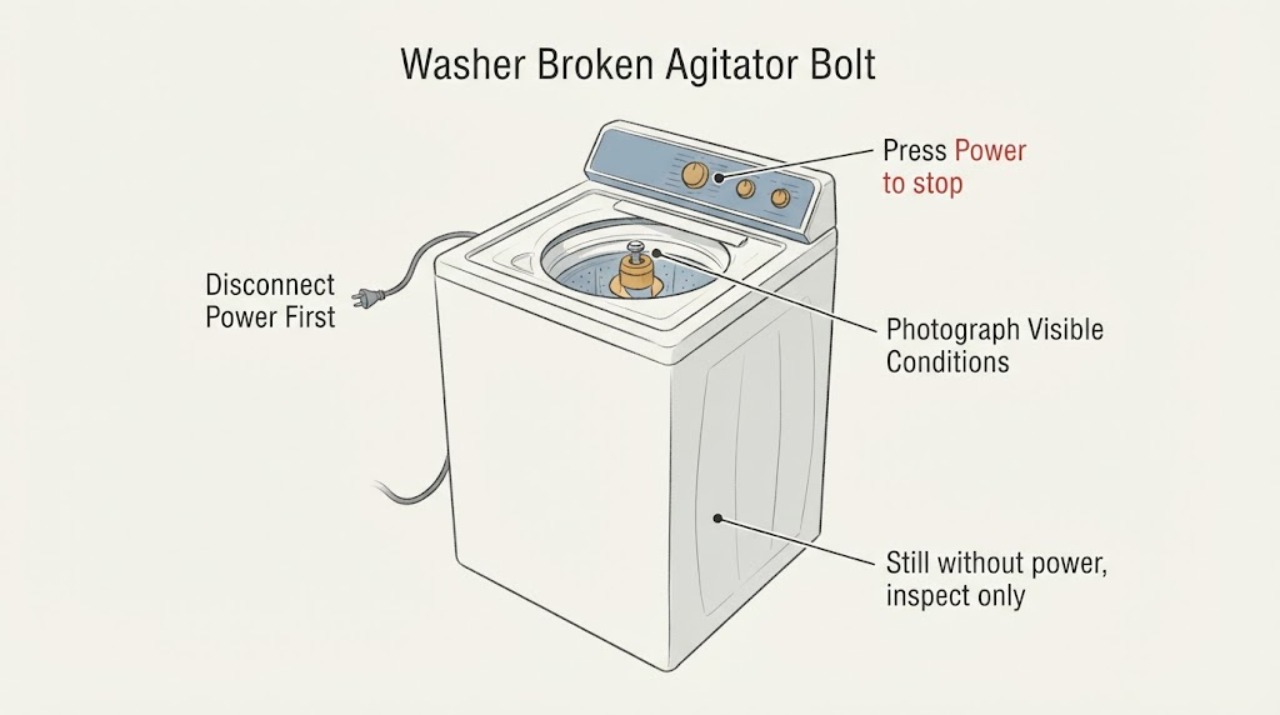
Press Power to stop the washer, wait for all movement to end, and unplug it before touching the tub or inspecting the agitator area. If water remains, use only the model's user-accessible drain procedure and keep hands out of the tub until the appliance is de-energized.
Expected result: The washer is fully stopped and de-energized, or the tub is still moving, the plug cannot be reached safely, or water is leaking or pooling near electrical parts.
Next step: Inspect only after power is safely disconnected. If power cannot be disconnected safely or water is near electrical parts, keep clear and arrange qualified service; do not reach into the machine or restart it.
Why this matters
Why: A powered or moving agitator area is not safe for inspection. LG's maintenance guidance turns the washer off and removes the plug before cleaning, and a leak or inaccessible power connection raises the service boundary.
-
Check 2
With the lid open and the washer unplugged, look from above at the agitator or wash plate, its center area, and the tub. Photograph any visibly broken fastener, missing center cover, loose piece, contact mark, or plastic cracking without removing the agitator or inserting a tool.
Expected result: The agitator or wash plate visibly rocks, a fastener is broken or missing, a loose fragment is present, or the assembly looks intact and stable.
Next step: Keep the washer out of service when a fastener is damaged, the assembly is loose, or a fragment is present. Do not remove the fragment if doing so requires prying or reaching into the drive area; provide the photos to LG service.
Why this matters
Why: Visible movement or a loose fragment supports a mechanical service concern, but it does not identify the part or prove that the reported bolt is the cause. An intact appearance does not rule out an internal fastener problem.
-
Check 3
Still without power, inspect only the visible tub surface and underside of the lid for scrape marks, a metal piece, plastic fragments, or signs that the agitator has contacted the tub. Remove only loose laundry or an obviously accessible object that can be lifted without touching the agitator or drive area.
Expected result: A foreign object or contact mark is visible, or the tub and lid show no accessible debris or impact marks.
Next step: If an object can be lifted safely from the open tub, remove it only while unplugged and document it. If it is trapped below the agitator or requires a tool, stop and request service; do not use the object guidance as permission to disassemble the agitator.
Why this matters
Why: LG says a coin or foreign object caught between the washboard and tub can interfere with the gear or motor and can cause related errors; a foreign object can therefore mimic or worsen a suspected agitator fault. The absence of visible debris does not clear an internal bolt.
-
Check 4
Read the complete model and serial tag without moving the washer, including the model suffix and region, then use LG's support flow to select the product and retrieve the matching manual or repair information. Confirm whether the unit is a top-load agitator design or another wash-plate arrangement before discussing parts.
Expected result: The exact model is available and LG returns matching support, or the tag is incomplete, the product page is for a different model, or the washer does not use the assumed agitator design.
Next step: Use only the matching model documentation and give the model, photos, symptom timing, and any error display to service. If the model or mechanism cannot be confirmed, stop at external observations and do not order a generic bolt.
Why this matters
Why: LG states that washer error codes may vary by model and its support flow begins with product selection. A similar-looking LG washer cannot validate a bolt, tool, or internal procedure.
-
Check 5
Document what happened before stopping: whether the symptom occurred during wash or spin, whether the agitator moved unevenly, whether the tub filled and drained, whether there was grinding or scraping, and whether any display code appeared. Do not run a new cycle solely to collect this information.
Expected result: The event was a single noise with no known visible damage, or the washer repeatedly stops, cannot agitate/spin, grinds, leaks, displays a code, or leaves a loose part.
Next step: For persistent noise, operation failure, a loose assembly, or any fragment, keep the washer unplugged and request model-specific diagnosis. Do not reset and repeatedly run cycles to test an unverified internal fastener.
Why this matters
Why: LG lists load imbalance, foreign objects, and leveling among causes of washer noise and movement, and directs persistent issues to service. Those symptoms can coexist with a broken bolt but do not prove it or select the repair.
-
Check 6
Arrange LG or qualified appliance service when the bolt is visibly broken, the agitator is loose, a fragment is trapped, the tub or drive area shows contact damage, or the washer continues to make noise or fail to agitate after safe external checks.
Expected result: The reported fastener damage is confirmed, or the washer has persistent symptoms despite no visible external cause.
Next step: Keep the washer out of service and provide the exact model, photos, cycle stage, sounds, visible fragments, water condition, and error display. Do not open the cabinet, remove the agitator, apply heat or penetrating chemicals, or perform powered tests.
Why this matters
Why: The repair requires model-specific identification of the agitator or wash plate, retaining hardware, drive interface, and any secondary damage. LG's public guidance routes unresolved mechanical conditions to service rather than publishing a universal bolt replacement.
Use your observations
Decision map
Find the observation that best matches what you see, then follow the next safe action.
-
PATH 01Next step
What you see
The agitator or wash plate rocks, the fastener is visibly broken or missing, a fragment is present, or scrape marks show contact with the tub.
Do this next
Leave the washer unplugged, photograph the condition, and request model-specific LG or qualified appliance service. Do not run another cycle or remove the assembly without matching documentation.
Why this path and its safety boundary
Why it matters: The report is consistent with a mechanical retaining or drive-area problem, but the evidence does not identify the correct bolt or the extent of internal damage.
-
PATH 02Next step
What you see
The washer is unplugged, the agitator looks stable, and no accessible fragment or contact mark is visible.
Do this next
Use the exact model support path and service description rather than guessing a broken bolt. Do not run a cycle just to reproduce the symptom if the user has already seen a broken or loose fastener.
Why this path and its safety boundary
Why it matters: The suspected bolt cannot be confirmed from the top. LG also lists imbalance, foreign objects, and leveling as possible causes of noise or movement.
-
PATH 03Next step
What you see
A coin, wire, metal fragment, or other object is visibly accessible in the tub, or the unit makes noise with an object trapped around the washboard or tub.
Do this next
Remove only a loose accessible object while unplugged. If it is trapped beneath the agitator or requires a tool, stop and request service; do not pry the agitator or reach into the drive area.
Why this path and its safety boundary
Why it matters: LG says foreign objects can interfere with the gear or motor and can produce related top-load errors. That does not prove the object is an agitator bolt or that the drive is undamaged.
-
PATH 04Next step
What you see
The washer repeatedly grinds, scrapes, stops agitating or spinning, shows a related code, leaks, or leaves the same symptom after the load and visible checks are addressed.
Do this next
Keep the washer unplugged and arrange service with the full model and symptom history. Do not perform a powered test or install an unverified fastener.
Why this path and its safety boundary
Why it matters: LG directs persistent top-load movement or noise concerns to service for a proper diagnosis. The symptom pattern does not distinguish the bolt from the gear, motor, wash plate, tub, foreign object, or another model-specific component.
-
PATH 05Next step
What you see
There is water near electrical parts, a damaged cord or outlet, smoke, burning odor, an inaccessible plug, or another condition that makes unplugging unsafe.
Do this next
Keep clear, shut off the water supply if safely accessible, and arrange qualified service. Do not touch wet electrical areas, move the washer, or restore power to reproduce the symptom.
Why this path and its safety boundary
Why it matters: This is a stop-use safety condition; the suspected agitator bolt must not be investigated until the appliance is safely isolated by a qualified person.
Helpful context
Understand the symptom
Treat a broken agitator bolt as a stop-and-identify problem
A bolt under a top-load agitator or wash plate is an internal retaining part, and LG washer designs differ. The model and exact mechanism are missing here, so the visible report cannot establish whether the fastener is the agitator retainer, a different hub fastener, or a fragment from another component. Do not run the washer with a loose or broken fastener: movement can create more damage or place a loose piece where it can interfere with the tub.
Use only safe external observations
Turn the washer off, unplug it before inspection, remove laundry and standing water only through the user-accessible procedure for the model, and look from above without prying or reaching below the agitator. Note whether the agitator or wash plate is visibly loose, whether a metal fragment is present, and whether the tub, basket, or cabinet shows contact marks. Do not rotate the assembly with force, apply a wrench, or start a cycle just to reproduce noise.
Do not transfer a bolt or repair sequence between LG washers
LG's public support pages provide model selection and explain that washer codes, images, and content vary by model. That matters here because a replacement bolt's thread, length, washer, locking method, and tightening instruction are not safely inferable from the word agitator. Find the full model suffix and region, then use the matching manual or LG service path. A generic hardware-store bolt or a procedure from another LG family can damage the drive or tub and may void service or warranty coverage.
Separate agitator evidence from other washer noise
LG lists unbalanced loads, foreign objects, an unlevel washer, and cycle-specific movement as possible noise or vibration causes. A broken agitator bolt becomes more credible when the visible fastener is damaged and the agitator is loose or the same noise appears with an empty tub, but those observations still do not identify the correct internal repair. If the washer continues to make noise after safe external checks, LG directs the owner to service for a proper diagnosis.
When checks do not resolve it
Need a professional?
Request LG or qualified appliance service when a fastener is visibly broken, the agitator or wash plate is loose, a fragment is trapped, the tub or drive area shows contact damage, the washer grinds or fails to agitate/spin, a code persists, or any water/electrical hazard is present. Keep the washer unplugged and do not attempt a model-unspecified internal repair.
Safety scope: Do not run the washer with a broken or loose fastener, reach into a powered or moving tub, pry or pull the agitator, remove the cabinet, perform live tests, or install a generic bolt. Unplug before any user-level inspection and use qualified service when power, water, or internal parts are involved.
Have this ready
- Provide the full model and serial number, region, top-load design, photos of the agitator or wash plate and any fragment, the cycle stage, sound description, whether the tub filled/drained, any display code, and whether the issue followed moving, loading, or previous repair.
Common questions
FAQ
Can I keep using an LG washer with a broken agitator bolt?
No. Stop the cycle and keep the washer unplugged. A loose or broken retaining fastener can allow movement or a fragment to interfere with the tub, and LG's public guidance sends unresolved movement, foreign-object, and noise conditions to model-specific service.
Can I replace the LG agitator bolt with a hardware-store bolt?
Do not substitute a bolt without the exact model documentation. The washer model and agitator design are missing, and LG states that its washer support content and error behavior vary by model. Use the matching LG manual or qualified service path before identifying any fastener.
What can I check before service?
Turn the washer off, unplug it, remove laundry, and photograph the visible agitator or wash plate, any broken fastener or fragment, and contact marks without prying or reaching into the drive area. Record the model, cycle stage, noise, operation failure, water condition, and any code. LG supports external checks for foreign objects, load balance, and leveling, but persistent issues need service.
Could a foreign object look like an agitator bolt problem?
Yes. LG says a coin or other foreign object between the washboard and tub can interfere with the gear or motor and produce related top-load errors. Remove only an object that is loose and safely accessible while unplugged; do not pry below the agitator or assume the object is the correct repair target.
Read the exact guide
Official sources
- Product Support: Help LibraryLG Electronics USA · Opened LG's official support library. It supports selecting the exact product and finding manuals or repair help; it does not verify a replacement fastener or internal procedure.
- LG Front Load Washer MaintenanceLG USA Support · Opened LG's official washer maintenance page. Although titled for front-load maintenance, the cited safety principle is limited to turning off/unplugging before maintenance and safely handling residual water; it is not used for agitator design or repair.
- LG Washer – Troubleshooting Vibration Issues on an LG Washing MachineLG USA Support · Opened LG's official washer vibration page. It is used only for external balance/level context and service escalation, not to transfer shipping-bolt procedures to an agitator bolt.
- LG Washer - Troubleshooting Noises During the CycleLG USA Support · Opened LG's official washer noise troubleshooting page. The article uses its top-load wash/spin branches to distinguish alternate external causes and to stop at service; no internal agitator repair is inferred.
- [LG Top Load Washer] Error Code ListLG USA Support · Opened LG's official top-load washer support page. It is used for the model-variance warning, foreign-object mechanism, and service boundary; it does not define an agitator-bolt repair.
Community feedback
Share a repair observation
Share a plain-text repair observation. Accepted observations are published automatically; this page may take a moment to update.