
On this page
Start here
Quick answer
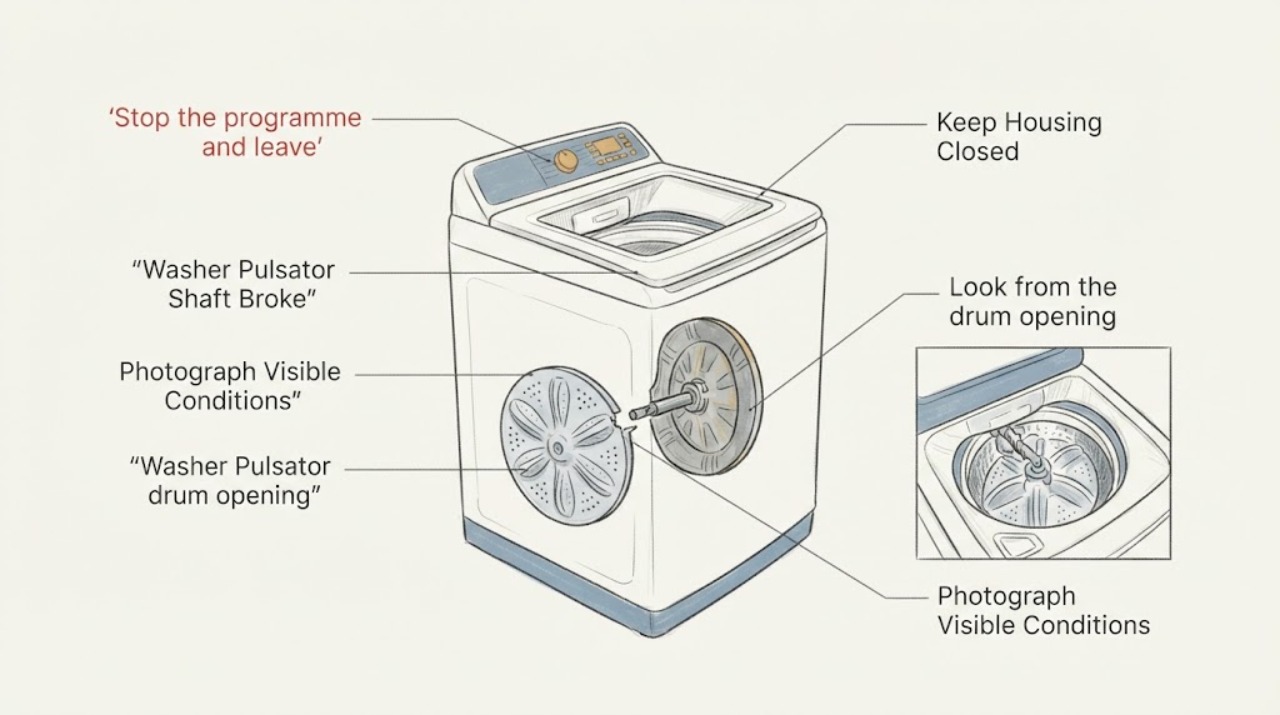
A visibly broken or wobbling pulsator shaft is not something to glue, force back into place, or match to a generic gearbox from a no-model description. Stop the washer and do not run another load if the pulsator is loose, the shaft is exposed, the tub will not spin, or the washer makes harsh mechanical noise. Record the full LG model and serial numbers, then make only safe external checks for a loose object, an obviously uneven load, or a rocking cabinet. LG’s general washer guidance says load, foreign objects and leveling can affect spin, and directs the owner to service when the unit will not spin; those checks do not identify a broken shaft or authorize internal repair.
Work through in order
Diagnostic checks
Use only checks that match the exact appliance or system and its official guide.
-
Check 1
Stop the programme and leave the washer unused if the pulsator is loose, visibly cracked, the shaft is exposed, the tub will not spin, or the machine produces grinding, scraping or repeated impact. Do not glue, bend, force the pulsator, remove the cabinet, or restart a load to test a suspected break.
Expected result: The pulsator or shaft is visibly damaged, or the washer will not spin; alternatively, the visible assembly is intact and the symptom is only a mild load-related wobble.
Next step: For visible damage, harsh mechanical noise or persistent no-spin, keep the washer out of service and request LG repair. Do not attempt a shaft, clutch or gearbox repair from this article. Continue only with the external checks below when no damage is visible and the appliance is safe.
Why this matters
Why: A visible structural defect or a persistent no-spin symptom is outside the supported external checks. The observation does not prove which internal part failed, while a mild wobble can still have a load or leveling cause.
-
Check 2
With the washer stopped and safe to inspect, record the complete LG model and serial numbers from the appliance label. Take a photo of the label and of any visible pulsator or shaft damage without removing screws or panels.
Expected result: A complete model and serial label is available, or only a partial label/brand name is available.
Next step: Give the complete label information, symptom timeline and photos to LG service or the responsible seller/installer. If the label is incomplete, do not order a generic shaft or gearbox and do not substitute a part by appearance.
Why this matters
Why: LG’s parts workflow is model-or-keyword based, so the complete model is needed before any part fit or model-specific procedure can be checked. A partial label cannot establish shaft, clutch or gearbox compatibility.
-
Check 3
Look from the drum opening for a coin, fastener or other loose object caught between the pulsator and tub. Remove only an object that is plainly accessible without prying on the pulsator or reaching into a damaged mechanism.
Expected result: A loose object is visible and removable without force, or nothing accessible is found; the pulsator may also be visibly broken or trapped.
Next step: Remove only the accessible loose object with the washer stopped, then stop if the pulsator remains loose, the shaft is damaged, or the symptom returns. If an object is trapped or removal would require loosening the pulsator, request service.
Why this matters
Why: LG identifies foreign objects between the pulsator and tub as a possible cause of a washer clutch error, but that guidance does not diagnose a broken shaft or make a trapped object a user-level disassembly job.
-
Check 4
Check the empty or lightly loaded washer from outside for an obviously tangled load and for rocking when gentle pressure is applied to opposite cabinet corners. Do not tilt, pull out or open the appliance to correct a suspected drive problem.
Expected result: Laundry is bunched on one side or the cabinet rocks, or the load is even and the cabinet is stable but the pulsator still will not turn.
Next step: Redistribute a safe load or address a clearly rocking installation only as an external check. If the pulsator remains loose or no-spin continues, stop testing and request model-specific service.
Why this matters
Why: LG says an uneven load and an unleveled washer can affect spin performance. A stable, evenly loaded washer that still will not spin leaves a mechanical fault unresolved; leveling cannot confirm or repair a broken pulsator shaft.
-
Check 5
Check for a safety stop such as a water leak, burning or electrical smell, smoke, damaged cord, exposed wiring, or severe movement. Do not touch a wet electrical connection or remove any cover.
Expected result: A safety stop is present, or there is no leak, smoke, smell, damaged wiring or severe movement.
Next step: Stop using the washer and isolate power only if this can be done without touching a wet or damaged connection; arrange qualified service. Otherwise, keep the washer stopped and provide LG with the model, serial, photos and observed error/no-spin behavior.
Why this matters
Why: A safety stop makes continued testing inappropriate. Without those hazards, the symptom can still require service if the pulsator is broken or the washer will not spin, but the external checks remain the limit of this no-model guidance.
Use your observations
Decision map
Find the observation that best matches what you see, then follow the next safe action.
-
PATH 01Next step
What you see
The pulsator or shaft is visibly broken, wobbles independently, or the washer still will not spin after the load and visible-object checks.
Do this next
Leave the washer out of service, do not glue or force the assembly, and request LG repair with the full model and serial information.
Why this path and its safety boundary
Why it matters: This is a persistent mechanical symptom, but the available LG family guidance does not identify the failed part or support a shaft/gearbox repair procedure without a model-specific source.
-
PATH 02Next step
What you see
A loose coin or other object is visible between the pulsator and tub, while the pulsator itself looks intact.
Do this next
Remove only the accessible object with the washer stopped. If the object is trapped, the pulsator is damaged, or the symptom remains, stop and arrange service.
Why this path and its safety boundary
Why it matters: LG documents a foreign-object check in this area for its washer clutch-error guidance; the object may be affecting operation, but this does not prove the shaft is sound under load.
-
PATH 03Next step
What you see
The load is tangled or the cabinet rocks, and the pulsator and shaft look intact.
Do this next
Redistribute the load or correct only an obvious external leveling issue when safe. If the washer continues to wobble, make harsh noise or fail to spin, stop using it and request service.
Why this path and its safety boundary
Why it matters: An uneven load or an unleveled washer can affect spin performance according to LG’s general troubleshooting guidance; that pattern does not establish a shaft failure.
-
PATH 04Next step
What you see
The complete model is unavailable or the parts lookup does not clearly match the washer.
Do this next
Do not order or install a part by appearance. Provide the appliance label, photos and symptom description to LG service or the seller/installer handling the recently purchased house.
Why this path and its safety boundary
Why it matters: Compatibility and repair procedure remain unresolved; a generic shaft, clutch, gearbox or adhesive repair would be an unsupported substitution.
Helpful context
Understand the symptom
Treat the shaft description as an observation, not a confirmed part diagnosis
The task does not provide an LG model number or a manual that identifies a pulsator-shaft repair. A loose pulsator, a trapped object, a drive fault and other mechanical problems can look similar from above. LG’s published washer guidance supports checking the visible drum, load and cabinet level, but it does not establish that this symptom is a particular shaft or gearbox failure. The steps below stop at external checks and service handoff.
A recently purchased house does not establish appliance coverage
The house-purchase condition does not identify the washer’s age, seller, warranty or service contract. Keep the model and serial label, purchase or closing records, and clear photos of the symptom for the party handling the repair. Do not remove panels or alter the appliance while ownership or warranty responsibility is being checked.
Do not turn an external symptom into a parts order
LG’s parts page asks for a product model or keyword and offers a model-and-serial lookup. Without the complete model, a generic pulsator shaft, clutch, gearbox or adhesive repair cannot be treated as compatible. If the visible part is broken or the washer cannot spin, give the exact label information to LG service instead of trying a substitute part.
Common questions
FAQ
Can I glue an LG washer pulsator shaft back together?
No supported LG source reviewed here authorizes a glue repair or identifies a compatible shaft without the exact model. Stop using a visibly damaged or loose assembly and request model-specific service.
Could a coin or other object be causing the pulsator problem?
It is possible for a foreign object between the pulsator and tub to affect washer operation, and LG tells owners to check that area for its E6 guidance. Remove only an accessible loose object with the washer stopped; do not pry on a broken or trapped assembly.
What should I give LG before arranging repair?
Give LG the complete model and serial numbers, photos of the visible symptom, the no-spin or wobble behavior, any displayed code, and whether an object, leak, smell or severe movement was observed. LG’s repair service accepts washer and dryer repair requests, while its parts page uses the product model or keyword for lookup.
Read the exact guide
Official sources
- LG Washer – Troubleshooting Washing Machine Drum Not SpinningLG USA Support · Official LG USA guidance for washers and washer-dryer combos; it supports checking error codes, load distribution, leveling and visible objects, and directs service when the unit will not spin. It does not diagnose a pulsator shaft or authorize internal repair without a model.
- LG Washer - Troubleshooting an E6 Error CodeLG USA Support · Official LG USA washer guidance; it explains the E6/clutch context and the foreign-object check, but it does not define a broken pulsator shaft or provide a shaft repair procedure.
- Parts and Accessories for LG Products | LG USA SupportLG USA Support · Official LG USA parts page asks for a product model or keyword, provides model-and-serial lookup, and lists washers under laundry appliances; it does not confirm any shaft, clutch or gearbox fit for this no-model task.
- Request Product Repair Service | LG USA SupportLG USA Support · Official LG USA repair page accepts appliance repair requests and explicitly includes washers and dryers; it supports service escalation but does not identify the failed shaft or part.
Community feedback
Share a repair observation
Share a plain-text repair observation. Accepted observations are published automatically; this page may take a moment to update.