
On this page
Start here
Quick answer
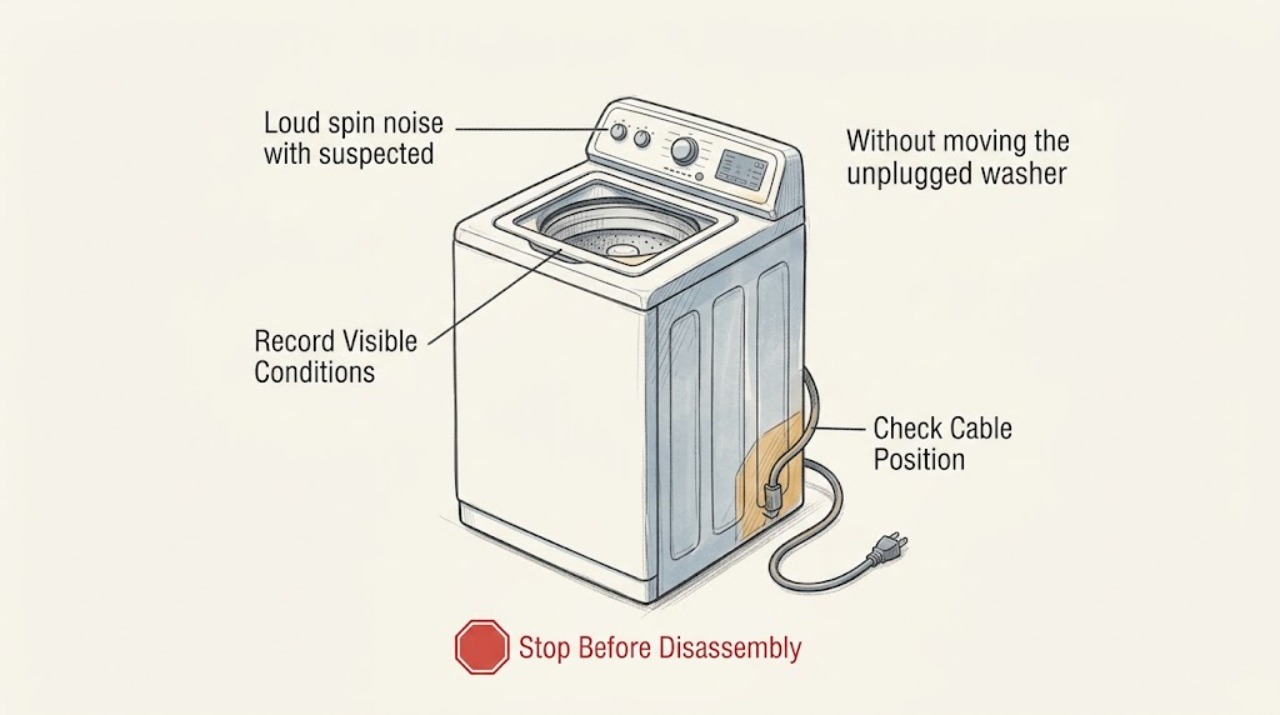
For the LG WT4801CW, a loud spin noise followed by a reported broken stator and damaged surrounding coil wiring should be treated as an out-of-service motor-area fault, not as a normal unbalanced-load noise. LG identifies the WT4801CW as a top-load washer and its current noise guidance says to stop and redistribute an unbalanced load, check the tub for a foreign object, verify that the washer is level, and request service when the noise continues with an empty tub. Those checks cannot certify a stator, rotor, harness, bearing, or mounting fault. Keep the used washer unplugged and do not run it to reproduce the noise, pull the cabinet, touch the motor wiring, or splice a damaged coil lead. Give qualified service the exact model and serial number, photos, the noise stage, and the written diagnosis; ask them to inspect the complete motor/rotor/stator area, wiring, bearings, and source of any wobble before approving parts. Ask LG about any model/serial coverage, but do not assume a used purchase carries the original warranty.
Work through in order
Diagnostic checks
Use only checks that match the exact appliance or system and its official guide.
-
Check 1
Stop the WT4801CW, press Pause or Power using the normal controls if safe, and disconnect power from a dry accessible position. Record whether the loud noise occurred during sensing, agitation, ramp-up, or full spin, whether the basket stopped or continued, and whether there was smoke, a burning odor, sparking, a hot cord, or visible damaged wiring.
Expected result: The noise is accompanied by electrical or burning symptoms, the washer cannot stop normally, the tub is moving abnormally, or the washer is now quiet and stable while unplugged.
Next step: Leave the washer isolated and arrange qualified appliance or electrical service for any hazard or known wiring damage. Keep the observation record for the provider and do not restart it to reproduce the sound.
Stop if: Do not pull a wet plug, touch exposed conductors, reset a tripped breaker repeatedly, or reach under a moving or unstable washer.
Why this matters
Why: Smoke, heat, sparking, exposed conductors, or uncontrolled motion is an immediate stop-use condition. A quiet unplugged washer is not evidence that the stator or harness is safe; intermittent rubbing or insulation damage can recur under load.
-
Check 2
Without moving the unplugged washer or removing panels, note whether the original load was tangled, too large, a single bulky item, or concentrated on one side. Check from outside whether the cabinet rocks when gently pushed at the corners and whether nearby shelving or objects were striking it.
Expected result: The load was badly unbalanced, the washer rocks or is not level, an adjacent object was contacting it, or the noise occurred with a normal balanced load and stable cabinet.
Next step: Correct only an obvious external load or leveling issue as the manual permits. If the stator, rotor, harness, or bearing has already been reported damaged, do not perform a test load; give the condition to service instead.
Stop if: Do not tip the washer, place unstable shims under it, continue a spin cycle, or move it across a wet floor to inspect the underside.
Why this matters
Why: LG says imbalance, unsuitable loads, leveling, and nearby objects can create spin noise. A normal empty-tub noise or a recurrence after correcting an external balance issue makes an internal mechanical or motor-area fault more likely, but does not identify a stator by itself.
-
Check 3
With the tub empty and the washer still unplugged, look only through the normal tub opening for a coin, wire, or other foreign object that could contact the wash plate or tub. If no ordinary-access object is visible, stop there; do not remove the wash plate, rotor, stator cover, cabinet, or wiring.
Expected result: A foreign object is visible and removable without tools or internal access, no object is visible but the noise was present with an empty tub, or the suspected stator/wiring area was already opened by a provider.
Next step: Remove only a loose, clearly reachable object without touching internal moving parts. For persistent empty-tub noise or exposed motor damage, leave the washer disconnected and request qualified service.
Stop if: Do not use a tool to reach behind the wash plate, scrape the tub, turn an energized motor, or pull on any coil or harness wire.
Why this matters
Why: LG identifies foreign objects as a possible source of squeaking or rattling. If the noise persists with the tub empty or the motor-area parts are damaged, the ordinary-access foreign-object branch is not a sufficient diagnosis.
-
Check 4
Ask the technician or seller for the exact written diagnosis and photos: what stator piece broke, which coil or harness conductors were damaged, whether the rotor contacted the stator, whether the shaft or bearings have play, and whether the machine had a prior loud-spin complaint. Keep the removed parts and the estimate together.
Expected result: The report names only a stator, names stator plus wiring, shows rotor contact or bearing/shaft play, or cannot identify the damage beyond a loud noise.
Next step: Request a complete motor-area and mechanical inspection before approving parts: stator, rotor, harness/connectors, shaft, bearings, mounting, tub, and any foreign-object or imbalance damage. Use LG's exact-model support path for documentation and service routing.
Stop if: Do not splice coil wires, glue a broken stator, bend a harness away from the rotor, bypass the lid lock, or approve a part based only on a photograph or generic WT washer listing.
Why this matters
Why: A part label without the failure mechanism cannot tell whether the replacement stator will be damaged again. Rotor clearance, shaft/bearing movement, mounting, harness routing, and an earlier noise can change the repair scope.
-
Check 5
For the used purchase, photograph the rating/model label and collect the seller's purchase date, prior repair invoices, serial number, and the current service estimate. Ask LG whether the exact serial and original purchase documentation support any remaining coverage; do not assume warranty transfer from the model name alone.
Expected result: The serial and original purchase records are available, the washer was sold without documentation, or the provider proposes a non-LG repair or used assembly.
Next step: Give the complete evidence package to LG or qualified service and ask for the exact repair scope, part identity, labor coverage, and cause-of-failure assessment in writing. Keep the appliance out of service until damaged wiring is addressed.
Stop if: Do not energize the washer to improve a warranty claim, discard the damaged parts before documentation, or install an unverified used stator/harness without model and connector confirmation.
Why this matters
Why: LG's support page identifies model-specific warranty and service routing, but coverage depends on its terms and original purchase information. A non-OEM or used motor part may have unknown condition and does not prove the original failure cause is corrected.
Use your observations
Decision map
Find the observation that best matches what you see, then follow the next safe action.
-
PATH 01Next step
What you see
The noise disappears after removing a clearly unbalanced load and the empty, unplugged tub has no foreign object or abnormal resistance, with no report of motor-area damage.
Do this next
Use the model's balanced-load and level guidance for one normal operation only if no internal damage is known. If the noise returns, stop and request service rather than continuing to rebalance indefinitely.
Why this path and its safety boundary
Why it matters: LG's external imbalance/load branch is more plausible than a confirmed stator failure. This observation does not certify the machine after a previous technician reported broken stator or wiring parts.
-
PATH 02Next step
What you see
The loud noise occurs with an empty tub, returns after load balancing, or is accompanied by a reported broken stator, rotor contact, damaged coil wiring, or shaft/bearing play.
Do this next
Keep the washer disconnected and have qualified service inspect the complete drive and wiring path before replacing any single component. Provide the original loud-noise timing and used-purchase history.
Why this path and its safety boundary
Why it matters: An internal motor or mechanical fault is more likely than an ordinary load imbalance. The report still does not determine whether the stator, rotor, bearing, harness, or mounting failed first.
-
PATH 03Next step
What you see
Damaged or exposed wiring, a burning odor, smoke, sparking, a hot cord, water near electrical parts, or an unstable cabinet is present.
Do this next
Leave the washer off and obtain qualified appliance or electrical service from a dry safe position. Do not touch damaged conductors or turn power back on to test the repair.
Why this path and its safety boundary
Why it matters: The issue has crossed the ordinary troubleshooting boundary into electrical, fire, or movement safety.
-
PATH 04Next step
What you see
A used or generic stator, harness, rotor, bearing, or motor assembly is proposed without confirmation against the complete WT4801CW model and connector layout.
Do this next
Pause the repair and ask LG or qualified service to confirm the exact part and inspect the cause of the original damage. Keep the removed parts and written estimate for comparison.
Why this path and its safety boundary
Why it matters: Part appearance or a related LG model is not enough to establish fit, wiring order, clearance, or safe motor operation. A wrong or reused part can create another rotor/stator contact or electrical fault.
Helpful context
Understand the symptom
The WT4801CW is an LG top-load washer. Loud spin noise can have ordinary causes such as an unbalanced load, a foreign object, or an unlevel installation, but a technician's report of a broken stator and damaged coil wiring moves the issue into the motor-area service boundary. A stator, rotor, harness, bearing, clutch or mounting problem can affect both noise and spin control; the word stator alone is not enough to select a part or prove why it failed.
Because this washer was purchased used and the original complaint was a loud spin cycle, preserve the failure evidence. Do not run another load to see whether the machine still works, and do not cover damaged wiring with tape or splice it in place. Photograph the model label, damaged area if already exposed by a technician, removed parts, and the written estimate, then ask for a complete cause-and-damage assessment.
LG's public noise guidance is for external user checks: pause and rebalance the load, check for a foreign object, verify that the washer is level, and request service if the noise remains. It does not authorize moving the appliance, opening the motor area, testing live wiring, or bypassing the lid lock.
When checks do not resolve it
Need a professional?
Arrange qualified LG or appliance service when loud spin noise continues with an empty tub, a stator, rotor, harness, bearing, or mounting part is damaged or suspected, the washer cannot spin normally, or diagnosis requires tipping the washer, removing panels, touching motor wiring, or bypassing the lid lock. Stop immediately for exposed conductors, burning odor, smoke, sparks, a hot cord, water near electricity, or severe movement.
Have this ready
- Provide the exact model WT4801CW, serial number and market, used-purchase date and original documents if available, prior invoices, video or description of the noise, cycle stage, load and leveling observations, photos of the damaged stator/wiring and removed parts, and the provider's written diagnosis and estimate.
Common questions
FAQ
Can I keep using the LG WT4801CW if only part of the stator wiring is damaged?
No. Exposed or damaged motor-area wiring can short, rub against moving parts, or worsen the original failure. Keep the washer unplugged and have qualified service identify and repair the full stator, rotor, harness, connector, and mechanical cause before operation.
Could an unbalanced load have caused the loud spin noise instead of a stator failure?
LG lists unbalanced loads, unsuitable items, foreign objects, and an unlevel washer as common causes of spin noise. If noise remains with an empty tub or a provider has found stator or wiring damage, do not assume rebalancing is the complete repair; request a full drive and wiring inspection.
Does buying the WT4801CW used affect service or warranty decisions?
Do not assume coverage from the model name alone. Record the serial number and original purchase information and ask LG or the service provider to check the applicable terms. Preserve the prior loud-noise description, photos, invoices, and removed parts for any repeat-failure review.
Read the exact guide
Official sources
- LG WT4801CW.ABWESED: Support, Manuals, Warranty & MoreLG USA · Exact LG WT4801CW support family page; it identifies the model and support/warranty path but does not diagnose a stator or authorize internal repair.
- LG Washer - Troubleshooting Noises During the CycleLG USA · Official general LG washer noise guidance; it supports safe external observation but does not establish an internal stator or harness diagnosis.
- [LG top load washing machine noise] A noise occurs when spinningLG USA · Official general LG top-load guidance; exact WT4801CW access and service procedures remain model-specific.
Community feedback
Share a repair observation
Share a plain-text repair observation. Accepted observations are published automatically; this page may take a moment to update.