
On this page
Start here
Quick answer
Do not assume the sand or small gravel came from the LG WM3170CW's drum. It can enter through the water supply or remain in the washer and be caught at the drain pump. Stop the cycle, turn off the faucets, unplug the washer, and keep a pan or towels ready before opening either filter. Check the inlet filters for sand or rust, then—only after the tub is drained—clean the lower-front drain pump filter for foreign objects. Check clothing pockets and the drum, and reassemble the hose cap, pump filter and service cover completely. If sediment returns, the tub or hoses are damaged, water leaks after filter cleaning, or the material is sharp, oily or metallic, stop using the washer and request LG service or a plumbing inspection.
Before you begin
Safety first
- Turn off faucets and unplug before cleaning filters. Drain hot or residual water into a container, do not operate without a correctly installed filter, do not open the tub/pump/control cabinet, and do not keep running cycles to flush unknown debris.
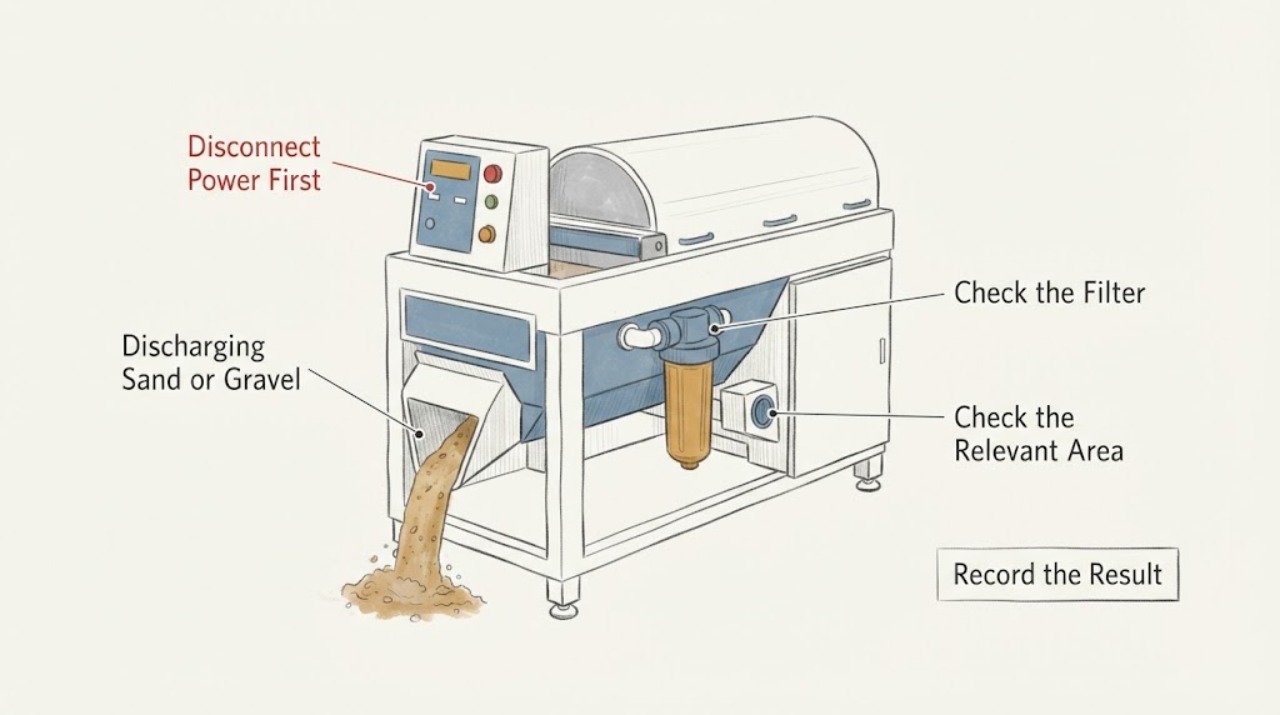
Work through in order
Diagnostic checks
Use only checks that match the exact appliance or system and its official guide.
-
Check 1
Stop the cycle, press Power, unplug the WM3170CW, turn off both water faucets, and keep the door closed if the tub may contain hot water. Put a shallow pan and towels at the lower service area before handling a hose or filter.
Expected result: The washer is empty and cool with no standing water, or the tub may contain hot water or a large amount of residual water; the floor is protected or cannot be protected from a spill.
Next step: If water may be hot or the spill cannot be controlled, leave the washer off and allow it to cool or arrange service. Do not open the pump cap while the washer is powered or without a container.
Stop if: Stop for a hot leak, water reaching electrical connections, a damaged hose or a floor that cannot be kept safe.
Why this matters
Why: LG warns that opening the pump cap can release a large amount of water and that hot tub water can burn. The washer must be powered off and the water contained before filter work.
-
Check 2
With the faucets off and the washer unplugged, inspect the two water-inlet filters where the hot and cold hoses attach to the washer. Remove only the filters and hose connections described by the WM3170CW manual or LG's inlet-filter guidance, and rinse visible sand, rust or buildup away without omitting a filter on reassembly.
Expected result: One or both inlet filters contain sand, rust or scale, or the filters are clean and the sediment is not present at the water entry point.
Next step: Clean and reinstall the filters, reconnect the correct hoses and open the faucets slowly while checking for leaks. If the filters immediately refill with grit, collect a sample and have the supply, faucet screens or plumbing checked; do not continue washing until the source is addressed.
Why this matters
Why: LG identifies sediment, sand and rust in inlet filters as a cause of restricted water flow. Material at this location points toward the supply hose, faucet or building water rather than proving a drum or pump failure.
-
Check 3
After the tub is drained and the floor is protected, open the lower-front service cover and use the residual-water hose if present to empty remaining water into the pan. Remove the pump filter as LG describes and inspect the filter and its opening for gravel, sand, coins, buttons, lint or other foreign material.
Expected result: The drain filter contains the same material seen in the discharged water, or it is clear while sediment was found only at the inlet or in the drum.
Next step: Wash the filter by hand, clear only accessible debris, reinstall it clockwise until fully seated, reconnect the hose cap and close the service cover. If the filter is cracked, cannot seat, or the opening contains sharp fragments or damage, stop and request service.
Why this matters
Why: LG says the front-load drain pump filter collects foreign objects and that a clogged filter can prevent draining. Material in this filter may have come from pockets or the washer load; it does not alone identify a failed pump.
-
Check 4
Inspect the current and recent laundry without restarting the washer: empty every pocket, check for stones or hard objects in garments, look through the drum and door seal, and note whether the sediment is gritty, rust-colored, plastic, metallic or oily. Do not reach into a moving drum or use tools to pry at the seal.
Expected result: A pocket item, loose object or residue is found in the load/drum, or no source is visible while the sediment continues to appear in the water.
Next step: Remove only accessible loose objects with the washer unplugged, clean the filter and gasket according to the model instructions, and retain a sample/photo of recurring material. Do not run repeated cycles to flush unknown debris through the pump.
Why this matters
Why: LG says paper and foreign objects from clothing pockets can enter the washer and may be caught in the drain pump filter. Recurrent material without a visible source raises concern for a hose, tub, filter housing or supply problem that requires diagnosis.
-
Check 5
After both filters are clean and fully reassembled, inspect the lower service area, hose connections and floor for leaks before any limited test. Confirm that the drain hose is not kinked or blocked and that the inlet hoses are connected correctly; stop if a leak appears.
Expected result: The caps and filters remain dry and the drain hose is clear, or water leaks from the pump filter, residual hose, inlet connection or drain hose.
Next step: Unplug the washer, close the faucets and reseat only the cap or filter procedure allowed by the manual. If the leak persists, the cap/filter housing/hose may be damaged or incorrectly fitted; keep the washer off and request LG service or plumbing help.
Why this matters
Why: LG states that an incompletely closed pump cap or hose cap can cause leaks and that a kinked or clogged drain hose can impair draining. A leak after filter work means the assembly is not cleared for use.
-
Check 6
Escalate with the WM3170CW model number, photos of the sediment, the inlet-filter and drain-filter findings, water source, leak location, error code and whether the material returns after cleaning. Do not open the tub, pump, motor or control cabinet or test the appliance with an incorrectly assembled filter.
Expected result: Sediment returns, draining remains abnormal, the washer leaks, the filter housing or hoses are damaged, or the material is sharp, oily, metallic or accompanied by a noise or error code.
Next step: Keep the washer unplugged and the faucets closed until LG-qualified service or a qualified plumber identifies the source. Preserve a sample/photo and do not run additional wash cycles to test a suspected repair.
Stop if: Do not use the washer until service clears recurring sediment, leaks, exposed damage, abnormal noise or an error code.
Why this matters
Why: The remaining causes cannot be distinguished safely from external cleaning and may involve a damaged hose, pump/filter housing, tub, supply or plumbing. LG directs persistent fill/drain problems to service rather than unsupported internal repair.
Use your observations
Decision map
Find the observation that best matches what you see, then follow the next safe action.
-
PATH 01Next step
What you see
Sand or rust is concentrated in one or both inlet filters, and the drain filter is clear.
Do this next
Clean and reinstall the inlet filters, check the hose/faucet screens and have the supply plumbing checked if grit returns. Keep the washer off if the filters rapidly clog again.
Why this path and its safety boundary
Why it matters: The material is entering with the water supply or hose/faucet path; the evidence does not point first to a washer drum or pump failure.
-
PATH 02Next step
What you see
Gravel, coins, lint or other foreign objects are found in the WM3170CW drain pump filter.
Do this next
Clean and reinstall the filter and residual-water hose as LG describes. If sharp fragments, housing damage, recurring sediment or poor draining remain, request service.
Why this path and its safety boundary
Why it matters: The filter is catching material from the washer's drain path, potentially from pockets or the load; the finding does not prove the pump itself has failed.
-
PATH 03Next step
What you see
The sediment returns after both filters are clean, or the washer begins leaking after filter reassembly.
Do this next
Stop using the washer, close the faucets and provide LG service with the sample/photo and leak location. Do not keep cycling water through the machine.
Why this path and its safety boundary
Why it matters: The source is not resolved by routine filter cleaning and may involve a supply, hose, filter housing, pump, tub or plumbing problem.
-
PATH 04Next step
What you see
The material is oily, metallic, sharp, accompanied by grinding/noise, an error code, visible hose/tub damage or electrical exposure.
Do this next
Keep the WM3170CW unplugged and the water supply closed; arrange LG-qualified appliance service and do not attempt internal disassembly.
Why this path and its safety boundary
Why it matters: This is outside a safe filter-cleaning diagnosis and may damage clothing, the pump or the washer or create a safety hazard.
Helpful context
Understand the symptom
First separate the water path from the drain path
The WM3170CW is a front-load LG washer, and LG provides two relevant external checks. Its inlet-filter guidance specifically lists sediment, sand and rust as material that can restrict water flow. Its drain-filter guidance says the front-load pump filter collects lost items and lint, while the foreign-object guidance says material from clothing pockets can end up there. Seeing grit in discharged water does not by itself prove that a pump, drum or sealed part has failed.
Protect the floor and prevent a second leak
A drain filter can release residual water, and LG warns that water may spill when the pump cap is opened. Use a shallow pan, towels and the residual-water hose if fitted; keep the washer unplugged and the faucets closed during the check. After cleaning, the hose cap and pump filter must be fully seated. A filter that is not reassembled correctly can leak, so do not run another cycle until the lower service area is dry and closed.
When checks do not resolve it
Need a professional?
Request LG service when sediment returns after inlet and drain-filter cleaning, the washer leaks, the filter or hose housing is damaged, draining remains abnormal, an error code or abnormal noise appears, or the material is sharp, oily or metallic. Ask a plumber to check the supply if the inlet filters refill with grit.
Safety scope: Turn off faucets and unplug before cleaning filters. Drain hot or residual water into a container, do not operate without a correctly installed filter, do not open the tub/pump/control cabinet, and do not keep running cycles to flush unknown debris.
Have this ready
- Provide model WM3170CW, photos/sample of the sediment, whether it appeared during fill or drain, inlet-filter and pump-filter findings, water source, load/pocket history, leak location, drain behavior, noises and any displayed code.
Common questions
FAQ
Could sand in the LG WM3170CW come from the water supply?
Yes. LG's washer guidance says inlet filters can collect sediment and foreign objects such as sand or rust. Turn off the water and power before checking those filters. If they quickly refill with grit, stop washing and have the faucet, hose screens or building supply inspected.
Where do I look for gravel that comes out with drain water?
After the tub is safely drained and the washer is unplugged, inspect the lower-front drain pump filter and its opening. LG says the front-load filter collects lost items and lint. Check pockets and the drum as well, because objects from clothing can enter the washer and be caught in that filter.
Can I run another cycle after cleaning the filters?
Only after every filter, hose cap and service cover is fully reassembled and the area is dry, and only if there is no recurring sediment, leak, damage, abnormal noise or error code. If grit returns or water leaks, keep the washer unplugged and request service instead of flushing it with more cycles.
Read the exact guide
Official sources
- LG Washer - Troubleshooting Fills Too Slow / Does Not FillLG USA · Official LG washer guidance; it explicitly states that inlet filters can collect sediment, sand or rust and gives the faucet-off, filter-cleaning sequence. It is used for the WM3170CW only as a family-level external check, with the exact model manual controlling variations.
- LG front load washing machine - LeakageLG USA · Official LG front-load leakage guidance used only for the post-cleaning cap/hose leak boundary and service escalation.
- LG Washer - Why Isn't My Washer DrainingLG USA · Official LG washer troubleshooting used for water-containment and drain-filter safety; it warns that images/content can vary by model, so no unseen internal repair is inferred.
- LG Front load washing machine foreign objects: There are foreign objects stuck on the laundryLG USA · Official LG all-model front-load guidance used to distinguish clothing-pocket material from supply sediment; it does not diagnose the WM3170CW's internal parts.
- LG Washer – How to Clean the Drain Pump FilterLG USA · Official LG guidance explicitly limited to front-load washers and combos, matching the WM3170CW's exact product-page identity. It notes model images may vary, so only the described external sequence is used.
- LG WM3170CW.ABWEPUS Support, Manuals, Warranty & MoreLG USA · Exact LG USA product support page for WM3170CW.ABWEPUS. It establishes the assigned model and provides the owner's manual/support path; the general LG filter pages supply the procedural checks and note that images/content can vary by model.
Community feedback
Share a repair observation
Share a plain-text repair observation. Accepted observations are published automatically; this page may take a moment to update.