
On this page
Start here
Quick answer
If an LG washing machine leaves water in the tub, first note whether it is paused, soaking, showing an error, or actually failing to drain. Stop if the water is hot, leaking toward the plug or outlet, or accompanied by smoke, a burning smell, sparks, severe vibration, or a breaker trip. When the floor and electrical area are dry, check the cycle status, load balance, drain hose routing and standpipe, then use the model-specific pump-filter procedure only on models that document an accessible filter. Excess suds, a kinked or submerged hose, a blocked household drain, a loose filter cap, and a failed pump can look similar. Do not force a locked door, reach into a wet pump, use a different model's filter procedure, or keep repeating a drain test after a hazard. Persistent standing water, an exact code that returns, a pump that only hums, or an internal obstruction needs qualified LG appliance service.
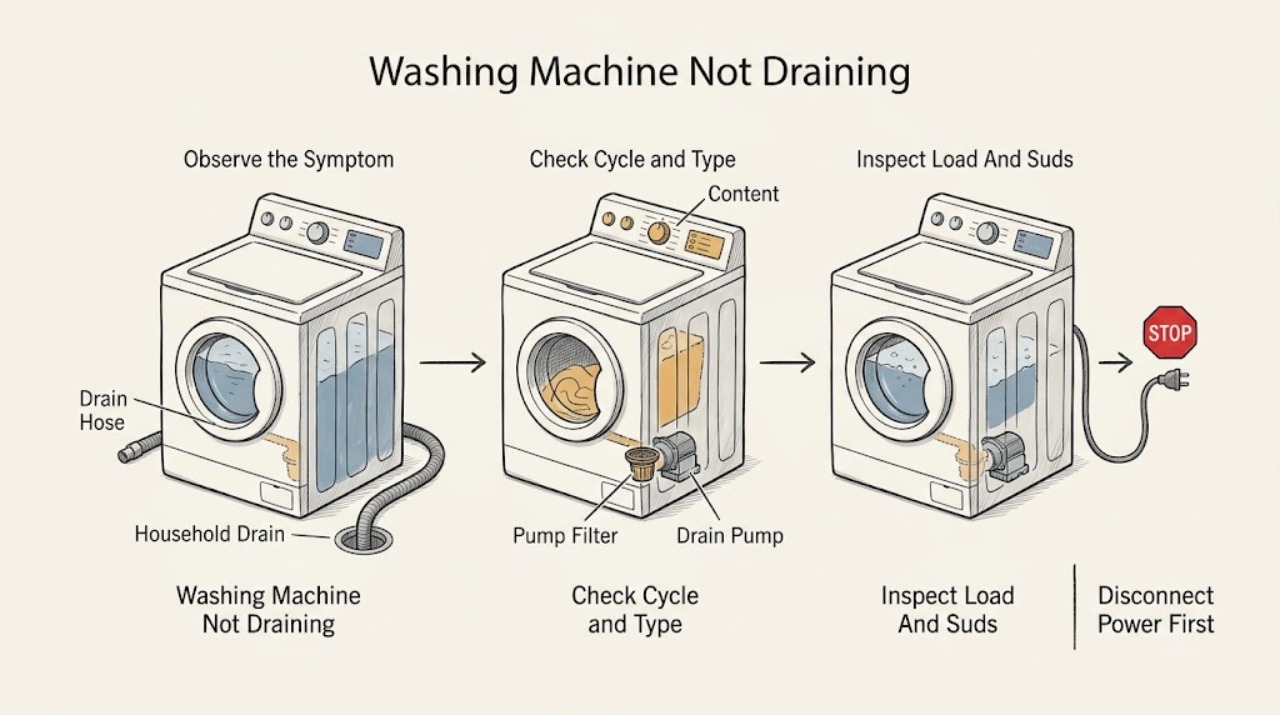
Work through in order
Diagnostic checks
Use only checks that match the exact appliance or system and its official guide.
-
Check 1
Stop the cycle with the normal control if it responds, keep clear of any puddle, and determine whether the remaining water is hot or near the cord, plug, outlet, controls, or a damaged hose.
Expected result: Classify the situation as cool water in a dry electrical area, hot water, water near electricity, a large leak, smoke or burning odor, visible sparks, severe movement, or a tripped breaker.
Next step: From a dry safe position close accessible water valves and isolate power at the breaker or by unplugging only an intact plug. Arrange qualified help before touching the washer if a hazard is present; otherwise continue with external observations.
Stop if: Do not touch a wet plug or outlet, cross standing water to unplug, restart after smoke, sparks, burning odor, heat, severe vibration, or a breaker trip, or reach into standing water around energized equipment.
Why this matters
Why: Hot or uncontrolled water and electrical or fire symptoms take priority over diagnosing a drain blockage.
-
Check 2
Read the display and note the exact cycle, stage, pause or soak setting, door or lid state, and any error code before changing controls.
Expected result: Record whether the washer is paused, in Soak or Add Item, waiting for a locked door, stopped after an imbalance, or showing a code; also note whether the tub is full or only slightly damp.
Next step: If a paused or soak state is safe, resume or select the documented drain, Spin, or Rinse+Spin function once. Record the code and model for service if the command is ignored or the condition returns.
Stop if: Do not bypass a door or lid lock, force a full door, or keep selecting cycles when the washer is leaking, hot, electrically unsafe, or mechanically violent.
Why this matters
Why: LG documents that pause or soak can leave the tub still, an imbalance can stop spin, and an exact code must be interpreted for the model rather than guessed as a pump failure.
-
Check 3
When the area is dry and no hazard exists, note the load size, bulky items, balance, selected cycle, and detergent type and amount; look for excessive bubbles without adding water or detergent.
Expected result: Record a normal load, a tightly packed or badly unbalanced load, a single bulky item, or visible oversuds and detergent above the model's recommended amount.
Next step: Only after the washer is safe, follow the model's load and HE-detergent guidance and use a suitable drain or spin command once. If a normal load still leaves water, inspect the drain path next.
Stop if: Do not keep running a foaming or violently shaking washer, add detergent to a full tub, or use load balance as an explanation for smoke, odor, heat, sparks, a leak, or a breaker trip.
Why this matters
Why: LG identifies unsuitable or unbalanced loads as causes of prolonged or incomplete spin, while excess detergent can create suds that interfere with washing and draining. These observations do not explain a pump hum with no flow or water near power.
-
Check 4
With water contained and power isolated, inspect the rear drain hose from the washer to the standpipe or laundry tub for kinks, crushing, submersion, freezing, a loose connection, an incorrect height or loop, and contact with the appliance base.
Expected result: Record an intact hose with model-correct routing, a pinched or submerged hose, a hose that has slipped out, water at the connection, or a hose height and loop that do not match the exact LG manual.
Next step: Correct only an obvious external displacement or kink according to the exact manual, then dry the area. Replace a damaged hose or obtain appliance service; do not assume another LG model's height or routing applies.
Stop if: Do not disconnect a full or hot hose without a safe container and drain plan, pull the washer across wet flooring, seal the standpipe, or run with water directed toward electrical parts.
Why this matters
Why: LG lists a high, pressed, clogged, frozen, submerged, or poorly routed hose as a reason water may remain and the washer may stop. A loose or cracked connection can also empty drain water onto the floor instead of into the standpipe.
-
Check 5
Observe the standpipe, laundry tub, or household drain connection from a safe dry position during any permitted single drain observation; check for slow discharge or water backing up outside the washer.
Expected result: Record free household drainage, water rising or backing up at the standpipe, a displaced hose, or a floor leak that begins only when the pump discharges.
Next step: Keep the washer off, secure only an obviously displaced hose using the manual, and arrange plumbing service for backup or appliance service for a damaged or hidden washer connection.
Stop if: Do not pour chemical drain cleaner into the washer or standpipe, disconnect a full hose into an uncontrolled puddle, or repeat a discharge that backs water toward electricity.
Why this matters
Why: A blocked household drain or a hose that is not secured can mimic a failed washer pump. Backflow is a plumbing path, not evidence that the appliance's internal pump is defective.
-
Check 6
If the exact model permits one safe drain or Spin-only command and the floor, cord, plug, and hoses are dry and intact, observe the washer from outside without moving it or reaching inside.
Expected result: Record normal water flow, no pump sound, a hum with no flow, repeated clicking, grinding or rattling, a code, or a new leak, odor, heat, smoke, spark, severe vibration, or breaker trip.
Next step: Stop after the single observation and give the model, stage, code, water level, hose result, and sound to qualified service. Keep the washer isolated when flow is absent or the sound is abnormal.
Stop if: Do not run repeated drain cycles, insert tools through the drum or filter opening, tilt the washer, or continue after a leak, hot water, odor, smoke, spark, heat, severe vibration, or breaker trip.
Why this matters
Why: Normal flow shifts attention to cycle or load completion; no sound, hum without flow, or abnormal mechanical noise suggests a pump, obstruction, control, or wiring problem that cannot be confirmed by repeated tests.
-
Check 7
Only if the full model's LG manual documents an accessible drain-pump filter or residual-water hose, switch off and unplug, allow hot water to cool, place a shallow container and cloth, and follow that model's access procedure.
Expected result: Record no documented access, a filter full of lint or an object, a residual-water cap that is loose, a filter that will not turn or seat, or water that leaks after the cap is restored.
Next step: Remove only loose debris that the exact manual says is user-accessible, fully close the cap and reseat the filter, dry the area, and stop use if the problem remains.
Stop if: Do not open a filter with hot or pressurized water, force the cap, reach into a wet pump, use a front-load procedure on a top-load model, or run with a loose filter or stopper.
Why this matters
Why: An accessible filter or cap can restrict flow or leak after cleaning, but filter design is not universal. A stuck filter, inaccessible obstruction, or persistent leak is a service condition.
-
Check 8
Record the exact error code, door or lid indicator, and whether the washer reports a lock or drain condition; wait for the documented cool-down or drain state rather than pulling the closure.
Expected result: Record a code that returns immediately, a door that remains locked with water inside, a door that unlocks after safe draining, or no code with a clear drain-path obstruction.
Next step: Use the model's documented cancel or drain command once, preserve the exact code and stage, and request service if water remains or the lock will not release after safe conditions return.
Stop if: Do not force or bypass a door/lid lock, reach through the opening, repeatedly reset an active code, or open the appliance while water is hot or moving.
Why this matters
Why: A lock can remain engaged while water is present, and an exact code may point to a model-specific condition. A locked door is a safety boundary, not proof that the lock should be bypassed.
-
Check 9
After external checks, and only with a dry safe area and no heat, leak, odor, smoke, spark, severe vibration, or breaker event, perform at most the model-documented power reset: turn off, unplug or switch off the breaker, hold Start/Pause as instructed, restore power, and observe once.
Expected result: Record whether the washer drains once, leaves the same water, returns the same code, or develops an electrical or mechanical warning.
Next step: Keep the washer out of service and provide the model, code, cycle stage, residual water level, hose/filter results, pump sound, and safe photos to LG or a qualified appliance technician.
Stop if: Do not reset after smoke, burning odor, sparks, a hot or damaged outlet/cord, water near electricity, severe vibration, or a tripped breaker; do not open panels to continue diagnosis.
Why this matters
Why: A reset can clear a transient control state but cannot repair a blocked hose, failed pump, household backflow, or unsafe electrical condition. A recurring code or standing water is evidence for service, not more resets.
-
Check 10
Prepare a service handoff with the full model number, front- or top-load design, exact code, cycle and stage, amount and temperature of remaining water, hose and household-drain observations, filter access/result, load and detergent details, and any pump sound or leak location.
Expected result: Classify the evidence as cycle state, load/suds, hose routing, household backflow, accessible filter, no-flow pump symptom, lock/code, or internal/electrical fault.
Next step: Use LG model-specific support or qualified appliance, plumbing, or electrical service. Keep water valves closed and power isolated until the cause is corrected and the floor is dry.
Stop if: Do not return the washer to use while water remains, the source is unexplained, a filter or hose is damaged, a lock is faulty, or there has been smoke, odor, heat, sparks, severe vibration, or a breaker trip.
Why this matters
Why: A stage-based record lets a technician distinguish a plumbing restriction from a pump, filter, control, lock, hose, or internal fault without unsafe owner disassembly.
Use your observations
Decision map
Find the observation that best matches what you see, then follow the next safe action.
-
PATH 01Safety boundary
What you see
The washer is paused, soaking, in Add Item, stopped after imbalance, or showing a code.
Do this next
Use the exact model's resume, cancel, drain, Spin, or Rinse+Spin control once; record the exact code and request service if the water remains or the code returns.
Why this path and its safety boundary
Why it matters: The tub may be waiting for a control state or safety condition rather than suffering a drain-pump failure.
Safety stop: Do not bypass the door/lid lock or continue if water is hot, leaking, electrically unsafe, or accompanied by smoke, odor, sparks, severe vibration, or a trip.
-
PATH 02Safety boundary
What you see
The drain hose is kinked, crushed, submerged, loose, or incorrectly routed, or the standpipe backs up when water is discharged.
Do this next
Keep the washer off, correct only an obvious hose displacement using the exact manual, and obtain appliance or plumbing service for damage, hidden blockage, or recurrence.
Why this path and its safety boundary
Why it matters: The external drain path is restricting flow or returning water; it can look like a washer failure.
Safety stop: Do not disconnect a full/hot hose, use chemical cleaner, seal the drain, or test a discharge toward wet electrical equipment.
-
PATH 03Safety boundary
What you see
The problem appears with a bulky, tightly packed, unbalanced, or over-sudsing load, while the external drain path is intact.
Do this next
Follow the exact model's load, water-level, and HE-detergent guidance and make only one safe observation. Service a normal load that still leaves water or shakes severely.
Why this path and its safety boundary
Why it matters: Load distribution or excess detergent may have prevented normal spin or drainage, but it is not a safe explanation for a recurring no-flow symptom.
Safety stop: Do not keep cycling a foaming or violent washer, add water or detergent, or dismiss a leak, odor, smoke, heat, spark, or breaker trip as a load issue.
-
PATH 04Safety boundary
What you see
The exact model documents an accessible pump filter and it contains lint or an object, has a loose cap, or will not seat correctly.
Do this next
Isolate power, cool and contain residual water, follow only the exact manual, and request service for a stuck filter, concealed obstruction, or leak after reassembly.
Why this path and its safety boundary
Why it matters: A restricted filter or cap can reduce flow or leak, but access and procedure are model-specific.
Safety stop: Do not force the cap, open it with hot/pressurized water, reach into the wet pump, or run with a loose filter/stopper.
-
PATH 05Safety boundary
What you see
The hose and household drain are clear, the relevant cycle command is correct, and the pump is silent, only humming, grinding, or repeatedly clicking while water remains.
Do this next
Stop testing, keep the washer isolated, and give service the sound, code, stage, water level, and filter result. Do not open panels or probe the pump.
Why this path and its safety boundary
Why it matters: A pump obstruction, pump, control, or wiring fault is more likely than a simple load imbalance and needs controlled diagnosis.
Safety stop: Stop immediately for odor, smoke, sparks, hot wiring, water near power, severe movement, or a breaker trip; do not repeat the drain cycle.
-
PATH 06Safety boundary
What you see
Water remains after safe external checks, a code or locked closure returns, the filter is inaccessible/stuck, the leak is underneath, or any electrical/fire symptom appears.
Do this next
Close water valves, isolate power only from a dry safe position, and arrange qualified LG appliance service; use plumbing or electrical service when the external system is implicated.
Why this path and its safety boundary
Why it matters: An internal pump, hose, seal, lock, control, or electrical fault cannot be safely separated by owner disassembly.
Safety stop: Do not tilt, pull, open panels, force a lock/filter, reach into a moving or wet mechanism, or keep the washer in service.
Helpful context
Understand the symptom
Standing water does not always mean a failed pump
A washer can retain water because a cycle is paused or soaking, because an imbalance prevents the spin portion, or because the drain hose, household standpipe, filter, or pump cannot move water. Begin with the exact stage and any displayed code. LG's general steps and access covers vary by model, so the full model number and the matching owner's manual control whether a pump filter or residual-water hose is present.
Separate the appliance drain path from the household drain
A hose that is kinked, crushed, too high for the model, submerged, or loose in the standpipe can stop or spill water. A blocked household drain can send water back toward the washer when the pump runs. Observe the connection from a dry, safe position; do not seal the standpipe, disconnect a full hose without a safe drain plan, or pour chemical cleaner into the washer path.
Filter access is model-specific
Many front-load LG instructions show a lower access area, but not every washer has the same filter or residual-water arrangement. If the exact manual documents one, power must be isolated and residual water cooled and contained before opening it. A filter that is stuck, cannot be reseated, or leaks after cleaning is a service condition rather than a reason to force the cap.
Suds and imbalance can change the drain result
Too much or unsuitable detergent can create foam and prolong or interrupt a cycle. Bulky or unbalanced loads can prevent a normal spin and leave clothes very wet. Correct the detergent and load only after the washer is otherwise safe; a normal load that still leaves water, a pump that hums without flow, or a repeated error points back to the drain system.
Safety boundary
Stop conditions
- Stop for hot or uncontrolled water, water near the cord, plug, outlet, controls, or a wet floor around electricity; isolate power only from a dry safe position.
- Stop for smoke, burning or melting odor, sparks, a hot/discolored connection, damaged cord, severe vibration, or a repeated breaker trip.
- Do not force or bypass a door/lid lock, open a hot or pressurized filter, reach into a wet pump, tilt the washer, or remove panels.
- Do not use chemical drain cleaner in the washer path, seal the standpipe, disconnect a full hose without a safe drain plan, or run with a loose filter, stopper, or hose.
- Do not repeat drain tests after a no-flow pump symptom, recurring error, standing water, leak, or abnormal mechanical sound.
Only after diagnosis
Potential parts
- drain pump
Consider only when the exact model's external drain path is clear and a qualified diagnosis finds no pump flow or a failed pump.
Confirm the full LG model and manufacturer fit information; do not infer compatibility from a similar washer. - drain hose
Relevant only when the installed hose is cracked, crushed, leaking, or otherwise confirmed to be the restriction.
Confirm exact model, hose length, connection, and routing requirements before ordering. - pump filter or filter cap
Relevant only for a model that documents an accessible filter and a cap or filter that is damaged or cannot seal after safe inspection.
Filter access and components vary by model; have service confirm the correct part. - door or lid lock
Consider only when the exact code and service diagnosis show a lock preventing a safe drain or cycle completion after the tub is safe.
Confirm the full model and lock design; never bypass the lock.
When checks do not resolve it
Need a professional?
Arrange LG or qualified appliance service when the drain hose and household drain are clear but water remains, the pump is silent or only hums, an exact code returns, a door or lid stays locked with water inside, the applicable filter is stuck or leaks after reassembly, the source is under the cabinet, or any leak, hot water, odor, smoke, spark, severe vibration, or breaker event occurs.
Common questions
FAQ
Why is my LG washing machine full of water after the cycle?
First determine whether it was paused, soaking, stopped after an imbalance, or displayed an exact code. If it truly failed to drain, check the model-correct drain hose routing and household drain, then the pump filter only if that model documents access. Standing water with a clear path needs service.
Can a kinked LG washer drain hose stop draining?
Yes. LG identifies a hose that is kinked, crushed, too high, submerged, blocked, frozen, or incorrectly routed as a possible cause of retained water. Correct only an obvious external issue according to the exact model manual and do not disconnect a full or hot hose without a safe plan.
Does every LG washer have a pump filter?
No. Filter and residual-water access differ by model and washer design. Use the full model number and its manual; never force a cap, open it with hot or pressurized water, or apply a front-load procedure to a top-load machine.
What does it mean if my LG drain pump hums but no water comes out?
A restriction, object, pump, control, or wiring fault is possible after the hose and household drain are shown clear. Stop after one safe observation, do not probe the wet pump or repeat cycles, and give the sound, code, stage, and filter result to qualified service.
Can too much detergent cause an LG washer not to drain?
Excess or unsuitable detergent can create suds and interfere with a normal cycle, while residue can restrict a dispenser. Follow the exact model's HE-detergent amount and load guidance, but do not use suds or an unbalanced load to explain a recurring no-flow pump symptom.
Why is the LG washer door still locked with water inside?
The lock may remain engaged while water or an unsafe condition is present. Use only the model's documented cancel or drain command once; never force or bypass the lock. If water remains or the code returns, keep the washer isolated and request service.
When should I stop troubleshooting an LG washer that will not drain?
Stop for hot or uncontrolled water, a wet electrical area, smoke, burning odor, sparks, a hot connection, severe vibration, damaged cord, or a breaker trip. Also stop when the pump is silent or abnormal, the hose/filter is stuck, or water remains after safe external checks; do not open panels or keep testing.
Read the exact guide
Official sources
- [LG front load washer leak] Water leaks from the drain outlet and drain hose during drainageLG USA Support · LG USA support for front-load washers; exact hose routing varies by model.
- [LG washing machine washing] The tub does not spin after water is supplied.LG USA Support · LG USA support; cycle names and controls vary by model.
- [LG Front Load Washer] Spinning takes too longLG USA Support · LG USA support for front-load washers; model access and cycle behavior vary.
- LG Washer - Detergent and Additive UsageLG USA Support · LG support for front- and top-load washers; dispenser arrangement varies by model.
- LG Washer - Troubleshooting Washer Does Not Drain or Spin (Clothes Too Wet)LG USA Support · LG USA support guidance; controls and drain access vary by model.
- [LG top load washing machine drain] Water is not drained during washing and the washing machine stops.LG USA Support · LG USA support for top-load washers; exact hose routing varies by model.
- LG Washing Machine - Washer Powered off Mid-CycleLG USA Support · LG USA support; exact controls and code meanings vary by model.
- Appliance and Electrical Fire SafetyU.S. Fire Administration · Government fire-safety guidance for major appliances including washers; it does not diagnose an LG washer.
Community feedback
Share a repair observation
Share a plain-text repair observation. Accepted observations are published automatically; this page may take a moment to update.