
On this page
Start here
Quick answer
An LG washer may refuse or interrupt spin when the load is bunched, the machine is not level, water has not drained, the door or lid is not confirmed closed, or a model-specific error is active. First stop for leaking water, violent movement, metal-on-metal scraping, smoke, burning smell, sparks, a hot cord, or repeated breaker trips. If the washer is safe, check the display, pause and redistribute a loose load, confirm the machine is stable, and use the exact model's drain or rinse-and-spin procedure. Front-load models require the door to lock before spin; top-load models require the lid to close and its lock to respond. Do not reach into a moving tub, remove panels, bypass an interlock, or keep retrying a noisy or damaged machine. If a safe empty spin still fails, LG recommends service for diagnosis.
Before you begin
Safety first
- Safe checks are limited to reading the display, observing movement and water from a safe position, redistributing a stopped load, checking visible hose and obstruction conditions, and following the exact manual. Interlock, pump, motor, suspension, control, wiring, and panel work require qualified service.
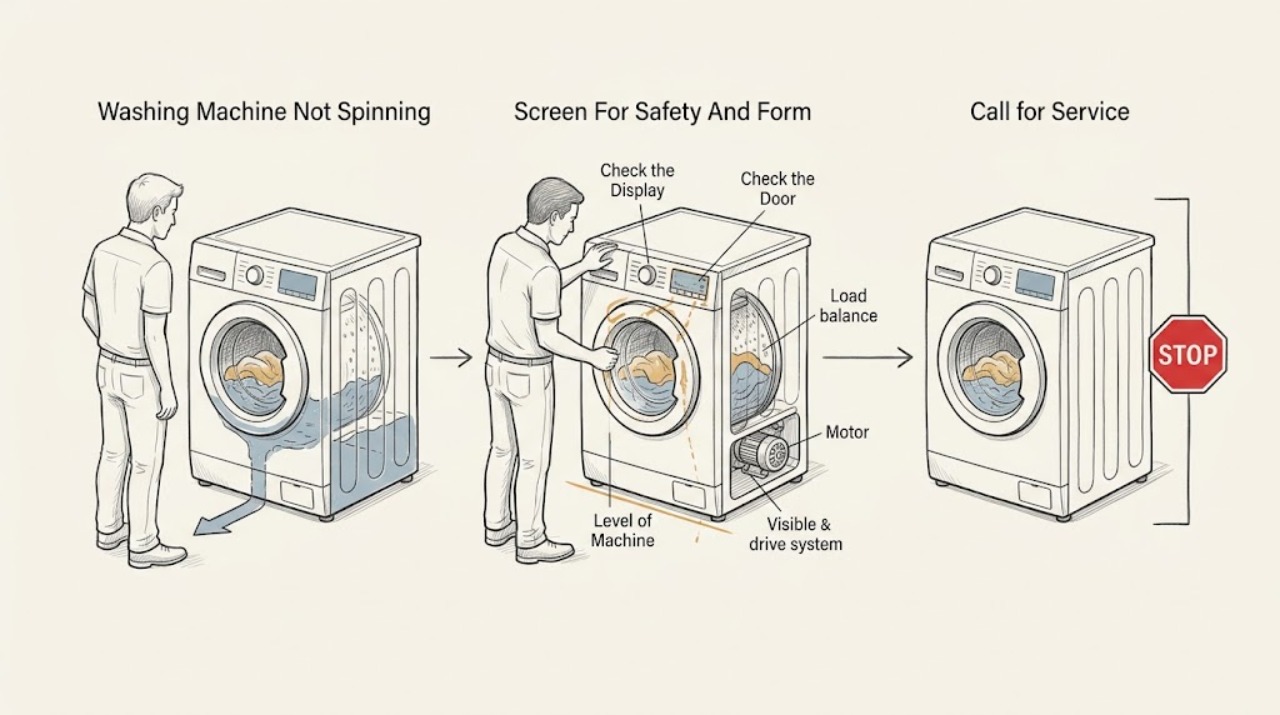
Work through in order
Diagnostic checks
Use only checks that match the exact appliance or system and its official guide.
-
Check 1
Stop the cycle and observe from a safe position whether the washer is violently moving, leaking, scraping metal, smoking, burning, sparking, unusually hot, or repeatedly tripping a breaker; identify whether it is front-load or top-load without opening panels.
Expected result: Record water on the floor or near power, damaged glass or lid, a moving tub, the exact noise, a hot plug or cord, smoke, odor, sparks, or repeated electrical trips; also record the washer form factor.
Next step: Keep the washer off. Isolate power only if the plug, outlet, floor, and hands are dry and intact; otherwise stay away and arrange appliance or electrical service. Use emergency help for fire or immediate danger.
Stop if: Do not touch wet power connections, reach into a moving tub, move a violently shaking washer, open a damaged door or lid, or retry a cycle with smoke, burning odor, sparks, or repeated trips.
Why this matters
Why: A hazard or severe mechanical symptom requires a safety stop, while the form factor determines whether the next check concerns a door interlock or lid lock and which user controls are applicable.
-
Check 2
With the washer stopped and safe, read the display, lights, beeps, selected cycle, and stage at which spinning stopped; photograph the exact code before clearing anything.
Expected result: Record UE or another balance indication, OE or a drain indication, a door or lid indication, a motor or control indication, no code, or a code that returns after the model's documented clear action.
Next step: Use the exact LG manual or code lookup for the recorded model and code. Continue with the relevant safe load, drain, door, or level check; arrange service for a returning code.
Stop if: Do not enter diagnostic mode, repeatedly clear a code, or run another load to see whether a safety or motor code disappears.
Why this matters
Why: The code and timing separate balance, drainage, interlock, and control branches, but LG codes and remedies are model-specific and must not be generalized from a different washer.
-
Check 3
For a front-load washer, confirm the door closes normally and the lock indicator engages; for a top-load washer, close the lid normally and confirm the model's lid-lock indication, without pressing on the lock or bypassing it.
Expected result: Record whether clothing or a loose item is caught at the visible seal or lid edge, whether the door or lid is damaged or misaligned, and whether the lock indication appears before spin.
Next step: Remove only a loose visible obstruction with the tub stopped, close the door or lid gently, and follow the exact manual's single retry. Arrange service for a damaged or unresponsive interlock.
Stop if: Do not insert tools, hold down a lid switch, jumper a lock, force a hinge, pull a gasket, or operate with cracked glass, a damaged lid, or a torn seal.
Why this matters
Why: LG front-load guidance says the door must be locked before spin; an incomplete closure, obstruction, damaged seal, or failed lock feedback can prevent spin. A top-load lid-lock fault has the same safety boundary but a model-specific mechanism.
-
Check 4
Look through the front door or inspect the top-load tub only when the machine is stopped and safe to determine whether water remains; check the visible drain hose for a kink or compression without disconnecting it.
Expected result: Record an empty tub, standing water, slow drain, an OE or outlet indication, a kinked hose, or water on the floor; do not reach into water or the pump opening.
Next step: If the surrounding power is dry and the manual permits it, run the exact model's Drain, Spin Only, or Rinse and Spin procedure. If water will not drain or a leak is present, keep the washer off and arrange service.
Stop if: Do not open a pump filter with hot or pressurized water, disconnect hoses as a test, reach into a pump, or touch electrical parts near water.
Why this matters
Why: A washer may withhold high-speed spin when water has not drained. LG associates OE with drain-path conditions and identifies a kinked or clogged hose or filter as possible causes.
-
Check 5
After the drum or tub has stopped and the door or lid is safely released, spread the laundry evenly; remove excess items from an overloaded load or add a compatible small item to a single heavy item only when the exact manual allows it.
Expected result: Record whether items were wrapped on one side, the load was very small or tightly packed, a single heavy blanket or mat was present, or the load was already evenly distributed.
Next step: Select the model's suitable cycle and spin setting once, then observe whether the washer reaches spin without excessive movement. Stop and arrange service if the same load fault returns or the machine bangs severely.
Stop if: Do not wash items the manual excludes, reach into a rotating tub, overload the washer, or keep restarting after violent vibration or a damaged load.
Why this matters
Why: A concentrated or unsuitable load can trigger balance correction and leave the load wet without proving a motor failure. An already balanced, appropriate load makes drainage, interlock, leveling, or mechanical causes more likely.
-
Check 6
With the washer empty, stable, and powered off, gently test whether it rocks at diagonal corners and inspect only the visible drum, tub, or agitator area for a loose coin, zipper, button, or other object.
Expected result: Record rocking, uneven feet, a soft or flexing floor, a visible foreign object, or harsh noise or resistance when the basket is moved only as the manual permits.
Next step: If the manual permits, level the feet using the specified tool and remove only a loose visible object with safe access. If noise, resistance, or movement remains, arrange service.
Stop if: Do not remove panels, reach behind moving parts, dismantle the agitator, test live wiring, or use a machine that walks, scrapes, leaks, or has damaged suspension or drive components.
Why this matters
Why: LG links an unleveled cabinet and foreign objects with abnormal spin behavior or noise. Persistent resistance, grinding, metal contact, or structural looseness suggests a mechanical fault rather than a leveling adjustment.
-
Check 7
After the load, drain, interlock, level, and hazard checks pass, run one model-approved empty or small-load Rinse and Spin or Spin Only test, staying nearby and stopping at the first severe vibration, scraping, leak, smell, or electrical warning.
Expected result: Record whether the tub accelerates smoothly, only tumbles slowly, stops and retries balance, leaves water, shows a code, or fails to spin with an empty or suitable load.
Next step: If it fails or the symptom returns, stop using the washer and arrange qualified repair with the model, code, load, drain, noise, and test results. Do not perform more tests.
Stop if: Do not repeat the test, run a full load, remove panels, measure energized circuits, or replace a motor, belt, pump, or control from the symptom alone.
Why this matters
Why: A smooth empty spin supports a load, drain, or balance issue; failure with a safe empty test, harsh mechanical noise, or a returning code supports a motor, drive, interlock, control, or other fault requiring diagnosis.
Use your observations
Decision map
Find the observation that best matches what you see, then follow the next safe action.
-
PATH 01Safety boundary
What you see
There is leaking water near power, violent movement, metal scraping, smoke, burning odor, sparks, a hot cord, broken glass or lid, or repeated breaker trips.
Do this next
Keep the washer off, isolate power only if dry and safely reachable, and arrange appliance or electrical service; use emergency help for fire or immediate danger.
Why this path and its safety boundary
Why it matters: This is a safety or damage condition, not an ordinary balance correction.
Safety stop: Do not touch wet electrical parts, move the washer, reach into the tub, or retry a cycle.
-
PATH 02Safety boundary
What you see
The front door or top lid does not close or lock normally, or a door/lid indication appears before spin.
Do this next
Remove only a loose visible obstruction and follow the exact manual once; arrange service for damage or an unresponsive lock.
Why this path and its safety boundary
Why it matters: The interlock is preventing movement as intended or its feedback is faulty.
Safety stop: Do not hold down, jumper, pry, or bypass the door or lid lock.
-
PATH 03Safety boundary
What you see
Water remains, the drain is slow, or OE or another outlet indication appears.
Do this next
Follow the exact model's safe drain or Spin Only procedure; arrange service if the drain fails or a leak is present.
Why this path and its safety boundary
Why it matters: The washer may withhold high-speed spin because the tub is not empty.
Safety stop: Do not open the pump or disconnect hoses with hot water, unsafe power, or flood risk.
-
PATH 04Safety boundary
What you see
The washer starts and stops, shows UE or a balance indication, or the load is bunched, too small, too large, or dominated by one heavy item.
Do this next
Pause only when safe, redistribute or resize the load, and choose the suitable cycle and spin setting once.
Why this path and its safety boundary
Why it matters: Load distribution or size is a plausible cause of withheld or reduced spin.
Safety stop: Stop for violent movement, persistent banging, floor instability, or damage; do not keep restarting.
-
PATH 05Safety boundary
What you see
The cabinet rocks, feet do not sit evenly, or a loose object is visible in the drum or agitator area.
Do this next
Use only the exact manual's leveling or visible-object procedure, then perform one safe test.
Why this path and its safety boundary
Why it matters: Leveling or a foreign object can alter spin stability and noise.
Safety stop: Do not dismantle the washer or continue if resistance, grinding, leaks, or structural damage remains.
-
PATH 06Safety boundary
What you see
A safe, suitable load and one empty or model-approved spin test fail, or a code returns after the documented user action.
Do this next
Keep the washer out of service and arrange qualified repair with the full symptom record.
Why this path and its safety boundary
Why it matters: A motor, drive, pump, level sensor, interlock, control, suspension, or other fault needs model-specific diagnosis.
Safety stop: Do not remove panels, test live wiring, or select replacement parts from the symptom alone.
Helpful context
Understand the symptom
Start with safety and the washer's form factor
Do not treat a washer that is jumping, scraping, leaking, smoking, or tripping protection as a normal balance problem. Front-load LG washers use a door interlock and cannot spin until the door is locked; top-load designs use a lid and model-specific lid lock. A top-load agitator or impeller and a front-load drum also have different load and access arrangements, so use the manual for the exact model rather than transferring a door, filter, or diagnostic procedure between them.
A wet load often points to balance or drainage
LG says laundry gathered on one side can make the washer repeatedly rebalance or stop before high speed. A very small heavy load, an overloaded tub, a blocked drain hose or filter, or an unleveled cabinet can leave clothes wet even when the washer appears to run. Redistribute only while the tub is stopped and the model permits access; if water remains, keep the door or lid closed and use the exact drain procedure.
Use codes and behavior to narrow the fault
Record the exact code and when it appears. UE or a balance indication can point toward load distribution or leveling, while OE or a water-outlet indication points toward drainage; door or lid indications point toward closure or interlock confirmation. These meanings vary by model and region, so the exact LG manual controls. A code that returns after one documented user action, or a washer that will not spin in a safe empty test, needs qualified diagnosis.
Mechanical noise changes the stopping point
A brief thump during balance correction can differ from continuous metal scraping, a grinding bearing-like sound, a loose object, or a cabinet that walks across the floor. Stop for harsh or worsening noise, severe vibration, a damaged door or lid, water leakage, or electrical warnings. Do not remove the cabinet, rotor, motor, suspension, belt, or control wiring as a first check.
Safety boundary
Stop conditions
- Stop for leaking water near electrical parts, smoke, burning smell, sparks, hot cord, repeated breaker trips, damaged glass or lid, or violent movement.
- Do not reach into a moving tub, force a door or lid, or operate with a damaged interlock, gasket, glass, lid, or cabinet.
- Do not open a pump filter, disconnect hoses, remove panels, test live wiring, or dismantle the motor or drive as a first check.
- Do not keep repeating cycles or resets after severe vibration, scraping, a returning code, a failed empty test, or a leak.
Only after diagnosis
Potential parts
- door lock or top-load lid-lock assembly
Consider only after service confirms that the door or lid closes and aligns normally but lock feedback prevents a safe spin.
Front-load door locks and top-load lid locks differ; confirm the exact LG model before any part decision and never bypass the interlock. - drain pump or drain-filter assembly
Consider only when water remains or a drain indication persists after safe hose and model-approved user checks.
Residual water and electrical access create hazards; model fit and installation require qualified diagnosis. - motor, drive, belt, or suspension component
Consider only when a suitable load, drain, interlock, level, and one safe empty spin test still show failure, resistance, or abnormal movement.
Do not infer a failed part from a wet load alone; confirm exact model fit and safe installation through service. - water-level sensor or control assembly
Consider only after service rules out load balance, drainage, door or lid lock, leveling, and mechanical obstruction and confirms a sensing or control fault.
Do not test energized wiring or select a control from the symptom alone; confirm the exact model and revision.
When checks do not resolve it
Need a professional?
Arrange repair for a failed safe spin test, recurring UE, OE, door or lid, motor, or control indication, persistent wet loads after a balanced load, unusual mechanical noise, leaks, or visible damage. Keep the washer out of service until assessed.
Safety scope: Safe checks are limited to reading the display, observing movement and water from a safe position, redistributing a stopped load, checking visible hose and obstruction conditions, and following the exact manual. Interlock, pump, motor, suspension, control, wiring, and panel work require qualified service.
Have this ready
- Provide the exact LG model, front-load or top-load form factor, code and indicator, cycle and load details, water level and drain result, door or lid behavior, balance and level observations, noise or movement description, and the result of the one safe test.
Common questions
FAQ
Why is my LG washer not spinning but still washing?
The washer may be redistributing an uneven load, waiting for drainage, or withholding spin because the front door or top lid is not confirmed closed. Check the code, water level, load, and level only when safe. Stop for severe movement or noise.
Can an unbalanced load stop an LG washer from spinning?
Yes. LG says laundry gathered on one side, an unsuitable load, or a very small or large load can prolong balance correction or interrupt spin. Redistribute a stopped load once and use the model's suitable cycle; arrange service if the washer still fails or bangs.
Does an LG washer need to drain before it spins?
A washer can withhold high-speed spin when water has not drained. Check for water and an OE or drain indication, then use the exact model's safe drain or Spin Only procedure. Do not open a filter or disconnect hoses with hot water or unsafe power.
What does UE or an LG washer spin error mean?
UE or a balance indication can point to load distribution, size, or leveling, but code meanings vary by model. Record the exact code and use the correct manual. A returning code, severe vibration, or a failed empty test needs service.
Why will my LG washer not spin after I close the door or lid?
The interlock may not be receiving normal closure feedback, or water may still be present. Check for a loose visible obstruction and the lock indicator without forcing it. Do not hold down or bypass the lock; arrange repair if it remains unresponsive.
When should I stop using an LG washer that will not spin?
Stop for leaking water near power, violent movement, metal scraping, smoke, burning smell, sparks, a hot cord, repeated trips, damaged glass or lid, or a returning code. Keep it out of service and arrange qualified appliance or electrical help.
Read the exact guide
Official sources
- LG Washing Machine and Dryer Owner's ManualLG Electronics · Use only as model-family context; the exact owner's manual takes precedence.
- LG Washer – Troubleshooting Washing Machine Drum Not SpinningLG USA Support · LG washer support guidance; exact cycle controls and access vary by model.
- LG Front Load Washer - Spinning takes too longLG USA Support · LG front-load washer guidance; use the exact model manual for controls and access.
- Not spinning [top load washer]LG Electronics Canada · Top-load support entry; use the exact LG model manual for lid-lock and spin controls.
- LG Washer - Recovering From a Locked WasherLG USA Support · LG front-load guidance; exact controls, labels, and timing vary by model.
Community feedback
Share a repair observation
Share a plain-text repair observation. Accepted observations are published automatically; this page may take a moment to update.