
On this page
Start here
Quick answer
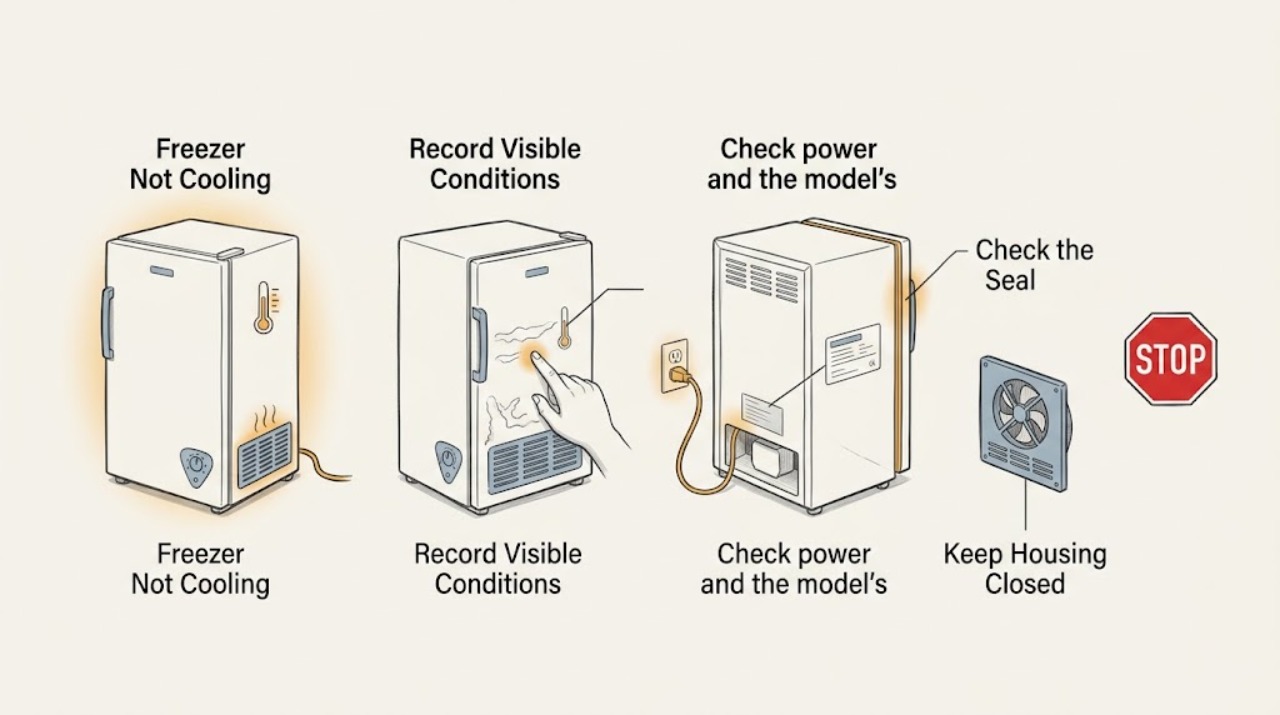
When a Liebherr freezer is not cooling, first protect the food and determine whether the cabinet has power, the door is sealing, and the display shows a temperature or power-failure alarm. Liebherr says a warm freezer can result from a wrong setting, an open door, inadequate ventilation or air extraction, unsuitable ambient conditions, frequent opening, a large fresh-food load, a nearby heat source, a power interruption, or an appliance fault. Check only the external causes: confirm the set mode, close the door, clear the ventilation area, and inspect the seal and visible frost without chipping ice or opening panels. If the alarm persists, the temperature does not recover after the model's normal stabilization period, food has thawed, or the compressor, fan, wiring, or sealed cooling system may be faulty, stop troubleshooting and arrange Liebherr service. Do not repeatedly power-cycle, move a built-in unit, puncture ice, or attempt refrigerant or electrical work.
Work through in order
Diagnostic checks
Use only checks that match the exact appliance or system and its official guide.
-
Record the alarm and protect the frozen food
Keep the freezer door closed while you note whether the display is on, the temperature alarm or power-failure indicator is active, and when the freezer was last known to be cold. If food has thawed, separate it from food that is still frozen and follow local food-safety guidance; do not taste questionable food or refreeze food that has fully defrosted.
Expected result: The display indicates a recent power interruption; the door was open for a long time; a temperature alarm persists; the display is dark; or there is no alarm but the contents are soft or warming.
Next step: If the freezer is dark, continue to the external power check. If the display is active, keep the door closed and check settings, seal, ventilation, and frost in that order. If the alarm persists or food safety is uncertain, arrange service promptly.
Stop if: Stop using the food and seek appropriate food-safety advice if it has spoiled, smells abnormal, or has thawed and been held in an unsafe condition. Stop appliance checks for smoke, burning odor, exposed wiring, or water near electricity.
Why this matters
Why: A power or door event can explain a temporary temperature rise, while a persistent alarm, dark display, or warming contents points to an unresolved power, control, airflow, or cooling fault. The food condition determines whether to transfer or discard food before further checks.
-
Check power and the model's cooling setting
Without moving the appliance, verify that the plug is seated in the intended outlet and that the household breaker or fuse has not opened. Confirm the freezer compartment is switched on, the set temperature has not been changed, and a mode such as HolidayMode or another energy-saving setting is not affecting the expected cooling; use the exact model instructions for mode names and controls. Do not repeatedly reset a tripping breaker or use an extension lead as a workaround.
Expected result: The display and interior light are off; the breaker has tripped; the freezer compartment was switched off or set warmer; a special mode was active; or power and settings are correct.
Next step: Restore only the model-approved external setting or power condition once, then close the door and allow the freezer to operate without repeated opening. If power does not hold or the temperature alarm remains, stop and contact Liebherr service.
Stop if: Do not remove panels, measure live voltage, replace wiring, use an extension lead, or keep resetting a breaker that trips again.
Why this matters
Why: A supply interruption, switched-off compartment, or incorrect mode can produce a warm cabinet without a failed compressor. A breaker that trips again or correct power and settings with no cooling shifts the problem toward service diagnosis.
-
Check the door seal, openings, and ventilation path
Inspect the closed door from the outside for a drawer, package, shelf, or gasket edge preventing full closure. Look at the gasket for a visible fold, gap, or displacement without removing it. Clear food and dust from accessible air passages and the manufacturer's required ventilation area; do not pull out a built-in unit or block the rear or plinth ventilation openings.
Expected result: The door does not close evenly; the gasket has a visible gap or is out of its groove; packages block the door; ventilation is obstructed; the freezer is beside a heat source; or all external sealing and ventilation conditions are normal.
Next step: Correct the package, gasket seating, or accessible ventilation obstruction only as the model instructions allow, close the door, and observe without frequent opening. If the gasket is damaged or the unit is still warm, arrange service rather than adjusting hinges or moving the appliance.
Stop if: Stop if the gasket is torn, the cabinet is wet near electricity, the appliance must be moved to reach ventilation, or the frame or door is damaged.
Why this matters
Why: Warm air entering through a poor seal or blocked ventilation can keep the freezer too warm and may trigger an alarm. A clear path and good seal make a fan, frost, sensor, compressor, or sealed-system issue more likely, especially if the freezer continues to warm.
-
Inspect visible frost and the load or heat conditions
Without scraping, dismantling, or applying heat, look for heavy frost covering interior air passages and note whether the freezer was recently loaded with a large amount of warm food or placed near a heat source. Confirm the door has not been opened repeatedly and that the appliance's ambient conditions match the climate class listed for the model. Do not cover vents or pack food tightly against them.
Expected result: Heavy frost blocks an air path; warm food was recently added; the cabinet is near a heat source or outside the specified ambient range; the freezer is overpacked around vents; or there is little frost and the external conditions are normal.
Next step: If the manual permits user defrosting for this exact model, follow that procedure; otherwise do not chip or heat the ice. Remove only the matching loading or heat-source condition, close the door, and allow one normal recovery period. If frost returns or the freezer remains warm, request service.
Stop if: Stop if ice must be chipped, an evaporator or wiring area is exposed, frost returns rapidly, or the cabinet becomes unusually hot or emits a burning smell.
Why this matters
Why: Frost, warm loading, restricted circulation, or unsuitable ambient conditions can temporarily reduce cooling performance. Little frost with normal conditions and continued warming points away from a simple loading issue and toward a cooling, fan, sensor, defrost, or control fault.
-
Make one closed-door recovery check and escalate persistent warming
After the external checks, close the freezer and make one recovery observation using the model's display or alarm behavior rather than repeatedly opening the door. Record whether the temperature trends colder, whether the alarm clears, and whether the compressor or fan behavior is abnormal only if it can be observed without touching or removing anything.
Expected result: The temperature recovers and the alarm clears; the alarm remains active; the freezer stays warm; the compressor or fan is silent for an unusual period or runs continuously; or a fault message returns.
Next step: Stop using the freezer for persistent warming or a returning alarm and contact Liebherr service. Provide the model and service number, alarm or fault message, power history, food condition, door/seal result, ventilation and frost observations, and recovery behavior.
Stop if: Stop immediately for smoke, burning odor, sparking, a hot cord or outlet, water near electricity, refrigerant/oil residue, or any need to open the sealed cooling system.
Why this matters
Why: Recovery after a door, setting, load, or ventilation correction supports a temporary external cause. Persistent warming, a returning fault, continuous abnormal operation, or no cooling with correct external conditions indicates an internal refrigeration, fan, sensor, defrost, control, or power problem.
Use your observations
Decision map
Find the observation that best matches what you see, then follow the next safe action.
-
PATH 01Safety boundary
What you see
The display is dark or the freezer has experienced a power interruption.
Do this next
Check the external outlet and breaker or fuse without moving the appliance. Restore power once if safe; if it will not hold, arrange qualified electrical or Liebherr service and assess food safety before consuming anything.
Why this path and its safety boundary
Safety stop: True
-
PATH 02Next step
What you see
The temperature setting, freezer mode, door closure, ventilation, or recent loading condition is incorrect.
Do this next
Correct only the model-approved external condition, close the door, and allow one normal recovery period with minimal opening. If the alarm or warming returns, request service.
-
PATH 03Next step
What you see
The door seal has a gap, is displaced or damaged, or packages prevent full closure.
Do this next
Remove the obstruction or reseat the gasket only if the model instructions explicitly permit it. A damaged seal, misaligned door, or hinge adjustment belongs with qualified service.
-
PATH 04Next step
What you see
Heavy frost blocks airflow and the exact model has a documented user defrost procedure.
Do this next
Follow the exact model's defrost instructions without knives, improvised heat, or cover removal. If the model is NoFrost, frost returns, or cooling remains poor, arrange service.
-
PATH 05Safety boundary
What you see
Power, setting, door seal, ventilation, load, and frost checks are correct, but the freezer remains warm or the alarm/fault returns.
Do this next
Stop using the freezer and contact Liebherr service for diagnosis of the fan, sensor, defrost system, compressor, sealed cooling circuit, or control. Do not open panels or attempt refrigerant or electrical work.
Why this path and its safety boundary
Safety stop: True
Helpful context
Understand the symptom
Protect food before diagnosing the appliance
A warm cabinet is both a cooling problem and a food-safety decision. Record the displayed temperature or alarm state, keep the door closed, and move vulnerable food to a known-safe freezer if available. Liebherr distinguishes a temperature alarm caused by a long-open door or power interruption from one caused by an appliance fault; the alarm is useful evidence, not a reason to keep opening the door.
Start with external heat and airflow causes
Before suspecting a sealed-system failure, check the set temperature or operating mode, door closure and gasket, ventilation and air extraction, ambient conditions, nearby heat sources, and whether a large amount of warm food was recently loaded. Clear accessible ventilation space without pulling a built-in appliance forward or blocking the required air path. The exact clearance and controls belong to the model's operating instructions.
Frost can explain weak cooling, but ice is not a repair target
Heavy frost can restrict airflow or indicate a door-seal, defrost, or cooling-system problem. Do not chip ice with a knife, heat the cabinet with an improvised device, or remove covers to reach an evaporator. If the exact model is not a NoFrost design, follow its manual's defrost procedure; if frost returns quickly or the freezer remains warm, qualified service is the safer branch.
Only after diagnosis
Potential parts
- freezer door gasket
Consider a gasket only if the exact model's seal is visibly torn, permanently deformed, out of its groove, or confirmed by qualified diagnosis to be leaking warm air after simple seating and obstruction checks.
Confirm the complete Liebherr model and manufacturer fit information; do not adjust hinges or remove a built-in door as an improvised repair. - evaporator or condenser fan assembly
Consider a fan assembly only after qualified diagnosis of persistent warming, abnormal fan behavior, or an airflow fault with the door, setting, ventilation, and frost conditions corrected.
Fan access and fitment vary by model; do not remove covers or reach into a powered appliance. - temperature sensor or defrost component
Consider a sensor or defrost component only when a qualified technician links a recurring temperature alarm, frost pattern, or control behavior to that component.
Verify the complete model and service information; do not bypass a sensor, thermal device, or defrost safety. - compressor or sealed-system component
Consider sealed-system work only after qualified diagnosis confirms persistent warming with correct power, settings, door seal, airflow, load, and frost conditions.
Refrigerant and compressor work requires qualified service and model-specific equipment; no part should be selected from a symptom alone.
When checks do not resolve it
Need a professional?
Call Liebherr or qualified appliance service when the freezer does not recover after safe external checks, a temperature or fault alarm returns, frost reappears, or the cooling system, fan, sensor, defrost circuit, compressor, or control may be involved.
Common questions
FAQ
Why is my Liebherr freezer not cooling?
Check the set temperature and operating mode, power status, door closure and gasket, ventilation, ambient conditions, recent warm loading, and visible frost. If the freezer remains warm or the alarm returns after the model-approved external checks, arrange service.
What does a Liebherr freezer temperature alarm mean?
It means the freezer is not cold enough. Liebherr lists a long-open door, power interruption, or an appliance fault as possible causes. Note the alarm and warmest reading if shown, keep the door closed, and check food quality before consuming or refreezing anything.
Can a Liebherr freezer stop cooling because of ventilation?
Yes. Liebherr identifies inadequate ventilation or air extraction and unsuitable ambient conditions as possible reasons for a freezer being too warm. Clear only accessible ventilation areas and use the exact model instructions for required clearances; do not move a built-in appliance as a DIY test.
Should I chip away ice in a Liebherr freezer that is not cooling?
No. Do not use a knife or improvised heat. If the exact model has a user defrost procedure, follow that manual; otherwise heavy or recurring frost should be handled by qualified service, especially on NoFrost appliances.
When should I call service for a Liebherr freezer that is not cooling?
Call when the freezer remains warm after the correct setting, power, seal, ventilation, load, and model-approved frost checks, or when an alarm or fault returns. Stop immediately for smoke, burning odor, sparking, water near electricity, or food that may be spoiled.
Read the exact guide
Official sources
- FAQs – frequently asked questions about Liebherr refrigerators & freezersLiebherr · Liebherr FAQ guidance for warm or cold freezer conditions, settings, door closure, ventilation, ambient class, loading, heat sources, food safety, and service escalation.
- Operating instructions of your Liebherr fridge or freezerLiebherr · Liebherr manual lookup page requiring the appliance service or serial number so owners can use model-specific controls, maintenance, and troubleshooting instructions.
- Audible warning signalLiebherr · Liebherr manual guidance that a temperature alarm indicates insufficient cold and can follow a long-open door, power failure, or appliance fault, with food-quality precautions.
- MessagesLiebherr · Liebherr manual guidance for temperature alarms, power-cut messages, appliance fault messages, recording the fault code, and contacting customer service.
Community feedback
Share a repair observation
Share a plain-text repair observation. Accepted observations are published automatically; this page may take a moment to update.