
On this page
Start here
Quick answer
When a Liebherr refrigerator is not cooling enough, first check the door seal, clear the ventilation grilles, and confirm the temperature setting before assuming a component failure. A recent warm load or frequent door opening can require recovery time. If the display shows a fault, the temperature stays high after these external checks, or the freezer also warms, move perishable food and request service.
Before you begin
Safety first
- Do not remove panels, probe wiring, or work on refrigerant components. Move perishable food if temperature cannot be maintained.
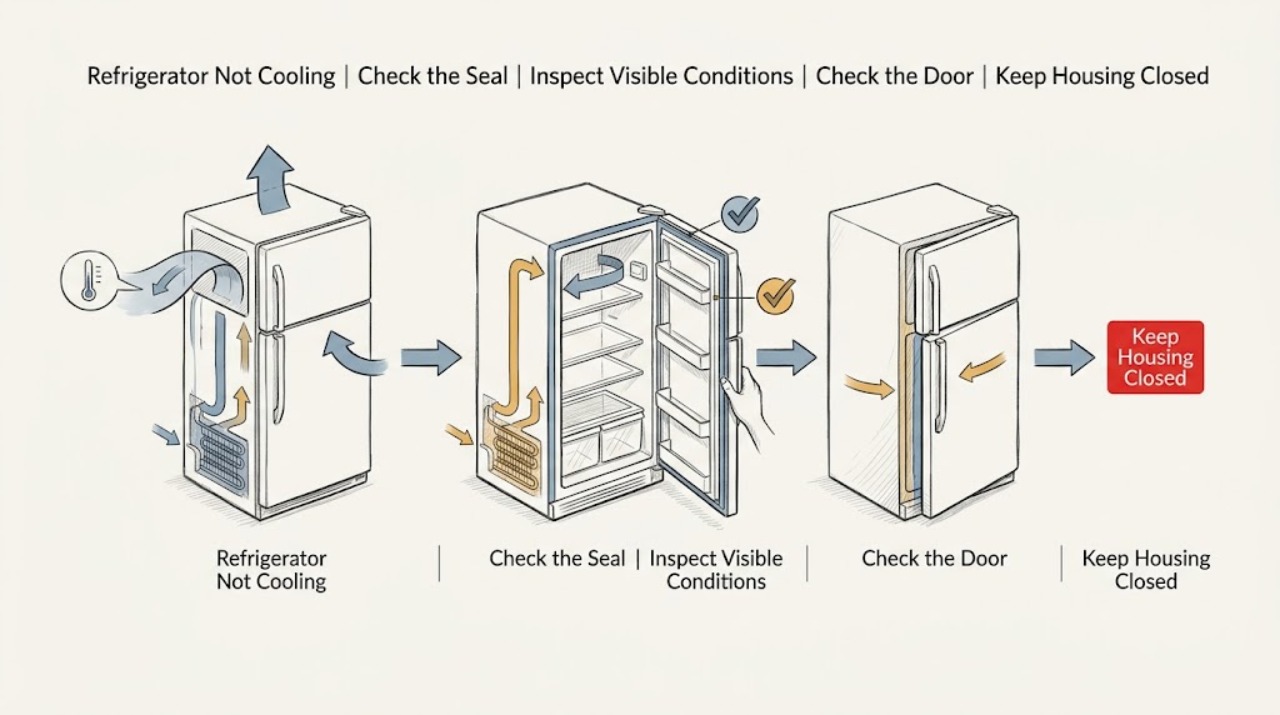
Work through in order
Diagnostic checks
Use only checks that match the exact appliance or system and its official guide.
-
Check 1
Close the refrigerator door normally and inspect the visible gasket contact all the way around, looking for a shelf or package preventing the door from seating.
Expected result: The door closes evenly with an unobstructed seal, or a package, shelf, or distorted seal leaves a gap.
Next step: Remove only the obstruction and close the door; do not pull or reshape the gasket aggressively.
Why this matters
Why: A closure gap lets warm air enter and is a supported external cause of poor cooling; a sound closure moves the diagnosis to airflow and settings.
-
Check 2
Look at the appliance ventilation grilles and the space around the cabinet without moving the refrigerator, and note whether dust, stored items, or a nearby heat source restricts airflow.
Expected result: A grille is covered or the cabinet is close to a heat source, or the grilles are clear with adequate space.
Next step: Clear accessible grille openings and reduce the external heat load; arrange help if the installation cannot be safely changed.
Why this matters
Why: Liebherr identifies inadequate ventilation and a nearby heat source as causes of reduced cooling performance.
-
Check 3
Read the refrigerator setting and consider the recent load: note whether a large amount of warm food was added or the door was opened repeatedly for a long period.
Expected result: The setting is warmer than intended, or cooling demand increased after warm loading or prolonged opening.
Next step: Set the control according to the manual and allow recovery with the door closed; do not keep changing it repeatedly.
Why this matters
Why: An incorrect setting or temporary demand can explain a warm compartment without proving a failed sealed system.
-
Check 4
After the external checks and a closed-door recovery period, check the display for an error or temperature alarm and compare the freezer and refrigerator compartments.
Expected result: Both compartments remain warm, only one compartment is affected, or an error or persistent alarm appears.
Next step: Protect perishable food, record the alarm and compartment pattern, and contact qualified service rather than opening panels.
Why this matters
Why: A persistent or combined loss is not explained by a single package or setting check and needs model-specific diagnosis.
Use your observations
Decision map
Find the observation that best matches what you see, then follow the next safe action.
-
PATH 01Next step
What you see
A door gap, blocked grille, heat source, or incorrect setting is found and cooling improves after correction
Do this next
Keep the door unobstructed and ventilation clear, then monitor normal temperatures.
Why this path and its safety boundary
Why it matters: An external installation or control condition is the best-supported explanation.
-
PATH 02Next step
What you see
The refrigerator was opened frequently or loaded with warm food but has no fault display
Do this next
Keep the doors closed during recovery and reassess before further changes.
Why this path and its safety boundary
Why it matters: Temporary heat load is more likely than an immediately proven component failure.
-
PATH 03Next step
What you see
Cooling remains poor after external checks, or an error/temperature alarm persists
Do this next
Move food to a safe cold appliance and arrange qualified service with the appliance identification and alarm details.
Why this path and its safety boundary
Why it matters: The manual does not identify a safe user repair for this pattern.
Helpful context
Understand the symptom
Start with the heat path
Cooling loss is easier to separate when you check what the appliance can show from the outside: door closure, free airflow, setting, room conditions, and the timing of a warm load. Avoid dismantling a refrigerator to search for refrigerant or electrical faults.
When checks do not resolve it
Need a professional?
Arrange qualified Liebherr service for unresolved cooling loss or any fault indication after the external checks.
Safety scope: Do not remove panels, probe wiring, or work on refrigerant components. Move perishable food if temperature cannot be maintained.
Have this ready
- Provide the appliance designation, service and serial numbers, compartment affected, temperature or alarm display, and the external checks already completed.
Common questions
FAQ
How long should I wait after adding warm food?
Allow the appliance to recover with the door closed rather than repeatedly changing the setting. If the required temperature does not return, Liebherr directs you to customer service.
Should I open the back of the refrigerator if it is warm?
No. Clear only accessible ventilation and check the door and controls. Internal cooling and electrical work should be handled by qualified service.
Read the exact guide
Official sources
- TroubleshootingLiebherr-Hausgeräte · Liebherr refrigerator insufficient cooling, ventilation, door, setting, loading, and service guidance
Community feedback
Share a repair observation
Share a plain-text repair observation. Accepted observations are published automatically; this page may take a moment to update.