
On this page
Start here
Quick answer
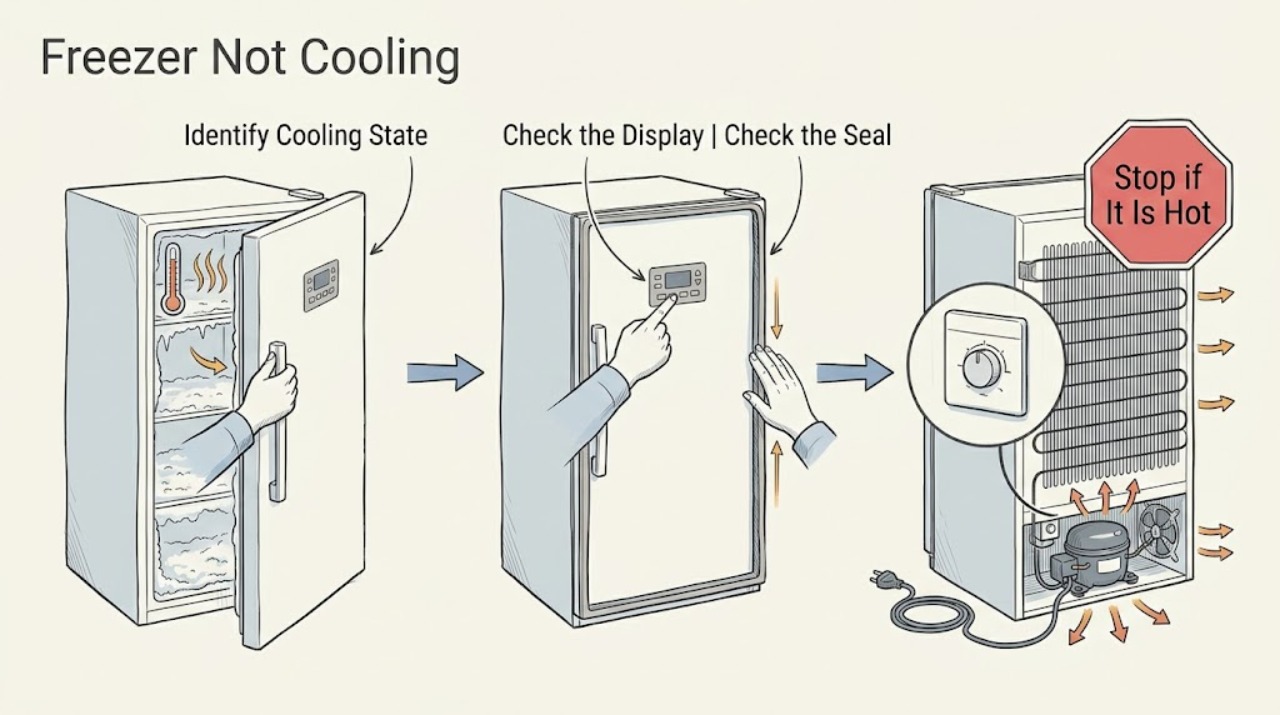
First confirm the freezer is powered, the temperature control is set for cooling, the door or lid closes and seals, and the unit has room for ventilation. If it was recently moved or unplugged, let it stand and cool according to the exact model manual before judging performance. Excessive frost, a large warm load, frequent openings, a dirty or damaged gasket, blocked clearances, or a control set too warm can all make a Magic Chef freezer appear not to cool. Defrost only as the manual directs; never chip ice with a sharp tool or use an unapproved heating device. If the compressor does not run, cycles abnormally, the cabinet overheats, or the freezer remains warm after safe external checks, stop and arrange qualified appliance service rather than opening the sealed system.
Work through in order
Diagnostic checks
Use only checks that match the exact appliance or system and its official guide.
-
Check 1
From a dry, stable position, record the freezer type and model, whether the display or light works, whether the compressor or cooling cycle can be heard, and whether the interior is uniformly warm or has a localized cold or frosted area.
Expected result: The unit is silent, clicks and stops, runs continuously, has a blank control, is partially cold, or is warm throughout.
Next step: Write down the model, recent move or outage, food load, temperature history, and any sound or odor before making the external checks.
Stop if: Stop for smoke, burning odor, sparks, a hot cord or outlet, exposed wiring, a leaking or bulging cabinet, or food spoilage with an unsafe odor.
Why this matters
Why: A blank or silent unit points first to power or control evidence; repeated clicking or continuous running narrows the service history but does not identify a part. Partial frost or a localized cold area can indicate airflow, door-seal, frost, or sealed-system behavior that needs careful model-specific interpretation.
-
Check 2
Check that the freezer's plug is fully seated in the correct grounded outlet, inspect the accessible breaker or fuse status, and confirm the temperature control is not at an off or warm setting; do not use an extension cord or alter the grounding arrangement.
Expected result: The plug is loose, the breaker or fuse is open, the control is set too warm or off, the unit was recently unplugged, or accessible power and settings appear normal.
Next step: Correct only an obvious plug, control, or single accessible breaker condition as the manual permits, then allow the freezer to run and stabilize before judging the result; do not repeatedly reset a tripping circuit.
Stop if: Stop for a repeated trip, hot outlet, damaged cord, missing ground, water near the connection, or uncertainty about the branch circuit.
Why this matters
Why: No power or a warm control setting can leave the freezer warm without a cooling-system failure. After a recent disconnection, the compressor may have a restart delay and the cabinet needs time to stabilize; normal power and setting shift attention to seal, frost, clearance, and service evidence.
-
Check 3
Inspect the door or lid from the outside for a package, shelf, basket, hinge, or edge obstruction, and look at the gasket for dirt, tears, twists, or a visible gap; do not pry, remove, or reshape the seal.
Expected result: The door or lid is not fully closed, the gasket is dirty or damaged, a shelf or item blocks closure, or the seal appears continuous and tight.
Next step: Remove only an obvious obstruction and clean the accessible gasket as the manual directs, then close the door or lid and make one supervised cooling observation.
Stop if: Stop for a warped door or lid, damaged hinge, torn gasket that cannot seal, a child or pet inside, or any need to dismantle door hardware.
Why this matters
Why: A closure or gasket gap admits warm air and can create frost or long compressor run time. If the seal is sound and the cabinet remains warm, do not order a gasket from appearance alone; proceed to temperature, frost, and clearance evidence.
-
Check 4
With food protected and the freezer isolated as the exact manual requires, observe whether frost is thick enough to block the compartment or airflow; if manual defrost is specified, follow only that procedure and never use a sharp tool, hot water, or an unapproved electric heater.
Expected result: Frost is thick or bridges the interior, the freezer is clear of excess frost, water is present after a prior defrost, or the model's defrost method is unknown.
Next step: Use the model manual's defrost and restart instructions, allow the cabinet to stabilize, and document whether cooling returns; arrange service if frost rapidly returns or the unit remains warm.
Stop if: Stop for a punctured liner, exposed tubing, electrical heating device, water near electrical parts, or any need to chip, pry, or melt ice aggressively.
Why this matters
Why: Excess frost can reduce usable space and interfere with cooling, while an unclear defrost procedure can damage the liner or cooling system. Repeated rapid frost after a safe defrost suggests a door seal, installation, or cooling fault rather than a need for more scraping.
-
Check 5
Observe whether the freezer has the manual's required space around the cabinet, sits level on a strong floor, is away from direct sun or heat, and has a reasonable load that does not block interior air outlets; do not move a loaded unit alone.
Expected result: The cabinet touches a wall, ventilation space is restricted, the room is unusually hot or cold, the unit is unlevel, a large warm load was recently added, or airflow space is blocked.
Next step: Correct only a safe accessible obstruction or placement issue described by the manual, keep the door or lid closed, and allow stabilization; obtain help for any loaded or built-in move.
Stop if: Stop for a weak floor, unstable cabinet, heat damage, an inaccessible rear area, heavy loaded movement, or any need to remove panels or tubing.
Why this matters
Why: Poor clearance, an unsuitable environment, a heavy warm load, or blocked internal airflow can lengthen recovery and make the temperature appear high. If installation and load are reasonable, a persistent warm cabinet is less likely to be a simple placement issue.
-
Check 6
Arrange qualified Magic Chef appliance service when one safe external test still leaves the freezer warm, the compressor is silent or repeatedly clicking, cooling is intermittent, frost returns rapidly, or the cabinet overheats; provide the model and the complete observation sequence.
Expected result: The problem persists with correct power, setting, seal, frost procedure, placement, and load, or the unit shows a code, unusual sound, odor, leak, or unsafe heat.
Next step: Keep the freezer closed to protect contents, move food only if safe and practical, and use Magic Chef's model-based support or authorized service route.
Stop if: Do not continue testing after smoke, burning odor, repeated trips, a hot compressor area, refrigerant tubing damage, or any need to open the sealed system.
Why this matters
Why: The remaining causes may include a thermostat or control, fan, start device, compressor, defrost component, wiring, or sealed cooling system. A warm freezer alone cannot identify a compatible component or justify refrigerant work.
Use your observations
Decision map
Find the observation that best matches what you see, then follow the next safe action.
-
PATH 01Next step
What you see
The freezer has no light or control response and the compressor is silent.
Do this next
Arrange qualified service and follow the exact model guidance.
Why this path and its safety boundary
Why it matters: Check the accessible plug, breaker, or fuse once. If power is present but the freezer remains inactive, arrange service without opening the electrical compartment.
-
PATH 02Next step
What you see
The temperature control is too warm, the unit was recently disconnected or moved, or a large warm load was added.
Do this next
Arrange qualified service and follow the exact model guidance.
Why this path and its safety boundary
Why it matters: Use the model setting and restart or settling guidance, keep the door or lid closed, and allow stabilization before judging cooling. Persistent warmth needs service.
-
PATH 03Next step
What you see
The door or lid is blocked, not fully closed, or the gasket is dirty, torn, or unable to seal.
Do this next
Arrange qualified service and follow the exact model guidance.
Why this path and its safety boundary
Why it matters: Correct only an obvious accessible obstruction or clean the gasket as directed. A damaged or misaligned closure needs model-specific service.
-
PATH 04Next step
What you see
Frost is thick enough to bridge the compartment or obstruct usable airflow.
Do this next
Arrange qualified service and follow the exact model guidance.
Why this path and its safety boundary
Why it matters: Follow the exact manual defrost procedure and avoid sharp tools, hot water, and unapproved heaters. Rapid recurrence or no recovery requires service.
-
PATH 05Next step
What you see
The freezer has restricted clearance, an unsuitable room condition, blocked internal space, or an unstable placement.
Do this next
Arrange qualified service and follow the exact model guidance.
Why this path and its safety boundary
Why it matters: Correct only a safe accessible placement or obstruction issue and allow recovery. Do not move a loaded unit or remove panels as part of this check.
-
PATH 06Next step
What you see
Power, setting, seal, frost, load, and clearance are correct but the freezer remains warm or the compressor behaves abnormally.
Do this next
Arrange qualified service and follow the exact model guidance.
Why this path and its safety boundary
Why it matters: Stop troubleshooting at the exterior and arrange qualified diagnosis for the control, fan, compressor, start device, defrost circuit, or sealed system.
Helpful context
Understand the symptom
Check whether the freezer is actually running
A light or control display, if present, does not prove that the compressor and cooling system are operating. Listen and observe from outside for the normal cooling cycle, and note whether the unit is silent, clicking repeatedly, running continuously, or producing any cold area. Do not remove a rear cover or touch the compressor, wiring, refrigerant tubing, or fan. A freezer that is warm and silent after an accessible power check needs service diagnosis.
Seal, clearance, and frost can defeat cooling
Warm air enters when a door or lid is left open, blocked, dirty, or unable to seal. A freezer also needs the clearances specified by its manual; pushing it against a wall or heat source can impair heat rejection. Frost that bridges shelves, walls, or the door can block airflow and keep the unit warm. Use only the model's defrost procedure and protect food while the unit is out of temperature.
Do not turn a temperature complaint into a refrigerant repair
The controls, door seal, load, clearance, and frost checks are user-observable. Compressor, relay, thermostat, fan, sealed-system, and refrigerant faults require model-specific testing. Do not puncture the liner, add refrigerant, bypass a control, or order a compressor or board based only on a warm cabinet.
Safety boundary
Stop conditions
- Smoke, burning odor, sparks, a hot cord or outlet, exposed wiring, or a breaker or fuse that opens again.
- A punctured liner, exposed cooling tubing, refrigerant odor or leak, bulging cabinet, or unusual pressure or hissing sound.
- Food spoilage, flooding, water near electrical parts, or unsafe handling of frozen food after a temperature loss.
- A damaged, warped, or unstable door, lid, hinge, gasket, cabinet, or floor support.
- Any need to remove a rear or control panel, test live circuits, add refrigerant, open tubing, or bypass a thermostat or safety control.
- The freezer remains warm after one safe external power, setting, seal, frost, and clearance check.
Only after diagnosis
Potential parts
- freezer temperature control or thermostat
Consider this category only after qualified testing confirms that the control fails to command cooling despite correct power, setting, seal, frost, and placement.
Confirm the complete Magic Chef model, control type, electrical rating, mounting, and manufacturer fit information; a warm cabinet does not establish a thermostat fault. - evaporator or condenser fan component
Consider this category only when a technician confirms a fan or airflow component fault after safe external clearance and frost checks.
Match the exact Magic Chef model, fan position, blade, motor, connector, and manufacturer fit information; do not reach through a guard or replace a fan based on sound alone. - compressor start device or sealed-system component
Consider this category only after qualified diagnosis identifies a start, compressor, or sealed-system fault and rules out power, control, seal, frost, and placement causes.
Confirm the complete model, refrigerant and electrical requirements, approved service method, and manufacturer fit information; do not open or recharge a sealed system as a user repair.
When checks do not resolve it
Need a professional?
The freezer is powered but the compressor never starts, repeatedly clicks, or runs continuously without cooling., A correct temperature setting, closed seal, safe defrost, and adequate clearance do not restore cooling., Frost rapidly returns, cooling is uneven, a fan or control symptom repeats, or the cabinet overheats., The exact defrost, electrical, or installation procedure is unknown for the model., Any smoke, electrical, puncture, leak, food-safety, or structural hazard is present.
Common questions
FAQ
Why is my Magic Chef freezer running but not getting cold?
Check the temperature setting, door or lid seal, frost, load, cabinet clearance, and room conditions. If the compressor runs but the freezer stays warm after those external checks, arrange service; the sound alone cannot identify a fan, control, compressor, or sealed-system fault.
How long should I wait after moving or unplugging a Magic Chef freezer?
Use the exact model manual. The opened Magic Chef manual instructs an upright rest after transportation and allows time for the cabinet to cool after connection; a large warm load or repeated door openings also lengthen recovery. If cooling does not return after the documented stabilization period, request service.
Can I scrape the ice out of a Magic Chef freezer?
Do not chip frost with a sharp tool or use hot water or an unapproved electric heater. Follow the model's manual-defrost procedure, protect the food, and arrange service if frost rapidly returns or the cabinet remains warm.
Should I replace the compressor if my Magic Chef freezer is warm?
No. A warm freezer can result from power, temperature setting, seal, frost, clearance, fan, control, start, or sealed-system causes. Have the exact model diagnosed before selecting any component, and do not open the sealed system yourself.
Read the exact guide
Official sources
- Manual HMBR350WE BE SE ENG 140307Magic Chef / MC Appliance · Supports power, temperature, clearance, door seal, recent-transport, defrost, and warm-cabinet decision points; exact freezer model instructions remain controlling.
- The Magic Chef Help CenterMagic Chef / MC Appliance · Supports using Magic Chef product support and model-specific resources for freezer diagnosis.
- 5.8 cu. ft. Upright FreezerMagic Chef · Supports that Magic Chef upright freezers use an adjustable temperature control and manual-defrost design; it is not a diagnosis for an unidentified model.
- 3.5 Cu. Ft. Chest FreezerMagic Chef · Supports that Magic Chef also sells chest freezer configurations, so door or lid and manual-defrost details must be model-specific.
- Freezer SupportMagic Chef / MC Appliance · Supports selecting the exact freezer model before applying troubleshooting or maintenance instructions.
Community feedback
Share a repair observation
Share a plain-text repair observation. Accepted observations are published automatically; this page may take a moment to update.