
On this page
Start here
Quick answer
First identify what is leaking and where it starts. Clear drops after cooking can be steam or condensation; food or cleaning residue usually points to a spill; and gas odor is a gas-safety problem, not a liquid leak. Turn the oven off, keep away from hot steam or liquid, and let it cool before looking at the cavity floor, visible door seal, door alignment, and nearby water sources. Magic Chef ovens and ranges vary by model, so use the model-specific manual through Magic Chef support for any control or service procedure. If liquid has reached electrical controls, the leak continues, the door or glass is damaged, or you notice a persistent gas odor, smoke, burning, arcing, or abnormal heat, stop using the appliance and arrange professional help.
Work through in order
Diagnostic checks
Use only checks that match the exact appliance or system and its official guide.
-
Check 1
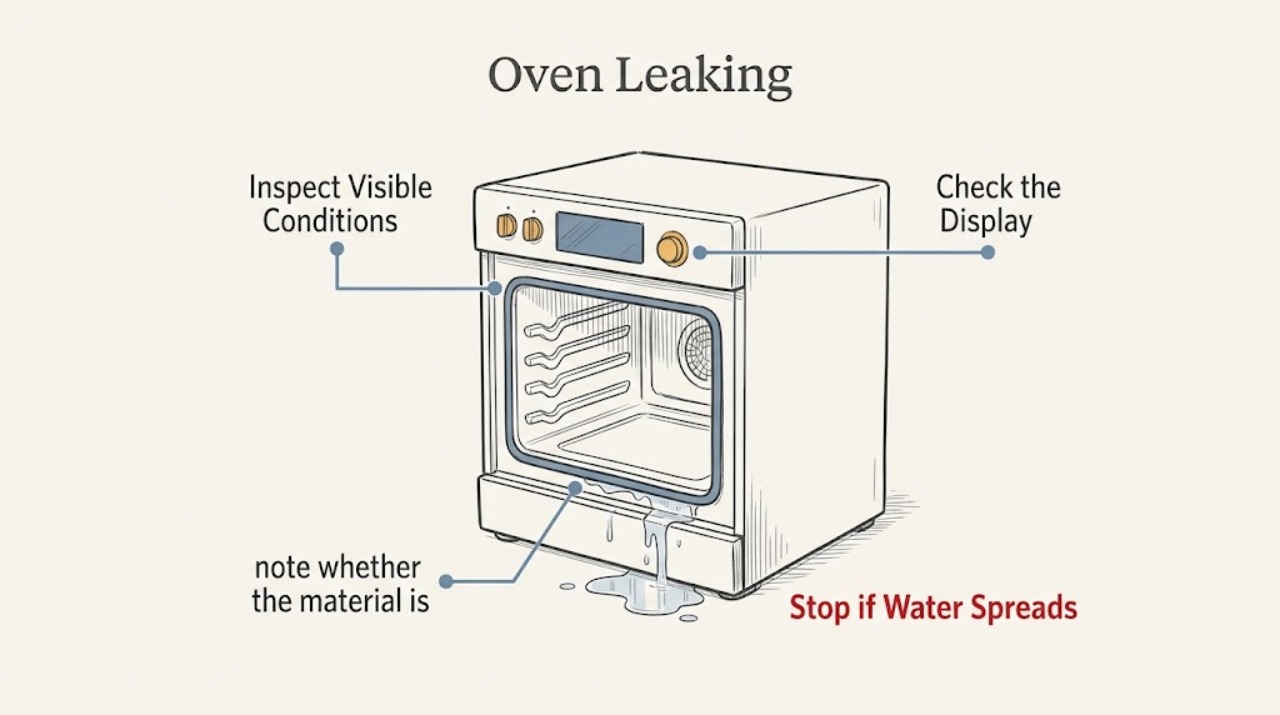
With the oven switched off, note whether the material is clear water, greasy or food-colored liquid, cleaner residue, or only an odor, and mark the first visible location without touching a hot surface.
Expected result: Clear moisture that appears after cooking differs from colored residue, while an odor without liquid is a separate symptom.
Next step: After the appliance cools, continue with the matching branch below; treat gas odor as an immediate stop condition rather than as a leak to test.
Why this matters
Why: The type and starting point determine whether to investigate condensation, a spill, an outside source, or a gas-safety condition.
-
Check 2
Wait until the oven, rack, door, and nearby floor are cool and dry, then look at the cavity floor, rack edges, and underside of the open door for a fresh trail or pooled residue.
Expected result: Moisture confined to the cavity or door area points inward; a dry cavity with a wet cabinet edge points to an outside source or a door-path issue.
Next step: Photograph the cooled trail and follow the cavity, spill, or door branch instead of repeating a heating test.
Why this matters
Why: A safe visual trail is more useful than wiping and immediately running another hot cycle, which can hide the starting point.
-
Check 3
When cool, inspect the cavity floor and lower door area for food, foil, cookware overflow, or cleaning product residue; remove only loose residue with a suitable damp cloth and keep liquid away from controls.
Expected result: A residue trail that ends at a rack or cavity edge supports a spill or cleaning source; fresh clear water returning without a spill is not explained by residue alone.
Next step: Clean and dry the accessible area only after cooling, then monitor for recurrence without starting another cycle if water returns.
Why this matters
Why: A spill can run out through a door gap or cabinet seam and look like an appliance failure, while recurring water needs a different diagnosis.
-
Check 4
Inspect the visible door gasket or seal, door corners, latch area, and surrounding frame for a fold, gap, trapped debris, loose edge, or impact damage; do not force the door or remove hinge hardware.
Expected result: A visible gap or damaged glass/frame can allow steam or liquid to escape at the door, while an intact, evenly seated seal makes an external source more likely.
Next step: Use the exact model manual and request service if the seal, hinge area, latch, or glass is damaged or the door no longer closes evenly.
Why this matters
Why: Door sealing and alignment are model-specific repair points, so a visual fault is evidence for service rather than permission to dismantle the door.
-
Check 5
Trace the dry perimeter around the oven without moving a gas range: check the counter, sink, kettle, wall, cleaning bucket, and any appliance above or beside it for a source that could run toward the oven.
Expected result: A wet trail that begins above, behind, or beside the oven indicates an external water source; a trail that begins inside the hot cavity does not.
Next step: Stop the external source if it can be done safely, dry the area, and escalate if water has reached controls or the trail returns.
Why this matters
Why: Nearby water can imitate an oven leak, and moving a connected range can create additional gas, electrical, or floor damage risks.
-
Check 6
If the smell is gas-like, strong, persistent, or accompanied by hissing, avoid flames and electrical switches, leave the area, and seek the local emergency or gas-safety response from a safe location.
Expected result: A gas odor without liquid is not an oven-water diagnosis; odor that clears only after ventilation still requires the appliance to remain unused until it is assessed.
Next step: Do not return to operate or investigate the appliance until the relevant safety professional says it is safe; do not include a phone number in the article because the correct response varies by location.
Why this matters
Why: A gas range may have fuel and electronic controls, but the safe response to suspected gas is isolation and professional assessment, not a leak test or repeat ignition.
-
Check 7
Read and record the complete model number from the appliance label, the cooking mode, and when the water appeared, then compare those details with the model-specific Magic Chef support material.
Expected result: A documented model and repeatable condition give support or a technician enough context to distinguish an oven configuration and its service path.
Next step: Arrange service for recurring liquid, a damaged door, wet controls, or an unexplained source; provide the model, photographs, and the first location of the trail.
Why this matters
Why: Magic Chef product families use different controls and configurations, so a generic button sequence or part assumption may be wrong.
Use your observations
Decision map
Find the observation that best matches what you see, then follow the next safe action.
-
PATH 01Next step
What you see
Clear moisture appears only after cooking and no water returns when the cool appliance is dry.
Do this next
If it returns as a pool, reaches controls, or appears without cooking, stop use and request service.
Why this path and its safety boundary
Why it matters: Treat it as possible steam or condensation, keep the area dry, and use the model-specific manual for normal ventilation and operating guidance.
-
PATH 02Next step
What you see
Food, foil, cookware overflow, or cleaner residue forms the trail and no fresh liquid returns.
Do this next
Escalate if residue is behind a panel, the door does not seal, or liquid returns after the area is dry.
Why this path and its safety boundary
Why it matters: Clean only the cool, accessible area using the model's care guidance and keep moisture away from controls.
-
PATH 03Next step
What you see
The trail starts above, beside, or behind the oven rather than inside the cavity.
Do this next
Keep the oven unused if water reached electrical controls or the source cannot be isolated, and arrange professional inspection.
Why this path and its safety boundary
Why it matters: Address the outside water source only when safe and without moving a connected range.
-
PATH 04Next step
What you see
The visible gasket, hinge area, latch, frame, or glass is damaged or the door closes unevenly.
Do this next
Give the technician the model number and a photo of the gap or damage so compatibility can be checked.
Why this path and its safety boundary
Why it matters: Stop using the oven and have the door assembly assessed; do not force or dismantle it.
-
PATH 05Next step
What you see
Water is continuous, pools near electrical controls, or is accompanied by smoke, burning, arcing, abnormal heat, or repeated power trips.
Do this next
Arrange urgent professional assessment and do not restore power or run another cycle until cleared.
Why this path and its safety boundary
Why it matters: Stop the appliance and keep people away from the wet or damaged area; only disconnect power if it is safe to reach without standing in water.
-
PATH 06Next step
What you see
There is a strong or persistent gas odor, hissing, delayed ignition, or an abnormal flame on a gas model.
Do this next
Keep the appliance out of service until a qualified professional confirms it is safe.
Why this path and its safety boundary
Why it matters: Leave the area and seek local emergency or gas-safety help from a safe location; do not operate switches, flames, or the oven.
Helpful context
Understand the symptom
A small amount of moisture is not automatically a failed oven. Cooking can create steam that condenses around a cooler door or surface, while a spill can run beneath a rack and appear to come from the appliance. Begin with the liquid itself and its entry point rather than ordering a part. Do not touch hot water, steam, cleaner, or a hot door edge.
Magic Chef sells more than one oven and range configuration. Record the complete model label before relying on a button sequence or service instruction. The opened Magic Chef product page demonstrates why this matters: a gas range can combine an oven, timer, and electronic controls, while other models may differ.
Once the appliance is cool and the surrounding floor is dry, use the observations below to decide whether this is normal condensation, a removable spill, an external source, a door-sealing problem, or a service issue.
Safety boundary
Stop conditions
- Stop immediately for persistent gas odor, hissing, delayed ignition, or an abnormal flame; leave and seek local emergency or gas-safety help from a safe location.
- Stop for smoke, burning smell, visible arcing, repeated power trips, abnormal heat, or a door or glass that is damaged or cannot stay closed.
- Stop and keep clear if water reaches controls, an outlet, wiring, or another electrical area, especially if the floor is wet.
- Do not continue heating cycles to reproduce a leak, force the door, move a connected gas range, or remove internal panels or hinge hardware.
Only after diagnosis
Potential parts
- oven door gasket or seal
Only consider this category when the cooled inspection shows a damaged or displaced seal and the exact model confirms the fit.
Confirm the full appliance model and the manufacturer's fit information before ordering. - door hinge or closure component
Only consider this category when the door is visibly misaligned or cannot close evenly and a technician confirms the closure fault.
Do not remove hinge hardware as a do-it-yourself leak test; verify model-specific compatibility. - oven door glass or frame component
Only consider this category for visible glass, frame, or heat-damage findings confirmed by a qualified technician.
Glass and frame parts are model-specific; confirm the exact model and safe installation path. - electrical protection or control component
Only consider this category after liquid has reached controls or a technician identifies an electrical fault; it is not a first response to surface moisture.
Do not open or work on energized equipment; have the model and diagnosis confirmed before sourcing a component.
When checks do not resolve it
Need a professional?
Call a qualified appliance technician for recurring water, a wet control area, a damaged seal or door, an unexplained cavity leak, or any electrical or gas-safety symptom. Give the technician the full model number, cooking mode, timing, and photos of the cooled trail. Consult Magic Chef support for the model-specific manual and service route.
Common questions
FAQ
Is water under a Magic Chef oven always a failed part?
No. Steam condensation, a cooking spill, cleaning residue, or water from a nearby surface can all imitate an oven leak. Let the appliance cool, trace the first visible location, and stop if water reaches controls or returns.
What if the oven smells like gas but there is no liquid?
Treat it as a gas-safety emergency rather than a water leak: avoid flames and electrical switches, leave the area, and seek local emergency or gas-safety help from a safe location. Do not repeat ignition tests.
Can I replace the oven seal to stop the leak?
Only after a cool visual inspection and model-specific confirmation show that the seal is damaged or displaced. A door gap, hinge, latch, or glass problem can require professional assessment, and the door should not be forced or dismantled.
Read the exact guide
Official sources
- SupportMagic Chef · Magic Chef manuals, FAQs, product videos, contact, and service routing
- 4 Burner Freestanding Gas Range in Stainless SteelMagic Chef · Opened Magic Chef gas-range product page showing model-specific oven, gas, timer, and manual context
- Product SupportMagic Chef / MC Appliance · Magic Chef product support and cooking-appliance assistance
Community feedback
Share a repair observation
Share a plain-text repair observation. Accepted observations are published automatically; this page may take a moment to update.