
On this page
Start here
Quick answer
If a Magic Chef washer dryer finishes with wet clothes, first confirm that a Dry option is selected and the dry indicator is actually running. Reduce the load below the washer's capacity, use a complete spin, and check that the water supply and drain path remain connected and clear because this is a ventless combo. Let the full Auto Dry or Timed Dry program finish, including its cooling period. If a small, well-spun load remains wet, the display shows a repeatable error, the unit cannot drain, or drying never starts, leave the appliance off and arrange model-specific service. Do not cut off the water during drying, remove hoses, open panels, or test energized heater, fan, or control parts. Stop immediately for smoke, a burning electrical smell, unusual heat, sparking, or a damaged cord.
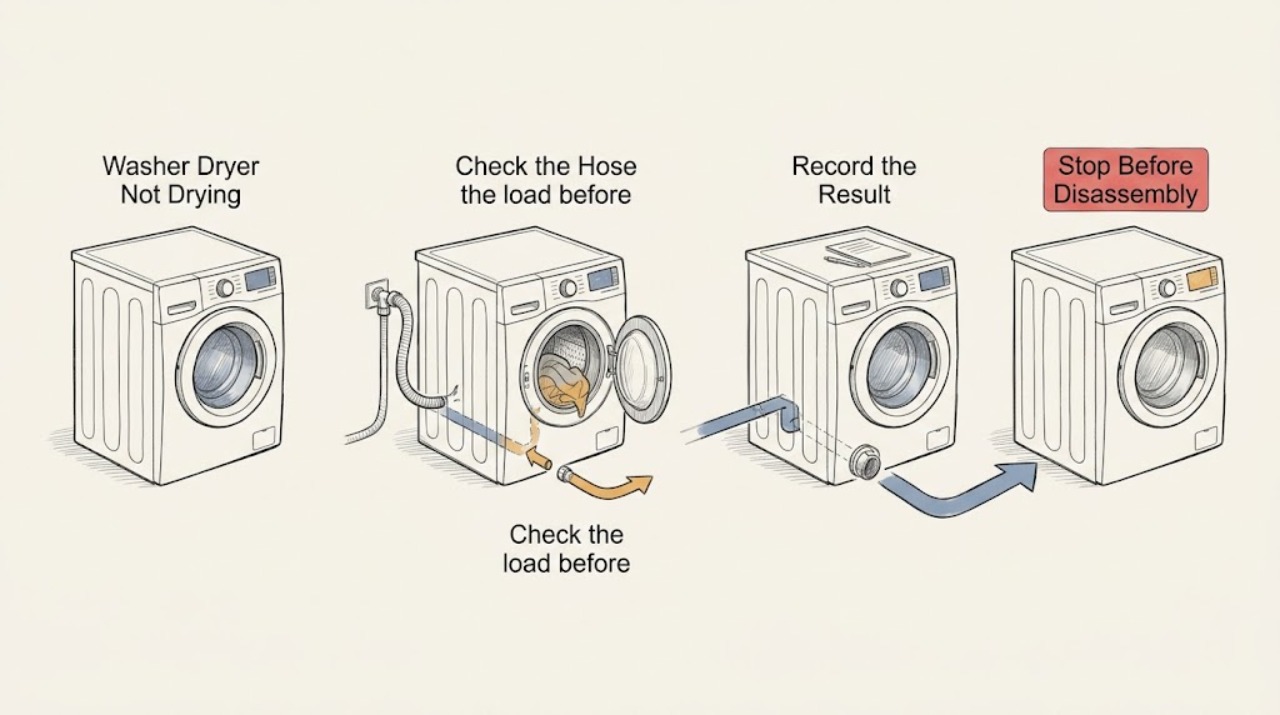
Work through in order
Diagnostic checks
Use only checks that match the exact appliance or system and its official guide.
-
Check 1
Run one controlled test with a small load of items whose care labels permit machine drying. Select the exact model's Dry, Auto Dry, or Timed Dry function and confirm that the display shows the dry stage or dry-level setting; do not add more items after the cycle starts.
Expected result: The unit only washes or spins, the dry indicator never appears, a dry level is not selected, or the dry stage runs and ends while the small load remains wet.
Next step: Use the exact model manual to select a permitted dry program once. If the dry stage will not start or the same error returns, stop repeated attempts and arrange service; if it runs, continue with the load and spin checks.
Why this matters
Why: A missing dry stage points to cycle selection or a control-state issue, while a completed dry stage with wet clothes moves the investigation to load moisture, water/drain conditions, or a drying-system fault.
-
Check 2
Check the load before the dry test: remove excess items, spread heavy and light fabrics, and make sure the wash phase completed a suitable spin. Compare a smaller load with the amount used for washing; do not exceed the dry limit stated for the exact model.
Expected result: The drum is tightly packed, clothes are dripping after spin, or a smaller and better-spun load dries more effectively.
Next step: Repeat only with a smaller load and the correct dry selection. If that controlled load remains wet after the complete program, record the result and continue with the water and drain checks rather than increasing the time indefinitely.
Why this matters
Why: A wash capacity can be greater than a drying capacity, and excess water or restricted tumbling can make a normal ventless cycle appear ineffective. No improvement with a small, well-spun load points beyond loading technique.
-
Check 3
From outside the appliance, verify that the household water supply is available and the inlet hoses remain connected, open, and free of visible kinks. Do not shut off the water, remove hose attachments, loosen fittings, or run this inspection if there is a leak.
Expected result: A tap is closed, an inlet hose is kinked or disconnected, the unit reports a water-related fault, or the water path appears normal while drying still fails.
Next step: Restore only an obviously closed tap if it is safe and no leak is present, then perform one controlled test. For a damaged hose, leak, recurring water error, or normal supply with continued failure, leave the unit off and request qualified service.
Why this matters
Why: This ventless combo uses water during the dry process; a missing or restricted supply can prevent condensation and drying. A leak or damaged hose is a safety and service condition, not a reason to keep testing.
-
Check 4
With the cycle stopped, the drum empty, the appliance cool, and power disconnected according to the manual, inspect the visible drain hose for kinks and confirm that the drain connection is secure. Follow the exact manual for accessing and cleaning the drain-pump filter; do not force a cap or open the filter while hot or full of water.
Expected result: The drain hose is kinked, the connection is loose, the filter area is obstructed or not seated, water remains in the drum, or the drain path is clear and the unit empties normally.
Next step: Correct only a visible hose-position problem or perform the model-directed filter clean with the appliance safely isolated. If water remains, the filter will not seat, or drying still fails after normal draining, stop and arrange service.
Why this matters
Why: Poor draining leaves extra water in the load and can prevent the drying sequence from working as intended. A clear drain path with persistent wet loads makes a drying heater, fan, sensor, or control diagnosis more likely, and those are not user-service checks.
-
Check 5
Let one selected Auto Dry or Timed Dry program complete without interrupting the door lock or removing water connections. Note whether the clothes are being spun, whether the display remains in Dry or Cool, when the door unlocks, and whether any error, smoke, odor, or unusual noise appears.
Expected result: The program is still in its documented cool period, the door unlocks after cooling, the cycle stops with an error, or the unit never produces a dry result after a small load and clear supply and drain paths.
Next step: If the cycle completes normally but drying remains poor, provide the technician with the load, cycle, water, drain, and timing record. For an error or safety symptom, leave the appliance out of service and follow the stop guidance below.
Why this matters
Why: A ventless combo has a spin and cool portion that can make the load feel different before the cycle is complete. A repeated error or a complete failure under controlled conditions points to a model-specific component or control fault; smoke, sparking, or burning odor is an immediate safety stop.
Use your observations
Decision map
Find the observation that best matches what you see, then follow the next safe action.
-
PATH 01Next step
What you see
The wash finishes but the display never enters a selected Dry stage.
Do this next
Use the exact Magic Chef model manual to select Auto Dry or Timed Dry once. If the dry command is accepted but the stage still will not run, arrange qualified service.
Why this path and its safety boundary
Why it matters: The symptom may be a cycle or control-selection problem rather than weak drying.
-
PATH 02Next step
What you see
A smaller, well-spun load dries better than the original full load.
Do this next
Use smaller drying loads and an appropriate spin. Do not use the washer capacity as the drying limit.
Why this path and its safety boundary
Why it matters: The original load likely exceeded the practical drying capacity or retained too much water after washing.
-
PATH 03Next step
What you see
Water supply is restricted, a hose is visibly damaged, or the combo is leaking.
Do this next
Stop the cycle if safe, do not remove or repair a pressurized hose, and arrange qualified service. Follow local water-damage and electrical-safety precautions for an active leak.
Why this path and its safety boundary
Why it matters: The ventless drying water path is not safe or available for continued testing.
-
PATH 04Next step
What you see
Water remains in the drum, the drain path is kinked or obstructed, or the pump filter will not seat correctly.
Do this next
Use only the exact manual's safe drain and filter procedure. Request service if the unit will not empty or the problem returns.
Why this path and its safety boundary
Why it matters: The unit may not be completing the drain and spin conditions needed before drying.
-
PATH 05Next step
What you see
A small load remains wet after a complete dry program with normal supply and drainage, or a repeatable error prevents drying.
Do this next
Leave the washer dryer off and provide the model number, selected program, error display, load size, spin result, water and drain observations, and cycle behavior to qualified Magic Chef service.
Why this path and its safety boundary
Why it matters: A heater, fan, sensor, wiring, or control fault is possible and cannot be identified safely from the symptom alone.
-
PATH 06Next step
What you see
There is smoke, sparking, a burning electrical smell, abnormal heat, a damaged cord, or unusual mechanical noise.
Do this next
Stop using the appliance. Disconnect power only if it is safe to do so without touching damaged parts or standing in water, keep clear of the unit, and arrange qualified service or emergency help as appropriate.
Why this path and its safety boundary
Why it matters: This is an immediate electrical, fire, or mechanical safety stop.
Helpful context
Understand the symptom
Separate a missing dry command from weak drying
A combo can complete the wash while never receiving a dry selection, or it can run a dry program that is overloaded or still in its cool period. The useful first distinction is whether the display shows the dry stage and whether a small, well-spun load improves. This Magic Chef design is ventless, so drying behavior also depends on an available water supply and a usable drain path.
Use the model's cycle and load limits
The Magic Chef manual describes Auto Dry and Timed Dry as different programs and warns that the maximum drying load is smaller than the maximum wash load. Test with a small compatible load rather than judging a full wash load. Do not treat the published cycle duration as a promise for every fabric or load; record the selected program and the point at which the result changes.
Keep the combo intact while it dries
The manufacturer's manual says this ventless unit releases moisture during drying and that the water supply and hose attachments should remain in place. The door can stay locked while the unit cools. Do not remove a cover, touch a heater or fan, or defeat the lock to investigate a drying fault; those checks belong to qualified service.
Only after diagnosis
Potential parts
- drying heater or heater assembly
Consider this category only if qualified diagnosis confirms that the ventless drying stage, supply, drain path, and controls are correct but the unit does not produce heat.
Confirm the complete model and manufacturer fit information before ordering; wet clothes alone do not identify a heater fault. - drying fan or airflow component
Consider this category only if qualified service confirms a fan or airflow fault after the load, water, drain, and cycle checks pass.
Use model-specific diagnosis and fitment information. Do not open the cabinet or touch the fan while energized. - drain pump filter or drain pump
Consider this category only when the unit cannot empty after the exact manual's safe filter and hose checks and qualified diagnosis identifies the drain path component.
Verify the exact model and manufacturer compatibility; do not order a pump from a no-dry symptom without confirming the drain fault.
When checks do not resolve it
Need a professional?
Request qualified Magic Chef appliance service when the dry stage will not start, a repeatable error returns, the unit cannot drain, the water path leaks or remains unavailable, or a small well-spun load is still wet after a complete dry program with normal water and drainage. Stop immediately for smoke, sparking, a burning electrical smell, abnormal heat, a damaged cord, water near energized equipment, or unusual mechanical noise.
Common questions
FAQ
Why does my Magic Chef washer dryer wash but not dry?
Confirm that a Dry, Auto Dry, or Timed Dry option is selected, then test a smaller load after a full spin. Keep the water supply and drain connected because the Magic Chef combo is ventless. If a small load remains wet after the complete program, arrange qualified service.
Can I turn off the water while my Magic Chef washer dryer is drying?
No. The Magic Chef manual says not to cut off the water supply or remove hose attachments during the dry cycle. Leave the connections in place and stop the appliance if there is a leak or damaged hose.
Why are my clothes still damp at the end of a Magic Chef combo dry cycle?
Check whether the load exceeded the model's smaller drying capacity, whether the wash spin removed enough water, and whether the water and drain paths were available. Do not judge the load before the full dry and cool period ends. Persistent poor drying with a small load needs qualified diagnosis.
Read the exact guide
Official sources
- 2.7 cu. ft. White All in One Ventless Washer Dryer ComboMagic Chef · Magic Chef's official product page identifies the MCSCWD27W5 as an all-in-one ventless washer and electric dryer with separate wash and dry functions.
- 2.7 cu. ft. Combo Washer and DryerMC Appliance · Official MC Appliance product record for Magic Chef model MCSCWD27W5, including separate maximum washing and drying capacities.
- Magic Chef 24” Combo Washer and Dryer / 24” Front Load Washer User's ManualMC Appliance · Official user manual covering the Magic Chef MCSCWD27W5 family, including Dry Cycles, dry-load limits, water connection during drying, door lock, and drain-filter maintenance.
- Service Manual MCSCWD27W5MC Appliance · Official service documentation used only to set the professional boundary around the drying heater, fan, energized servicing, drain system, and control diagnosis.
Community feedback
Share a repair observation
Share a plain-text repair observation. Accepted observations are published automatically; this page may take a moment to update.