
On this page
Start here
Quick answer
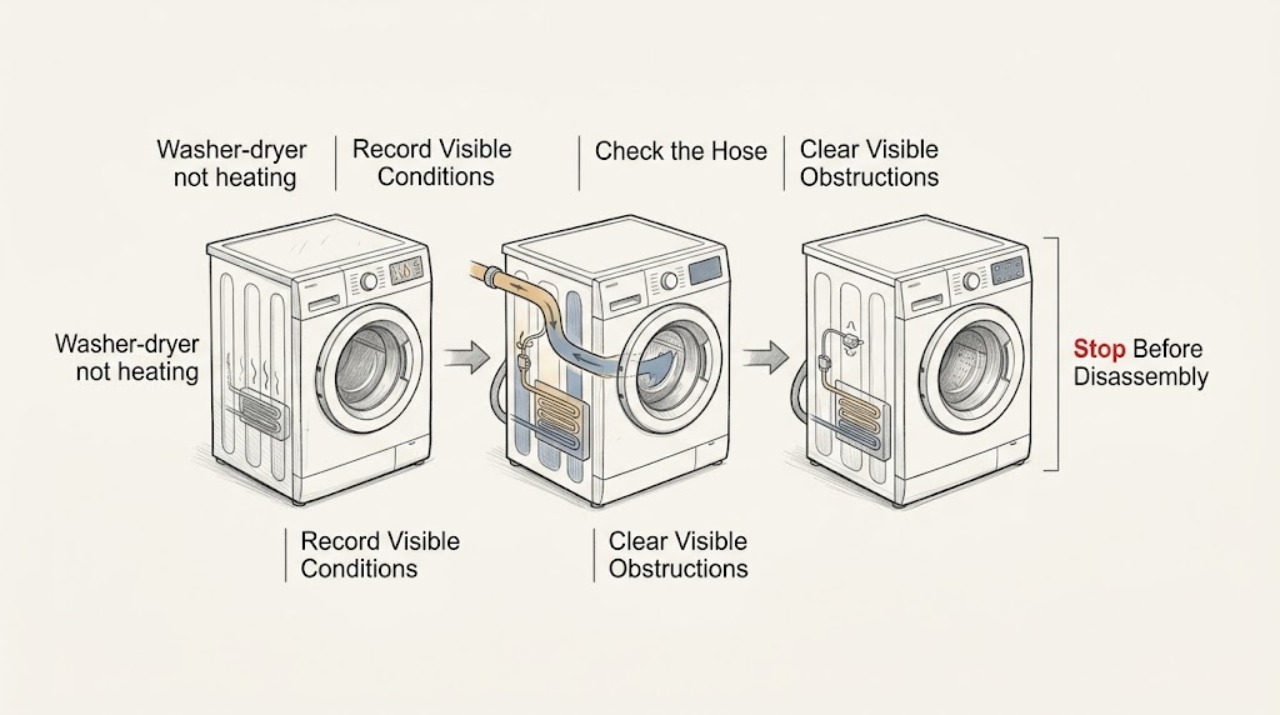
First separate a cold wash from a dryer that produces no heat. Magic Chef washer-dryer combo manuals list the selected cycle and load size as operating factors, and identify a heating fault as a damaged NTC thermistor or worn heating pipe that needs service. Confirm that the chosen wash temperature or dry program is intended to heat, keep the dry load within the model's dry capacity, and do not mistake a programmed cool-down period for a heating failure. If a heating fault appears, the drum stays cold on an appropriate heated cycle, or the unit has a burning smell, damaged cord, repeated breaker trip, or abnormal error, unplug it when safe and arrange qualified service rather than opening the cabinet.
Work through in order
Diagnostic checks
Use only checks that match the exact appliance or system and its official guide.
-
Check 1
Write down whether the complaint is about wash water or drying, then identify the selected cycle and temperature or dry program. Check the display for a heating-related or other fault indication, and note whether the drum tumbles, remains cold, or enters a normal spin/cool portion of the program.
Expected result: The selected cycle is Cold/Eco or another non-heated option, the machine is in a documented cool period, or an appropriate heated program remains cold or shows a fault.
Next step: If the setting explains the symptom, use the exact model manual to select the needed temperature or dry program. If the correct program remains cold or a fault persists, stop repeated cycles and continue with the service boundary.
Why this matters
Why: A non-heated selection or cool period can look like no heat without a failed component. A cold result on a suitable heated program or a heating fault points toward the heating circuit, sensor, or control and needs a service decision.
-
Check 2
For drying, compare the load with the model's drying limit rather than its washing limit. Remove excess or tightly packed items only after the drum has stopped and the door has unlocked; also confirm that the selected dry program is not a cool-air or cool-down stage. Do not cut the water supply or remove hose attachments during a ventless dry cycle.
Expected result: The dry load is above the stated dry capacity, is tightly packed, or the program is still in its spin/cool portion; alternatively, the load and program are appropriate but no warmth is produced.
Next step: Correct only the load or program issue described by the manual. If the appropriate program still produces no heat, keep the unit out of service and arrange diagnosis rather than extending the cycle repeatedly.
Why this matters
Why: A load that is too large for drying can reduce drying performance, and a cool phase is expected behavior. If an appropriate smaller load and heated program remain cold, the symptom is less likely to be a load-selection issue.
-
Check 3
With the appliance switched off and unplugged, inspect only accessible, user-serviceable areas described in the manual: the dry lint or air filters if your exact model provides them, the door area, and the exterior openings. Remove lint or debris according to the model instructions, and check that no clothing or object is blocking the door from closing. Do not spray water on the unit or touch internal heater, fan, wiring, or thermistor parts.
Expected result: A filter or accessible opening is blocked, the door does not close correctly, or no accessible obstruction is found.
Next step: Clean or reposition only the accessible item as the manual allows. If the unit still produces no heat, shows a fault, or has abnormal odor, leave it unplugged and arrange qualified service.
Why this matters
Why: An obstructed filter or incorrect loading can impair drying, while a door that cannot close may prevent the heating program from operating. No accessible obstruction leaves the heating fault or control as the likely service path.
-
Check 4
Review the complete behavior after the safe setting and load checks: determine whether the washer-dryer heats on the appropriate program, or whether it stays cold, reports a heating fault, stops early, trips power, or develops a burning odor. Do not repeat a failed cycle solely to reproduce the symptom.
Expected result: Heat returns after a correct program/load selection, or the no-heat symptom persists with a correct selection or is accompanied by an error, power interruption, odor, or damage.
Next step: If heat does not return, record the program, load, displayed code, and whether the drum tumbled, then keep the washer-dryer disconnected and contact qualified service. For smoke or active fire, leave the area and contact emergency services.
Why this matters
Why: A corrected program or load can explain reduced drying performance. Persistent no heat or a fault indicator is consistent with the manual's heater/thermistor service boundary; odor, smoke, damaged wiring, or a tripped breaker raises the urgency.
Use your observations
Decision map
Find the observation that best matches what you see, then follow the next safe action.
-
PATH 01Safety boundary
What you see
The chosen wash or dry program is Cold, Eco, Air Dry, or in a documented spin/cool stage, and no fault or safety symptom is present.
Do this next
Use the exact model manual to select a cycle that is intended to heat, respecting the cycle's load limits and normal cool-down behavior.
Why this path and its safety boundary
Safety stop: Do not keep extending a cycle or alter wiring to force heat if the selected heated program remains cold.
-
PATH 02Safety boundary
What you see
The dry load exceeds the model's dry capacity or is packed tightly, while the machine otherwise runs normally.
Do this next
Stop after the drum is stationary, reduce the load according to the manual, and use the correct dry program. Do not cut water supply or remove hoses during a ventless dry cycle.
Why this path and its safety boundary
Safety stop: If a properly sized load still produces no heat, stop treating capacity as the cause and arrange service.
-
PATH 03Safety boundary
What you see
A heating fault is displayed, or a suitable heated wash/dry program stays cold after the safe program and load checks.
Do this next
Keep the washer-dryer off and arrange qualified service. Magic Chef's manual identifies the NTC thermistor and heating pipe as service causes and says to contact customer service.
Why this path and its safety boundary
Safety stop: Do not dismantle the unit, touch the drying heater or fan motor while energized, or replace a part based only on the symptom.
-
PATH 04Safety boundary
What you see
There is a burning smell, smoke, a damaged cord or plug, water on the controls, a repeated breaker trip, or an active fire.
Do this next
Stop using the appliance. Isolate power only from a safe external disconnect, keep clear of smoke or wet electrical areas, and arrange qualified electrical/appliance service; leave and contact emergency services for an active fire.
Why this path and its safety boundary
Safety stop: Do not restart the appliance or use water on an electrical fire.
Helpful context
Understand the symptom
“Not heating” can describe two different symptoms: the wash water is not as warm as expected, or the dryer portion tumbles but never produces warm air. The selected program matters. Some wash cycles are Cold or Eco, and a combo dry cycle can spend part of its programmed time spinning or cooling. Identify the phase before treating the heater as failed.
The heating circuit and thermistor are inside the appliance. Magic Chef's combo manual says not to dismantle the washer and identifies the drying heater as a service hazard while energized. Keep the enclosure panels in place and leave electrical diagnosis to a qualified technician.
Only after diagnosis
Potential parts
- NTC thermistor
Consider this only when a qualified technician confirms a thermistor fault and identifies the correct repair for the exact model.
Confirm the complete model number and manufacturer fit information before ordering; the no-heat symptom alone does not establish compatibility. - drying heater or heating pipe
Consider this only after service confirms that the heating pipe or drying heater has failed and that the selected program and controls are otherwise correct.
Use the exact model information and the technician's diagnosis to verify the part; do not access or replace an energized heater. - filter or airflow component
Consider this only if the exact model has an accessible filter or airflow component that is damaged or cannot be cleaned and service confirms it affects drying.
Confirm the model-specific component and installation instructions before ordering; a filter issue does not explain a displayed heating fault by itself.
When checks do not resolve it
Need a professional?
Arrange qualified service when an appropriate heated program remains cold, a heating fault appears, the unit stops early, the door lock or controls behave abnormally, or inspection would require opening the cabinet. Stop immediately for burning odor, smoke, a damaged cord or plug, water near controls, or repeated breaker trips; use emergency services for an active fire.
Have this ready
- Magic Chef model and serial information
- Whether wash water, drying air, or both remain cold
- The selected cycle, temperature or dry program, load size, and whether the drum tumbles
- Any displayed fault code, power interruption, unusual odor, smoke, or cord/plug damage
- Whether the symptom began after moving, cleaning, or a change in electrical or water connections
Common questions
FAQ
Why is my Magic Chef washer dryer not heating?
First rule out a Cold/Eco or cool portion of the selected program and an overloaded dry load. If an appropriate heated cycle remains cold or a heating fault appears, the manual points to the heater or NTC thermistor and qualified service.
Does a ventless Magic Chef combo need water during drying?
The combo manual says not to cut off the water supply or remove hose attachments during a dry cycle. Check that the installation and supply are intact, but leave internal diagnosis to service.
Can a cool-down period look like no heat?
Yes. Magic Chef dry programs include spin and cool portions, so the drum or air can feel cool during part of the program. Persistent cold air on the heated portion is a different symptom.
Can I replace the heating pipe or thermistor myself?
Not as an ordinary user check. Magic Chef identifies these as service causes and warns against dismantling the washer; the heater, fan, wiring, and controls require qualified service.
Read the exact guide
Official sources
- The Magic Chef Help CenterMC Appliance · Magic Chef product support, laundry help, manuals, parts, and service routing
- ComboWD_MCSCWD27W5_Rev1Magic Chef · Magic Chef combo washer and dryer models MCSCWD27W5, MCSCWD27S5, MCSFLW27W, MCSFLW27S, and MCSCWD27G5
Community feedback
Share a repair observation
Share a plain-text repair observation. Accepted observations are published automatically; this page may take a moment to update.