
On this page
Start here
Quick answer
Identify the sound by when it occurs. Maytag describes rushing water, swishing, a soft drain-pump hum, a brief gurgle, and some clicks as normal cycle sounds. Rattling from loose dishes or a louder vibration from an unlevel or poorly secured unit can be corrected externally; grinding, scraping, smoke, or a new noise with poor operation should stop the cycle and prompt service.
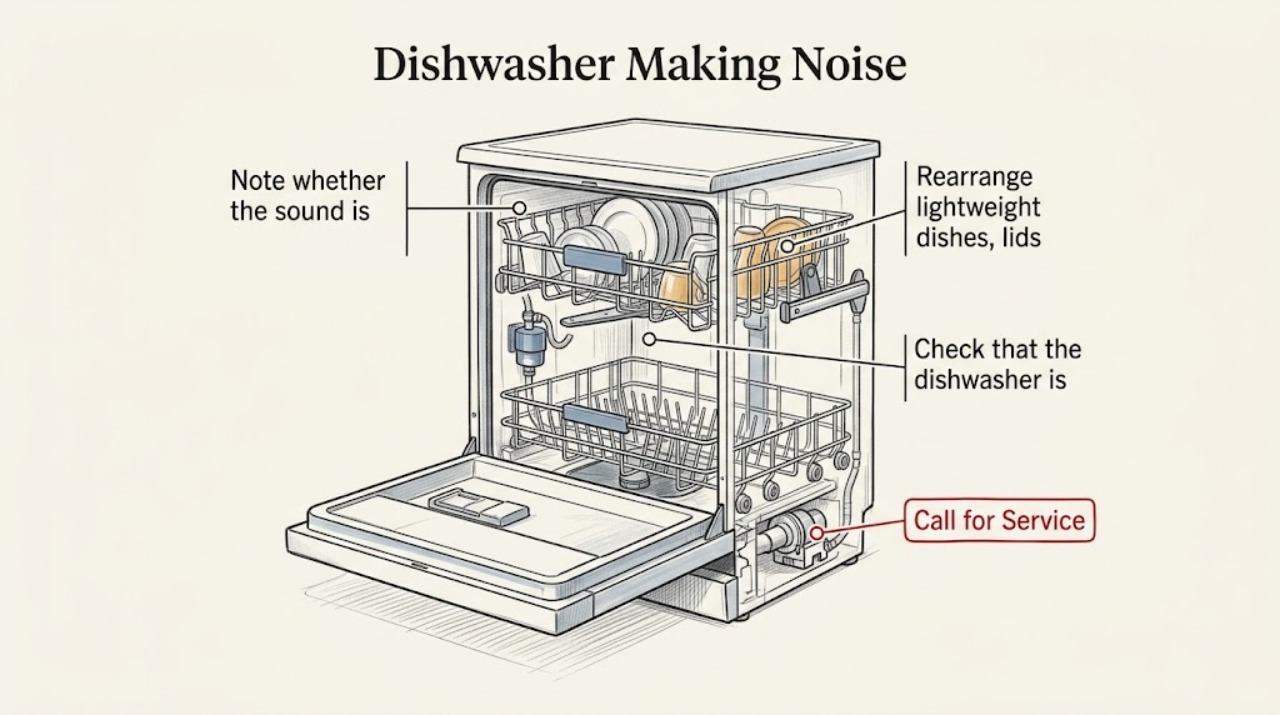
Work through in order
Diagnostic checks
Use only checks that match the exact appliance or system and its official guide.
-
Check 1
Note whether the sound is a rush, swish, hum, gurgle, click, rattle, grinding, or scraping, and which cycle phase produces it.
Expected result: The sound matches a documented fill, wash, drain, valve, or fan phase, or it is harsh and new.
Next step: Continue with loading and installation checks for normal-phase sounds; stop for grinding, scraping, smoke, or abnormal operation.
Why this matters
Why: Maytag links several soft sounds to normal water movement, valves, pumps, or fan operation; harsh mechanical sounds require a different boundary.
-
Check 2
Rearrange lightweight dishes, lids, and utensils so they cannot contact one another or the spray arms, and confirm nothing is loose in either rack.
Expected result: The rattle disappears after rearranging, or it remains with an empty or stable load.
Next step: Use heavier items below and secure light items; continue if the sound is unchanged.
Why this matters
Why: Maytag notes that load type and arrangement can create incidental rattles and clatter that are not a motor fault.
-
Check 3
Check that the dishwasher is level, supported by its leveling legs or wheels, and securely mounted without the cabinet or toe-kick vibrating against it.
Expected result: The unit rocks or transmits vibration, or the installation is stable.
Next step: Have installation alignment corrected if needed; do not remove panels while the dishwasher is powered.
Why this matters
Why: An unlevel or poorly secured dishwasher can amplify normal operating sounds.
-
Check 4
If the sound is grinding or scraping, stop the cycle and inspect only the accessible filter, spray-arm area, and rack clearance for a hard object.
Expected result: A removable object is found, or the sound persists with clear accessible areas.
Next step: Leave the dishwasher off and arrange service if the noise persists, recurs, or accompanies poor cleaning or draining.
Why this matters
Why: A hard object or obstruction can create a non-routine sound; a persistent internal noise is not safely isolated by external checks.
Use your observations
Decision map
Find the observation that best matches what you see, then follow the next safe action.
-
PATH 01Next step
What you see
The sound is a soft rush, swish, hum, gurgle, or brief valve click tied to a cycle phase
Do this next
Monitor for a change in sound or performance rather than replacing a part based on sound alone.
-
PATH 02Next step
What you see
The noise changes or disappears after the load is rearranged
Do this next
Secure lightweight items and keep rack contents clear of the spray arms.
-
PATH 03Next step
What you see
Grinding, scraping, smoke, or a new harsh noise persists with a clear load
Do this next
Stop using the dishwasher and arrange qualified service.
Helpful context
Understand the symptom
Timing is more useful than loudness alone
Listen during fill, spray, drain, and after-cycle fan operation. A repeatable sound tied to one phase is easier to compare with Maytag's normal operating descriptions than a generic label such as noisy.
When checks do not resolve it
Need a professional?
Arrange service for persistent grinding, scraping, smoke, a new harsh noise, or any noise accompanied by leaking, poor draining, poor cleaning, or a cycle that stops.
Common questions
FAQ
Which Maytag dishwasher noises can be normal?
Maytag describes rushing water, swishing during spray, a soft drain-pump hum, brief gurgling, and some valve or dispenser clicks as normal on applicable cycles and models.
When should a dishwasher noise be treated as a fault?
Stop and arrange service for persistent grinding or scraping, smoke, or a new harsh noise—especially when cleaning, draining, leaking, or cycle completion also changes.
Read the exact guide
Official sources
- Normal Dishwasher Sounds and NoiseMaytag Product Help · Maytag dishwasher noises
Community feedback
Share a repair observation
Share a plain-text repair observation. Accepted observations are published automatically; this page may take a moment to update.