
On this page
Start here
Quick answer
On a Maytag Bravos XL dryer, AF means restricted airflow, not a generic heater failure. Maytag lists a clogged lint screen or vent, a crushed or kinked run, and too many turns as causes. A new house does not prove a roof-vent run is clear: the vertical duct, roof cap or hood, termination, and any lint, debris, nest, or screening can still restrict exhaust. Clean the lint screen, inspect the accessible dryer-to-wall section, and check the roof termination only from a safe location. If airflow is weak, the roof run is inaccessible, or AF and long dry times persist, keep the dryer off and have a qualified venting specialist clean and test the full run.
Before you begin
Safety first
- Do not climb onto the roof, remove roofing components, use a screen or cap that traps lint, open the dryer cabinet, bypass a thermal or door safety device, or continue heated cycles when the dryer is smoking, overheating, or electrically abnormal.
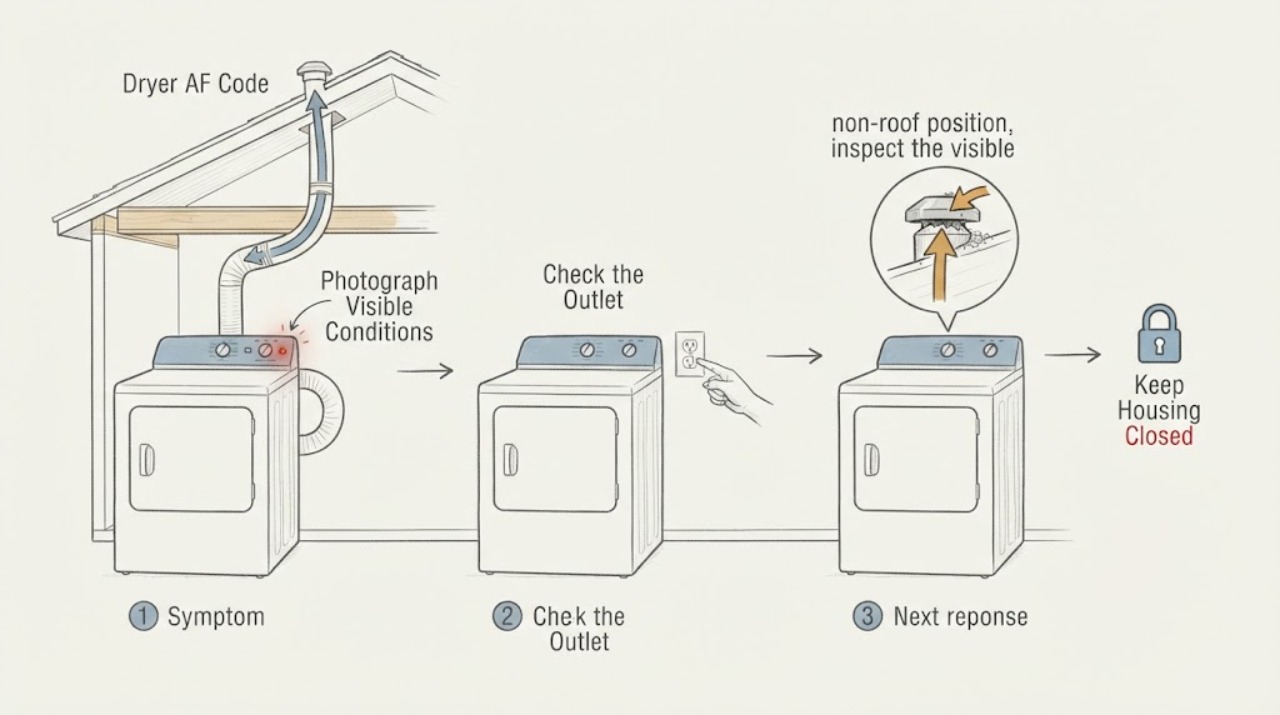
Work through in order
Diagnostic checks
Use only checks that match the exact appliance or system and its official guide.
-
Check 1
Photograph the display and record the complete Maytag model number, gas or electric type, selected cycle, load condition, and whether AF appears during sensing, while drying, or after a long cycle. Confirm that the message is AF or Check Vent rather than F4E3 or another code.
Expected result: AF is confirmed on a Maytag Bravos XL, or the exact display and model are uncertain.
Next step: If AF is confirmed, continue with the external airflow checks. If the display differs or the model cannot be matched, use the exact owner guide before applying this path.
Why this matters
Why: Maytag maps AF and F4E3 to restricted airflow, while other dryer codes use different branches. The exact model and display must stay together before changing the vent or ordering any part.
-
Check 2
With the dryer off and cool, clean the lint screen and inspect the accessible duct from the dryer outlet to the wall for lint, crushing, kinks, sagging, foil or plastic material, and an overly long or sharply turned section. Do not run the dryer without the screen or reach into the cabinet.
Expected result: The screen or short duct is blocked, damaged, sharply bent, or visibly clear.
Next step: Remove only loose accessible lint and correct an obvious external kink without opening the dryer. If the accessible path is clear, move the diagnosis to the roof termination and full-house vent run.
Why this matters
Why: Maytag identifies a clogged screen or vent and a crushed, kinked, or over-turned run as direct AF causes. A clear short section does not rule out a restriction in the concealed roof run.
-
Check 3
From ground level or another safe, non-roof position, inspect the visible roof exhaust termination for a blocked hood, lint, leaves, bird or rodent nesting, a screen that traps lint, or a cap that cannot open freely. Do not climb onto the roof, remove roofing components, or insert a tool into the concealed duct.
Expected result: The roof outlet is obstructed or screened, the flap or hood cannot open freely, the termination cannot be safely seen, or it appears clear.
Next step: If an obstruction is safely reachable from the ground, remove only loose external debris. For a roof-level, concealed, screened, or uncertain termination, arrange professional vent inspection and cleaning rather than attempting a roof repair.
Why this matters
Why: Maytag says lint and debris at the exhaust hood or roof cap can restrict the path, and its roof-vent instructions warn against screening or capping the end in the wrong configuration. An apparently clear cap does not prove that the vertical run is clean.
-
Check 4
If there is no heat, humidity or lint discharge at the safe exterior outlet, run a short heated timed cycle only if the dryer has no smoke, burning smell, extreme heat, leak, or electrical symptom; otherwise leave it off. Note whether airflow is weak and whether AF returns after the accessible checks.
Expected result: The outside airflow is weak or absent, clothing remains warm but damp, the laundry area becomes humid, or AF clears and drying returns to normal.
Next step: If airflow remains weak or AF returns, stop using the dryer and have the entire roof run measured, cleaned, and checked against the model installation instructions by a venting specialist. If performance returns, continue cleaning the screen before every load and monitor the next cycles.
Why this matters
Why: Maytag associates weak exhaust movement, warm damp loads, and elevated laundry-room humidity with restricted venting. Clearing AF after a local correction makes that condition more likely, but it does not prove the concealed roof run is safe.
Use your observations
Decision map
Find the observation that best matches what you see, then follow the next safe action.
-
PATH 01Next step
What you see
AF appears on the Bravos XL, the lint screen or dryer-to-wall duct is restricted, and airflow improves after the accessible obstruction is removed.
Do this next
Run only a normal observation cycle without safety symptoms, clean the screen before each load, and arrange professional vent cleaning if AF or long drying returns.
Why this path and its safety boundary
Why it matters: The result is consistent with the external restriction Maytag names, but the roof termination and concealed run still need monitoring because the house exhaust path continues beyond the wall.
-
PATH 02Next step
What you see
The accessible screen and short duct are clear, but the roof outlet is screened, blocked, inaccessible, or produces weak airflow with warm damp loads.
Do this next
Stop treating this as a dryer-component fault and have a venting specialist inspect and clean the complete run and roof termination against the Bravos XL installation requirements.
Why this path and its safety boundary
Why it matters: A restriction in the concealed vertical run or roof termination is more likely than a lint-screen problem. New construction does not establish that the roof path or cap is correctly configured.
-
PATH 03Next step
What you see
AF returns after the full vent path is professionally verified, or the dryer has smoke, burning odor, extreme heat, water, or repeated breaker trips.
Do this next
Keep the dryer off and arrange qualified Maytag appliance service. Provide the code, model, vent test result, cycle behavior, and any hazard observations; do not open the cabinet or bypass a safety device.
Why this path and its safety boundary
Why it matters: Persistent AF after a verified exhaust path leaves an appliance-side airflow or control diagnosis; hazard symptoms require immediate shutdown rather than further vent testing.
Helpful context
Understand the symptom
What AF means on a Bravos XL
Maytag's AF guidance describes restricted airflow. The Bravos XL owner guide gives the same low-airflow path: clean the lint screen, inspect the vent from the dryer to the wall, confirm the exterior hood is clear, and check the vent length and turns. The dryer may continue to run while AF is displayed, but continuing to run against a restricted exhaust can leave clothing damp and increase heat and lint risk.
Why a roof outlet changes the first diagnosis
Maytag explains that a vent can end at an exhaust hood or roof cap. With a roof outlet, the part that needs checking is not only the short hose behind the dryer: the concealed vertical run and roof termination also affect airflow. Do not climb onto the roof or dismantle the termination just to clear AF; have the inaccessible portion inspected and cleaned by a venting specialist.
When checks do not resolve it
Need a professional?
Use a venting specialist for the concealed roof duct, roof cap, lint cleaning, airflow measurement, and installation review. Use qualified Maytag appliance service when AF persists after the full vent path is verified or when the dryer itself shows a safety symptom.
Safety scope: Do not climb onto the roof, remove roofing components, use a screen or cap that traps lint, open the dryer cabinet, bypass a thermal or door safety device, or continue heated cycles when the dryer is smoking, overheating, or electrically abnormal.
Have this ready
- Provide the Bravos XL model and serial information, AF photograph, gas or electric type, cycle and load details, accessible airflow observations, roof outlet condition, approximate vent path, and any professional cleaning or test result.
Common questions
FAQ
Can a new house still cause an AF code on a Maytag Bravos XL dryer?
Yes. A new installation does not prove that the full roof run and termination provide adequate airflow. Maytag says the path, roof cap or hood, lint, debris, turns, and vent length all affect drying performance.
What should I check when the dryer vents through the roof?
Clean the lint screen and inspect the accessible duct first. From a safe location, look for an obstructed or screened roof termination and have a venting specialist inspect the concealed vertical run; do not climb onto the roof to troubleshoot AF.
Does AF mean the Maytag dryer's heater is broken?
Not by itself. Maytag defines AF as restricted airflow. Restricted exhaust can make clothes stay warm but damp and can affect heat behavior, so verify the vent path before treating the dryer as an appliance-side heater failure.
Read the exact guide
Official sources
- Owner's ManualMaytag · Official Maytag Bravos XL owner guide opened for the assigned Bravos XL dryer family.
- INSTALLATION INSTRUCTIONSMaytag · Official Maytag dryer installation instructions opened for roof-termination and concealed-run safety; exact model installation instructions control if different.
- How to Check VentingMaytag Product Help · Official Maytag vent-check page opened for accessible screen, duct, hood, vent-length, and professional-cleaning checks.
- How does a Dryer Dry Clothing?Maytag Product Help · Official Maytag airflow explanation opened for the roof-exhaust condition.
- Dryer is not Drying or Experiencing Long Dry TimesMaytag Product Help · Official Maytag drying-performance page opened for warm-damp loads, new-home venting context, and service escalation.
- AF or "Check Vent" - DryerMaytag Product Help · Official Maytag dryer AF page opened for the assigned Maytag Bravos XL airflow topic.
Community feedback
Share a repair observation
Share a plain-text repair observation. Accepted observations are published automatically; this page may take a moment to update.