
On this page
Start here
Quick answer
Treat a Maytag oven gas smell as a possible gas emergency until a qualified gas professional clears it. Do not light the oven or any other appliance, operate electrical switches, use a phone inside, or try to locate the leak. If the odor is strong, persists while the oven is off, comes with hissing, delayed ignition, an abnormal flame, or causes symptoms, leave immediately and contact the gas supplier or fire department from a safe location. A brief odor during a normal ignition event can still need model-specific service if it is strong, repeated, or accompanied by a flare, bang, or yellow flame. Do not keep relighting the oven or move the range; provide the model, fuel type, timing, and observations to qualified service.
Work through in order
Diagnostic checks
Use only checks that match the exact appliance or system and its official guide.
-
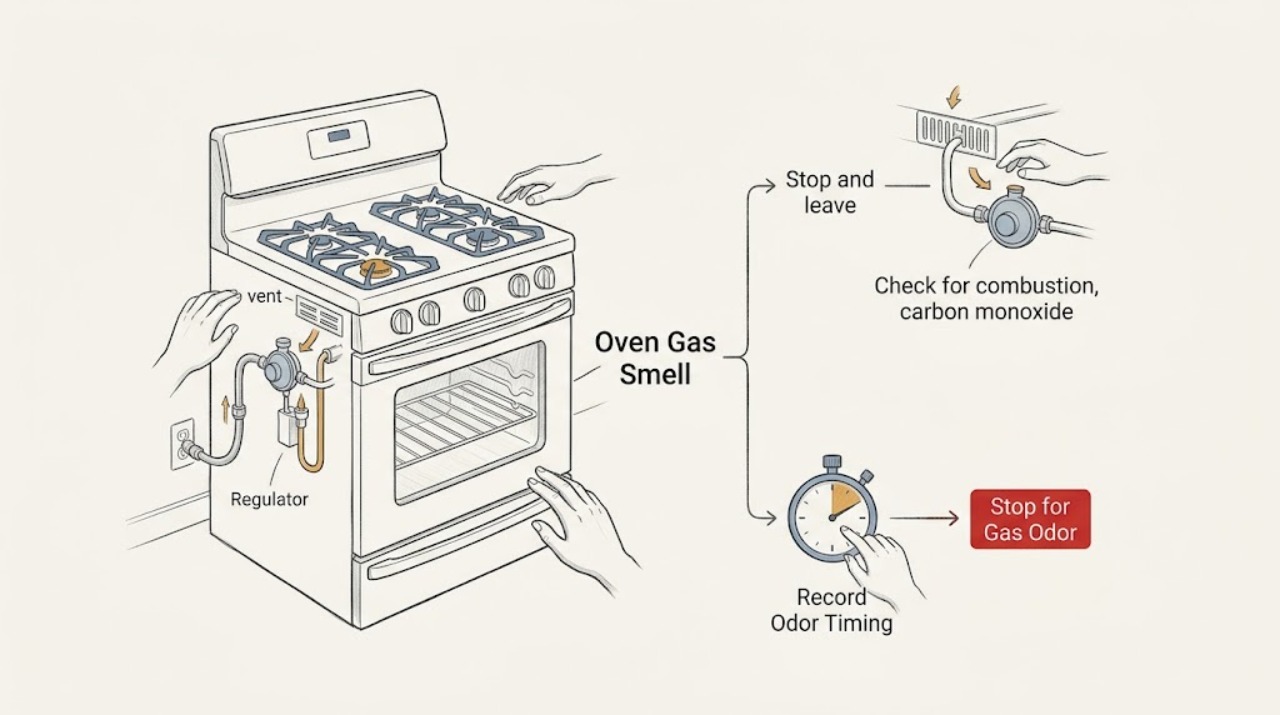
Stop and leave for a suspected gas leak
If you smell raw gas or rotten eggs, hear hissing, or cannot confidently tell whether the odor is gas, do not light the oven, cooktop, or another appliance. Do not touch light switches, plugs, thermostats, or other electrical controls, and do not use a phone inside. Leave people and pets behind only if necessary for immediate safety, then contact the gas supplier or fire department from a safe location.
Expected result: The odor persists with the oven off, is strong or spreading, or there is hissing; alternatively, a qualified responder has already cleared the area.
Next step: For a suspected leak, stop the article here and follow the gas or emergency service instructions. Continue only after the area and appliance have been declared safe.
Stop if: Stop immediately for gas odor, hissing, uncertain odor source, or any instruction that would require ignition, an electrical switch, a leak search, or re-entry.
Why this matters
Why: Maytag treats a gas smell as an emergency response situation, not a user diagnosis. The oven must not be relit or re-entered for troubleshooting until it is cleared.
-
Check for combustion, carbon monoxide, or fire warning signs
From a safe position, note whether there was a bang, delayed ignition, lifting or yellow flame, smoke, soot, flame outside the burner area, visible arcing, a hot control, or symptoms such as headache, dizziness, nausea, or unusual sleepiness. Do not repeat the ignition to see whether the symptom returns.
Expected result: Any abnormal flame, delayed ignition, smoke, fire, arcing, electrical burning odor, or possible carbon-monoxide symptom is present; or the oven has none of these signs.
Next step: For any warning sign, leave the area when appropriate, keep the oven out of service, and contact emergency or qualified gas/appliance help from a safe location. If none occurred and a responder has cleared the gas concern, document the odor context before any further step.
Stop if: Do not use an oven with an abnormal flame, smoke, soot, repeated ignition failure, visible damage, arcing, hot controls, or suspected carbon monoxide.
Why this matters
Why: Combustion and electrical warning signs raise the risk beyond a brief odor and can require emergency response or qualified service even if the oven later appears to operate.
-
Record the exact odor timing without recreating it
After the gas concern is cleared, write down whether the odor occurred before starting, during ignition, while preheating, during Bake or Broil, after shutdown, or near the cooktop rather than the oven. Record the fuel type, model number, whether the oven was recently installed or reconnected, and any display code. Do not turn the oven on again solely to reproduce the smell.
Expected result: The odor has a repeatable stage or location, or it remains intermittent and cannot be localized safely.
Next step: Use the matching branch below. If the location or cause remains uncertain, keep the oven off and arrange qualified service rather than performing more tests.
Why this matters
Why: Timing distinguishes a gas-supply or ignition event from a non-gas residue and gives a technician useful evidence without repeated ignition.
-
Separate a brief ignition odor from a persistent gas odor
If a qualified responder has cleared the appliance and the odor was only a brief event at ignition, review the exact Maytag manual for the installed model and fuel type. Do not assume a brief smell is acceptable if it repeats, grows stronger, occurs before ignition, or is paired with a bang, flare, delayed ignition, or abnormal flame.
Expected result: The event was brief and isolated with normal ignition and no gas odor while off; or the odor repeats, lasts after ignition, or is paired with abnormal combustion.
Next step: For a repeated or abnormal event, keep the gas oven off and arrange certified gas/appliance service. Do not conduct another ignition test. For a cleared, isolated event, follow the model instructions and monitor only under normal safe use.
Stop if: Stop for any odor while the oven is off, recurrence, delayed ignition, bang, flare, yellow flame, soot, or inability to identify the fuel configuration.
Why this matters
Why: A single context-limited event still needs model-specific interpretation; recurrence or abnormal combustion is evidence that the appliance should not be operated.
-
Rule out a non-gas surface odor only when the gas branch is clear
With the oven completely cool and cleared for inspection, look at accessible cavity surfaces for food, grease, cleaner residue, packaging, foil, or a liner. Do not reach into burner openings or vents, disturb the door gasket, or spray cleaner into openings. If the odor was clearly food or compatible cleaner residue rather than gas, follow the model's cool-oven cleaning instructions.
Expected result: A visible spill or residue matches the odor and no gas, combustion, or electrical warning exists; or the cavity is clean while the smell remains near the burner, vent, or controls.
Next step: Clean only the confirmed accessible residue with the exact model-approved method. If the source is hidden, recurring, or near controls or the vent, stop use and request service.
Stop if: Do not use cleaner to mask a gas odor, mix chemicals, block vents, line the oven bottom with foil, or remove panels or burners.
Why this matters
Why: Maytag says trapped spills and debris under foil or liners can cause odors, but a persistent odor near gas or electrical components is not a surface-cleaning diagnosis.
-
Check installation and fuel identity without moving the range
If the problem began after installation, reconnection, conversion, or moving the appliance, compare the model and fuel type with the installation documents. Ask a certified technician to verify the gas connection, regulator, and ignition path. Do not slide a hard-piped range, adjust the regulator, kink a flexible connector, or open a gas fitting yourself.
Expected result: The fuel type is uncertain, the oven was recently connected, the cooktop behaves differently from the oven, or the odor followed appliance handling.
Next step: Leave the appliance out of service and provide the installation history, fuel type, model number, and odor timeline to a certified gas or appliance technician.
Stop if: Stop for any gas odor, damaged or stretched connector, uncertain fuel conversion, hard-piped installation, or need to access a regulator or gas fitting.
Why this matters
Why: Maytag distinguishes the oven regulator shutoff from the home's main gas supply and warns that a hard-piped range may not be safe to slide; an incorrect or disturbed installation needs qualified review.
-
Use only a single model-approved recovery step after clearance
Only after the gas concern has been cleared and the exact manual permits it, confirm the controls are Off and perform the manual's documented reset or reinitialization step once. Observe the controls without repeatedly starting the oven; do not use a reset as a substitute for gas or combustion diagnosis.
Expected result: The control recovers without an odor or abnormal display, or the smell, code, ignition issue, or abnormal flame returns.
Next step: If the odor or fault returns, leave the oven off and arrange qualified service. Do not keep cycling power or relighting the burner.
Stop if: Do not reset during an active gas or fire concern, bypass an interlock, open the control panel, or perform a live electrical or gas test.
Why this matters
Why: A reset can clear a control state but cannot prove that a gas valve, regulator, igniter, burner, vent, or wiring is safe.
-
Prepare a qualified-service handoff
Keep the oven unused and report the exact model number, fuel type, odor description, strongest location, whether the oven was on or off, cycle and stage, ignition sound, flame appearance, smoke or code, recent installation or cleaning, and whether a responder cleared the gas concern. Do not provide a phone number or attempt a component replacement; use the manufacturer's or local qualified service channel appropriate to the location.
Expected result: The smell persists, returns, comes from behind controls or a vent, follows a gas event, or cannot be confidently classified.
Next step: Request qualified Maytag or appliance service. Use emergency gas or fire help instead if the condition is active, strong, unexplained, or accompanied by smoke, symptoms, or uncontrolled combustion.
Stop if: Do not open gas fittings, remove panels, replace gas or electrical parts, bypass safety devices, or run more tests to obtain evidence.
Why this matters
Why: The likely causes span the gas supply, regulator, valve, igniter, burner, venting, sensor, and electrical controls; exact diagnosis depends on the model and fuel system.
Use your observations
Decision map
Find the observation that best matches what you see, then follow the next safe action.
-
PATH 01Next step
What you see
Raw-gas or rotten-egg odor, hissing, odor while the oven is off, or uncertain odor source.
Do this next
Do not ignite anything, operate electrical switches, use a phone inside, look for the leak, or re-enter to troubleshoot. Leave and contact the gas supplier or fire department from a safe location.
-
PATH 02Next step
What you see
Delayed ignition, bang, abnormal or yellow flame, smoke, soot, flame outside the burner area, carbon-monoxide symptoms, arcing, or electrical burning odor.
Do this next
Stop using the oven and obtain emergency or qualified gas/appliance help from a safe location; do not repeat ignition.
-
PATH 03Next step
What you see
A qualified responder has cleared the appliance and the odor was a single brief ignition event with no abnormal flame or recurrence.
Do this next
Follow the exact model manual and monitor only under normal safe operation; stop if any odor returns or changes character.
-
PATH 04Next step
What you see
A cool, cleared cavity contains food, grease, cleaner, packaging, foil, or liner residue and no gas or electrical warning exists.
Do this next
Use the model-approved cool-oven cleaning procedure. Do not mix cleaners, block vents, or use foil to cover the oven bottom.
-
PATH 05Next step
What you see
The odor followed installation, reconnection, conversion, or moving, or the fuel type is uncertain.
Do this next
Do not move the range or adjust a regulator; keep it off and arrange certified installation or appliance service.
-
PATH 06Next step
What you see
The odor persists, recurs during ordinary cooking, comes from the burner, vent, or controls, or cannot be classified after the gas clearance.
Do this next
Keep the oven out of service and provide the complete symptom timeline to qualified Maytag appliance service.
Helpful context
Understand the symptom
A gas odor around a Maytag oven is not a normal cleaning problem. First separate an active gas or combustion hazard from a short-lived odor during a documented ignition event. The exact model manual and fuel configuration control the details; this page does not authorize opening a gas connection, testing for leaks, or changing a regulator.
If the odor is strong, unexplained, or present when the oven is off, stop at the emergency branch. Do not stay inside to gather more evidence. Gas can be present even when smell is weak or absent, so a lack of odor is not a clearance test.
When checks do not resolve it
Need a professional?
For raw-gas odor, hissing, odor while the oven is off, delayed ignition, abnormal flame, smoke, fire, carbon-monoxide symptoms, or an active electrical hazard, leave when safe and contact the appropriate gas or emergency service from a safe location. Request qualified Maytag or appliance service for any recurring or unexplained odor, odor near the burner, vent, or controls, an event after installation or reconnection, or a problem that returns after the model-approved recovery step.
Common questions
FAQ
What should I do first if my Maytag oven smells like gas?
Do not light the oven or another appliance, operate electrical switches, use a phone inside, or search for the leak. Leave the area and contact the gas supplier or fire department from a safe location. Do not return to troubleshoot until it is cleared.
Can a brief smell during Maytag oven ignition be normal?
A brief event still requires context and the exact model instructions. It is not safe to assume it is normal if it repeats, is present while the oven is off, or comes with delayed ignition, a bang, flare, yellow flame, soot, smoke, or an abnormal flame. Do not relight the oven to test it.
Could food or cleaner cause an odor in a Maytag gas oven?
Yes, but only investigate that branch after the gas and combustion safety screen is clear. When the oven is cool, inspect accessible surfaces for residue and follow the model-approved cleaning method. Do not use cleaner to mask a gas odor or spray into burner or vent openings.
Should I move my Maytag range to inspect the regulator?
Do not move or slide the range as an odor test. Maytag notes that a regulator shutoff is distinct from the home's main gas supply and that a hard-piped range may not be safe to move. Have a certified technician verify the gas path.
When does a Maytag oven gas smell require service?
Arrange qualified service for any recurring or unexplained odor, odor while the oven is off, delayed ignition, an abnormal flame, a problem after installation or reconnection, or an odor near the burner, vent, or controls. Use emergency gas or fire help for an active strong odor, hissing, smoke, fire, or symptoms.
Read the exact guide
Official sources
- Odors or SmellsMaytag Product Help · Official Maytag gas-cooking guidance applied to a gas oven or range when the odor source is uncertain.
- Oven Not Working - GasMaytag Product Help · Official Maytag gas range or oven operation guidance; exact model installation instructions control.
- Odors or Smells - RangeMaytag Product Help · Official Maytag range guidance for non-gas residue branches; it does not clear a gas-like or electrical odor.
- GAS RANGE Use & Care GuideMaytag · Official Maytag gas-range owner manual for the documented manual family; the exact installed model manual controls.
- How to Check the Gas Regulator Shut-Off Valve on an OvenMaytag Product Help · Official Maytag installation support; not a gas-odor DIY procedure.
- Cleaning and Maintenance of RangeMaytag Product Help · Official Maytag range-care guidance used only after the gas and combustion safety branch is clear.
Community feedback
Share a repair observation
Share a plain-text repair observation. Accepted observations are published automatically; this page may take a moment to update.