
On this page
Start here
Quick answer
A real burning or electrical odor together with water and a stopped basket is a stop-use event, not a belt, pump, or motor diagnosis. Press stop and wait for all movement to end; from a dry, safe position, close both water faucets and isolate power at the breaker or unplug only when the plug and floor are dry. Do not restart the Maytag Bravos XL MCT, run a drain-and-spin cycle, remove a panel, reach underneath, or test a suspected part. Once the area is safe, record whether the water first appeared during filling, wash/agitation, drain, or spin, and whether the smell was rubber-like, electrical, or accompanied by smoke, arcing, a hot cord, or a tripped breaker. Maytag's Bravos XL guidance separates load/suds/drain causes of a wet load from leak paths at hoses, household plumbing, overfill, or tub splash; none of those observations proves a failed motor, belt, pump, seal, or control. Arrange qualified appliance service, with an electrician for a wet or damaged supply and a plumber for a building-side drain or faucet leak.
Before you begin
Safety first
- Owner checks stop at pressing stop, waiting for movement to cease, closing accessible water faucets, isolating power from a dry safe location, recording the complete model/serial and timing, and inspecting visible external hoses, drain route, upper splash/foam clues, and floor conditions. Do not touch wet electrical parts, move or tilt the washer, reach underneath, open panels, enter service mode, bypass the lid lock, or rerun a cycle.
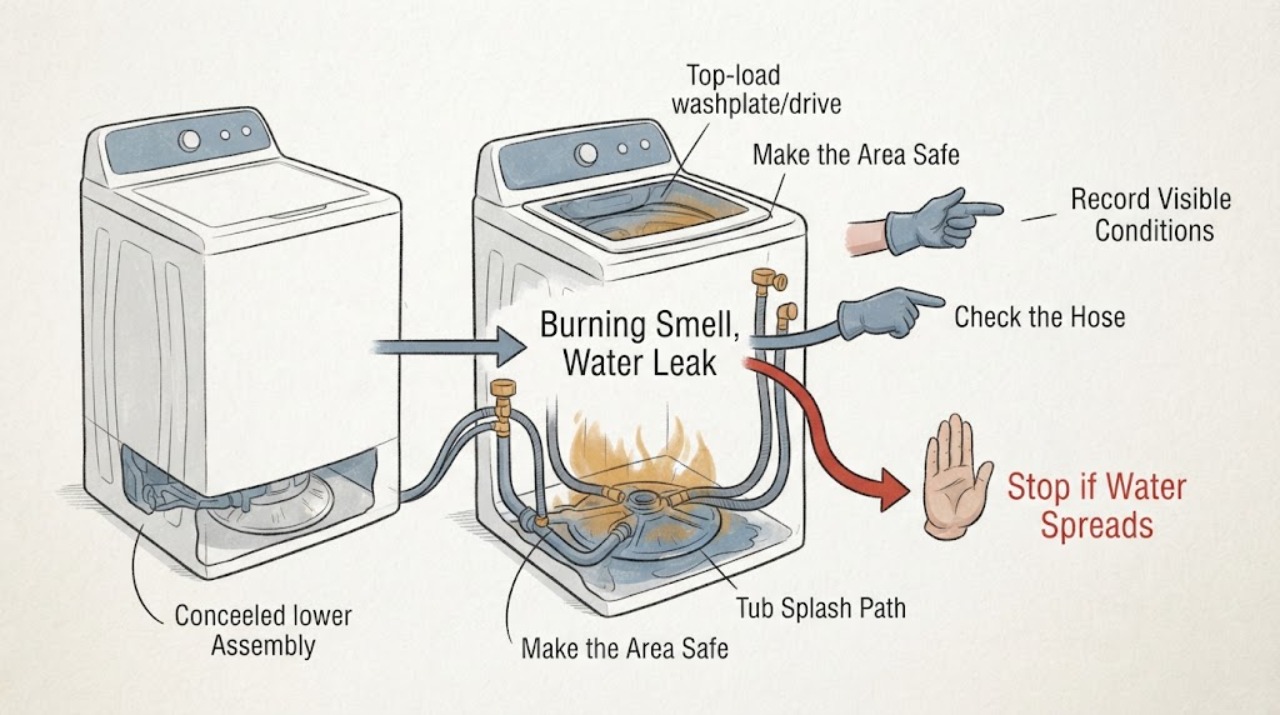
Work through in order
Diagnostic checks
Use only checks that match the exact appliance or system and its official guide.
-
Check 1
Press stop or pause and wait until the basket and washplate are completely still. From a dry, safe location, close the hot and cold supply faucets. Disconnect power only by unplugging from a dry, reachable outlet or switching off the breaker from a dry location; if water reaches the outlet, cord, or washer electrical area, do not touch the appliance or plug.
Expected result: There is smoke, arcing, a hot or damaged cord/plug, a breaker trip, water near electrical parts, active flooding, or a burning smell that persists after the washer stops.
Next step: Keep people away and leave the washer out of service. Use an electrician for a wet or damaged receptacle/supply, and qualified appliance or emergency service for the washer and water damage. Do not restart to see if the odor has gone away.
Stop if: Do not step through water, handle a wet plug or cord, move the washer, open a panel, or reset a breaker repeatedly.
Why this matters
Why: This is an electrical, fire, shock, and water-damage event before it is a mechanical diagnosis. A safe power isolation does not identify whether the cause was the drive, pump, wiring, or a water path.
-
Check 2
Without moving the washer or reaching underneath, map the first visible water from the front, sides, rear, and floor after the machine is stopped. Record whether it began while filling, washing/agitating, draining, spinning, or while idle, and whether the water is clear, soapy, dirty, or mixed with oil-like residue. Do not run another cycle to reproduce the leak.
Expected result: A supply fitting or hose is wet, the drain hose or standpipe spills during discharge, water splashed from the top/front, or water is present only below the cabinet with no visible external source.
Next step: Keep the faucets closed and power isolated. Document the visible first wet point for service; use a plumber for an independently backing-up household drain and appliance service for a washer-side or concealed leak.
Stop if: Do not pull the washer out, tilt it, reach beneath it, or loosen a water connection under pressure.
Why this matters
Why: Maytag's top-load leak guidance separates supply connections, household drain backup, overfill/added items, and splash from an unbalanced load. A lower-floor pool is only a location and cannot establish a pump, seal, belt, or tub failure.
-
Check 3
From a dry position, inspect only the visible inlet hoses, hose washers and fittings at the wall and washer, plus the drain hose, standpipe or laundry tub opening. Look for a split hose, displaced gasket, kink, loose drain hose, or independent household drain backup; do not tape the drain opening, use drain chemicals, or remove the cabinet.
Expected result: A supply connection or hose is wet/damaged, the drain route is kinked or backs up, the household plumbing is leaking, or all accessible connections are dry and normal.
Next step: Keep the washer off. Have a qualified person correct a clearly identified hose or installation fault; call a plumber for building-side backup or supply plumbing, and appliance service when the external path is dry or the leak returns.
Stop if: Do not loosen pressurized fittings, pull the machine through standing water, or reconnect power for a leak test.
Why this matters
Why: A visible external connection or household plumbing fault can explain water without proving a washer-internal failure. A normal exterior does not clear a concealed pump, valve, tub, clamp, or hose path, especially when burning odor and no-spin are also present.
-
Check 4
With the washer unpowered and still, inspect from above for a visible overflow/splash mark at the tub rim or dispenser, excessive suds, a lid obstruction, or a load that was tightly packed, water-resistant, or heavily clumped. Do not reach into a moving basket, add water, or clean with the washer connected to power.
Expected result: Foam or residue is concentrated at the top, the load was overfilled or badly clumped, the washer rocked, the upper area is dry, or the smell is electrical/rubbery rather than detergent-like.
Next step: Do not resume use because the load looks like a possible explanation. Preserve the observation and request service for any burning odor, lower leak, recurrence, or movement that would require moving the appliance.
Stop if: Do not substitute a new load, add detergent, run Rinse/Drain & Spin, or remove a lid, dispenser, or cabinet part to test the theory.
Why this matters
Why: Maytag identifies unbalanced loading, low-water HE operation, and excess or non-HE detergent as causes of poor draining/spinning or splash-related leaks. Those clues may explain a wet load or surface spill but do not make a burning odor safe or prove the drive system is sound.
-
Check 5
Record the complete model and serial label, washer style, selected cycle, exact phase when it stopped, smell description, any buzz/click/grind, first wet point, water amount/color, load and detergent used, recent move or hose work, and breaker behavior. Photograph only from a dry, stationary position and consult the matching Maytag manual for service intake; do not enter service mode or perform live tests.
Expected result: The numeric model suffix is missing, the smell was accompanied by smoke or a hot connection, the basket stopped during wash or spin, the water is underneath, or the incident cannot be safely classified from outside.
Next step: Give the record and photos to Maytag or a qualified appliance technician. Keep water closed and power isolated until the technician determines whether the washer, electrical supply, or household plumbing is responsible.
Stop if: Do not power the washer for a video, bypass a lid or safety control, remove panels, or order a part from the odor or floor location alone.
Why this matters
Why: A Bravos XL MCT label alone does not establish the exact drive, pump, lid-lock, or control configuration. The combined high-risk symptoms require model-specific professional inspection rather than a guessed belt, pump, motor, or board.
Use your observations
Decision map
Find the observation that best matches what you see, then follow the next safe action.
-
PATH 01Next step
What you see
Smoke, arcing, a hot/damaged plug or cord, repeated breaker action, water near electrical parts, uncontrolled flooding, or a persistent burning smell is present.
Do this next
Keep clear and isolate power and water only from a dry, safe location. Use an electrician for the building supply and qualified appliance/emergency service for the washer. Do not restart it.
Why this path and its safety boundary
Why it matters: The immediate risk is fire, shock, injury, or property damage; mechanical troubleshooting must stop.
-
PATH 02Next step
What you see
The first wet point is a wall-side or washer-side supply hose, or the washer drips while idle with the faucets open and the visible connection is wet.
Do this next
Keep both faucets closed and power isolated. Have the visible connection or hose handled by a qualified person; request appliance service if the fittings are dry or the idle drip continues.
Why this path and its safety boundary
Why it matters: The supply path is more likely than a spin splash, but a damaged hose, fitting, or internal inlet valve cannot be distinguished safely from the floor alone.
-
PATH 03Next step
What you see
Water appears only during drain/spin, the drain hose is loose or kinked, or the household standpipe/laundry tub backs up independently.
Do this next
Do not run another cycle. Use a plumber for independent household backup and appliance service for an underside leak, normal drain route, or any burning odor/no-spin combination.
Why this path and its safety boundary
Why it matters: Discharge restriction, hose routing, or building plumbing is more likely; a wet load may also reflect reduced spin from suds or an unbalanced load. The burning smell remains an independent stop-use warning.
-
PATH 04Next step
What you see
Foam, an overfull or water-resistant load, an unlevel/rocking washer, or a top-rim splash mark is visible, and no smoke or electrical warning occurred.
Do this next
Leave the washer off and provide the observation to service. Only after a technician clears the safety issue should the exact manual be used for loading, detergent, or leveling corrections.
Why this path and its safety boundary
Why it matters: A loading, suds, leveling, or splash path may contribute to the water and reduced spin, but it does not explain away a genuine burning odor or establish that the machine is safe to operate.
-
PATH 05Next step
What you see
The cabinet is wet underneath, the basket stopped with a burning smell, and no safe external hose, drain, load, or splash cause is visible.
Do this next
Keep the Bravos XL MCT unpowered and water-isolated. Arrange model-specific Maytag or qualified appliance service and provide the complete model/serial information and incident record.
Why this path and its safety boundary
Why it matters: A concealed drive, pump, tub, seal, hose, wiring, or control fault remains possible, but the symptom cluster does not identify a part and opening the washer adds risk.
Helpful context
Understand the symptom
The combination matters. A Bravos XL MCT washer that stops spinning while emitting a burning odor and leaking may have an electrical, overheating, drive, drain, or water-path problem, but the user cannot safely separate those possibilities by restarting it. Treat smoke, arcing, a hot plug or cord, a breaker trip, a continuous leak, or water near electrical parts as an immediate fire/shock and property-damage boundary.
The phrase Bravos XL MCT is a product family label rather than a complete model number. Maytag's own manual route asks for the complete model and serial number, and the opened Bravos XL guide warns that features vary by model. Use the label on the appliance to identify the exact suffix before any service or part decision; do not transfer a service-mode sequence or part number from another Bravos, Centennial, or Whirlpool washer.
When checks do not resolve it
Need a professional?
Request Maytag or qualified appliance service for any burning smell with no spin, any underside leak without a visible external source, recurring leak, abnormal buzz/grind, smoke, or suspected pump, drive, seal, valve, wiring, or control issue. Call a plumber for independent household drain backup or a wall-side supply leak and an electrician for a wet/damaged circuit or receptacle.
Safety scope: Owner checks stop at pressing stop, waiting for movement to cease, closing accessible water faucets, isolating power from a dry safe location, recording the complete model/serial and timing, and inspecting visible external hoses, drain route, upper splash/foam clues, and floor conditions. Do not touch wet electrical parts, move or tilt the washer, reach underneath, open panels, enter service mode, bypass the lid lock, or rerun a cycle.
Have this ready
- Provide the complete numeric Maytag model and serial number, market, washer style, cycle and phase, smell description, sounds, breaker history, water location/color/amount, visible hose and drain findings, load/detergent details, recent installation or move, and dry-position photos.
Common questions
FAQ
Is the burning smell probably the belt, pump, or motor?
Not from these observations alone. A burning odor plus a stopped basket and water can involve several electrical, drive, drain, or water-path conditions. Keep the washer off and let a qualified technician identify the first failed or unsafe condition; do not order a belt, pump, motor, or board based on the smell or floor location.
Can I run Rinse/Drain & Spin to remove the water?
Not when the washer has emitted a genuine burning smell, leaked, or stopped spinning. A repeat cycle can add heat, motion, water, or electrical exposure and can erase the first-wet-point evidence. Isolate power and water safely and arrange service.
Could too much detergent or an unbalanced load explain it?
Maytag says excessive suds and tightly packed or unbalanced loads can slow draining or spinning, and its leak guidance notes splash or overfill paths. Those are useful observations, but they do not make a burning smell safe or rule out an internal fault. Do not resume use until the odor and leak have been professionally assessed.
Read the exact guide
Official sources
- Not Draining - WasherMaytag Product Help · Opened Maytag's official top-load drain guide; used for drain-hose routing, HE/suds, tightly packed or unbalanced loads, and the boundary between a wet load and a confirmed part failure.
- Washing Machine Not Spinning: Possible Causes And FixesMaytag · Opened Maytag's official no-spin guide; used only for the symptom distinction among overload, imbalance, level, lid, spin speed, suds, and drain hose. It is not used to diagnose the Bravos XL MCT burning odor or name a part.
- Leaking Water Underneath - WasherMaytag Product Help · Opened Maytag's official top-load leak guide; used for visible supply-hose, drain/household-plumbing, and overfill/additional-clothing branches. It does not assign a specific pump, seal, belt, or motor to a Bravos XL MCT floor leak.
- BRAVOS XL Top-Loading High Efficiency Low-Water Washer Use and Care GuideMaytag · Opened Maytag's official Bravos XL owner guide. The task supplies only the Bravos XL MCT family label, so this is used for series-level top-load and safety/troubleshooting boundaries, not to identify an exact internal part or complete model variant.
Community feedback
Share a repair observation
Share a plain-text repair observation. Accepted observations are published automatically; this page may take a moment to update.