
On this page
Start here
Quick answer
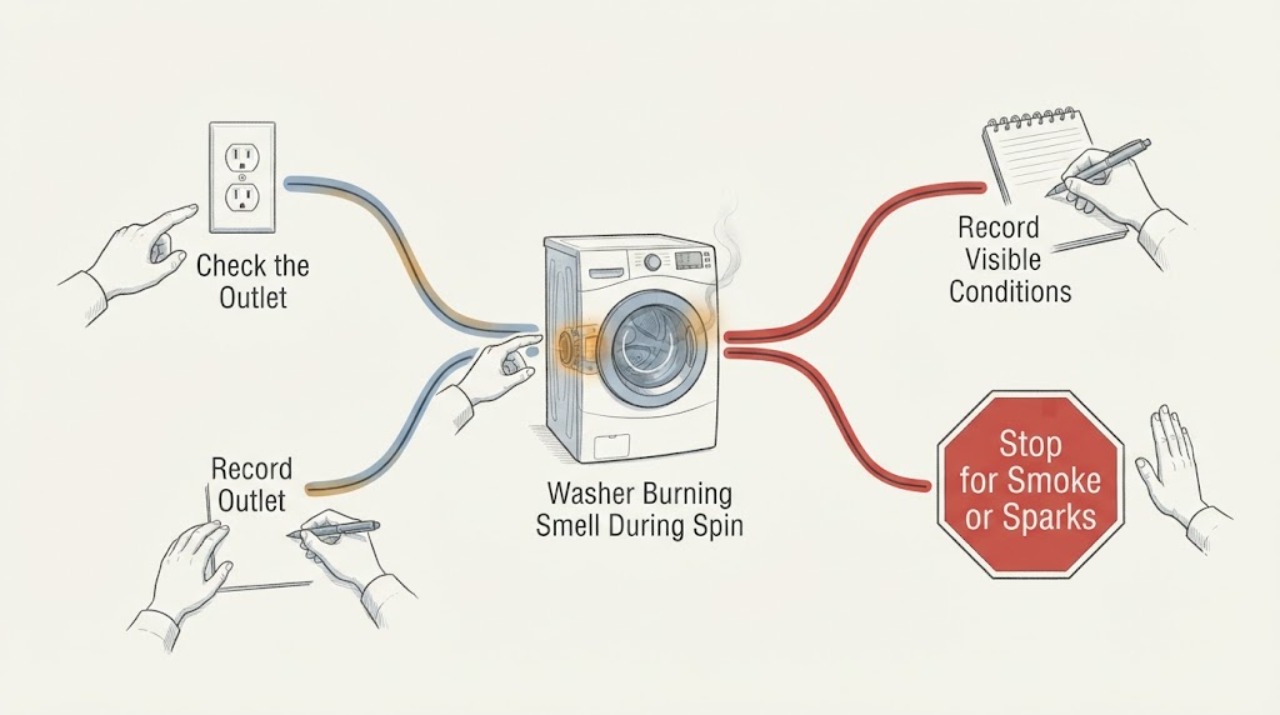
A burning smell from a Maytag LAT8406AAE during spin is a stop-use symptom, not a reason to run another test cycle or guess that a belt, motor, brake, pump, or transmission is bad. Stop the washer, let the basket come fully to rest, disconnect power only if the plug or breaker is safely accessible, and keep the area clear if there is smoke, sparking, heat, or a burning electrical odor. From outside the cabinet, note whether the odor came with smoke, a hot plug or outlet, a water leak, unusual noise, or a stuck load, and record when it occurred in the spin cycle. Maytag's public odor guidance covers mildew and detergent residue, not a confirmed burning mechanism for this exact older model, so do not substitute a Clean Washer cycle for a fire or electrical investigation. Use the full model and serial to obtain the correct Maytag literature and service.
Before you begin
Safety first
- Do not run another cycle, open the cabinet or console, adjust a belt or motor, bridge a protection device, or perform live electrical tests. Disconnect power only at an accessible safe point; use qualified appliance service and an electrician when the outlet, cord, breaker, or wiring is implicated.
Work through in order
Diagnostic checks
Use only checks that match the exact appliance or system and its official guide.
-
Check 1
Stop the cycle and do not restart it to reproduce the smell. Wait until the basket has completely stopped, keep hands out of the washer, and disconnect power only by an accessible plug or dedicated breaker when doing so is safe. If there is smoke, flame, sparking, a hot outlet, or a rapidly worsening odor, leave the area and use the appropriate emergency or fire response.
Expected result: The smell stops after the washer is isolated, or smoke, flame, sparking, heat, or an active electrical odor remains.
Next step: Keep the washer out of service. Do not reset, reconnect, or open the cabinet; obtain qualified appliance or electrical help, and use emergency services for an active fire or immediate danger.
Why this matters
Why: A burning smell during a moving spin mechanism is a safety signal even when the washer still completes the cycle. Continued smoke, heat, or electrical evidence is beyond user-level troubleshooting and must not be tested by another run.
-
Check 2
From outside the washer, record the odor location and visible context without removing the top, rear, or console. Check whether there is a scorch mark, melted-looking plug or cord, hot outlet face, water on the floor, cabinet heat, or smoke residue. Do not touch a hot component or wet electrical connection.
Expected result: The evidence is at the plug/outlet, near the cabinet or floor, near a water leak, or there is no visible external evidence after the washer has cooled.
Next step: Keep power isolated and arrange the appropriate qualified service. Photograph the safe external evidence and leave the plug or breaker untouched if it is hot, damaged, wet, or repeatedly trips.
Why this matters
Why: An outlet/cord or water/electrical condition changes the safety response and may involve the home's electrical or plumbing system. No visible mark does not rule out an internal fault and is not permission to run the washer.
-
Check 3
Write down when the smell appeared: at spin start, mid-spin, near the end, or after the basket stopped. Record any simultaneous scraping, squealing, thumping, failure to drain, smoke, or load movement, plus the load type and whether the symptom followed prior work or a change in the outlet.
Expected result: The odor repeats at a particular spin phase or occurred once with a separate leak, noise, electrical sign, or unusually heavy load.
Next step: Give the record and the full LAT8406AAE model/serial to Maytag or a qualified technician. Do not reproduce the timing with a test cycle.
Why this matters
Why: Timing and accompanying observations help a technician separate a motion-related complaint from an electrical or water-safety event, but they do not identify a belt, motor, brake, pump, or transmission from the outside.
-
Check 4
Use Maytag's model lookup only to obtain the LAT8406AAE literature and service path. Compare the model and serial on the appliance with the request before accepting any procedure or part information; do not use a newer top-load or dryer manual as a substitute.
Expected result: The full model/serial identifies matching literature, or the label is missing, inconsistent, or produces no matching manual.
Next step: If matching literature is available, follow only its safety instructions and still report a burning spin odor for service. If it is unavailable, provide the label photos and symptom record to Maytag or a qualified technician rather than guessing from a similar model.
Why this matters
Why: Maytag states that its manuals and support materials are selected by model number. A missing or mismatched document leaves the exact mechanism and user instructions unresolved.
-
Check 5
Only after a qualified assessment has ruled out burning, smoke, heat, water near electrics, and electrical damage, decide whether the remaining odor is a normal-maintenance odor. If it is clearly mildew or detergent residue, use the exact model manual before any Clean Washer product or bleach procedure.
Expected result: The smell is stale/mildew-like with no heat or smoke and the washer has been cleared for maintenance, or it remains burning/chemical/electrical or returns during motion.
Next step: For a cleared maintenance odor, follow the exact manual and Maytag cleaning guidance. For any recurrent burning or motion-related odor, keep the washer off and arrange service; do not clean-test it.
Why this matters
Why: Maytag's cleaning guidance supports HE detergent and a Clean Washer cycle for residue-related odor. It does not explain or clear a burning odor that recurs during spin.
Use your observations
Decision map
Find the observation that best matches what you see, then follow the next safe action.
-
PATH 01Next step
What you see
There is smoke, flame, sparking, a hot or damaged outlet/plug, or a rapidly worsening burning odor.
Do this next
Leave the area if necessary, use emergency or fire response for active danger, and do not reconnect or open the washer. Arrange qualified electrical/appliance service after the area is safe.
Why this path and its safety boundary
Why it matters: This is an immediate electrical or fire-safety condition, not a washer-maintenance odor.
-
PATH 02Next step
What you see
The smell occurred during spin, the washer is now cool and isolated, and there is no visible external mark or smoke.
Do this next
Keep the LAT8406AAE out of service, preserve the timing/noise/load record, and request model-specific service. Do not run an empty or small-load test.
Why this path and its safety boundary
Why it matters: The absence of visible evidence does not clear an internal moving or electrical fault; the symptom remains unscoped from outside the cabinet.
-
PATH 03Next step
What you see
The smell is only stale or mildew-like, with no heat, smoke, electrical sign, water hazard, or recurrence during motion, and the washer has been cleared for maintenance.
Do this next
Use the exact LAT8406AAE manual to choose a compatible Clean Washer procedure and detergent. Stop immediately if a hot, burning, chemical, or electrical odor returns.
Why this path and its safety boundary
Why it matters: This matches the narrower odor/residue problem covered by Maytag's cleaning guidance rather than the assigned burning-spin symptom.
-
PATH 04Next step
What you see
The odor occurs with water on the floor, a stuck or unusually heavy load, unusual noise, or a breaker/outlet event.
Do this next
Keep power and water isolated as safely accessible, do not reach into a moving or wet washer, and give the full context to a qualified appliance technician and electrician when the outlet or breaker is involved.
Why this path and its safety boundary
Why it matters: A combined mechanical, water, and electrical risk cannot be narrowed safely by a user-level visual check.
Helpful context
Understand the symptom
A burning smell is different from ordinary washer odor
Maytag's public odor guidance discusses mildew, detergent film, and a monthly Clean Washer cycle. That guidance does not establish that a smell occurring during spin is mildew, and it does not authorize another cycle when the odor is burning, hot, electrical, or accompanied by smoke. Treat the spin-cycle symptom as a safety and service issue until the source has been assessed.
Keep the older LAT8406AAE identity exact
The task supplies Maytag model LAT8406AAE. Maytag's official manuals page says to enter the model number to obtain the correct literature, and its support page asks for the model and serial when arranging help. Do not transfer a belt, motor, brake, or other repair procedure from another Maytag top-loader simply because the cabinet looks similar.
Do not use cleaning as a test for a suspected burning fault
If the smell is later confirmed to be only stale or mildew-like, Maytag's cleaning guidance describes HE detergent, the Clean Washer cycle, and leaving the lid open between uses. Those maintenance steps apply only after the burning, smoke, electrical, heat, and water-risk observations have been ruled out by a qualified assessment; they are not a way to test the washer's spin mechanism.
When checks do not resolve it
Need a professional?
Call Maytag or a qualified technician immediately for any burning smell during spin, especially with smoke, heat, sparking, a hot outlet, water near electrical parts, unusual noise, or a repeat occurrence. Give the full LAT8406AAE model and serial and do not reproduce the symptom.
Safety scope: Do not run another cycle, open the cabinet or console, adjust a belt or motor, bridge a protection device, or perform live electrical tests. Disconnect power only at an accessible safe point; use qualified appliance service and an electrician when the outlet, cord, breaker, or wiring is implicated.
Have this ready
- Provide the full LAT8406AAE model and serial, when the smell occurred in the spin cycle, odor character, smoke/heat/sparking observations, outlet and cord condition, water or load context, unusual noises, prior work, and any safe photographs.
Common questions
FAQ
Can I run the Maytag LAT8406AAE again to see whether the smell returns?
No. A burning smell during spin should be treated as a stop-use symptom. Record when it happened and what else you observed, then arrange model-specific service instead of reproducing the condition.
Could this just be mildew or detergent odor?
Maytag says detergent residue and mildew can cause ordinary washer odor and describes HE detergent and a Clean Washer cycle for that narrower problem. A smell that is hot, burning, electrical, chemical, or tied to spin motion must not be treated as mildew without a qualified safety assessment.
Should I replace the belt or motor?
Not from the smell alone. The opened Maytag sources do not establish a belt, motor, brake, pump, or transmission failure for LAT8406AAE. Do not open the cabinet or order a part until the exact model is diagnosed by a qualified technician.
What information should I give Maytag service?
Give the full LAT8406AAE model and serial, the spin-stage timing, odor description, any smoke/heat/sparking, outlet and cord observations, water or load context, unusual sounds, and whether the symptom followed previous work. Maytag's support pages ask owners to have model and serial information ready.
Read the exact guide
Official sources
- Cleaning the Interior - WasherMaytag Product Help · Official cleaning guidance for non-HE detergent film and ordinary washer odor; only applied conditionally after burning/electrical/heat/water hazards are ruled out.
- Contact MaytagMaytag · Official Maytag support path for supplying the model/serial and arranging service; it does not diagnose the burning smell or authorize a user internal repair.
- Service & Support Owners CenterMaytag · Official Owner Center path for Maytag washers and model-specific support; no LAT8406AAE internal diagnosis is inferred.
- Removing Odor or Smell - WasherMaytag Product Help · Official guidance for mildew/detergent-related odor only. It is used to distinguish ordinary maintenance odor from the assigned burning smell during spin; it is not used to diagnose a burning mechanism.
- Appliance Manuals and LiteratureMaytag · Official Maytag model lookup and documentation path. It supports using the full LAT8406AAE model number to select literature, but the opened page does not itself define a burning-smell cause or internal repair.
Community feedback
Share a repair observation
Share a plain-text repair observation. Accepted observations are published automatically; this page may take a moment to update.