
On this page
Start here
Quick answer
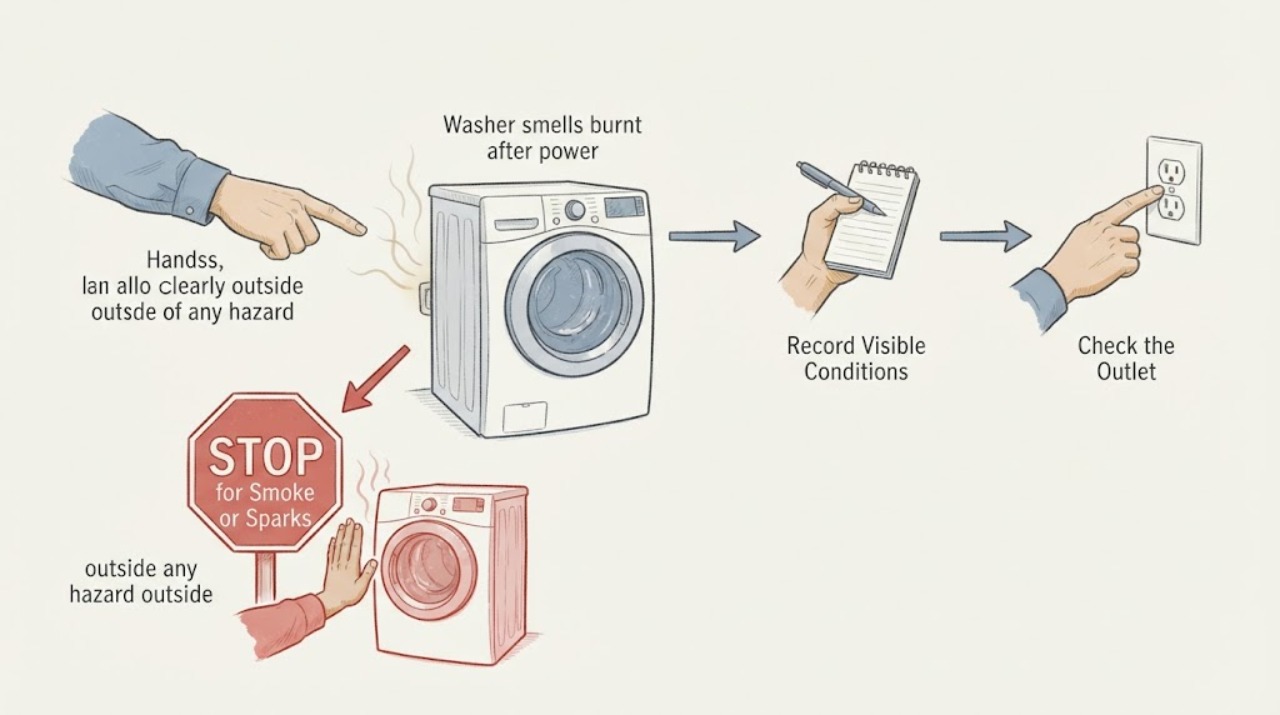
A burning smell that appears after a tornado and power restoration is a stop-use condition, not a routine washer-odor cleaning branch. Keep the GE washer off and do not run another cycle or repeatedly reset the breaker. From a dry, safe position, record when the odor began and look only for external smoke, sparks, a hot or discolored plug/outlet, melted plastic, a damaged cord, standing water, or a new breaker trip. Any of those signs requires safe isolation and qualified appliance or electrical service. Even when the controls still light and no damage is visible, storm-related moisture or a supply/inside-appliance fault cannot be cleared by a test run. GE's opened owner page identifies the closely matching WCSR2090GWW as an older top-load model; verify that the rating label really reads WCSR2090G5WW before using any model-specific instruction.
Before you begin
Safety first
- Owner checks stop at the rating label, dry external observation, visible moisture/heat/damage, and a single visual record of breaker status. Do not run a confirmation cycle, repeatedly restore power, pull or tip the washer, open the cabinet or console, probe the outlet or internal wiring, bypass a protector, or replace a cord, motor, control, pump, or switch by symptom.
Work through in order
Diagnostic checks
Use only checks that match the exact appliance or system and its official guide.
-
Check 1
Stop the cycle, leave the washer off, and write down the timeline: when power failed, when it returned, whether the smell was already present while idle, and whether anyone noticed smoke, a flash, a pop, a breaker trip, or a hot-plastic smell. Do not start a cycle to reproduce it.
Expected result: The odor began immediately at power restoration, appeared only after a prior running cycle, is present while idle, or was accompanied by smoke, a flash, a pop, or a breaker trip.
Next step: Keep the washer out of service and continue only the dry external checks below. Give the timeline to qualified appliance or electrical service; use emergency procedures for active smoke or fire.
Stop if: Do not run another wash, spin, or empty-cycle test and do not repeatedly reset a tripping breaker.
Why this matters
Why: A post-restoration or idle electrical odor is materially different from an ordinary retained-moisture odor and keeps the supply, cord, motor, and control area in scope. The timeline is evidence for triage, not a component diagnosis.
-
Check 2
From a dry position and without moving the washer, inspect only the visible plug, cord, outlet face, cabinet exterior, nearby floor, and wall for scorch marks, melted plastic, discoloration, unusual heat, water, mud, or a damaged connection. Do not touch a wet or hot connection.
Expected result: There is scorching, melting, heat, a loose or damaged plug/cord/outlet, water or mud near electrical parts, or no visible external damage.
Next step: For any damage, heat, or water, keep clear and arrange qualified electrical/appliance assessment. If nothing is visible, leave the washer off rather than using a cycle as a diagnostic test.
Stop if: Do not unplug from a wet area, pull the washer out, remove a cover, dry an energized outlet, or probe the receptacle.
Why this matters
Why: Visible heat, water, or electrical damage is a direct stop condition. A clean exterior does not rule out moisture inside the cabinet or damage behind the receptacle after a storm.
-
Check 3
Look at the household breaker or fuse indicator from a safe location and record whether the washer circuit is off or has tripped. Do not reset it repeatedly and do not substitute a larger fuse or breaker.
Expected result: The circuit is tripped/off, it trips again when a qualified person restores power, or it remains on without any visible damage.
Next step: Leave a recurring-trip circuit and the washer isolated and call a qualified electrician or appliance technician. If the circuit is simply off with no hazard, report that fact to service rather than testing the washer.
Stop if: Do not cycle the breaker for diagnosis, bypass protection, change wiring, or use an adapter, extension cord, or power strip.
Why this matters
Why: A storm-related supply event or a washer fault can both leave a breaker tripped; the breaker state cannot identify the failed part. A repeat trip is an electrical hazard, not a reason to keep trying.
-
Check 4
Check the area around the washer for storm intrusion, standing water, damp flooring, a wet wall, mud, or a leak from the fill/drain hoses without disconnecting any hose or moving the appliance.
Expected result: Water or dampness is near the plug/outlet or under the cabinet; a hose or floor is visibly damaged; or the surrounding area is dry.
Next step: Keep people away from wet electrical areas, close the water faucets only if that can be done without entering a hazard, and arrange professional assessment. Preserve the moisture history and photographs for service.
Stop if: Do not unplug from standing water, tip the washer, open panels, or continue a cleaning cycle to remove water.
Why this matters
Why: Moisture can create a separate shock and fire risk even when the washer appears mechanically intact. A dry floor lowers one visible risk but cannot prove that the cabinet or receptacle stayed dry.
-
Check 5
Classify the smell only from outside and from the already observed event: sharp electrical/ozone, smoky, melting plastic, chemical, hot rubber, musty, or sewage-like. Record whether it came from the plug/outlet, rear hose area, cabinet, basket, or drain.
Expected result: The odor is sharp, smoky, chemical, melting, hot, or localized near power; it is musty/sewage-like; or it was a rubber odor only during filling of a genuinely new washer with no storm or electrical signs.
Next step: For the first group, keep the washer disconnected when safe and arrange service. Do not perform GE's new-hose fill test in this event; tell service the observed phase and odor instead. Only a technician or the exact manual should reopen an ordinary-odor branch after the appliance is declared safe.
Stop if: Do not sniff inside the cabinet, run fill/agitation/spin to compare phases, mix cleaners, or treat hot rubber as normal without confirming the exact model and installation history.
Why this matters
Why: The first group remains a storm/power safety path. Musty or sewage-like odors can fit the family moisture or drain branches, but the power-restoration history must be resolved first. GE's narrow new-hose explanation applies only to a new washer and fill-only timing, not to a post-storm electrical smell.
-
Check 6
Prepare a service handoff without opening the washer: photograph the rating label, plug/outlet and any visible mark from a safe distance, and record the complete model/serial, storm and restoration time, breaker behavior, moisture history, odor location, and whether smoke, sparks, heat, or a leak occurred.
Expected result: The label confirms WCSR2090G5WW, it instead shows WCSR2090GWW or another model, or the label cannot be read safely.
Next step: Give the exact label information and the no-test history to qualified GE appliance service; use a qualified electrician as well if the outlet, breaker, cord, or house wiring is implicated.
Stop if: Do not remove the console or rear panel to find the model, and do not order a motor, switch, cord, or control part from the odor alone.
Why this matters
Why: The suffix determines which manual, electrical arrangement, and parts information applies. GE's available page confirms only the closely matching WCSR2090GWW record, so an unreadable or different label is an identity uncertainty rather than permission to use that manual.
Use your observations
Decision map
Find the observation that best matches what you see, then follow the next safe action.
-
PATH 01Next step
What you see
Smoke, sparks, a hot or melted plug/outlet, a damaged cord, repeated breaker trips, water near electrical parts, or an active fire is observed.
Do this next
Leave the area if there is smoke, fire, or immediate electrical danger and contact emergency services from a safe location. Otherwise keep the washer isolated and arrange qualified electrical and appliance service.
Why this path and its safety boundary
Why it matters: This is an immediate electrical, fire, or moisture hazard. It is not a washer-cleaning or user component-selection problem.
-
PATH 02Next step
What you see
The burning smell started after storm-related power returned, but there is no visible external damage and the washer display or controls still work.
Do this next
Keep the washer off and request qualified appliance service; request electrical inspection if the outlet, breaker, or other household loads were also affected. Do not use a cycle to confirm the diagnosis.
Why this path and its safety boundary
Why it matters: Power at the controls does not clear a damaged supply path, wet internal area, motor, or other energized component. The post-restoration timeline remains the independent decision point.
-
PATH 03Next step
What you see
The label or manual does not confirm WCSR2090G5WW, or the observed installation differs from the available WCSR2090GWW record.
Do this next
Keep the washer out of service, recover the full rating-label identity, and have GE or qualified service assess it using the correct documentation.
Why this path and its safety boundary
Why it matters: Model-specific electrical and maintenance details are unresolved. The close model match cannot establish compatibility for a suffix, market, or revision that was not found.
-
PATH 04Next step
What you see
The only already-observed odor was a rubber smell during fill on a genuinely new washer, with no power event, heat, smoke, leak, breaker trip, or electrical odor.
Do this next
Follow the exact installation/manual guidance and contact service if the odor persists, changes, or appears once the motor or pump runs. Do not deliberately perform this test on the storm-affected washer.
Why this path and its safety boundary
Why it matters: This narrow pattern matches GE's explanation that new inlet hoses can smell like burning rubber before agitation. It does not match the assigned post-tornado scenario unless the storm timeline and electrical signs are disproven.
Helpful context
Understand the symptom
The timing matters. A sharp electrical, smoky, melting-plastic, or hot-rubber smell that starts when power returns after severe weather should be treated as possible electrical or moisture damage. It is not equivalent to a musty basket odor. Do not operate the washer to find out whether the smell returns, and do not assume that a working display means the power path and motor circuit are safe.
The assigned identity is GE WCSR2090G5WW. GE's public Owner Center page that was available for this research is WCSR2090GWW, an older 3.2-cu.-ft. top-load washer manufactured from February 2007 through October 2010. The extra 5 suffix is not established by that page, so read the rating label and give the complete model and serial to service; do not borrow a reset, filter, or part procedure from a near-match.
GE does document a narrow non-electrical exception for a genuinely new washer: a rubber smell only during the fill phase, before the motor or pump runs, can come from new inlet hoses. That article suggests a controlled fill-versus-agitation check for a normal new installation, but it does not make that test appropriate after a tornado, power disturbance, visible water, heat, smoke, or electrical odor.
When checks do not resolve it
Need a professional?
Call qualified GE appliance service for any post-storm burning smell or any need to inspect internal wiring, motor, controls, or moisture damage. Call a qualified electrician when the household supply, receptacle, breaker, cord, or storm-related wiring may be involved. Use emergency services for smoke, fire, sparks, or immediate electrical danger.
Safety scope: Owner checks stop at the rating label, dry external observation, visible moisture/heat/damage, and a single visual record of breaker status. Do not run a confirmation cycle, repeatedly restore power, pull or tip the washer, open the cabinet or console, probe the outlet or internal wiring, bypass a protector, or replace a cord, motor, control, pump, or switch by symptom.
Have this ready
- Provide the complete model and serial, the rating-label photo, market/location, storm and power-restoration timeline, whether the smell occurred while idle or during a prior phase, odor location and character, breaker status, photos of visible damage, and any water, smoke, spark, heat, or leak history.
Common questions
FAQ
Can I run the washer once to see whether the burning smell returns?
No. Because the smell followed a tornado and power restoration, keep the washer off. A working display does not rule out a damaged outlet, cord, wiring, motor, control, or moisture inside the cabinet; arrange qualified service instead.
Is this just the normal GE new-inlet-hose smell?
Only a genuinely new washer with a rubber odor limited to filling, before the motor or pump runs, fits GE's narrow explanation. That does not normalize a sharp electrical, smoky, hot, or melting odor after storm-related power restoration, and you should not run a deliberate fill test in that event.
Should I reset the breaker or plug the washer into a surge protector?
Do not repeatedly reset a breaker after a burning smell. GE says a washer should plug directly into a properly grounded three-prong wall outlet and not into an extension cord, surge protector, or multi-outlet adapter. A recurring trip or damaged connection belongs with qualified electrical/appliance service.
What if I cannot find the extra 5 in WCSR2090G5WW on GE's site?
Read the full rating label and serial information again. The opened GE Owner Center record is for WCSR2090GWW, an older top-load model, and does not establish that the extra-suffix identity is interchangeable. Give the exact label to service before using model-specific instructions or ordering parts.
Read the exact guide
Official sources
- Washer - Use of Extension Cord or Surge ProtectorGE Appliances · General GE washer electrical guidance; exact model installation instructions still control. It is used here to prevent an improvised post-storm power arrangement, not to diagnose the odor.
- User Manual & Care for WCSR2090GWW | GE AppliancesGE Appliances · The page is a close public model record, not proof that the extra 5 suffix is interchangeable. It identifies the listed washer as a GE 3.2 Cu. Ft. Super Capacity Washer and dates manufacture February 2007 through October 2010.
- Washer - Burning or Rubber Odor in a New WasherGE Appliances · Applies only to a genuinely new washer when the odor is limited to the fill phase before motor or pump operation. It is a contrast branch and does not authorize a deliberate test after storm-related power restoration or an electrical smell.
- GE Washer Owner's Manual 49-90025GE Appliances · This is an official older GE washer manual and is not asserted to be the exact WCSR2090G5WW manual. Its safety instructions support the no-operation boundary for damaged appliances and the requirement to disconnect power before maintenance.
Community feedback
Share a repair observation
Share a plain-text repair observation. Accepted observations are published automatically; this page may take a moment to update.