
On this page
Start here
Quick answer
Stop the Amana washer and do not run another cycle when you smell burning, see smoke, scorch marks, melted plastic, sparking, a hot cord or a breaker that trips. If there is no immediate danger, leave the controls off and disconnect power only from a safe accessible point; do not open panels, reach under the washer or reset a tripping circuit to test it. Amana's normal-odor guidance covers mildew, detergent residue and stale laundry odors, not a confirmed burning smell. Record the exact smell, when it occurred and any visible signs, then arrange qualified appliance or electrical service with the washer's model number.
Before you begin
Safety first
- Do not operate or clean-test the washer after a burnt or uncertain odor, open panels, reach under the cabinet, perform live electrical measurements, bypass a lid/door lock, reset a repeatedly tripping circuit, or replace a motor, belt, pump, bearing or control board based on smell alone.
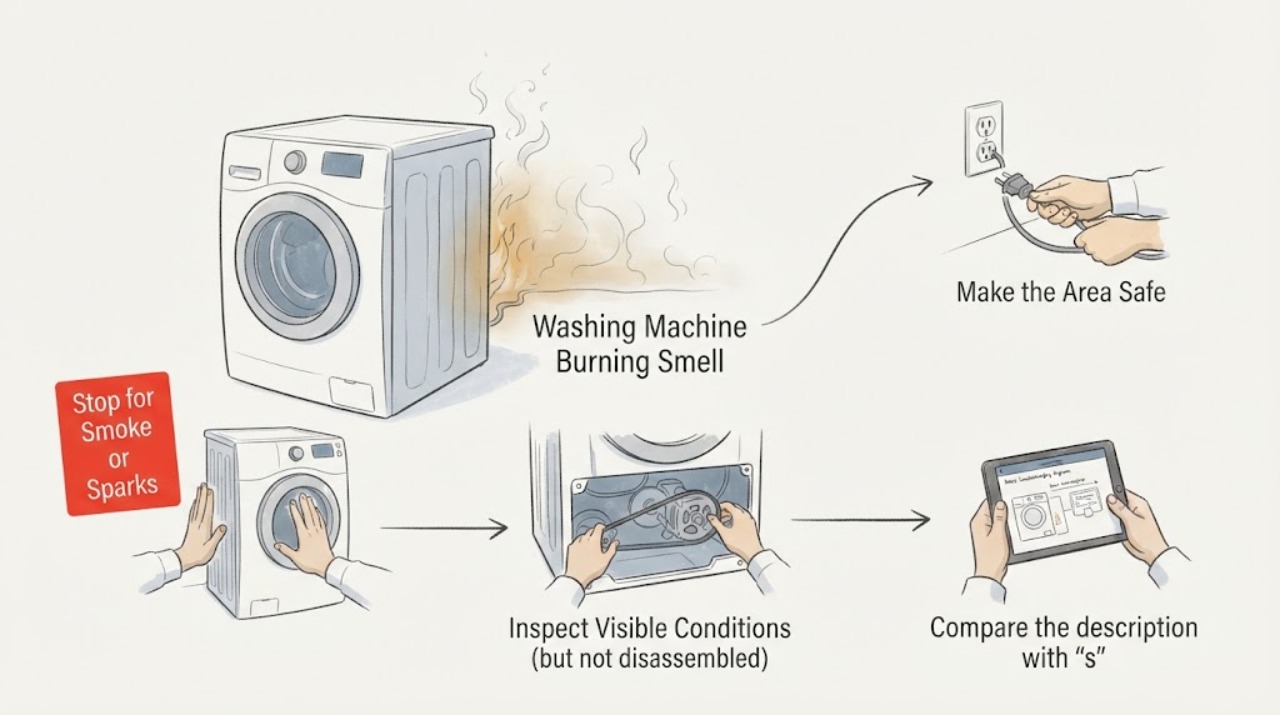
Work through in order
Diagnostic checks
Use only checks that match the exact appliance or system and its official guide.
-
Check 1
Stop the cycle and keep the Amana washer off after any burning smell; if safe, disconnect power from the accessible plug or switch off the appliance circuit without touching damaged wiring.
Expected result: Smoke, flame, sparking, a hot or melted cord/outlet, scorch marks, water at the electrical connection, or a breaker that trips is present; or the smell occurred without any visible sign.
Next step: Leave the washer off. Move away from active smoke or flame and use emergency help as appropriate; use a qualified electrician for an unsafe circuit and qualified appliance service for the washer. Do not restart it to reproduce the smell.
Why this matters
Why: The symptom is not an ordinary washer-freshness odor. Visible heat, smoke, water, electrical damage or repeated tripping is an immediate hazard; no visible sign still does not identify a safe restart condition.
-
Check 2
From outside the unplugged or isolated appliance, record when the smell began and look for visible residue, melting, scorch marks, water, a damaged cord or outlet, or a load caught around the door or lid.
Expected result: Damage, water or heat is visible; the smell coincided with a particular cycle stage; or nothing visible can be found.
Next step: Photograph only what is visible and keep the washer off. Do not open panels, reach below the cabinet, move internal parts or perform live measurements.
Why this matters
Why: The observation can help service distinguish the timing and surrounding hazard, but it does not prove which internal component caused the odor. No visible damage does not make a restart safe.
-
Check 3
Compare the description with Amana's documented ordinary washer odors without operating the machine: musty/stale clothing or detergent-residue odor versus a sharp burnt, hot-plastic or electrical odor.
Expected result: The odor is clearly musty or detergent-like with no heat, smoke, electrical sign or mechanical symptom; or it is burnt, hot-plastic, electrical, or uncertain.
Next step: For a burnt or uncertain odor, do not run Clean Washer or another test cycle; arrange service. Only after the appliance is cleared and the odor is clearly ordinary may the matching model's maintenance guidance be considered.
Why this matters
Why: Amana links ordinary odor maintenance to wet clothing, non-HE or excess detergent, ventilation and a Clean Washer cycle. Those explanations do not establish the cause of a burnt or uncertain odor.
-
Check 4
Only if there is no burning smell now, no heat, smoke, damage, water or repeated trip, record whether the cord is in a grounded three-prong outlet without an extension cord and whether the household breaker/GFCI is tripped; do not reset a circuit that trips again.
Expected result: The outlet/cord look sound and the circuit stays on; the outlet is damaged or dead; or the breaker/GFCI trips again.
Next step: If the circuit is damaged or trips again, leave it off and call a qualified electrician. If the washer had a burning smell even with a sound outlet, keep the washer off and arrange appliance service instead of resetting or cycling it.
Why this matters
Why: Amana's routine no-power guidance supports the external power path, but a persistent trip points to an unresolved electrical or appliance issue and does not identify an internal part.
-
Check 5
Find the full model and serial number from an accessible tag and give service the appliance type, smell description, cycle timing, load, power-path observations and photos.
Expected result: The model tag is readable under the top-load lid/tub rim or inside the front-load door; or it is not accessible without moving panels or reaching into the cabinet.
Next step: Use the visible information for a service request. If it cannot be safely read, let the technician identify the washer; do not open the cabinet or perform an internal diagnosis.
Why this matters
Why: The model and washer configuration control which manual and service information applies. A missing tag is a documentation gap, not a reason to dismantle the washer.
Use your observations
Decision map
Find the observation that best matches what you see, then follow the next safe action.
-
PATH 01Next step
What you see
Smoke, flame, sparking, melted plastic, a hot/damaged cord or outlet, water at the power connection, or repeated breaker/GFCI trips is present.
Do this next
Move away, isolate power only if safe, use emergency help for active smoke or flame, use a qualified electrician for the circuit, and arrange qualified appliance service. Do not touch or restart the washer.
Why this path and its safety boundary
Why it matters: The washer or its circuit may have an immediate fire, electrical or water hazard; the symptom is not suitable for repeated user testing.
-
PATH 02Next step
What you see
The odor is burnt, hot-plastic, electrical or uncertain, even if no visible damage remains after the washer is off.
Do this next
Keep the appliance out of service and schedule qualified appliance evaluation; do not run a Clean Washer cycle or another load to test it.
Why this path and its safety boundary
Why it matters: Amana's ordinary odor pages do not establish a maintenance explanation for this symptom, and smell alone cannot identify a motor, belt, pump, bearing or control fault.
-
PATH 03Next step
What you see
After the washer has been cleared by service or the concern is clearly only musty/stale or detergent residue with no heat, smoke, electrical sign or abnormal noise.
Do this next
Use only the matching model's Clean Washer, HE-detergent, load-removal and ventilation guidance; do not mix chemicals or substitute that maintenance advice for service if a burnt smell returns.
Why this path and its safety boundary
Why it matters: The symptom is consistent with Amana's odor-maintenance guidance rather than a confirmed burning fault.
-
PATH 04Next step
What you see
The power path is unsafe or repeatedly trips, or the model/configuration cannot be identified without opening the appliance.
Do this next
Leave power off when safe, provide the accessible information to an electrician or appliance technician, and do not remove panels or bypass a lock or safety device.
Why this path and its safety boundary
Why it matters: The issue requires circuit or model-specific professional assessment; a generic washer procedure cannot establish the cause.
Helpful context
Understand the symptom
Burning smell is a stop-use symptom
Do not treat a burning smell as the same problem as a stale or musty washer odor. Amana's odor articles discuss wet clothes, detergent residue, ventilation and the Clean Washer cycle; they do not identify the source of a burnt odor. Keep the washer off after a burning smell, especially if there was smoke, heat, sparking, a tripped breaker or visible damage.
Only observe the outside after it is off
From a safe position, note whether the smell came during filling, agitation, spinning, draining or immediately after the washer stopped. Look without touching for smoke residue, melted plastic, a damaged cord or outlet, water near the power connection, or a breaker/GFCI that has tripped. Do not remove a rear panel, reach beneath the cabinet, turn the drum by hand to reproduce the smell, or run another cycle to locate it.
Use Amana's ordinary-odor advice only when the smell is clearly different
If the smell is clearly musty or detergent-like, with no heat, smoke, electrical sign or mechanical symptom, Amana documents ventilation, correct HE detergent use, prompt removal of wet clothing and a model-supported Clean Washer cycle. That maintenance advice is not a safe response to a burnt smell. Do not start a cleaning cycle to see whether an electrical or mechanical odor disappears.
Do not convert a power check into a repair test
Amana's no-power guidance says a washer should use a grounded three-prong outlet without an extension cord and permits checking a household breaker or GFCI in an ordinary no-power situation. A washer that has produced a burning smell is outside that routine restart scenario: leave the circuit or appliance off when there is heat, smoke, damage or repeated tripping, and have the appropriate qualified professional assess it.
Give service the model and timing
Record the full model and serial number without dismantling the washer. Amana lists the tag beneath the lid on the tub rim for a top-load washer and inside the door on the rim for a front-load washer. Provide the service provider the model, washer type, cycle stage, load, duration of the smell, any noise or water, breaker result and photos of visible damage. Do not guess a motor, belt, pump, bearing or control-board failure from odor alone.
When checks do not resolve it
Need a professional?
Arrange qualified appliance service after any unexplained burning smell, even if the odor stops. Use an electrician when the outlet, cord, breaker or GFCI is damaged or trips again, and use emergency help for active smoke or flame. Do not continue washing to see whether the smell returns.
Safety scope: Do not operate or clean-test the washer after a burnt or uncertain odor, open panels, reach under the cabinet, perform live electrical measurements, bypass a lid/door lock, reset a repeatedly tripping circuit, or replace a motor, belt, pump, bearing or control board based on smell alone.
Have this ready
- Provide the complete model and serial number if safely accessible, top-load or front-load configuration, cycle stage, load, smell description, duration, visible damage, water location, cord/outlet condition, breaker/GFCI behavior, noises and photos.
Common questions
FAQ
Can I run an Amana washer once more to find where the burning smell comes from?
No. Keep it off after a burnt or uncertain odor. Repeating a cycle can turn an unresolved electrical or mechanical condition into a fire, water or additional damage event. Record the cycle stage and visible signs for service instead.
Could the smell just be mildew or detergent residue?
Amana documents wet clothing, detergent residue, ventilation and the Clean Washer cycle as causes or maintenance responses for ordinary washer odors. That does not establish the cause of a burnt, hot-plastic or electrical odor. Do not run a cleaning cycle until the appliance is cleared when the smell is burnt or uncertain.
Should I reset the breaker after the washer smells burnt?
Do not reset a breaker or GFCI that trips again, and do not use a reset as a test after a burning smell. Amana's routine no-power page discusses checking the power path for ordinary no-power symptoms; a burnt odor, heat, damage or repeated trip needs qualified service or electrical assessment.
Where can I find the Amana washer model number?
Amana lists the tag beneath the lid on the tub rim for a top-load washer and inside the door on the rim for a front-load washer. Read it only from an accessible position; do not remove panels or reach into the cabinet to find it.
Read the exact guide
Official sources
- Removing Odor or Smell - WasherAmana Product Help · Opened Amana's official top-load washer odor page. It discusses wet clothing, non-HE detergent residue and the Clean Washer cycle; it does not define or diagnose a burning smell, so the article uses it only to separate ordinary odor maintenance from a burnt odor.
- Manuals and GuidesAmana · Opened Amana's official manuals page. It requires a model number to search and identifies washer tag locations; it is used to require model-specific instructions rather than infer internal repairs from a smell.
- No Power - WasherAmana Product Help · Opened Amana's official top-load no-power page. It supports a grounded three-prong outlet without an extension cord, checking a tripped breaker/GFCI in an ordinary no-power case, and calling an electrician if the problem continues; it does not support resetting a circuit after a burning smell or diagnosing an internal part.
- Where is my Model and Serial Number Located?Amana Product Help · Opened Amana's official model/serial locator. It lists the accessible tag locations for front-load and top-load washers and explains that model information is needed for maintenance, parts and support.
- No Power - Not Turning On - Front Load WasherAmana Product Help · Opened Amana's official front-load no-power page. It supports a grounded three-prong outlet without an extension cord and directs unresolved cases to service; it does not authorize internal or live electrical troubleshooting.
- Removing Odors or Smells - Front Load WasherAmana Product Help · Opened Amana's official front-load odor page. It documents door ventilation, Clean Washer, dispenser cleaning, prompt load removal and HE detergent for ordinary odors; it does not define a burning smell or authorize operating a washer with electrical or mechanical warning signs.
- Removing Odors from the Interior of a WasherAmana Product Help · Opened Amana's official interior-odor maintenance guide. It supports only ordinary odor maintenance and explicitly provides model-neutral precautions such as not adding other chemicals to the cleaning procedure; it is not used as a burning-smell diagnosis.
Community feedback
Share a repair observation
Share a plain-text repair observation. Accepted observations are published automatically; this page may take a moment to update.