
On this page
Start here
Quick answer
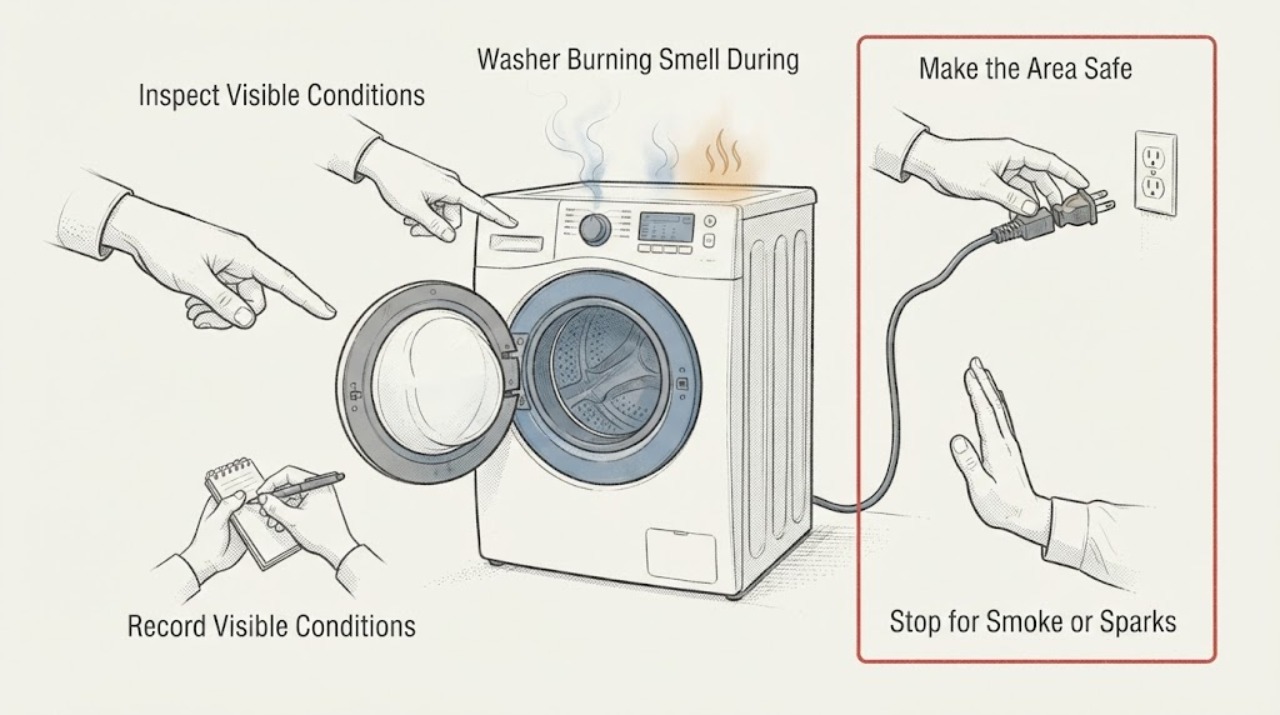
Stop the Electrolux EFLW417SIW0 washer when a burning smell appears during a cycle. Press Pause or Cancel only if you can do so without approaching smoke, sparks, flames, or a hot electrical area; then isolate power from a dry, safe position without touching a wet or damaged plug. Do not restart it, run an empty cleaning cycle, open a panel, or guess that the belt, motor, or control board is at fault. After the washer is cold and disconnected, record the cycle stage, load, smell location, smoke or heat, breaker events, and whether the unit is new or was recently moved. A smell strongest at the outlet or cord needs electrical and appliance service; a smell at the door boot with visible rubbing or melted rubber needs the installer or appliance technician; any smoke, arcing, flame, hot plug, damaged cord, or repeated trip is an immediate stop-use and emergency/qualified-service boundary.
Work through in order
Diagnostic checks
Use only checks that match the exact appliance or system and its official guide.
-
Check 1
Stop the cycle. If the controls are reachable from a dry, clear position and there is no smoke, flame, arcing, or hot electrical area, press Pause or Cancel once. Otherwise step away. Isolate power only from a dry, safe position, such as the breaker when it can be operated without approaching a hazard; never touch a wet or visibly damaged plug or cord.
Expected result: The washer stops without a hazard, or there is smoke, flame, arcing, a hot plug or outlet, a damaged cord, water near electrics, or a breaker that has tripped.
Next step: For smoke or flame, leave the area and contact emergency services as appropriate. For a hot/damaged electrical supply or repeated trip, keep the washer isolated and arrange a qualified electrician and appliance service. In every case, do not restore power to test the washer.
Stop if: Do not touch a wet plug, damaged cord, hot outlet, smoke, flame, or exposed wiring, and do not repeatedly reset a breaker.
Why this matters
Why: Smoke, flame, arcing, abnormal electrical heat, water contacting electrics, or protective trips make this an immediate safety problem rather than a cleaning or routine maintenance issue. If the washer simply stops with no such sign, it is safe to document the event from outside while it cools.
-
Check 2
Once the washer is disconnected and cold, inspect only visible areas without moving the cabinet or removing a panel. Compare the smell at the door boot/glass, dispenser opening, lower front, sides, and the wall outlet or plug from a distance. Look for black transfer, melted rubber, scorch marks, smoke residue, or a distorted visible edge; do not pull the boot from its groove.
Expected result: The smell is strongest at the outlet or cord, at the door boot with visible rubber transfer or deformation, near the dispenser, or from the cabinet/base with no visible source.
Next step: Keep the washer off and give the technician the strongest location and photographs. Do not clean away scorch evidence, pull the seal out, remove the dispenser housing, or open the cabinet to search for a belt, motor, pump, heater, or board.
Stop if: Stop observing immediately for smoke, visible melting, a hot outlet/plug, water near electrical parts, sharp material, or any need to reach behind the cabinet.
Why this matters
Why: A smell concentrated at the electrical supply points to an electrical inspection; a localized door-boot smell with rubbing or deformation supports a fit or mechanical inspection; a hidden cabinet/base source cannot be safely identified by sight. A dispenser or detergent smell is not proof that the machine is safe to run when the original report was burning.
-
Check 3
Write down when the odor began relative to fill, agitation, spin, or drain; the load size and any bulky item; whether the drum was moving or the machine was vibrating; the display message; and whether the unit was newly installed, moved, or recently repaired. Do not rerun a cycle to reproduce the smell.
Expected result: The smell began only during high-speed movement, during filling or draining, immediately after a repair or move, or with smoke/heat independent of the cycle stage.
Next step: Send the timing and installation history with the exact model label to the installer or appliance technician. If the washer is new or was just moved, request an installation/transport-material check under warranty or installer support; leave it disconnected until then.
Stop if: Do not move a heavy washer alone, remove shipping bolts, reach below the cabinet, or run a high-speed test to identify the sound.
Why this matters
Why: Electrolux's washer noise guide ties different sounds to filling, draining, load balance, foreign objects, and installation conditions, and calls out shipping materials, leveling, and a solid floor for newly installed units. Those observations can narrow a technician's inspection, but none proves a belt, motor, pump, or control fault and none makes a burning smell safe to reproduce.
-
Check 4
From outside the appliance, note the last load's size, whether detergent was HE and correctly measured, and whether there was unusual foam, a detergent-like odor, or a drain problem. Do not add cleaner, bleach, vinegar, or extra detergent, and do not run a cleaning or rinse cycle after a burning smell.
Expected result: There was a very large or unbalanced load, visible foam or detergent residue, a normal drain with a hot-plastic smell, or standing water and a separate drain odor.
Next step: Record the detergent, load, foam, and water status for the technician. If standing water remains, do not open a wet pump area or loosen a hose; arrange appliance or plumbing service and isolate water only if it can be done safely from a dry position.
Stop if: Do not restart the washer to clear foam or water, mix chemicals, open a pump filter with retained water, or disconnect a pressurized hose.
Why this matters
Why: Load, detergent, and drain history may be useful correlations for service, but they do not convert a burning smell into a safe user-cleaning problem. A drain or detergent observation should remain a separate branch; persistent hot-plastic or electrical odor still requires the washer to stay off.
-
Check 5
Verify the complete model and serial label using the Electrolux support location guidance, and gather the cycle name, display, smell location, photos, breaker history, installation date, and recent repair details for service. Ask the technician to inspect the supply connection and the appliance externally and internally only after safe isolation.
Expected result: The label confirms EFLW417SIW0, the label differs from that number, or the model/market remains uncertain.
Next step: Give the exact label and event record to Electrolux or a qualified appliance technician. If the label cannot be read, provide clear photographs and do not order a part or assume another Electrolux front-load platform is equivalent.
Stop if: Do not remove panels, access wiring, measure live voltage, or restore power for a technician-style test yourself.
Why this matters
Why: Electrolux routes washer support through model and serial information, while the opened general pages do not publish an EFLW417SIW0-specific burning-smell diagnosis. A different or incomplete label prevents model-specific parts or wiring conclusions.
Use your observations
Decision map
Find the observation that best matches what you see, then follow the next safe action.
-
PATH 01Next step
What you see
There is smoke, flame, arcing, a hot or discolored plug/outlet, a damaged cord, water near electrics, or a breaker trips again.
Do this next
Keep clear and power isolated if that can be done safely; contact emergency services for fire or active smoke and a qualified electrician/appliance service for the appliance and supply. Do not reset and retry.
Why this path and its safety boundary
Why it matters: This pattern crosses the ordinary washer troubleshooting boundary and may involve an electrical or fire hazard. The symptom does not identify a specific washer part.
-
PATH 02Next step
What you see
The smell is strongest at the wall outlet, plug, or cord, or those areas are hot, discolored, loose, or damaged while the washer cabinet has no clear external source.
Do this next
Leave the washer disconnected and have a qualified electrician inspect the receptacle/circuit and an appliance technician inspect the washer. Do not use an extension cord, substitute outlet, or repeatedly reset protection.
Why this path and its safety boundary
Why it matters: The supply connection or circuit needs electrical assessment in addition to an appliance inspection; a washer component cannot be blamed from smell location alone.
-
PATH 03Next step
What you see
The smell is strongest at the door boot or drum edge and there is visible black transfer, melted/deformed rubber, rubbing evidence, or a recent door-seal/door repair.
Do this next
Keep the washer off and ask the installer or qualified appliance technician to verify the boot, clamp/fit, clearance, and any recent repair work. Do not pull the seal out, force the door, or run another cycle.
Why this path and its safety boundary
Why it matters: A door-boot fit, rubbing, or repair-related inspection is more relevant than ordering a belt or motor, but the observation does not prove which mechanical part is involved.
-
PATH 04Next step
What you see
The odor appeared during movement or spin, especially after a move or installation, with vibration, an oversized load, or a suspected shipping-material/leveling issue, but there is no smoke, hot electrical supply, or visible melting.
Do this next
Leave the washer disconnected and request installer or appliance service to verify leveling, transport materials, clearances, and the reported timing. Do not move the appliance alone or remove hardware yourself.
Why this path and its safety boundary
Why it matters: Installation, load, or contact history may guide the inspection, and Electrolux documents these as relevant to washer noise and vibration. It still does not justify a powered retest after a burning smell.
-
PATH 05Next step
What you see
The smell persists or its source is hidden at the cabinet/base, or the only evidence is a burning odor without visible damage.
Do this next
Keep the cabinet closed and arrange model-specific Electrolux or qualified appliance service. Provide the exact EFLW417SIW0 label and the complete event record, and request a diagnosis before any part is ordered.
Why this path and its safety boundary
Why it matters: An internal drive, pump, wiring, heater, or control-path issue remains unresolved; no one of those components is established by odor alone.
Helpful context
Understand the symptom
A burning smell during operation is not the same problem as a routine musty washer odor. Treat the machine as a stopped appliance first. The useful first decision is where the heat-like smell is strongest and whether there is any smoke, arcing, hot plastic, cord or outlet damage, water near electrics, or a repeated protective trip. Those observations can guide the next professional without claiming that one component caused the smell.
The model number supplied for this task is EFLW417SIW0. Electrolux's owner guidance says to use the appliance model and serial information for support; verify the complete label inside or around the washer door before a service call. The generic Electrolux pages opened for this research do not establish a model-specific burning-smell cause or a compatible replacement part.
Do not keep testing a washer that smells of hot plastic or electrical insulation. Do not touch a wet plug, pull the cabinet apart, probe live wiring, bypass the door lock, or order a belt, motor, pump, or control board from the odor alone.
Common questions
FAQ
Can I run an empty cleaning cycle to see whether the smell goes away?
No. A burning smell during a cycle is a stop-use symptom for this washer. Isolate power safely, let it cool, record where and when the smell occurred, and arrange service instead of restoring power for a test.
Does a burning smell prove the belt or motor is bad?
No. The smell can be reported alongside load, installation, door-boot, drain, or electrical-supply observations, but it does not identify a part. Leave the cabinet closed and have the exact EFLW417SIW0 and event record assessed by qualified service.
What if the smell seems to come from the outlet rather than the washer?
Keep the washer disconnected and do not touch a hot, loose, wet, discolored, or damaged plug or outlet. Have a qualified electrician inspect the circuit and an appliance technician inspect the washer; do not use an extension cord or repeatedly reset a breaker.
Read the exact guide
Official sources
- What should I do if my washer does not start?Electrolux · Opened Electrolux washer guidance supports a tight wall connection, no extension cord, and qualified electrician help for an overloaded circuit; it is not evidence of a specific EFLW417SIW0 fault.
- SPARE PARTS LISTElectrolux Pro Corner · Opened official Electrolux Pro Corner service material for a different washer model; used only for its explicit instruction to turn off and unplug before detaching parts and its shock/short warning. It does not identify a component or burning-smell cause for EFLW417SIW0.
- Gen2 Washer Quick Start GuideElectrolux · Opened Electrolux washer quick-start material used only for the generic control/label context; it is not a model-specific EFLW417SIW0 repair manual and does not authorize a powered retest after a burning smell.
- Laundry Washers Noises GuideElectrolux · Opened Electrolux washer guidance for all laundry washers; it supports cycle-stage sound interpretation, load/vibration observations, and new-install shipping-material/leveling checks, not a specific burning-smell component diagnosis for EFLW417SIW0.
- Where can I find my model and serial number?Electrolux · Opened Electrolux owner guidance applies to all appliances and is used here only to verify the complete EFLW417SIW0 label for support; it does not publish an EFLW417SIW0-specific burning-smell diagnosis.
Community feedback
Share a repair observation
Share a plain-text repair observation. Accepted observations are published automatically; this page may take a moment to update.