
On this page
Start here
Quick answer
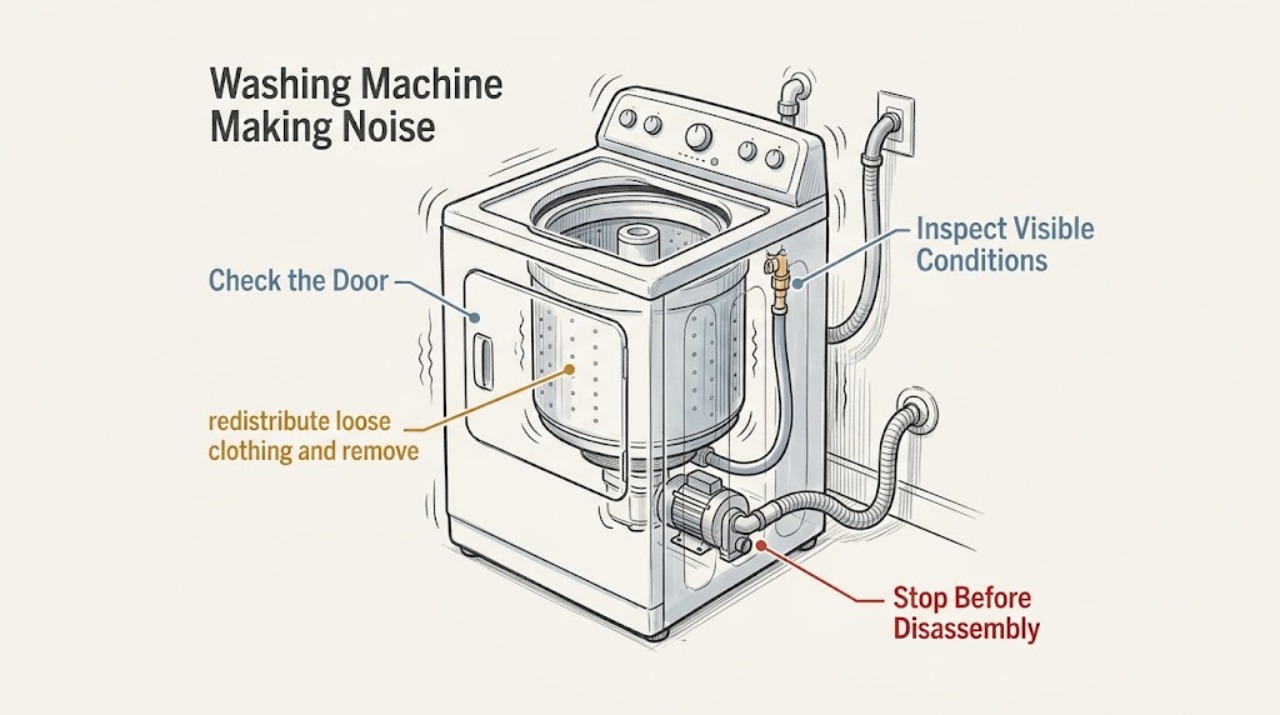
First identify the sound and the cycle phase. Clicking when a lock operates, humming or whirling during agitation or draining, and some gear sounds can be normal on Maytag washers; banging, grinding, rubbing, metal scraping, or a washer that walks across the floor needs closer attention. Stop the washer if the basket is striking the cabinet, the machine moves violently, water leaks, metal-on-metal friction is heard, or there is smoke, a burning smell, arcing, or a repeated power trip. With the washer stopped and safe, check the load for an out-of-balance or bulky item, confirm the machine is level, inspect visible hoses and any drain pan, and check for objects around the door or lid. On a front-load model, shipping materials left in place can cause excessive noise. Use the exact Maytag manual for the model and arrange service when the sound persists with a normal load or comes from inside the cabinet.
Work through in order
Diagnostic checks
Use only checks that match the exact appliance or system and its official guide.
-
Check 1
Note whether the noise occurs during fill, wash or agitation, drain, spin, or door or lid locking, and describe it as a click, hum, whir, bang, thump, grind, rub, squeal, or metal scrape.
Expected result: Maytag identifies motor sounds during agitation and spin and pump humming during drain as possible normal operating sounds, while grinding or rubbing is usually tied to agitation or spin.
Next step: Stop for impact, metal friction, leaking, smoke, burning, arcing, or violent movement; otherwise continue with the matching external check.
Why this matters
Why: The phase and sound type separate normal motor or pump operation from load, installation, hose, or mechanical concerns.
-
Check 2
With the washer stopped and the load accessible, redistribute loose clothing and remove only an obvious overload or single bulky item when the tub or basket is stationary.
Expected result: Maytag says an uneven or bulky load can create movement, noise, and vibration during spin, and an overloaded washer can make grinding louder.
Next step: Use the model's loading guidance and do not add water to correct balance; stop and request service if the basket still strikes or the washer walks.
Why this matters
Why: A noise that changes when a safe load is balanced points toward load distribution; the same noise with a normal load points toward installation or service.
-
Check 3
Check that the washer is level and that all four feet are firmly on the floor; look for a rocking cabinet or a damaged drain pan beneath the machine.
Expected result: Maytag links an unlevel washer to louder grinding, vibration, and out-of-balance movement; a tub bottom can also rub against a drain pan under heavy or bulky loads.
Next step: Follow the exact installation instructions for any foot adjustment; if the floor, pan, or cabinet is damaged, keep the washer stopped and arrange service.
Why this matters
Why: A stable floor contact and clear pan relationship can explain noise that appears mainly during spin without proving a failed internal part.
-
Check 4
Inspect visible drain and inlet hoses at the rear and sides for a loose loop, contact with the cabinet, a kink, or a connection that could move as water flows; do not pull the washer out across a wet floor.
Expected result: Maytag notes that hoses can bang against the rear cabinet during fill or vibration and that hose contact can transmit noise through the washer.
Next step: Secure only an accessible hose position as the model instructions allow; stop for a wet connection, leak, or damaged hose and request service.
Why this matters
Why: A hose striking the cabinet is an external sound source, unlike a scrape that remains after hose clearance and load correction.
-
Check 5
For a front-load washer, confirm that shipping materials were removed at installation; for either design, check the outside of the tub area and floor for an object, panel, or drain pan that could be contacted during movement.
Expected result: Maytag says shipping materials left in a front-load installation can cause excessive noise, and a drain pan can rub against the tub bottom on some models.
Next step: Do not remove panels or reach into moving parts; correct only a clearly accessible external obstruction and stop if contact or damage remains.
Why this matters
Why: An installation remnant or external contact can mimic a drive or bearing fault, but a persistent internal scrape needs professional diagnosis.
-
Check 6
Listen from a dry, safe position for the point at which the sound changes: motor direction, pump drain, high-speed spin, door or lid lock, or the transition between wash and spin.
Expected result: Maytag describes direction-changing motor and gear sounds during agitation, pump humming during drain, and load-related vibration during spin; a new sound isolated to one transition is more useful than a general loudness judgment.
Next step: Do not lean over a moving basket or run a damaged washer for a closer listen; record the safe observation and arrange service for metal friction, impact, or repeated noise.
Why this matters
Why: The transition identifies whether to follow the normal-operation, hose, balance, drain-pan, or service branch.
-
Check 7
Record the full model number, top-load or front-load design, load type, cycle phase, noise description, whether the machine moved, and any leak or error indication for Maytag support or a technician.
Expected result: Maytag directs owners to use the model number for manuals and installation information, and its noise pages route persistent problems to service.
Next step: Keep the washer out of service for persistent noise with a normal load, movement, leaks, heat damage, smoke, or electrical symptoms.
Why this matters
Why: The model and event sequence let service distinguish normal operating sounds from a fit-specific installation or internal fault.
Use your observations
Decision map
Find the observation that best matches what you see, then follow the next safe action.
-
PATH 01Next step
What you see
The sound is a click at the lock, a motor hum or direction change during wash, or a pump hum during drain, with no impact, leak, or damage.
Do this next
Continue monitoring at a safe distance; request service if the sound changes, becomes metallic, or appears with abnormal movement or heat.
Why this path and its safety boundary
Why it matters: Maytag describes these sounds as possible normal operating noises for the relevant phase.
-
PATH 02Next step
What you see
Banging or thumping occurs mainly in spin and the clothing is gathered to one side or contains one bulky item.
Do this next
Stop when the basket is stationary, redistribute or reduce the load according to the manual, and request service if the washer still walks or strikes.
Why this path and its safety boundary
Why it matters: An out-of-balance or bulky load may be causing the movement and sound.
-
PATH 03Next step
What you see
The washer rocks, a foot is not firmly grounded, or a drain pan is visibly contacting the tub area.
Do this next
Use the model installation instructions for safe leveling; keep the machine stopped for a damaged pan, floor, cabinet, or recurring contact.
Why this path and its safety boundary
Why it matters: Leveling, floor contact, or the pan relationship may be amplifying or creating the noise.
-
PATH 04Next step
What you see
A hose hits the cabinet during fill or vibration, or the washer is newly installed with front-load shipping materials still present.
Do this next
Secure the accessible hose or follow the exact installation guide for shipping material removal; request service if the sound remains or a connection leaks.
Why this path and its safety boundary
Why it matters: An external installation condition may be producing the noise.
-
PATH 05Next step
What you see
Grinding, rubbing, scraping, or metal-on-metal sound persists with a normal load and a stable installation, or the sound comes with a new leak.
Do this next
Stop using the washer and arrange qualified service; do not remove panels or attempt to run it with a suspected internal contact.
Why this path and its safety boundary
Why it matters: The remaining cause may be inside the tub, drive, pump, or support system and needs model-specific diagnosis.
-
PATH 06Next step
What you see
The washer walks, strikes surrounding objects, leaks, emits smoke or a burning smell, shows arcing, or trips power repeatedly.
Do this next
Stop the cycle, keep clear, and disconnect power only if it is safe to reach without touching water or damaged equipment; arrange urgent professional assessment.
Why this path and its safety boundary
Why it matters: Treat the event as an immediate movement, water, fire, or electrical safety concern.
Helpful context
Understand the symptom
A washer can sound different during fill, agitation, drain, and spin. A pump hum or motor change during normal operation is not the same as a new metallic scrape or a basket that strikes the cabinet. Stop the cycle when movement or heat makes the situation unsafe, then classify the sound from a safe, stationary position.
Top-load and front-load Maytag washers have different drive, door or lid, balance, and installation details. Maytag's own guidance separates those designs, so do not use a front-load shipping-bolt procedure on a top-load machine or assume a drain pan is present.
The checks below are external. They can identify a load, hose, floor, pan, or installation issue without authorizing cabinet removal or work on the motor, pump, suspension, wiring, or lock.
Safety boundary
Stop conditions
- Stop immediately for violent movement, walking, basket impact, metal-on-metal friction, a new leak, or damage to the cabinet, floor, hose, or drain pan.
- Stop for smoke, burning smell, visible arcing, repeated power trips, a hot electrical odor, or water near an outlet, plug, controls, or wiring.
- Do not keep running cycles to reproduce a scraping or impact sound, reach into a moving basket, open panels, or work on energized parts.
- Do not force a door or lid, defeat a lock, or move a leaking washer across a wet floor.
Only after diagnosis
Potential parts
- leveling foot or installation hardware
Only consider this category if the model-specific installation check confirms a damaged foot or hardware after the floor is stable.
Confirm the complete model and manufacturer fit information before ordering. - drain or inlet hose restraint
Only consider this category when an external hose is damaged or cannot be safely supported as the model instructions require.
Verify the model's hose routing and approved hardware before sourcing a replacement. - drain pump or pump mounting component
Only consider this category when noise is isolated to draining and a qualified diagnosis confirms a pump or mount fault after the external drain path is clear.
Do not open the washer to confirm this part yourself; verify the exact model and safe service path. - tub support or drive component
Only consider this category after persistent grinding, rubbing, or impact is professionally traced to an internal support or drive fault.
Internal components are model-specific and require qualified diagnosis before sourcing.
When checks do not resolve it
Need a professional?
Arrange qualified Maytag washer service when grinding, rubbing, scraping, or impact persists after a safe load and installation check, when the washer walks or leaks, or when noise appears with smoke, burning smell, arcing, heat damage, or repeated power trips. Provide the full model number, design, cycle phase, sound description, load, movement, and photos taken only from a dry and safe position.
Common questions
FAQ
Are humming and clicking sounds normal on a Maytag washer?
They can be. Maytag describes motor sounds during agitation or spin, pump humming during drain, and lock clicks as possible normal operation. A new metallic scrape, impact, leak, or violent movement is not a normality test; stop and arrange service.
Why does my Maytag washer bang or walk during spin?
An uneven or bulky load, an unlevel cabinet, loose floor contact, or front-load shipping materials left in place can cause vibration and movement. Stop if the washer strikes objects or moves violently, then use the exact installation and loading guidance.
Should I open the washer to find a grinding noise?
No. Check only the load, visible hoses, level, drain pan, and accessible installation items. Persistent grinding, rubbing, or metal contact with a normal load needs qualified diagnosis rather than cabinet removal or a guessed part.
Read the exact guide
Official sources
- Bang or Banging - NoiseMaytag Product Help · Maytag top-load washer hose contact, load balance, level, spin movement, and service guidance
- Vibration, Walking or Off Balance - Front Load WasherMaytag Product Help · Maytag front-load washer walking, shipping materials, leveling, load, and service guidance
- TroubleshootMaytag · Maytag product troubleshooting, documents, washer support, and service routing
- Grinding or Rubbing Noise - Product HelpMaytag Product Help · Maytag top-load washer grinding, leveling, overload, drain-pan, and service guidance
- Grinding or Rubbing Noise - WasherMaytag Product Help · Maytag front-load washer grinding, load, leveling, drain-pan, and service guidance
- Humming or Whirling - NoiseMaytag Product Help · Maytag top-load washer motor, pump, agitation, spin, and drain sound guidance
Community feedback
Share a repair observation
Share a plain-text repair observation. Accepted observations are published automatically; this page may take a moment to update.